1. Introduction
Bipolar disorder usually declares itself in adolescence or early adulthood, and the years that follow the first clear episode carry a high risk of recurrence. Staging models describe this period as the point at which the course of the illness may still be open to influence, before repeated episodes bring cumulative functional loss (Berk et al., 2017). That view owes much to the older kindling hypothesis, which held that early episodes are closely tied to stressors and that later ones arise with less provocation (Post, 1992).
Sleep has an obvious claim to attention in this search for early indicators. A decreased need for sleep is a criterion symptom of mania, insomnia or hypersomnia is a criterion symptom of depression, and sleep complaints do not disappear when mood returns to normal. Two influential reviews drew these strands together and argued that sleep and circadian disturbance should be treated as a core feature of the disorder instead of a by-product of mood episodes (Harvey, 2008; Plante and Winkelman, 2008). Current treatment guidelines reflect the same position and recommend attention to sleep and regular routines as part of maintenance care (Yatham et al., 2018).
This article reviews the published evidence on sleep disturbance and relapse with the early course specifically in mind. It asks three things: what is known about how sleep behaves across mood states and in remission, how strong the case is that sleep change precedes and contributes to relapse, and whether the notion of a sleep trajectory, a pattern of change over months or years that differs between people and predicts outcome, is supported by data or remains a hypothesis.
2. Scope and Approach
This is a narrative review of the published literature. It draws on prospective cohort studies, experimental work on sleep deprivation, meta-analyses of sleep in remitted bipolar disorder, treatment trials and theoretical papers that are widely cited in the field. It was not conducted as a systematic review, and no claim is made that every relevant study has been identified. The article reports no new data, and where the literature is thin or inconsistent this is stated.
3. Sleep Across Mood States and in Remission
The forms that sleep disturbance takes in bipolar disorder differ by mood state. In mania the characteristic change is a reduced need for sleep: the person sleeps little and does not feel tired. In bipolar depression insomnia is common, but so is hypersomnia, which appears to be more frequent in bipolar than in unipolar depression and has been less studied than its clinical weight deserves (Kaplan and Harvey, 2009).
The more striking observation is that sleep often stays abnormal between episodes. A meta-analysis of studies in inter-episode bipolar disorder and in high-risk groups found longer sleep onset latency, more time awake after sleep onset and greater variability of sleep-wake timing in patients than in healthy comparison groups (Ng et al., 2015). A second meta-analysis restricted to actigraphy studies of remitted patients reached a similar conclusion, with longer sleep duration and poorer sleep efficiency among patients (Geoffroy et al., 2015). Clinical cohort work shows that a substantial share of people who meet criteria for euthymia still report disturbed sleep (Sylvia et al., 2012). Sleep disturbance is therefore not confined to episodes; for many patients it is a standing feature of the illness.
4. Evidence That Sleep Change Precedes Relapse
Four kinds of evidence bear on the claim that sleep disturbance signals or drives relapse, and they differ in what they can show. Table 1 summarises them with representative sources.
| Line of evidence | What it shows | Main limitation | Representative source |
|---|---|---|---|
| Prodrome studies | Sleep change is the most common early sign of mania | Largely retrospective recall | Jackson et al., 2003 |
| Daily self-monitoring | Change in sleep duration tends to come before mood change | Self-report; selected, adherent samples | Bauer et al., 2006 |
| Prospective cohorts | Short or poor sleep predicts later symptoms | Residual mood symptoms may confound | Perlman et al., 2006 |
| Sleep deprivation | Imposed sleep loss can trigger a switch into mania | Short term; depressed inpatients | Colombo et al., 1999 |
| Life events research | Events that disrupt routine precede manic onsets | Sleep itself not measured directly | Malkoff-Schwartz et al., 1998 |
| Sleep-focused treatment | Treating insomnia may reduce relapse | Small pilot trial | Harvey et al., 2015 |
4.1. Prodromes and prospective observation
Studies of prodromes ask patients, and sometimes relatives, what they noticed before an episode. A systematic review of this literature found that sleep disturbance was the most frequently reported early sign of mania and one of the more common early signs of bipolar depression (Jackson et al., 2003). A later systematic review that focused on the period before the first episode reached a more cautious conclusion: disturbed sleep is common before onset, but it is also common in young people who never develop bipolar disorder, so its specificity as an early marker is low (Ritter et al., 2011).
Prospective designs avoid the problem of recall. In a study that used daily electronic self-ratings, a change in sleep or bed rest was followed by a change in mood in the opposite direction, typically on the next day (Bauer et al., 2006). Cohort studies have reported that shorter sleep duration predicts later depressive symptoms (Perlman et al., 2006) and that sleep problems are associated with more severe symptoms and poorer functioning across follow-up (Gruber et al., 2011). Work that tested both directions found evidence for each: poor sleep was followed by worse mood, and worse mood by poor sleep (Talbot et al., 2012). The picture that emerges is of a reciprocal relationship, not a simple one-way cause.
4.2. Experimental and quasi-experimental evidence
The strongest support for a causal role comes from sleep deprivation. Wehr and colleagues proposed that sleep reduction is a final common pathway through which varied triggers, from travel across time zones to bereavement and drug effects, lead to mania (Wehr et al., 1987). Therapeutic sleep deprivation, used as a treatment for depression, offers a partial test, and a minority of patients with bipolar depression switch into hypomania or mania after it (Colombo et al., 1999). Life events research adds indirect support. Events that disrupt daily routine, as distinct from events that are merely distressing, were found to be more common in the weeks before manic episodes than before depressive ones (Malkoff-Schwartz et al., 1998).
These findings concern mania more than depression. For depressive relapse the evidence is correlational: persistent insomnia or hypersomnia in remission goes with a higher likelihood of later depressive symptoms, but no experimental manipulation comparable to sleep deprivation is available, and residual depressive symptoms may account for part of the association.
5. Explanatory Models
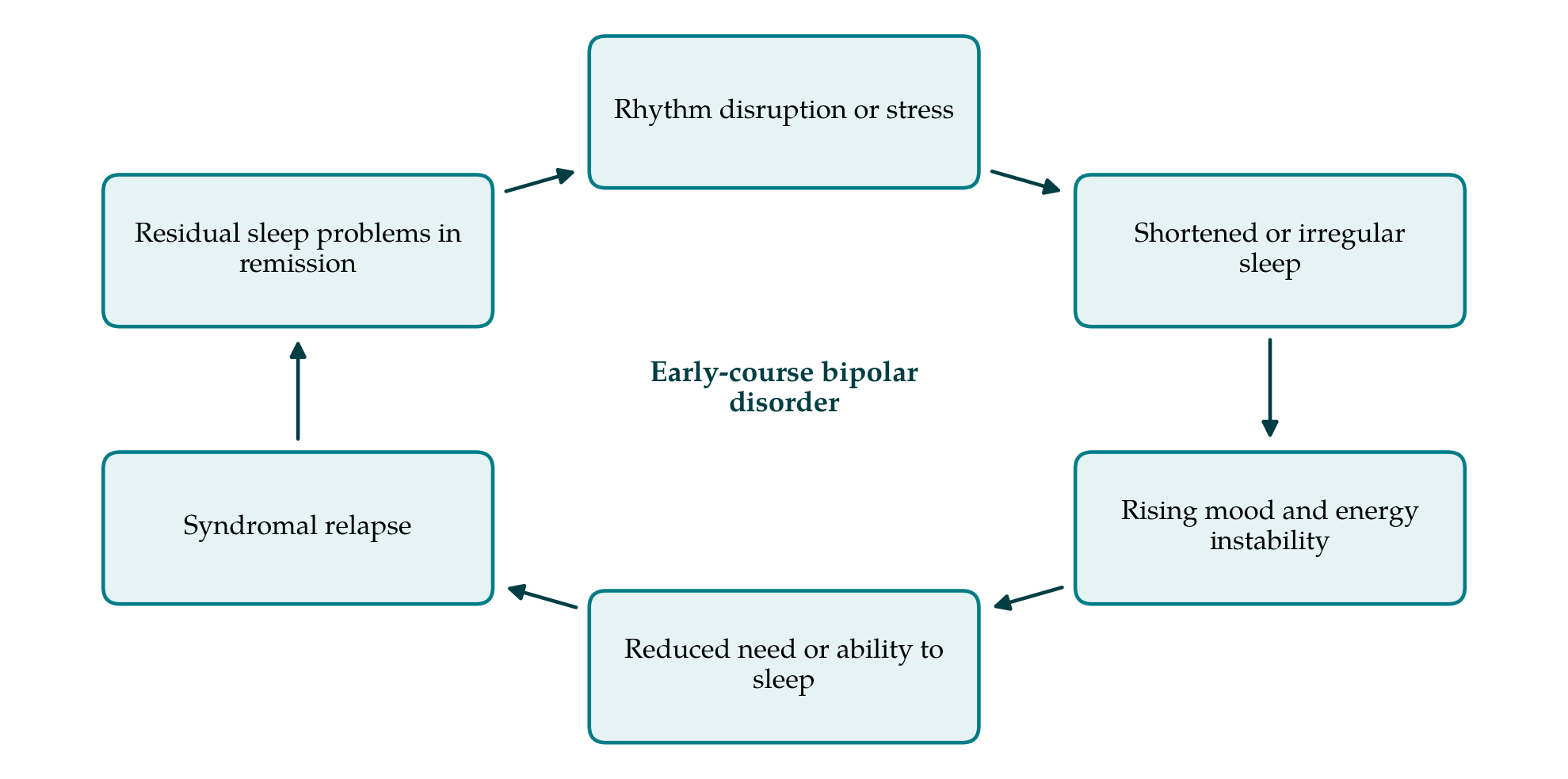
Three accounts are used to explain why sleep and relapse are linked, and they are compatible with one another. The first is the sleep reduction hypothesis already described, in which lost sleep raises mood and energy, which in turn reduces sleep further (Wehr et al., 1987). The second is the social zeitgeber theory, which holds that regular social routines such as mealtimes, work and contact with others entrain biological rhythms, and that losing those routines destabilises rhythms and precipitates episodes in vulnerable people (Ehlers et al., 1988). The third draws on the two-process model of sleep regulation, in which sleep timing reflects the interaction of a homeostatic sleep drive with a circadian process (Borbély, 1982), and proposes that one or both processes are less stable in bipolar disorder (Harvey, 2008).
Figure 1 combines these accounts into a single cycle as it might operate in the early course. The diagram is a conceptual summary of the hypotheses in the literature and not a tested model.
6. From Single Measurements to Trajectories
Most studies cited so far measured sleep once, or averaged it over a short baseline, and related it to later outcome. A trajectory approach asks something different: whether the pattern of sleep over time, such as steadily worsening regularity or failure of sleep to normalise after an episode, carries prognostic information beyond a single reading. Statistical tools suited to the question exist, including growth mixture and group-based trajectory models. Their application to repeated sleep measures in early-course samples is, on the evidence available to this review, sparse. The term sleep trajectory should therefore be read as a description of a research aim.
Measurement is part of the difficulty. Sleep diaries and questionnaires such as the Pittsburgh Sleep Quality Index are inexpensive and capture the person's experience of sleep (Buysse et al., 1989), but they depend on recall and may be coloured by mood. Actigraphy provides an objective estimate of rest and activity over weeks and suits long follow-up, though it infers sleep from movement and can misclassify quiet wakefulness (Ancoli-Israel et al., 2003). Studies that combine subjective and objective measures often find that they disagree, and it is not yet clear which is the better predictor of relapse.
Early-course samples raise problems of their own. Diagnosis is less certain in the first years, and some people first seen with depression will later be reclassified. Medication is frequently changed, and several commonly used agents alter sleep directly. Substance use, shift work and the irregular schedules of student life are common at the age of onset and affect sleep independently of the illness.
7. Implications for Treatment
If sleep disturbance contributes to relapse, treating it should reduce relapse. Interpersonal and social rhythm therapy was designed around the social zeitgeber theory and teaches patients to keep regular times for sleep, waking, meals and activity. In a randomised trial in bipolar I disorder, patients who received it during acute treatment remained well for longer during maintenance, and the benefit was related to the increase in regularity of their routines (Frank et al., 2005). A pilot randomised trial of cognitive behavioural therapy for insomnia modified for bipolar disorder reported better sleep and a lower rate of mood relapse than a psychoeducation comparison (Harvey et al., 2015). Both findings are encouraging. Neither trial was confined to early-course patients, and the second was small by design.
Guidelines accordingly recommend psychoeducation that includes monitoring of sleep and early warning signs, and they regard structured psychological treatments as adjuncts to medication, not substitutes (Yatham et al., 2018). Standard sleep restriction, a component of insomnia therapy, deliberately shortens time in bed, and in bipolar disorder the procedure is modified so that sleep opportunity is not reduced to a level that could provoke hypomania. Decisions about hypnotic or sedating medication belong with the treating clinician and are outside the scope of this review.
8. Gaps and Directions for Research
Several gaps follow from the material reviewed. The first is the shortage of longitudinal studies that begin at or near the first episode and measure sleep repeatedly with both subjective and objective methods. The second is specificity: disturbed sleep is common in young people with many conditions, and a marker that predicts relapse in bipolar disorder needs to be distinguished from general distress. The third is polarity. The case for sleep loss as a trigger of mania is much stronger than the case for any particular sleep pattern as a trigger of depression, yet depressive episodes account for most of the time spent unwell.
A further gap concerns mechanism. It is not known whether stabilising sleep prevents relapse because sleep is causal, or because people who can keep regular hours differ in other ways that protect them. Trials that randomise a sleep-focused treatment and measure both sleep and relapse, with analysis of whether change in sleep accounts for the effect, would speak to this directly.
9. Conclusion
Sleep disturbance is a consistent companion of bipolar disorder in episodes and between them, and the evidence that shortened sleep can precede and provoke mania is among the better established findings in the field. For depressive relapse and for the early course in particular the evidence is thinner and mostly correlational. The concept of sleep trajectories is plausible and testable, but it has not yet been shown that patterns of sleep over time identify those at highest risk. Until such work is done, the practical position supported by the literature is modest: sleep should be asked about routinely, changes in sleep should be treated as possible early warning signs, and regular routines are worth protecting.
Conflict of interest
To be declared by the author(s) before publication.
Funding
To be declared by the author(s) before publication.