1. Introduction
Glucocorticoid replacement for adrenal insufficiency has changed little in principle since cortisone became available. Current guidance favors hydrocortisone in two or three divided oral doses, the largest on waking (Bornstein et al., 2016). The regimen prevents adrenal crisis when combined with patient education, yet large surveys show that many treated patients report fatigue and reduced health status compared with population norms (Hahner et al., 2007), and long-term outcomes remain worse than expected (Husebye et al., 2021). One explanation offered is that the pattern of cortisol exposure, and not only the total dose, is wrong. The same concern applies to secondary adrenal insufficiency from pituitary disease and to congenital adrenal hyperplasia, in which glucocorticoid is given both to replace cortisol and to restrain adrenal androgen production.
This communication considers continuous subcutaneous hydrocortisone infusion as a means of correcting that pattern. It is a commentary on published work and presents no new observations.
2. The Rhythm That Tablets Miss
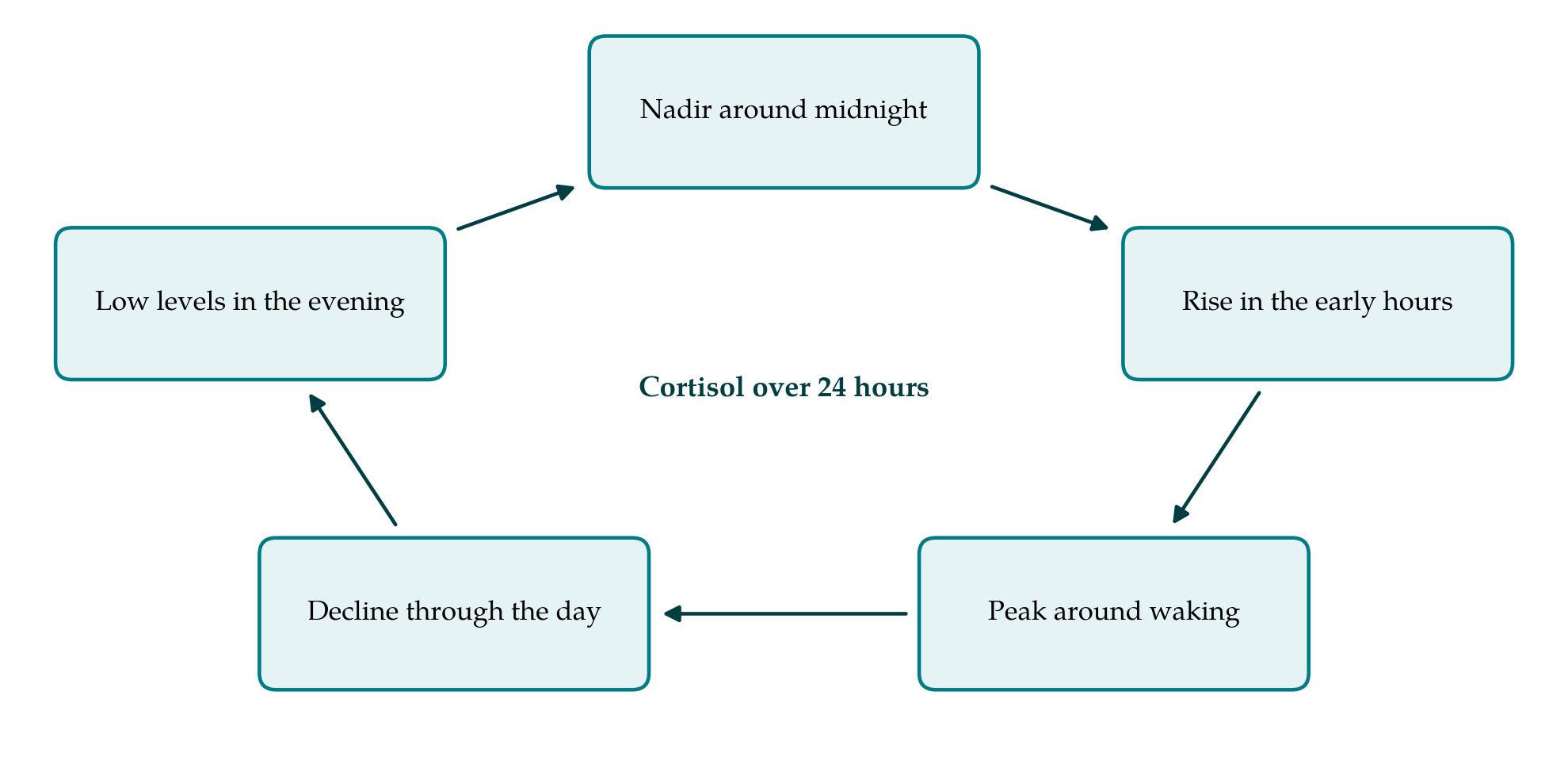
Cortisol secretion in health follows a circadian cycle, sketched in Figure 1. Concentrations are lowest around midnight, begin to rise in the second half of the night, reach their peak around the time of waking and decline across the day. Superimposed on this are ultradian pulses roughly every hour, which appear to be important for the transcriptional response of target tissues (Lightman and Conway-Campbell, 2010). Immediate-release hydrocortisone has a short plasma half-life. A patient who takes the last dose in the late afternoon has almost no circulating cortisol through the night and wakes at the lowest point of the cycle, when a healthy person would be at the highest. Each dose then produces a brief supraphysiological peak. Over a day the total exposure may be adequate or even excessive while its distribution is wrong at nearly every hour. Raising the dose to relieve morning fatigue adds to the daytime excess without filling the overnight gap, and chronic overexposure is thought to contribute to the adverse metabolic and skeletal outcomes seen in treated patients.
Several strategies have been devised to bring replacement closer to this cycle. Table 1 compares them. Intravenous infusion with rates varied by the hour demonstrated that the physiological curve can be matched closely (Merza et al., 2006), but it is not a practical long-term treatment. The subcutaneous route, using pumps designed for insulin, made the same idea portable. Hydrocortisone for injection is loaded into the reservoir, and the basal rate is programmed in several blocks across the day and night so that delivery rises in the early hours, peaks around waking and tapers toward the evening. Additional boluses can be given for intercurrent illness.
| Approach | Cortisol profile achieved | Main limitations | Source |
|---|---|---|---|
| Oral hydrocortisone, divided doses | Peaks and troughs; no rise before waking | Unphysiological exposure; multiple daily doses | Bornstein et al., 2016 |
| Dual-release tablet, once daily | Smoother daytime curve; low overnight | No pre-waking rise | Johannsson et al., 2012 |
| Delayed-release capsule, night and morning | Overnight rise with morning peak | Studied mainly in congenital adrenal hyperplasia | Mallappa et al., 2015 |
| Continuous subcutaneous infusion | Near-physiological circadian curve | Unlicensed; cost; site reactions; pump failure | Øksnes et al., 2014 |
| Circadian intravenous infusion | Closely matches normal curve | Research setting only | Merza et al., 2006 |
3. What the Trials of Pump Therapy Show
The first report came from Norway, where Løvås and Husebye (2007) treated a small group of patients with Addison's disease and showed that a programmed infusion re-established circadian variation in cortisol and brought the raised morning corticotropin of primary adrenal insufficiency into the normal range. A multicenter randomized crossover trial in Norway and Sweden then compared the pump with thrice-daily oral hydrocortisone. Infusion gave a more physiological cortisol profile, normalized morning corticotropin and was accompanied by better scores on some dimensions of health-related quality of life, vitality among them (Øksnes et al., 2014). That trial was open-label, which matters for subjective outcomes. A companion analysis of the same participants described the hormone profiles in more detail and found the overnight and early-morning cortisol pattern on the pump to be close to that of healthy people, without evidence of deterioration in insulin sensitivity (Björnsdottir et al., 2015).
An Australian trial addressed the point with a double-blind, placebo-controlled crossover design in which every participant wore a pump and took tablets, one of them inactive. It found no improvement in subjective health status with active infusion (Gagliardi et al., 2014). The participants had good wellbeing at entry, leaving little room for gain, and the authors did not exclude a benefit in patients who are more symptomatic. The two trials are therefore less contradictory than they first appear: one shows that the biochemistry can be corrected and suggests benefit without blinding, the other shows that correction of the profile does not improve wellbeing in patients who already feel well.
In congenital adrenal hyperplasia the aim is different, since the overnight rise in corticotropin drives adrenal androgen excess. A phase 2 study in adults with difficult-to-control classic disease reported improved androgen control and quality of life during pump treatment (Nella et al., 2016). It was small and uncontrolled, and it has not been followed by a randomized trial.
4. Practical Constraints
Hydrocortisone is not licensed for subcutaneous infusion, and the pumps are approved for insulin. The patient must manage cannula changes, local skin reactions and the possibility that an occluded or displaced cannula interrupts delivery without warning; unlike a missed tablet, a failed infusion may go unnoticed until symptoms develop. Sick-day rules still apply, and patients need oral and injectable hydrocortisone to hand. Rates have to be set individually, usually guided by serial cortisol measurements, for which there is no agreed target. The cost of the device and consumables is considerable, and few health systems reimburse it for this purpose. A service that offers the treatment needs staff familiar with pump technology as well as with adrenal disease, and written arrangements for out-of-hours advice. Against this background, oral modified-release preparations have advanced. A dual-release tablet smooths the daytime profile (Johannsson et al., 2012), and a delayed-release formulation taken at night produces the pre-waking rise that had been the pump's distinctive advantage (Mallappa et al., 2015).
5. Open Questions
Three matters are unsettled. It is not known which patients benefit: trials have not been stratified by baseline symptoms, and the hypothesis that those with the poorest wellbeing gain most is untested. It is not known whether a restored rhythm improves metabolic, skeletal or cardiovascular outcomes over years, since studies have lasted months. And no trial has compared pump therapy with the newer oral modified-release preparations, which is now the comparison that matters. Whether adding ultradian pulses to the circadian pattern brings further benefit is a research question at an early stage.
6. Conclusion
Continuous subcutaneous hydrocortisone infusion does what it was designed to do: it reproduces the circadian cortisol curve more faithfully than tablets. Proof that this makes patients healthier is incomplete, and the practical burdens are real. The technique has a place for carefully selected patients under specialist supervision and as a model for studying why rhythm matters. It is not a replacement for standard oral therapy.
Conflict of interest
To be declared by the author(s) before publication.
Funding
To be declared by the author(s) before publication.