1. Introduction
For most of the twentieth century a company could commit itself to decades of rent on aircraft, shops or ships and show none of it as a liability. The old standard, IAS 17, divided leases into finance leases, which were capitalised, and operating leases, which appeared only as a note of future commitments (IASB, 2003). The line between the two was drawn by a handful of indicators, and contracts were routinely written to land just on the operating side of it. Academics showed thirty years ago that the omitted amounts were large enough to move leverage and return ratios substantially (Imhoff et al., 1991; Beattie et al., 1998), and when the IASB finally replaced the standard it estimated that listed companies were carrying trillions of dollars of lease commitments, most of them off the balance sheet (IASB, 2016b).
IFRS 16 and its United States counterpart, ASC 842, took effect for most companies in 2019. Both require a lessee to recognise a right-of-use asset and a lease liability for nearly every lease (IASB, 2016a; FASB, 2016). Measured by what now sits on balance sheets, the reform worked. This article takes a different measure. It asks whether the reform ended what might be called off-balance-sheet thinking: the preparer's habit of treating a lease as something to be arranged so that it weighs as lightly as possible on reported debt and reported performance. The argument here is that it did not, and that the reasons lie in the design of the standards and in the way companies responded to them.
2. What the Reforms Changed
The core change is easily stated. Under IFRS 16 there is one lessee model. At the start of a lease the lessee recognises the present value of the lease payments as a liability and a matching right-of-use asset, then charges depreciation on the asset and interest on the liability. Because interest is highest when the liability is largest, the total expense is front-loaded, and what used to be a single rent line above operating profit is split between depreciation and finance cost.
ASC 842 reaches the same balance sheet by a different route. It keeps two kinds of lease. Finance leases are accounted for much as under IFRS 16. Operating leases are also capitalised, but the income statement shows a single lease cost, recognised on a straight-line basis, and the liability is presented apart from borrowings. Table 1 summarises the three regimes. The differences in the lower rows matter more for the argument that follows than the similarity in the first.
| Feature | IAS 17 (old) | IFRS 16 | ASC 842 |
|---|---|---|---|
| Operating-type leases on the balance sheet | No; disclosed in the notes | Yes | Yes |
| Lessee models | Two: finance and operating | One | Two: finance and operating |
| Expense pattern for a former operating lease | Straight-line rent | Depreciation plus interest; front-loaded | Single straight-line lease cost |
| Short-term leases (12 months or less) | Operating lease | May be left off the balance sheet | May be left off the balance sheet |
| Low-value asset exemption | Not applicable | Yes | No |
| Usage- or sales-based variable payments | Expensed as incurred | Excluded from the liability | Excluded from the liability |
3. Why the Old Habit Survives
A rule that puts leases on the balance sheet removes the reward for one particular piece of structuring, the engineering of a finance lease into an operating lease. It does not remove the preparer's underlying preference for lower reported obligations. Four features of the new regime give that preference somewhere to go.
3.1. The definition of a lease still has an edge
Capitalisation applies to leases, so the boundary that matters has moved from operating-versus-finance to lease-versus-service. A contract contains a lease only if it conveys the right to control the use of an identified asset. Where the supplier keeps a substantive right to substitute the asset, or where the customer does not direct how it is used, the arrangement is a service and stays off the balance sheet. Outsourced logistics, data-centre capacity and power purchase arrangements can all be drafted on either side of that line. Commentators on the exposure drafts warned that a control-based definition would relocate the structuring opportunity and not abolish it (Biondi et al., 2011), and the literature reviews written before the standards took effect reached the same expectation (Barone et al., 2014; Spencer and Webb, 2015).
3.2. Exemptions, lease term and variable payments
Even where a contract is plainly a lease, the measured liability can be much smaller than the economic commitment. Leases of twelve months or less may be expensed as before, which favours rolling annual agreements over long ones. IFRS 16 adds an exemption for low-value assets. The lease term includes renewal periods only where exercise is reasonably certain, a judgement that preparers make and auditors can rarely disprove. Most important, payments that vary with sales or usage are left out of the liability altogether. A retailer whose rent is largely a percentage of turnover, or an airline paying by the flight hour, reports a far lower obligation than one paying the same amount as fixed rent. None of this is abuse; each provision has a defensible rationale. Together they mean that the number on the balance sheet remains something a preparer can manage through the terms of the contract.
3.3. Two models and one mindset
The United States standard goes further in preserving the old way of seeing things. By keeping a straight-line operating lease cost within operating expenses, ASC 842 leaves EBITDA, operating margin and interest cover exactly where they were. By presenting operating lease liabilities separately from debt, it invites users and lenders to go on excluding them. A company reporting under ASC 842 therefore retains every reason it had under the old rules to keep leases classified as operating, and the classification tests it must pass are close relatives of the ones it learned to pass decades ago.
3.4. The numbers people are judged on were rebuilt
The fourth reason has nothing to do with the text of the standards. Reported figures matter to preparers because other things hang on them: loan covenants, bonus targets, the measures quoted to analysts. When IFRS 16 arrived, many of these were adjusted so that the change would have no effect. Loan agreements commonly contained frozen-GAAP clauses that kept covenant tests on the old basis. Companies in lease-heavy sectors began to publish profit and leverage measures stated before the effect of the new standard, and remuneration targets were reset to match. Where the measures that drive decisions are computed as if leases were still off the balance sheet, the incentive to think of them that way is untouched.
There is a further irony. One justification for the reform was that users could not see lease obligations properly. The evidence is that sophisticated users already allowed for them. Credit ratings and loan pricing reflected operating leases before capitalisation was required (Altamuro et al., 2014; Lim et al., 2017), and equity risk measures responded to them as well (Dhaliwal et al., 2011). If the people pricing the company's debt were not misled by the old presentation, moving the number onto the face of the balance sheet was never likely, on its own, to alter how the company chose to finance its assets. Cornaggia et al. (2013) documented a long shift towards operating leases under the old rules; the open question is whether it has reversed or has simply moved into shorter, more variable and more service-like contracts.
4. A Worked Illustration
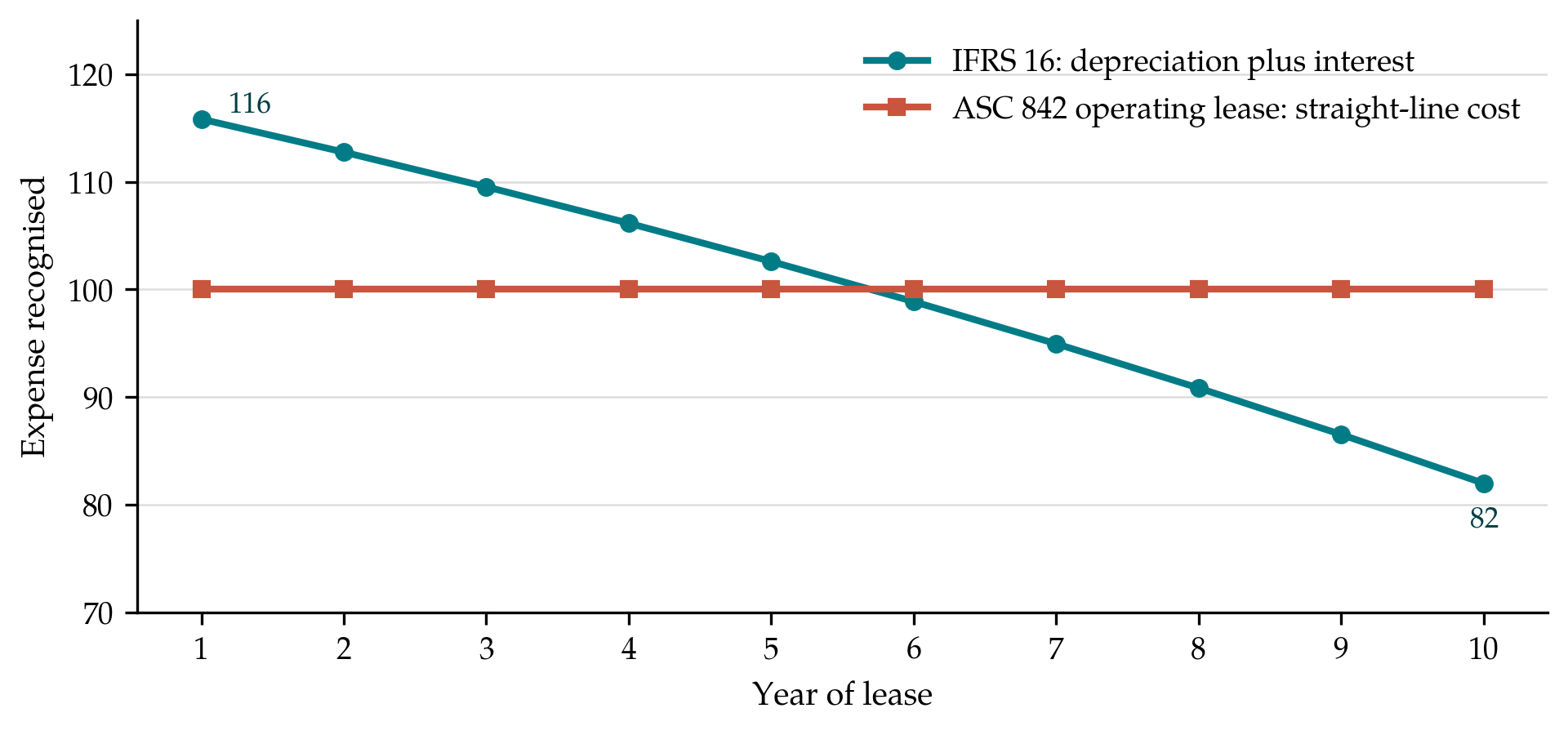
A simple example shows why the expense pattern matters to a preparer. Take a ten-year lease with a payment of 100 at the end of each year and a discount rate of 5 per cent. The liability on day one is 772. Under ASC 842 operating lease accounting the cost is 100 in every year. Under IFRS 16 the charge is depreciation of 77 plus interest that starts at 39 and falls to 5, so the total begins at 116 and ends at 82. Figure 1 plots the two profiles. Total cost over the ten years is identical. What differs is timing and geography: IFRS 16 lowers profit in the early years of every new lease, and it moves the whole cost below EBITDA. A growing company with a young lease portfolio reports lower earnings under IFRS 16 than under ASC 842 for the same contracts, which is one reason that adjusted, pre-standard measures proved so attractive. Estimates of the effect on ratios by sector, with retail, hotels and transport most exposed, are given by Morales-Díaz and Zamora-Ramírez (2018).
5. What Would Change Behaviour
If the aim is to change how preparers think and not only what they present, three things follow. The first concerns standard setters. Variable payments and renewal options are where the measured liability now parts company with the economic one, and disclosure of the expected cash outflows under them, on a consistent basis, would do more than further refinement of the recognition rules. The boundary between a lease and a service deserves the same attention the old classification tests once received.
The second concerns auditors. Lease term and the identification of a lease are judgements, and they are judgements made at contract inception by people who know what answer they would prefer. An auditor who tests the computation of the liability and accepts the inputs is auditing the arithmetic. The more useful questions are why a contract was structured as it was and whether its term in practice matches its term on paper.
The third concerns users. Adjusted measures that strip out the effect of the standard recreate the old blind spot by choice. Analysts and lenders who accept them, and boards that set pay by them, are telling preparers that the off-balance-sheet view is still the one that counts.
6. Conclusion
Lease accounting reform achieved its stated purpose. Balance sheets are more complete than they were, and comparisons between companies that buy and companies that lease are easier. It did not end the practice of arranging leases with an eye to how lightly they will show, because the standards left room for that practice and the surrounding contracts and measures were adapted to protect it. A change in recognition is a necessary step. Whether it becomes a change in behaviour depends on what is disclosed alongside it, how hard the underlying judgements are tested, and whether those who read the accounts keep asking for the old numbers.
Conflict of interest
To be declared by the author(s) before publication.
Funding
To be declared by the author(s) before publication.