1. Introduction
Functionally graded materials vary continuously in composition, most often from a ceramic-rich face to a metal-rich face, so that one side resists heat while the other supplies toughness. The concept was developed for thermal barrier applications at the macroscale and has since been carried over, at least on paper, to micro- and nanoscale beams intended for electromechanical devices that operate hot. A slender beam restrained at its ends and heated develops compressive force and, at a critical temperature rise, buckles. For most devices that is a design limit; for a thermally actuated switch it may be the operating principle.
At thicknesses of tens of nanometres the classical Euler-Bernoulli and Timoshenko theories lose accuracy, because they contain no length that could register the discreteness of the material or the growing share of surface atoms. Bending experiments on epoxy microbeams by Lam et al. (2003) showed a clear rise in normalised stiffness as thickness fell. Continuum theories with internal length scales are the practical response, since atomistic simulation of a graded beam over a range of temperatures is costly. A large analytical literature now applies these theories to thermal buckling of functionally graded nanobeams. This communication comments on what that literature establishes and on three points where its foundations are less secure than its volume suggests.
2. The Competing Size-Dependent Theories
In the nonlocal elasticity of Eringen (1983), stress at a point depends on strain in a neighbourhood of that point, and for a particular kernel the integral relation reduces to a differential one in which the stress is acted on by an operator containing a single nonlocal parameter with the dimension of length. Peddieson et al. (2003) pointed out the usefulness of this form for nanoscale beams, and Reddy (2007) wrote out nonlocal versions of the standard beam theories with solutions for bending, buckling and vibration. For a simply supported beam the nonlocal buckling load equals the classical one divided by a factor greater than one, which grows with the ratio of the nonlocal parameter to the buckling half-wavelength. The beam is predicted to be softer than its classical counterpart.
Gradient theories work the other way. In the modified couple stress theory of Yang et al. (2002) the strain energy depends on the curvature tensor as well as on strain, through one material length parameter; the fuller strain gradient theory of Lam et al. (2003) has three. Either adds to the bending rigidity a term that matters when the thickness is comparable to the length parameter, and the predicted buckling load rises. Lim et al. (2015) combined the two ideas in a nonlocal strain gradient theory with one parameter of each kind, so that softening or stiffening results according to which is larger. Table 1 compares the theories as they bear on thermal buckling.
| Theory | Added length parameters | Effect on critical temperature | Principal reservation |
|---|---|---|---|
| Classical beam theory | None | Reference value; no size effect | Not valid at nanometre thickness |
| Nonlocal elasticity (Eringen, 1983) | One nonlocal parameter | Lowered | Differential form ill-posed on bounded beams |
| Modified couple stress (Yang et al., 2002) | One material length | Raised | Length parameter unmeasured for graded materials |
| Strain gradient (Lam et al., 2003) | Three material lengths | Raised | Three constants to identify |
| Nonlocal strain gradient (Lim et al., 2015) | One nonlocal, one gradient | Lowered or raised | Outcome fixed by the ratio assumed |
The first applications to graded nanobeams treated vibration and static buckling (Eltaher et al., 2012; Şimşek and Yurtcu, 2013), and thermal buckling in the nonlocal Timoshenko setting followed (Ebrahimi and Salari, 2015). The pattern of results is consistent across this work. Increasing the nonlocal parameter lowers the critical temperature; increasing a gradient parameter raises it; and both influences fade as the beam becomes thicker or longer in relation to the internal length.
3. What Else Sets the Critical Temperature
The size-dependent theory is only one input, and Figure 1 gathers the factors that enter a prediction. They all act through the same balance. A temperature rise produces an axial thermal force, obtained by integrating the product of modulus, expansion coefficient and temperature change over the cross-section, and with immovable ends this force enters the governing equation as a compressive pre-load. The critical temperature is the rise at which the thermal force equals the size-dependent buckling load. In the differential nonlocal model the nonlocal operator acts on the term containing the thermal force as well, so the reduction factor familiar from mechanical buckling carries over unchanged for simple supports.
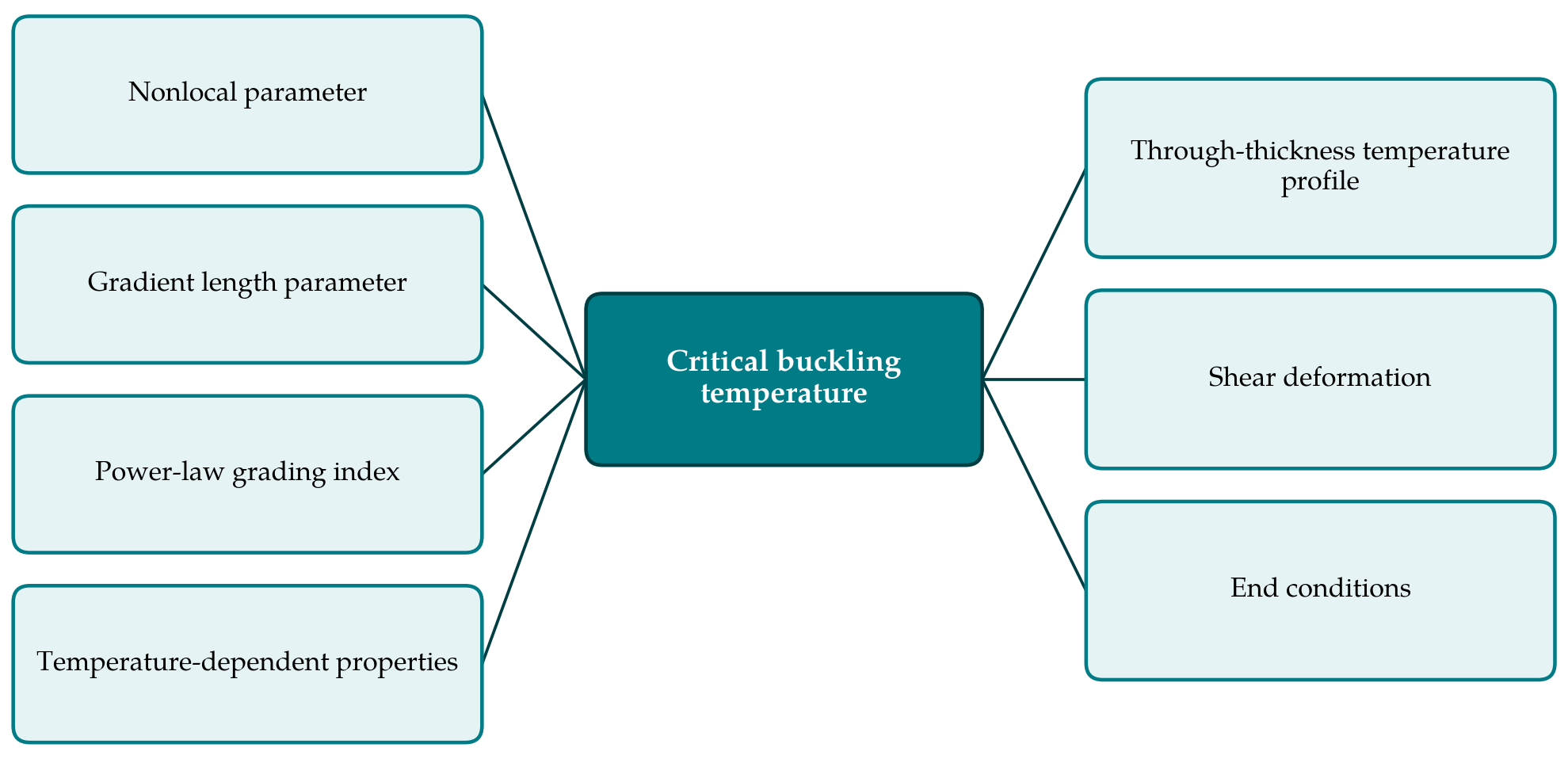
Both the thermal force and the bending rigidity are proportional to the modulus. In a homogeneous beam the modulus therefore cancels, and the critical temperature depends on slenderness and expansion coefficient alone. In a graded beam the two integrals weight the constituents differently, and that difference is the route by which the grading enters. The grading is usually a power law in the thickness coordinate, with effective properties from the rule of mixtures, so that a single index moves the beam from ceramic-rich to metal-rich. Raising the metal fraction generally lowers the critical temperature, because metals expand more and are less stiff, although the trend depends on the constituent pair.
Material properties change with temperature. Analyses that include this effect commonly use the polynomial fits tabulated by Touloukian (1967), in the form applied to graded structures by Reddy and Chin (1998), and they find lower critical temperatures than analyses with constant properties, since stiffness falls as the beam heats. The temperature field matters too: a uniform rise, a linear variation through the thickness and the nonlinear profile obtained from steady heat conduction through the graded section give different thermal forces for the same face temperatures. Shear deformation reduces the critical temperature of short beams, and clamped ends raise it relative to hinged ends through the shorter effective length.
4. Three Difficulties
The first difficulty is whether the problem being solved exists. In a beam graded asymmetrically about its mid-plane, the neutral surface does not coincide with the mid-plane, and extension and bending are coupled. A uniform temperature rise in a beam with ends that are held against axial movement but free to rotate then produces a thermal moment and a lateral deflection from the first degree of heating. The response is a gradual bending, and there is no flat pre-buckling state from which to bifurcate. A true critical temperature exists when the ends are clamped, since the clamps supply the reacting moment. Studies that report bifurcation temperatures for hinged graded nanobeams have in effect suppressed the coupling, and their results should be read with that in mind.
The second concerns the nonlocal model itself. Eringen's differential law is equivalent to the integral law only on an unbounded domain. On a beam of finite length the equivalence requires additional constitutive boundary conditions, which are in general incompatible with the equilibrium conditions at the ends; this explains the long-noted paradoxes in which a nonlocal cantilever under a tip load behaves exactly like a local one or stiffens with the nonlocal parameter (Romano et al., 2017). Stress-driven and two-phase integral formulations have been proposed as well-posed replacements. Much of the thermal buckling literature predates or disregards this result, and the softening it reports for boundary conditions other than simple supports may not survive a consistent formulation.
The third is calibration. The nonlocal and gradient parameters are material properties in principle, to be identified from experiment or from atomistic simulation. For a graded nanobeam, in which composition and therefore microstructure vary through the thickness, there is no reason to expect a single constant value, and measured values appear to be lacking. Published studies vary the parameters over assumed ranges and report trends. Those trends are properties of the equations. They become predictions about a physical beam only when the parameters have been tied to that beam. A related gap lies in the description of the grading itself. The rule of mixtures is a macroscale homogenisation, and its validity across a thickness of a few tens of nanometres, where only a small number of grains or atomic layers separate the two faces, has not been established.
5. Conclusion
Analyses of size-dependent thermal buckling of functionally graded nanobeams agree on the qualitative roles of nonlocal and gradient effects, grading index, temperature dependence and end conditions. Their quantitative content is limited by an idealised bifurcation assumption, by the boundary-condition defect of the differential nonlocal law and by length-scale parameters that have not been measured. Future work would be better directed at well-posed nonlocal formulations, at clamped or otherwise moment-resisting configurations in which buckling is properly defined, and at experiments or atomistic calculations capable of fixing the parameters, than at further parametric studies within the present assumptions.
Conflict of interest
To be declared by the author(s) before publication.
Funding
To be declared by the author(s) before publication.