1. Introduction
Carbapenems were for many years the agents held in reserve for infections caused by Enterobacterales that produce extended-spectrum beta-lactamases. That position has eroded. Enzymes able to hydrolyse carbapenems were described in Klebsiella pneumoniae at the beginning of this century, first the serine carbapenemase later named KPC (Yigit et al., 2001) and soon afterwards an oxacillinase with carbapenemase activity (Poirel et al., 2004). The metallo-beta-lactamase NDM-1 followed, in an isolate from a patient who had been treated in India (Yong et al., 2009). Within a decade these enzymes were reported from every inhabited continent (Nordmann et al., 2011), and carbapenem-resistant K. pneumoniae was placed in the critical tier of the priority list that the World Health Organization published to guide antibiotic development (WHO, 2017).
Attention has been largely clinical, as it should be, because the infections are severe and the remaining treatment options are few (Rodriguez-Bano et al., 2018). A second strand of work has followed the same organisms out of the ward and into the drain. Hospital effluent carries patient excreta, antiseptics and antibiotic residues into municipal sewers, and from there, after treatment of variable quality, into rivers, canals and coastal waters. The question that this literature asks is whether the water downstream of a hospital is simply a record of what is happening inside it or whether it is itself a compartment in which resistant lineages persist, exchange genes and return.
This article reviews that literature as a narrative synthesis rather than a systematic one. It draws on the primary descriptions of the main carbapenemases, on population genomic studies of Klebsiella, on wastewater and surface water surveys, and on the reviews and policy statements that have framed the environmental dimension of antimicrobial resistance. The aim is to separate findings that several independent groups have reproduced from inferences that rest on a single study design, and to state where the evidence is thin.
2. Scope and Approach
The literature surveyed covers three overlapping bodies of work. The first is clinical and molecular microbiology: the characterisation of carbapenemases and the genetic platforms that mobilise them. The second is the population genomics of Klebsiella, which has given the field a vocabulary of sequence types and clonal groups and a way of comparing isolates from any source. The third is environmental microbiology, including culture-based surveys of effluent and receiving water, targeted quantification of resistance genes, and sewage metagenomics. These traditions use different units of observation. A clinical study counts patients and isolates, a genomic study counts genomes, a metagenomic study counts sequence reads mapped to reference genes. Much of the apparent disagreement in the field follows from comparing results expressed in these incommensurate units.
3. The Enzymes and Their Genetic Context
Three enzyme families account for most carbapenem resistance in Klebsiella. KPC is a class A serine enzyme, first reported from a clinical isolate in the eastern United States (Yigit et al., 2001), usually carried on transposon Tn4401 and strongly associated with particular plasmid backbones. The class B metallo-enzymes, of which NDM is the best known, require zinc at the active site and are not inhibited by the classical inhibitors (Yong et al., 2009). OXA-48 and its relatives are class D enzymes whose hydrolysis of carbapenems is comparatively weak but clinically consequential when combined with porin loss (Poirel et al., 2004). The functional classification that organises these groups, and the structure-activity reasoning behind it, is set out by Bush and Jacoby (2010).
For the environmental question the genetic context matters more than the enzyme. All three families sit on mobile elements, and the plasmids that carry them also carry resistance to aminoglycosides, quinolones and sulphonamides, and frequently to heavy metals and quaternary ammonium compounds. That co-location is the mechanism by which selection pressures unrelated to carbapenem use, including disinfectant residues in a hospital drain, can maintain carbapenemase genes in a population (Bengtsson-Palme et al., 2018). It also means that the detection of a carbapenemase gene in water does not identify its host: the same gene may be found in Klebsiella, in Escherichia coli, in Acinetobacter or in environmental genera that are not clinically relevant. Table 1 summarises the main evidence streams and what each can and cannot establish.
| Evidence stream | What it measures | What it cannot establish | Representative source |
|---|---|---|---|
| Selective culture | Viable organisms growing on carbapenem media | Genes in non-culturable hosts | Walsh et al., 2011 |
| Targeted gene assays | Concentration of named genes per volume | Viability and host identity | Pruden et al., 2006 |
| Sewage metagenomics | Abundance of the catchment gene pool | Which strain carries which gene | Hendriksen et al., 2019 |
| Genome sequencing | Lineage, plasmids and relatedness | Prevalence, as isolates are selected | Wyres et al., 2020 |
| Paired ward and drain sampling | Overlap between the two populations | Direction of traffic without a time series | Canton et al., 2012 |
4. Lineages Rather Than Species
A finding that has changed how the field reads its own data is that carbapenem resistance in Klebsiella is concentrated in a small number of clonal groups. Genomic analysis of large isolate collections showed that the species is deeply structured, that acquired resistance is unevenly distributed across that structure, and that a handful of lineages account for a large share of resistant clinical isolates (Holt et al., 2015). The synthesis by Wyres et al. (2020) describes the resulting picture of globally distributed, high-risk clonal groups alongside a much larger and mostly susceptible environmental and commensal population. The clinical consequences of that concentration were set out by Pitout et al. (2015).
For water studies this has two implications. The first is that reporting Klebsiella at species level in an effluent sample conveys very little, because the genus is a normal inhabitant of soil, plants and surface water. The second is that the question worth asking is not whether Klebsiella is present but whether the high-risk lineages are, and whether the lineages in water match those circulating in the adjacent hospital. Answering that requires sequencing isolates rather than quantifying genes, which is why culture has not been superseded by molecular methods in this field.
5. What Sampling Studies Have Found
The environmental point prevalence study of Walsh et al. (2011) remains the most widely cited demonstration that carbapenemase-producing organisms can be recovered from public water and seepage in an urban setting, and it reported NDM-1 positive bacteria across a range of genera. Work on resistance genes as contaminants predates the carbapenemase era and established the basic analytical approach, in which gene concentrations are compared upstream and downstream of a discharge (Pruden et al., 2006). Reviews of wastewater as a resistance reservoir have since argued that the signal measured in sewage is dominated by the gut flora of the contributing population rather than by selection occurring in the sewer itself (Karkman et al., 2018), a conclusion that matters because it bears directly on whether treatment plants should be regarded as sources or as sinks.
Sewage metagenomics has given the field a comparative instrument. Sampling of urban sewage across many countries showed systematic regional differences in the composition of the resistance gene pool and demonstrated that a catchment can be characterised without culturing anything (Hendriksen et al., 2019). The case for using sewage as a routine surveillance substrate, including its ethical advantages over individual sampling, has been made by Aarestrup and Woolhouse (2020). These methods describe the pool of genes well. They do not identify lineages, and they are therefore complementary to, not a replacement for, isolate-based work. Figure 1 shows the compartments and the connections between them that this literature describes.
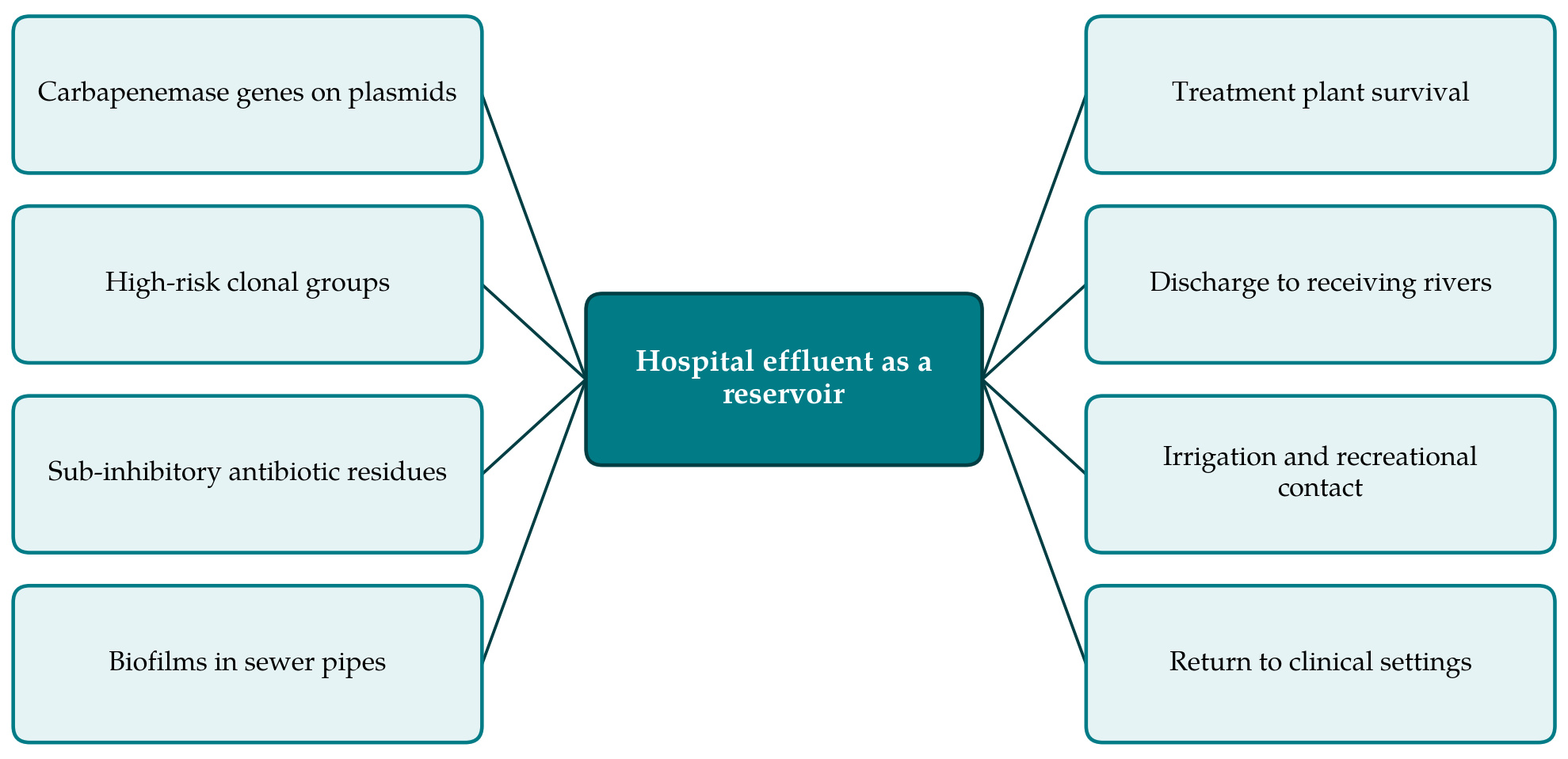
Hospital effluent differs from municipal sewage in composition. It carries higher concentrations of antibiotic residues, disinfectants and radiocontrast media, and the proportion of contributors who are colonised with resistant organisms is far higher than in the general population. Several reviews have therefore treated hospital drains as a distinct compartment with its own selective regime (Berendonk et al., 2015). The counter-argument, developed by Larsson and Flach (2022), is that concentration alone does not establish selection, and that the residues present in most effluents fall below the concentrations at which resistance is selected in experimental systems, with manufacturing discharges as the clear exception.
6. Treatment, Survival and Receiving Waters
Conventional activated sludge treatment reduces bacterial loads by orders of magnitude but is not designed to eliminate resistance genes, and the sludge itself concentrates both organisms and genes. The reviews cited above agree that resistant organisms are detectable in treated effluent and in receiving waters downstream of discharge points, and that the resistance gene pool in a river typically increases below a plant and declines with distance. What they do not agree on is the interpretation. One reading treats the plant as a reactor in which high cell densities, biofilms and sub-inhibitory residues promote conjugative transfer. The other treats it as a passive conduit in which the observed genes are those that entered with the faecal load (Karkman et al., 2018). The experimental work needed to separate these readings, in which transfer rates are measured under realistic conditions rather than inferred from co-occurrence, is still sparse.
Standardised definitions matter here more than they might appear to. Reports of multidrug-resistant organisms in water are difficult to compare unless the phenotype is defined consistently, and the interim standard definitions proposed by Magiorakos et al. (2012) provide the common vocabulary. Studies that classify isolates by their own local criteria contribute little to a cumulative picture, and this remains a practical weakness of the environmental literature.
7. Gaps and Future Work
Four gaps stand out. The first is temporal. Most sampling is cross-sectional, and the direction of movement between ward, drain and river cannot be inferred from a single time point; repeated paired sampling with genomic resolution would resolve much that is currently argued from plausibility. The second is the plasmid. Studies typically report which genes are present, but long-read sequencing now makes it feasible to report which plasmid carries them and whether the same plasmid is found in clinical and environmental hosts, which is a far stronger form of evidence. The third is exposure: the step from detecting an organism in a canal to estimating human risk from irrigation, bathing or fishing has rarely been attempted and is where the environmental and public health literatures remain disconnected. The fourth is geographical. Most published surveys come from a small number of well-resourced settings, while the places where untreated hospital effluent reaches surface water directly are the least studied.
Progress on all four is largely a matter of study design rather than of new technology. Sequencing costs have fallen to the point where isolate-level resolution is affordable in most national reference laboratories, and the analytical frameworks developed for clinical genomics transfer to environmental isolates without modification. What is missing is sustained sampling programmes with agreed protocols, of the kind that sewage-based surveillance proposals have outlined (Aarestrup and Woolhouse, 2020).
8. Conclusion
The published evidence supports three statements with reasonable confidence: carbapenemase genes and the organisms carrying them are routinely detectable in hospital effluent and in waters receiving treated sewage; the clinically important resistance in Klebsiella is concentrated in a limited set of lineages that can be identified by sequencing; and the resistance signal measured in sewage largely reflects the carriage of the contributing population. Whether the water compartment amplifies resistance or merely records it is not settled, and the question will not be answered by more cross-sectional surveys. Longitudinal, genomically resolved sampling that follows named lineages and named plasmids between the ward and the river is the design the field now needs.
Conflict of interest
To be declared by the author(s) before publication.
Funding
To be declared by the author(s) before publication.