1. Introduction
Fitting ceiling panels, welding the underside of a vehicle body and drilling into soffits all keep the upper arms elevated for long periods. Epidemiological work has related the time spent with the arms raised to shoulder disorders, with clearer effects at higher elevation (Svendsen et al., 2004). Where the task cannot be redesigned, an exoskeleton that carries part of the weight of the arm is an option, and reviews of industrial exoskeletons describe a growing number of such devices (de Looze et al., 2016; Theurel and Desbrosses, 2019).
Nearly all devices in use are passive. A spring mechanism beside the shoulder produces a lifting torque on an arm cuff, and laboratory evaluations have reported reduced activity in the shoulder muscles during simulated overhead tasks (Kim et al., 2018). A spring, however, delivers a fixed torque profile whether the arm is working overhead or reaching down for a tool. Active devices can adapt, but conventional designs place motors and rigid links around a joint that is poorly suited to them (Gopura et al., 2016). Cable-driven joints are a way of obtaining active support without that penalty. This note examines the idea on mechanical grounds and presents no experimental results.
2. Why Cables Suit the Shoulder
The gravitational moment of the arm about the shoulder varies with the sine of the elevation angle measured from the hanging position. It is greatest with the arm horizontal and remains substantial throughout the range used in overhead work (Winter, 2009). Support is therefore needed in one direction only, against gravity, and gravity itself returns the arm. That matches the principal property of a cable, which can pull and cannot push. A single cable per degree of freedom may suffice where a general-purpose robot joint would need an antagonistic pair.
The shoulder is also the joint at which rigid exoskeletons fit worst. Its centre of rotation moves as the scapula rotates and the clavicle lifts, and a mechanical joint fixed to the trunk cannot follow it without extra passive degrees of freedom; the resulting misalignment generates unwanted interaction forces on the limb (Schiele and van der Helm, 2006). A cable attached to an upper-arm cuff imposes no axis of its own. The human joint remains the only joint, a principle shared with the soft exosuits developed for the lower limb (Asbeck et al., 2014) and with the cable-driven arm exoskeleton of Mao and Agrawal (2012), in which cables run from a shoulder frame to cuffs on the arm.
A third attraction is the distribution of mass. With the motors on a back plate or belt, the arm carries a cuff and a length of cable. Low distal mass keeps the inertia felt during fast movements small, which matters to a worker who must also reach, turn and climb.
3. Six Design Questions
Whether these advantages survive in a working device depends on six linked design questions, shown in Figure 1 and summarised with their usual remedies in Table 1.
| Design question | Why it matters | Usual remedy |
|---|---|---|
| Routing and moment arm | Lifting torque equals tension times moment arm | Raised guide above the shoulder; larger offset at the cuff |
| Sheath friction | Tension lost along the cable varies with posture | Short, gently curved sheaths; sensing at the cuff |
| Anchoring | Soft tissue and garment stretch absorb cable travel | Wide, stiff load paths to pelvis and trunk |
| Joint reaction | Cable tension presses the humerus into the socket | Pull direction closer to vertical; rigid frame |
| Sensing and control | Motor current is a poor measure of delivered torque | Series elastic element or load cell near the cuff |
| Failure behaviour | Arm must never be driven or trapped | Tension limits; slack on power loss; quick release |
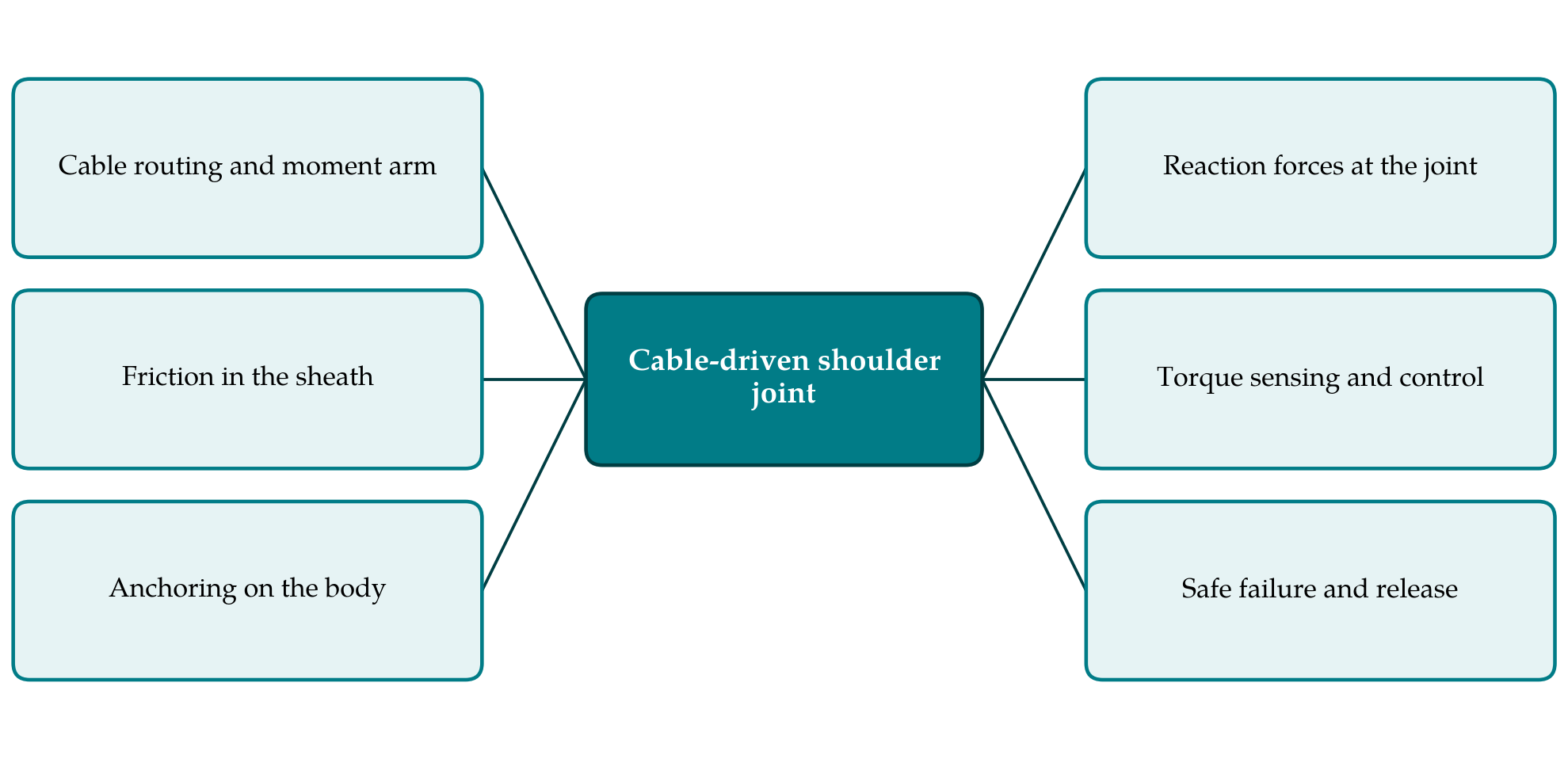
3.1. Routing, friction and anchoring
The torque delivered equals cable tension multiplied by the perpendicular distance from the line of the cable to the centre of the joint. A cable lying close to the body has a short moment arm and needs high tension to give useful support. Designs therefore lift the cable away from the shoulder with a guide or frame, at some cost in bulk above the shoulder, which is exactly where clearance is scarce in overhead work. Between the motor and the guide the cable usually runs in a Bowden sheath, and friction there grows exponentially with the total angle through which the sheath is bent, as the capstan relation predicts. Because the bend changes as the wearer moves, so does the loss, and the transmission shows hysteresis and backlash that complicate control (Veneman et al., 2006).
The cable must also react against something. In a soft device the reaction passes through straps and textiles to the trunk and pelvis, and the compliance of that path, together with the compression of soft tissue under the cuff, takes up cable travel before any torque reaches the arm. Asbeck et al. (2014) describe this suit and body stiffness as a governing parameter of exosuit performance. A semi-rigid back frame shortens the load path but gives away part of the comfort and freedom that motivated the soft approach.
3.2. Reaction forces at the joint
A lifting torque on the arm can be produced by a force at the cuff directed upwards, or by a force directed along a cable towards a point near the shoulder. The two are not equivalent for the joint. In the second case much of the tension acts along the humerus and presses its head into the glenoid, so the muscles that elevate the arm may be relieved while the compressive load on the joint is not, or is even increased. The published evaluations of occupational devices rely mainly on surface electromyography and reported discomfort (de Looze et al., 2016; Kim et al., 2018), which describe muscle effort and say little about joint contact force. For a device intended to prevent joint disorders this is the question that most needs an answer, and it can be approached only through musculoskeletal modelling combined with measured cable forces and kinematics.
3.3. Sensing, control and safe failure
Given friction that varies with posture, the tension at the motor is an unreliable guide to the tension at the cuff. The established remedy is to measure force close to the load, either with a load cell or through the deflection of a series elastic element, which also makes the actuator compliant to unexpected movement (Pratt and Williamson, 1995; Veneman et al., 2006). The controller then needs an estimate of the wearer's intention, commonly taken from arm elevation measured by inertial sensors, so that support rises as the arm is raised and falls away when the arm is lowered or a tool is exchanged.
An active device on a worker's arm must fail harmlessly. The safety standard for personal care robots, which includes physical assistant robots worn on the body, requires hazards from excessive force, loss of power and entrapment to be assessed and controlled (ISO, 2014). A cable is helpful here because it goes slack when tension is removed and cannot push the arm, but a jammed cable could hold it, so mechanical limits on tension and a release that the wearer can operate with the other hand belong in the basic design.
4. Evidence That Evaluations Would Need to Provide
Reviews of occupational exoskeletons note that most evidence comes from short laboratory sessions with healthy volunteers and that field and long-term studies are few (Theurel and Desbrosses, 2019). A cable-driven shoulder joint would need to be judged on more than reduced deltoid activity. An adequate evaluation would report the torque delivered at the arm against that commanded across postures, estimates of glenohumeral contact force with and without the device, loads transferred to the trunk and lower back, the effect on precision and reach, and wearers' tolerance of the device over full shifts. Comparison with a passive spring device on the same tasks is the relevant benchmark, since that is what a purchaser would otherwise choose.
5. Conclusion
Cable-driven actuation fits the mechanics of shoulder support well: assistance is needed in one direction, the joint resists rigid alignment, and distal mass is costly. The same mechanics define its weaknesses, namely a short moment arm, posture-dependent friction, compliant anchoring and a cable force that may compress the joint it is meant to protect. None of these is beyond engineering remedy, and each has a body of literature to draw on. Until joint loading is estimated and reported alongside muscle activity, claims that such devices reduce shoulder load should be read as claims about muscular effort.
Conflict of interest
To be declared by the author(s) before publication.
Funding
To be declared by the author(s) before publication.