1. Introduction
Classical male hypogonadism has a cause that can be named: Klinefelter syndrome, orchitis, a pituitary tumor, Kallmann syndrome. Testosterone replacement in such men is uncontroversial. The difficulty lies with the far larger number of middle-aged and older men who have nonspecific symptoms, a testosterone concentration at or a little below the lower reference limit, and no structural disorder of the hypothalamic-pituitary-testicular axis. Longitudinal studies established that testosterone declines slowly across adult life (Harman et al., 2001; Feldman et al., 2002), and the symptoms attributed to that decline, such as low libido, fatigue and loss of muscle, are common in aging men whatever their hormone levels.
Prescribing moved faster than evidence. Sales of testosterone rose many-fold in a number of countries in the first decade of this century, a trend Handelsman (2013) documented and attributed largely to promotion for age-related indications. Regulators responded, and in 2015 staff of the United States Food and Drug Administration stated that the benefit and safety of testosterone for age-related hypogonadism had not been established (Nguyen et al., 2015). Since then several large placebo-controlled trials have reported. This review asks what they show, where they agree and what they leave unresolved.
2. Approach of This Review
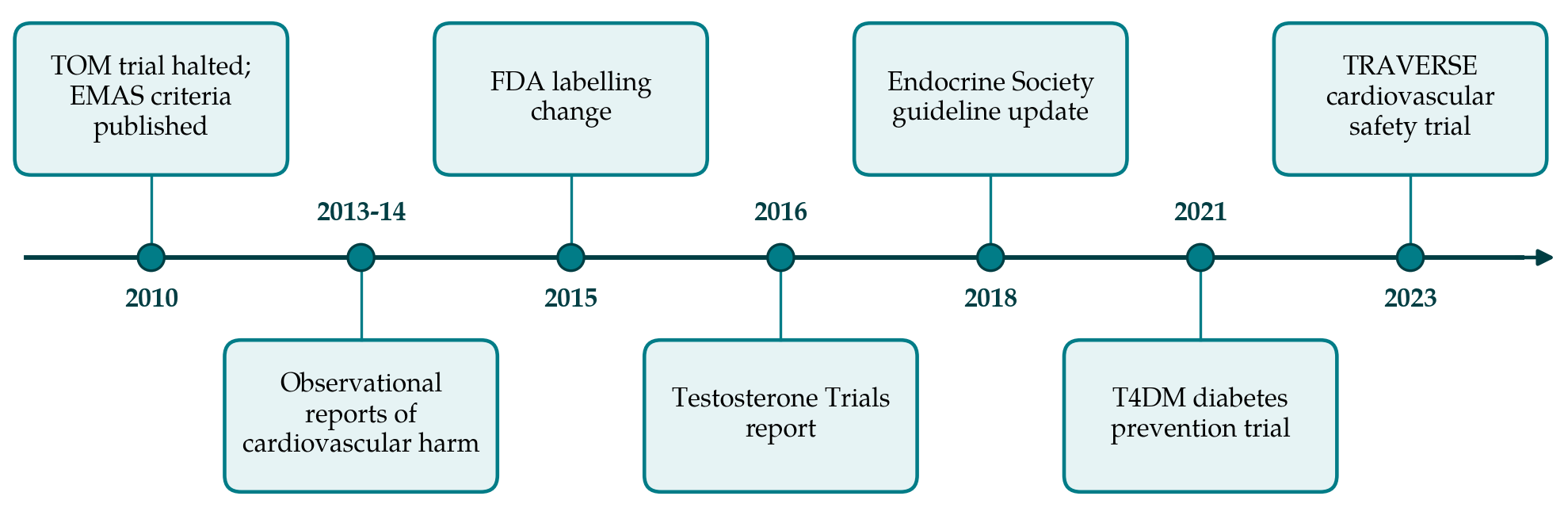
This is a narrative review of the published literature, organized around the principal randomized trials, the cohort studies that defined the condition, and current clinical practice guidelines. It was not conducted as a systematic review, and it makes no claim to completeness. Observational studies of treatment outcomes are mentioned for their historical influence but are given less weight than trials. Figure 1 places the main events in order, from the early stopping of a trial in frail men to the completion of a dedicated cardiovascular safety trial.
3. Defining Functional Hypogonadism
The term functional hypogonadism was proposed to describe low testosterone with compatible symptoms in the absence of recognizable organic disease of the axis, on the analogy of functional hypothalamic amenorrhea in women. The implication is that the suppression is a consequence of something else and may be reversible (Grossmann and Matsumoto, 2017). The label overlaps with late-onset hypogonadism and age-related low testosterone, and the three are often used interchangeably, although they carry different assumptions about cause.
3.1. Age, obesity and illness
The European Male Ageing Study showed that the effects of age and of adiposity on the axis differ. Age was associated mainly with a rise in luteinizing hormone and sex hormone-binding globulin, a pattern of primary testicular impairment, whereas obesity was associated with low total and free testosterone without a compensatory rise in luteinizing hormone (Wu et al., 2008). In the same cohort, men who gained weight during follow-up lost testosterone and men who lost weight regained it (Camacho et al., 2013). Chronic disease, opioids and glucocorticoids act in the same direction. Much of what is called age-related hypogonadism is thus better described as the hormonal footprint of poor health.
3.2. Thresholds and measurement
Symptoms alone do not identify the condition. In the European cohort only three sexual symptoms, poor morning erection, low sexual desire and erectile dysfunction, were consistently related to low testosterone, and when these were combined with biochemical thresholds the syndrome was present in about two percent of men aged 40 to 79 (Wu et al., 2010). The Endocrine Society accordingly recommends a diagnosis only in men with symptoms and signs of deficiency and unequivocally and consistently low concentrations, measured fasting in the morning on at least two occasions, and it advises against screening the general population (Bhasin et al., 2018). Assay variability long hampered the choice of thresholds, and a harmonized reference range from four cohorts now provides a common footing (Travison et al., 2017).
4. Benefits Shown in Randomized Trials
The Testosterone Trials were a coordinated set of seven placebo-controlled trials in men aged 65 or older with low testosterone and symptoms, treated with a gel for one year. They were commissioned to settle whether treatment has any benefit at all, and they remain the main source on efficacy. Table 1 summarizes their findings alongside those of later trials.
| Outcome | What the trials show | Main sources |
|---|---|---|
| Sexual function | Modest improvement in desire, activity and erectile function | Snyder et al., 2016 |
| Walking and vitality | Small or no effect on primary measures | Snyder et al., 2016 |
| Cognition | No improvement in memory or other domains | Resnick et al., 2017 |
| Anemia | Hemoglobin raised; unexplained anemia often corrected | Roy et al., 2017 |
| Bone | Density and estimated strength increased; fractures not reduced | Snyder et al., 2017; Snyder et al., 2024 |
| Glycemia | Fewer men with type 2 diabetes at two years, added to lifestyle program | Wittert et al., 2021 |
| Major cardiovascular events | Noninferior to placebo over a few years | Lincoff et al., 2023 |
4.1. Sexual function
The clearest benefit is sexual. Men assigned to testosterone reported more sexual activity, greater desire and better erectile function than men assigned to placebo (Snyder et al., 2016). The effect was statistically robust and of moderate size, smaller for erectile function than that expected from a phosphodiesterase inhibitor. It is on this evidence that the American College of Physicians suggests discussing treatment only with men who have age-related low testosterone and sexual dysfunction and who wish to improve sexual function, and suggests against starting it to improve energy, vitality, physical function or cognition (Qaseem et al., 2020).
4.2. Physical function, vitality and mood
Results for the outcomes that most often prompt a prescription were disappointing. Among men enrolled for slow walking, testosterone did not significantly increase the proportion who improved their six-minute walk distance by the prespecified margin, although an effect emerged when all participants were pooled. Fatigue scores did not improve by the primary criterion, and there were small favorable changes in mood and depressive symptoms (Snyder et al., 2016). Testosterone reliably increases muscle mass; whether that translates into function that matters to an older man, such as rising from a chair, climbing stairs or avoiding falls, is much less certain. The trials were also short, and a year may be too brief for changes in muscle to alter mobility in either direction.
4.3. Bone, blood and metabolism
Three further effects are well documented. Volumetric bone density and estimated bone strength rose, more in the spine than the hip (Snyder et al., 2017). Hemoglobin increased, and in men with otherwise unexplained anemia it was frequently restored to normal (Roy et al., 2017). Memory and other cognitive functions did not change (Resnick et al., 2017). In the Australian T4DM trial, men with impaired glucose tolerance or newly diagnosed type 2 diabetes who received injectable testosterone undecanoate on top of a lifestyle program were less likely to have diabetes at two years than those who received the program with placebo (Wittert et al., 2021). That finding is important, but it does not show that testosterone is preferable to more effective weight loss.
5. Risks
Concern about harm has centered on the heart and the prostate. On both, the evidence is now better than it was, and on both it has limits that are easy to overlook.
5.1. Cardiovascular events
The alarm was raised by the Testosterone in Older Men with Mobility Limitations trial, which was stopped early because cardiovascular adverse events were more frequent in the testosterone group (Basaria et al., 2010). The participants were frail, the doses were relatively high and the events were heterogeneous and not a prespecified endpoint. Two observational analyses then reported more myocardial infarction and death among treated men (Vigen et al., 2013; Finkle et al., 2014); both attracted methodological criticism, and both influenced regulators. Within the Testosterone Trials, coronary computed tomography showed a greater increase in noncalcified plaque volume with treatment, a finding of uncertain clinical meaning (Budoff et al., 2017).
TRAVERSE was designed to answer the question directly. It enrolled men aged 45 to 80 with hypogonadal symptoms, two low testosterone measurements and either established cardiovascular disease or high risk of it, and it found testosterone gel noninferior to placebo for a composite of cardiovascular death, nonfatal myocardial infarction and nonfatal stroke (Lincoff et al., 2023). An individual participant meta-analysis of earlier trials had reached a compatible conclusion for the short to medium term (Hudson et al., 2022). The reassurance is real but bounded. Adherence in TRAVERSE was incomplete, average exposure was around two years, and the achieved testosterone concentrations were modest. The trial also recorded higher incidences of atrial fibrillation, acute kidney injury and pulmonary embolism in the testosterone group. These were secondary safety observations and not tests of a prior hypothesis, but they are biologically plausible, given the effect of testosterone on hematocrit, and they are a reason for continued caution in men with a history of thrombosis or arrhythmia.
5.2. Prostate, erythrocytosis and fracture
Prostate events in TRAVERSE were infrequent and did not differ between groups, including high-grade cancer (Bhasin et al., 2023). Men at raised prostate risk were excluded at entry and monitoring was structured, so the result applies to carefully selected and supervised patients. Erythrocytosis is the adverse effect seen most often in every trial; guidelines require hematocrit to be checked before and during treatment and treatment to be withheld or reduced when it exceeds the stated limit (Bhasin et al., 2018). The most surprising safety finding was skeletal. Despite the gain in bone density seen earlier, clinical fractures in TRAVERSE were more frequent with testosterone than with placebo (Snyder et al., 2024). No mechanism has been established, and the result is a caution against inferring fracture protection from densitometry.
6. Treating the Underlying Cause
If low testosterone in these men is largely a consequence of adiposity and illness, the logical first response is to treat those. A meta-analysis of weight loss interventions found that testosterone rose in proportion to the weight lost, with the largest increases after bariatric surgery (Corona et al., 2013). Review of medication, treatment of sleep apnea and control of diabetes belong to the same approach, which Grossmann and Matsumoto (2017) argue should precede any decision about hormone treatment. The argument is persuasive in principle. In practice sustained weight loss has been difficult to achieve, and no trial has compared a lifestyle-first strategy with early testosterone for symptoms. The arrival of highly effective incretin-based drugs for obesity may change the practical balance, and their effect on gonadal function in men deserves formal study.
7. Unanswered Questions
Four gaps stand out. The first is duration. No trial informs treatment beyond about three years, yet men who start in their sixties may continue for decades. The second is generalizability. Trials excluded men with recent cardiovascular events, high prostate risk, untreated sleep apnea, raised hematocrit and thrombophilia, who are numerous in ordinary practice. The third concerns thresholds: trials enrolled on total testosterone cut-offs, and it is not known whether benefit depends on how low the starting concentration is or on free testosterone. The fourth is formulation, since safety data for a transdermal gel may not transfer to long-acting injections that produce higher peaks and more erythrocytosis.
The unexpected signals also need explanation. Atrial fibrillation, venous thromboembolism and fracture were not primary endpoints, and each requires confirmation and a mechanism. Finally, the outcomes patients care about most, independence, mobility and wellbeing over years, have not been shown to improve.
8. Conclusion
For an older man with functional hypogonadism, testosterone offers a moderate improvement in sexual function, correction of anemia and denser bone, with little effect on energy, mobility or cognition. Over two to three years in supervised, selected patients it does not appear to raise the risk of heart attack, stroke or prostate cancer, though it does cause erythrocytosis and may increase arrhythmia, venous thrombosis and fracture. This is a narrower indication than past prescribing patterns assumed. Attention to weight, comorbidity and medication comes first, and the decision to treat is best made with the patient on the basis of the specific benefit he seeks and with an agreed plan for monitoring and for stopping.
Conflict of interest
To be declared by the author(s) before publication.
Funding
To be declared by the author(s) before publication.