1. Introduction
Finger millet, Eleusine coracana, was domesticated in the highlands of eastern Africa and has been grown in South Asia since antiquity (Hilu and de Wet, 1976). It is known as ragi in southern India, mandua in Uttarakhand and kodo in Nepal. The crop tolerates thin soils and uncertain rain, stores for years without serious insect damage, and gives a grain unusually rich in calcium, qualities that have earned it a place in every account of neglected cereals (National Research Council, 1996). On terraced hill land it is commonly transplanted or sown into standing maize as a relay crop, and its straw is valued as winter fodder.
Plant breeding has served these systems poorly. Varieties are selected on research stations with better soil and more inputs than a hill terrace receives, and are judged mainly on grain yield. Farmers weigh other things as well: maturity that fits the relay with maize, straw yield, ease of threshing, resistance to blast, and the quality of the flour for local dishes. A variety that wins on the station may therefore be turned down on the farm, and a variety that farmers would have liked may be discarded before they ever see it. Participatory varietal selection was devised to close this gap by letting farmers choose among finished or nearly finished varieties under their own conditions (Witcombe et al., 1996).
This article proposes a design for participatory varietal selection of finger millet with hill farmers. It is a methodological guide. It does not report a programme that was carried out, and no farmer data are presented. The design is assembled from published methods and from what is generally known of the crop, and it should be read as a proposal awaiting field application.
2. Background
The proposal rests on two bodies of work: the development of participatory methods in plant breeding since the 1990s, and the trial formats that grew out of it.
2.1. Participatory varietal selection and its rationale
The approach was set out in a series of papers from projects in India and Nepal. Joshi and Witcombe (1996) described four steps, namely identifying farmers' needs, searching for suitable material, testing it in farmers' fields and disseminating what farmers prefer, and that sequence still organises most programmes. Participatory varietal selection deals with fixed lines, and is distinguished from participatory plant breeding, in which farmers select within segregating material (Sperling et al., 2001). Later writing recast both as forms of client-oriented breeding, the point being that the purpose is a better fit to users and that participation is the means (Witcombe et al., 2005). An early application to finger millet in Karnataka was reported by Gowda et al. (2000).
There is a quantitative argument as well as a social one. Atlin et al. (2001) examined decentralised selection with the tools of selection theory and showed that selecting in the target environment is advantageous when the genetic correlation between station and farm is low, provided that on-farm trials are replicated well enough to keep heritability acceptable. Hill agriculture, with its steep gradients in altitude, aspect and soil depth over short distances, is a setting where that correlation is likely to be weak. Experience with barley in dry areas led Ceccarelli and Grando (2007) to the same position, and the practical methods are collected in a handbook edited by Ceccarelli et al. (2009).
2.2. Trial formats
Several formats exist for testing varieties with farmers, and they differ in what they measure and in the burden they place on participants. The mother and baby design pairs a small number of replicated trials containing all entries with many single-entry or few-entry plots managed entirely by farmers (Snapp, 2002). Triadic comparison of technologies, known as tricot, gives each of a large number of farmers three entries drawn from the full set and asks only for rankings (van Etten et al., 2019). Farm walks and post-harvest tests can be attached to either. Table 1 compares the formats. For finger millet in the hills this article proposes the mother and baby design as the core, for reasons given under the third stage below.
| Format | What it involves | Strength | Limitation |
|---|---|---|---|
| Mother trial | All entries together, replicated, researcher-designed and farmer-managed | Measured yields; side-by-side viewing | Few sites; needs a larger plot |
| Baby trial | One or two new entries beside the farmer's own variety | Real management; many households | Yields are rough; entries unbalanced |
| Tricot | Three entries per farmer from a larger set; rankings only | Scales to many farms and environments | No direct yield measurement |
| Farm walk | Group visit to a mother trial near maturity with scoring or voting | Quick; reveals reasons for choice | Dominant voices can sway the group |
| Post-harvest test | Threshing, milling, cooking and tasting of each entry | Captures traits invisible in the field | Needs enough grain of every entry |
3. The Proposed Design
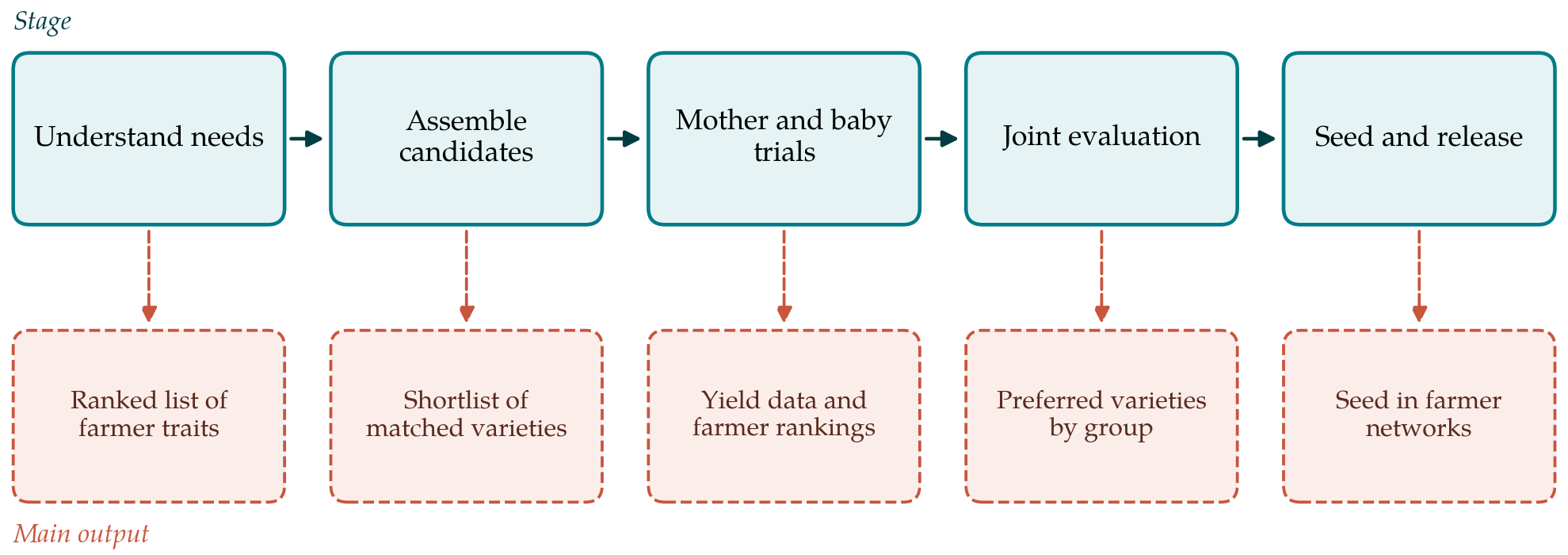
The design has five stages spread over a preparatory season and at least two cropping seasons. Figure 1 shows the stages with the main output of each. The description assumes a team from a national research station or a non-governmental organisation working in a cluster of villages that share a watershed but span a range of altitude.
3.1. Stage 1: Understand what farmers need
Work begins in the season before any trial, with the methods of participatory rural appraisal (Chambers, 1994). Group discussions, held separately with women and with men, establish which landraces and varieties are grown, on what kind of land, in what sequence with other crops, and why. A matrix ranking exercise turns the discussion into a list of traits ordered by importance. Women do much of the transplanting, weeding, harvesting and all of the processing of finger millet in most hill communities, so their ranking may differ from that of men and must be recorded on its own. The team also walks transects from valley floor to upper terraces to define the land types that the trials will have to represent. The stage ends with a short written profile of the variety farmers are looking for in each land type.
3.2. Stage 2: Assemble candidate varieties
The search for entries is guided by the profile from the first stage and not by what happens to be on the shelf. Three sources are worth combining: varieties already released for comparable environments, including those released in a neighbouring state or country; advanced lines from national breeding programmes; and landraces from other hill districts held in genebanks. The core subset of the finger millet collection described by Upadhyaya et al. (2006) offers a structured sample of the last. Between six and ten entries, including the most popular local landrace as a check, is a manageable number. Seed must be obtained under the proper agreements and checked for germination and for seed-borne disease before it is distributed.
3.3. Stage 3: Mother and baby trials
A mother trial containing all entries in two or three replicates is placed on each main land type, on land lent by a farmer who then manages it in the usual local way. Around each mother trial, a larger number of households grow baby trials. Each baby consists of one or two new entries next to the household's own variety, on plots large enough to yield grain for a family meal and straw for a fair comparison. Entries are allotted so that every one of them appears on a similar number of farms. The design is preferred here to tricot for two reasons. Finger millet programmes in the hills usually need measured grain and straw yields to support a release proposal, which mothers supply. And terraces are small, so that a baby with one new entry is easier to host than three unfamiliar ones. Where a programme already has release data and seeks only wide testing, tricot would be the better choice.
3.4. Stage 4: Joint evaluation in the field and after harvest
Evaluation takes place at three moments. Near maturity, farmers visit the mother trial in a farm walk. Entries are identified by number, not by name, and each visitor casts votes privately for the entries liked most and least before the group discusses reasons; women and men vote with tokens of different colours so that the tallies can be separated. At harvest, grain and straw are weighed from the mothers, and blast and lodging are scored. After harvest, households that grew babies are asked to rank the new entry against their own for each trait in the first-stage list, and a tasting session is held in which flour from each entry is cooked into the local staple, such as roti or the thick porridge called dhindo, and scored without the entries being identified.
3.5. Stage 5: Seed supply and release
Selection is pointless if seed of the chosen varieties cannot be had. In the second season, entries that farmers rejected are dropped and the remainder are repeated, while the team arranges seed multiplication of the leading entries with a farmers' group or a community seed bank. Finger millet is self-pollinating and its seed rate is low, so a variety can spread quickly from farmer to farmer once a modest quantity is in the village. In parallel, the mother trial data and the preference records are compiled in the format the national release committee requires, since release procedures in the region, notably in Nepal, have been adapted to admit participatory data as supporting evidence.
4. Analysing Rankings and Yields Together
The trials produce two kinds of data, and the analysis should respect the difference. Yields from mother trials are analysed by the ordinary methods for multi-location trials, with attention to the interaction between entries and land types. Rankings and votes are ordinal. Coe (2002) explains why averaging ranks as if they were measurements can mislead and describes models suited to ranks and ratings from on-farm trials. Rankings of subsets of entries, as in baby trials, can be fitted with models of the Plackett-Luce family (Plackett, 1975), the approach adopted for tricot data (van Etten et al., 2019). Results should be reported separately for women and men and for each land type before any pooling. A variety preferred strongly by one group and disliked by another is a finding in itself and should not be averaged away.
5. Consent, Seed Rights and Inclusion
Farmers contribute land, labour and knowledge, and the design should treat them accordingly. Participation is voluntary and is agreed after the purpose, the risks of growing an untried variety and the use of the data have been explained in the local language. Households that host trials on scarce terrace land should not bear a loss if a new entry fails, and the simplest safeguard is to keep babies small relative to the household's own crop. Landraces brought in from genebanks, and any local landraces that the team collects, are handled under the International Treaty on Plant Genetic Resources for Food and Agriculture (FAO, 2009) and the national laws that give effect to farmers' rights. Care is needed over who is invited. Programmes that work through village leaders tend to recruit better-off men with larger holdings, and a deliberate quota for women and for households with little land corrects this (Weltzien et al., 2003).
6. Limitations and What Remains to Be Shown
The design is a proposal and has not been tested in this article. An application would need to show several things. The first is whether mother trials on small, irregular terraces can be run with enough precision to separate entries, since heritability on farm is the condition on which the case for decentralised selection depends (Atlin et al., 2001). The second is whether the preferences recorded in farm walks and baby trials predict what farmers actually sow in later seasons, which only a follow-up of adoption can answer. The third is cost per household reached, compared with the tricot alternative.
Some limits are built in. Two seasons cannot reveal how a variety behaves in a severe blast year or a failed monsoon unless one happens to occur. The entries are limited to what already exists, so if nothing in the candidate set matches the farmers' profile the exercise will show the gap and not fill it; in that case the appropriate next step is participatory breeding within crosses involving the local landrace. Finally, preferences are local. A result from one watershed is evidence about that watershed, and extending it to other hill districts requires trials there.
7. Conclusion
Finger millet in the South Asian hills is a crop for which the usual route from research station to farm has delivered little, and for which farmers' criteria are many and specific to place. The design proposed here begins from those criteria, selects candidates to match them, tests the candidates in mother and baby trials on the land types that matter, gathers the judgements of women and men at three points in the season, and ties the outcome to seed supply and release. Each element is drawn from established practice. Their combination for this crop and setting is offered for trial, and its worth will be decided by whether farmers keep growing what they chose.
Conflict of interest
To be declared by the author(s) before publication.
Funding
To be declared by the author(s) before publication.