1. Introduction
Colloidal silver has been made by chemical reduction for well over a century, and the citrate method of Lee and Meisel (1982) remains a standard preparation. Interest in replacing synthetic reductants and stabilisers with benign ones grew with the green chemistry movement (Anastas and Warner, 1998). Raveendran et al. (2003) showed that glucose and starch suffice, and crude plant extracts were soon found to do the same work. Plant-mediated synthesis has since been reviewed at length (Iravani, 2011).
Fruit peel is a natural choice of plant material because it is discarded in quantity and is rich in reducing compounds. Banana peel (Bankar et al., 2010) and orange peel (Kaviya et al., 2011) were among the first examined, and pomegranate peel was used to prepare a catalyst for nitrophenol reduction (Edison and Sethuraman, 2013). The literature that followed is large and repetitive, and much of it is hard to compare or reproduce. This note sets out, without new data, the points of chemistry and practice on which interpretable work depends.
2. Chemistry of the Route
Peel extracts are mixtures. Citrus peel contains flavanone glycosides such as hesperidin together with ascorbic and citric acids, pectin and sugars; pomegranate peel is dominated by hydrolysable tannins; banana peel carries catecholamines and other phenolics. The reduction of silver ions is generally ascribed to phenolic hydroxyl groups, which are oxidised to quinones, and to ascorbate and reducing sugars, while stabilisation is ascribed to carboxylate-bearing polysaccharides, proteins and the oxidised phenolics that remain adsorbed on the metal. These assignments rest largely on shifts in infrared bands before and after reaction. They are plausible, but infrared spectra of a dried crude mixture cannot establish which compound did what, and the mechanism should be described as probable and not as determined.
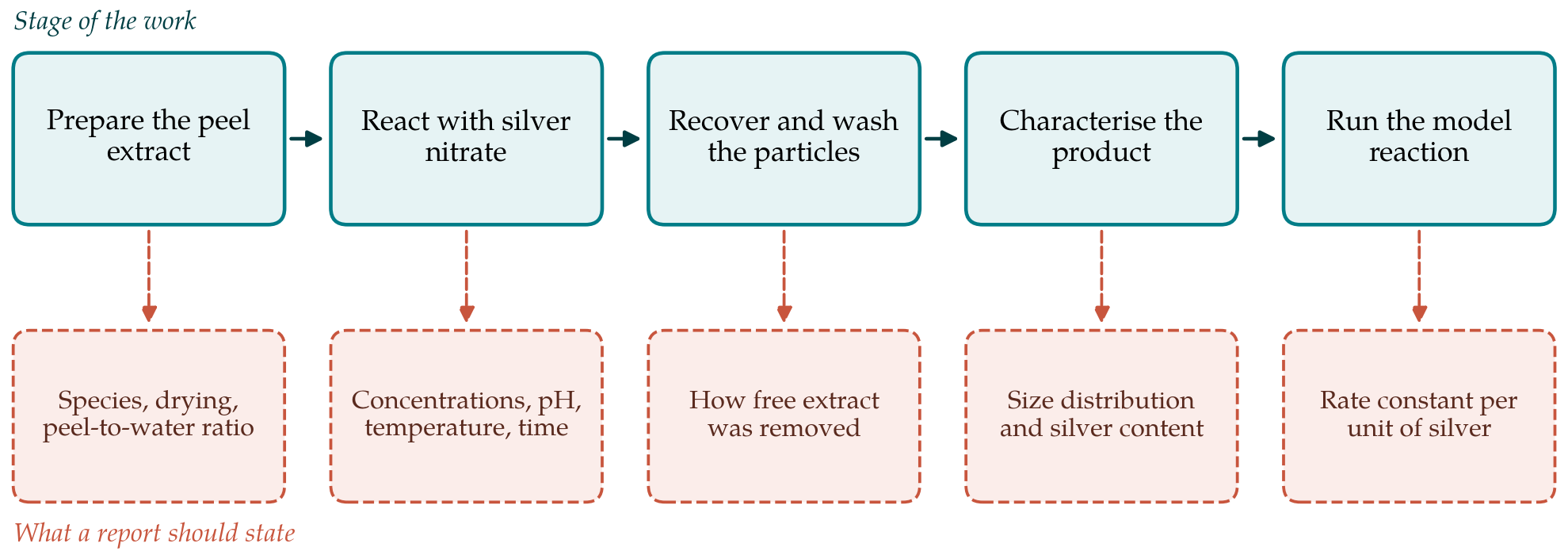
Because the reductant is a mixture of variable composition, the outcome depends on factors that are easy to leave unrecorded: the cultivar and ripeness of the fruit, whether the peel was dried, the temperature and duration of extraction, and the age of the extract. The pH is especially influential, since phenols reduce silver far more readily when deprotonated, and alkaline conditions typically give faster reaction and smaller particles. Formation of the colloid is followed by the growth of the surface plasmon band, which for roughly spherical silver particles in water lies near 400 to 450 nm and broadens or shifts to longer wavelength as particles grow or aggregate (Mulvaney, 1996). The stages of the work and the information each should yield are shown in Figure 1.
3. Assessing Catalytic Behaviour
Catalytic behaviour is almost always assessed through the reduction of 4-nitrophenol to 4-aminophenol by sodium borohydride, a reaction that silver particles were shown to catalyse by Pradhan et al. (2002). Its convenience explains its popularity. In alkaline borohydride the substrate is present as the yellow 4-nitrophenolate ion, absorbing at about 400 nm; the reaction does not proceed at a useful rate without a catalyst; and its progress can be followed in a cuvette. With borohydride in large excess the decay is treated as pseudo-first-order, and an apparent rate constant is read from the slope of the logarithmic plot. Hervés et al. (2012) discuss the reaction as a model and the conditions under which that treatment is justified.
Three matters deserve more care than they commonly receive. The first is spectral overlap. The plasmon band of silver falls in the same region as the nitrophenolate peak, so the absorbance at 400 nm contains a contribution from the catalyst that may itself change if the particles aggregate in the strongly reducing, high ionic strength medium. A blank containing catalyst and borohydride without substrate, and inspection of the full spectrum for clean isosbestic points, guard against mistaking one for the other. The second is the induction period often seen before the absorbance begins to fall. Kinetic analysis on polymer-supported particles related it to processes at the metal surface and showed that the reaction follows a Langmuir-Hinshelwood scheme in which both reactants adsorb (Wunder et al., 2010), and dissolved oxygen is also known to contribute to the delay. The rate constant should be taken only from the region after it.
The third matter is normalisation. An apparent rate constant scales with the amount and surface area of metal in the cuvette, so a bare value says nothing about the quality of the catalyst. Comparison between preparations requires the constant to be divided by the mass of silver present, determined by elemental analysis and not assumed from the silver nitrate taken, or better by the total particle surface area estimated from the measured size distribution. Table 1 lists these and related weaknesses with the corresponding remedy.
| Aspect | Common practice | Consequence | Remedy |
|---|---|---|---|
| Extract | Described only as "peel extract" | Preparation cannot be repeated | State source, drying, ratio, temperature, time and pH |
| Silver content | Assumed equal to silver nitrate added | Unknown catalyst dose | Measure silver in the washed product |
| Particle size | A few selected micrographs | No basis for surface area | Report a size distribution from many particles |
| Kinetic signal | Absorbance at 400 nm alone | Plasmon band confounds the reading | Run catalyst blank; check isosbestic points |
| Rate constant | Apparent value quoted bare | Preparations cannot be compared | Normalise to silver mass or surface area |
| Controls | None with extract alone | Role of residual organics unknown | Test extract and borohydride without silver |
Reuse deserves a word as well. Colloidal particles cannot be recovered from the cuvette without centrifugation and loss, and recycling experiments on unsupported colloids are of doubtful meaning. Where reuse is claimed the particles should be immobilised on a support, and the silver released into solution should be measured.
4. How Green Is the Route?
The description "green" is earned by analysis and not by the presence of a plant. In favour of the route, water is the only solvent, the reductant is renewable and would otherwise be discarded, and no hazardous reagent is added. Against it, the silver salt carries the environmental burden of silver mining and refining whatever the reductant; extraction and reaction are often carried out hot; a large volume of dilute liquid is processed for a small mass of product; and purification by repeated centrifugation consumes energy. Simple mass-based measures such as the E factor (Sheldon, 2017) can be calculated for any preparation and would allow an honest comparison with the citrate or glucose methods. The fate of the particles matters too, since ionic and nanoparticulate silver are toxic to aquatic organisms, and a catalyst intended for water treatment should not leave silver behind in the water.
5. Conclusion
Peel extracts do reduce silver ions to stable colloids, and the particles do catalyse borohydride reductions; neither fact is in doubt. What is lacking is the detail that would let one preparation be repeated or compared with another. Recording how the extract was made, measuring the silver in the product, reporting a size distribution, separating the plasmon signal from the kinetic one, normalising rate constants and quantifying waste would cost little. With those in place, work on this route could begin to answer the questions that matter, namely which peel constituents control particle formation and whether the route offers any advantage over simpler benign reductants.
Conflict of interest
To be declared by the author(s) before publication.
Funding
To be declared by the author(s) before publication.