1. Introduction
Two classical theorems guarantee fixed points under very different hypotheses. The contraction principle of Banach (1922) requires a complete metric space and a map that shrinks all distances by a fixed factor; it gives a unique fixed point and convergence of every orbit. The theorem of Tarski (1955) requires a complete lattice and an order-preserving map; it gives a fixed point with no metric at all. Ran and Reurings (2004) combined the two settings. They showed that on a complete metric space carrying a partial order, a continuous monotone map has a fixed point if it contracts distances between comparable points and some point is comparable with its image. Their motivation was a class of nonlinear matrix equations, where the natural order on Hermitian matrices makes the hypotheses easy to check.
Nieto and Rodríguez-López (2005) removed the continuity assumption in favour of a condition on the space, weakened the requirement for uniqueness, and applied the result to periodic boundary value problems for ordinary differential equations with a lower solution. Their version is the one most often quoted, and it is the subject of this note. Earlier results of a related kind, set in ordered metrizable uniform spaces, are due to Turinici (1986).
The proofs in the original papers are not long, but they treat the cases separately and repeat estimates. This communication arranges the argument around a single lemma so that each hypothesis is seen to do one job. Nothing new is proved. The intention is to give a version suitable for teaching and for citation in work that uses the theorem as a tool.
2. Statement of the Result
Let (X, ≤) be a partially ordered set and let d be a metric on X for which (X, d) is complete. Two points are called comparable if one of them is below the other. Let f map X into itself. Four hypotheses are used. (H1) The map is nondecreasing: x ≤ y implies f(x) ≤ f(y). (H2) There is a constant k with 0 ≤ k < 1 such that d(f(x), f(y)) ≤ k d(x, y) whenever x and y are comparable. (H3) There is a point x0 with x0 ≤ f(x0). (H4) Either f is continuous, or X is regular in the following sense: whenever a nondecreasing sequence converges to a point x, every term of the sequence is below x.
The theorem states that under (H1) to (H4) the map f has a fixed point, obtained as the limit of the iterates of x0. If in addition (H5) every two points of X have a common upper bound or a common lower bound, then the fixed point is unique and the iterates of every point of X converge to it (Ran and Reurings, 2004; Nieto and Rodríguez-López, 2005). Table 1 records the role of each hypothesis in the proof that follows, and Figure 1 shows the order of the steps.
| Hypothesis | Where it enters | What can fail without it |
|---|---|---|
| H1: monotone map | Lemma: comparable pairs are mapped to comparable pairs | The contraction estimate cannot be iterated |
| H2: contraction on comparable pairs | Lemma: distances between iterates decay geometrically | Orbits need not be Cauchy |
| H3: a point below its image | Existence: starts a monotone orbit | A fixed point may not exist |
| H4: continuity or regularity | Existence: identifies the limit as a fixed point | The limit of the orbit need not be fixed |
| H5: common bounds for pairs | Uniqueness and convergence of all orbits | Several fixed points may coexist |
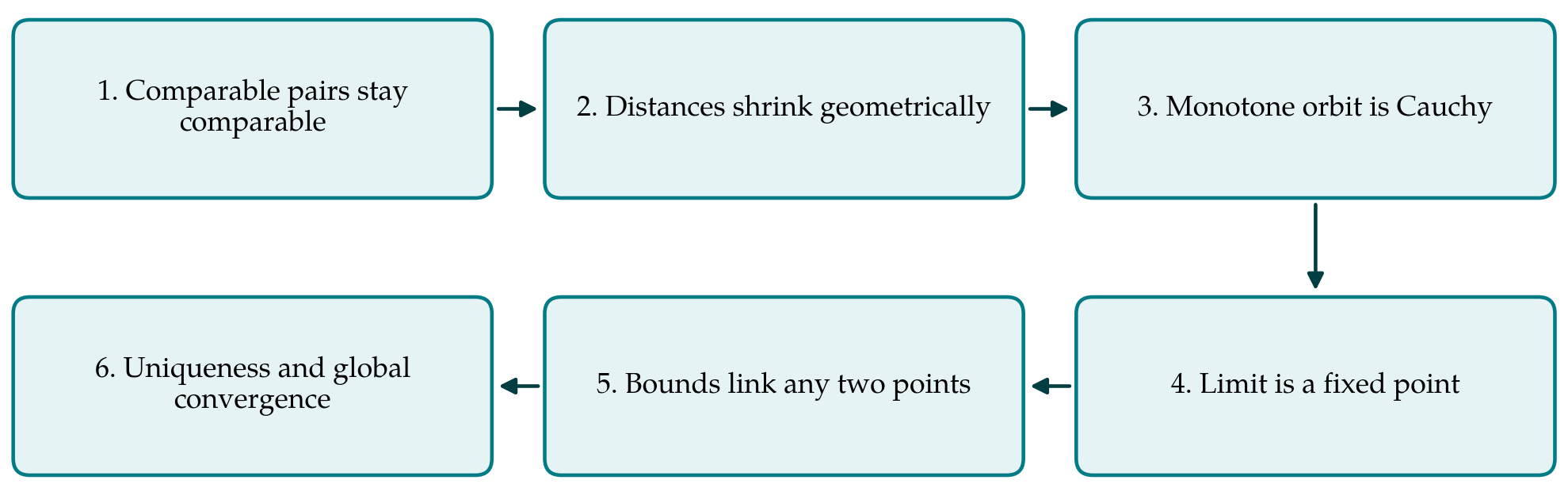
3. The Proof
Lemma. Assume (H1) and (H2). If x and y are comparable, then for every positive integer m the iterates fm(x) and fm(y) are comparable and their distance is at most km d(x, y). The proof is an induction. A nondecreasing map sends a pair with x ≤ y to a pair with f(x) ≤ f(y), so comparability is preserved at each step, and since the metric is symmetric (H2) applies to the pair in either order. Applying (H2) once more to the comparable pair of m-th iterates multiplies the bound by k.
Existence. Write xm for the m-th iterate of x0. By (H3) the points x0 and x1 are comparable, with x0 ≤ x1, and (H1) applied repeatedly shows that the sequence is nondecreasing. The lemma, applied to the pair x0, x1, gives d(xm, xm+1) ≤ km d(x0, x1). Summing the geometric series and using the triangle inequality, the distance between any two terms with indices at least m is at most km d(x0, x1)/(1 − k). The sequence is therefore Cauchy and, by completeness, converges to some point x*.
It remains to see that x* is fixed, and here (H4) is used. If f is continuous, then f(x*) is the limit of f(xm) = xm+1, which is x*. If instead X is regular, then xm ≤ x* for every m, so (H2) applies to this pair and gives d(xm+1, f(x*)) ≤ k d(xm, x*). The right-hand side tends to zero, so the sequence converges to f(x*) as well as to x*, and limits in a metric space are unique. In both cases f(x*) = x*. The estimate above also yields the usual error bound: the distance from xm to x* is at most km d(x0, x1)/(1 − k).
Uniqueness and global convergence. Assume (H5) and let y be any point of X. If y is comparable with x*, the lemma gives d(fm(y), x*) ≤ km d(y, x*), because x* is its own iterate. If not, choose by (H5) a point z that is a common upper bound or a common lower bound of y and x*. Then z is comparable with both, and two applications of the lemma with the triangle inequality give d(fm(y), x*) ≤ km (d(y, z) + d(z, x*)). Either way the iterates of y converge to x*. In particular, if y is itself a fixed point, its iterates are constant and equal to y, so y = x*. This completes the proof.
4. Remarks
Two-point examples show that the hypotheses are not decorative. Let X consist of two points that are not comparable, at distance one. Every self-map of X satisfies (H1) and (H2) vacuously, since the only comparable pairs are pairs of equal points, and is continuous. The map that exchanges the two points has no fixed point; of the hypotheses needed for existence it violates (H3) alone. The identity map satisfies (H1) to (H4) and has two fixed points; it violates only (H5). The contrast with the contraction principle is that (H2) says nothing about pairs that the order does not relate, and (H3) and (H5) are what tie such pairs back into the argument.
The lemma uses monotonicity only to preserve comparability, and a nonincreasing map preserves comparability equally well. The same proof therefore covers order-reversing maps once (H3) is replaced by comparability of x0 with its image and regularity is restated for sequences whose consecutive terms are comparable, as in Nieto and Rodríguez-López (2007). Dually, a point above its image and nonincreasing sequences may be used throughout. The linear factor k can be replaced by a comparison function, which leads to the generalised contractions of Agarwal et al. (2008), and a closely related argument on a product space with a mixed order gives the coupled fixed points of Gnana Bhaskar and Lakshmikantham (2006).
The proof also makes plain that the order matters only through the relation of comparability. Jachymski (2008) took this observation to its conclusion by replacing the order with a directed graph on X and asking that the map preserve edges and contract distances along them. Hypothesis (H5) says that any two points are joined by a path of at most two comparable steps; in the graph setting it becomes a connectivity condition, and chains of any finite length serve as well as chains of length two. For background on the metric theory the reader may consult Kirk and Sims (2001).
5. Conclusion
The fixed point theorem for monotone contractions on ordered metric spaces can be proved in a few lines once it is noted that a monotone map carries comparable pairs to comparable pairs. That remark separates the roles of the hypotheses cleanly: monotonicity and the restricted contraction condition give geometric decay along comparable pairs, the starting point supplies one such pair, continuity or regularity identifies the limit, and common bounds connect the remaining points. Presented in this way the theorem is an immediate relative of the contraction principle, and the generalisations that followed it appear as natural variations on a single short argument.
Conflict of interest
To be declared by the author(s) before publication.
Funding
To be declared by the author(s) before publication.