1. Introduction
Allergic contact dermatitis is among the commonest occupational skin diseases, and the hazard that produces it, the capacity of a chemical to induce skin sensitisation, has been a mandatory endpoint in chemical regulation for decades. For most of that period it was assessed in animals. The guinea pig maximisation test described by Magnusson and Kligman (1969) and the occluded patch test of Buehler were codified in OECD Test No. 406 (OECD, 1992), and the murine local lymph node assay, which measures lymphocyte proliferation in the draining node rather than an elicited skin reaction, followed as Test No. 429 (OECD, 2010).
Two pressures then changed the picture. One was legal. The European cosmetics regulation banned animal testing for cosmetic ingredients and the marketing of products tested on animals (European Parliament and Council, 2009), while the registration regime for industrial chemicals obliged companies to generate sensitisation data for large numbers of substances (European Parliament and Council, 2006). The other was scientific. The adverse outcome pathway framework set out by Ankley et al. (2010) offered a way of organising mechanistic knowledge so that measurements at early steps could support conclusions about an apical effect, and skin sensitisation turned out to be the endpoint where the biology was understood well enough for this to work.
This article reviews how that combination produced a working non-animal system, what the system can and cannot do, and where the outstanding problems lie. It is a narrative review of the published literature, the OECD test guidelines and the guidance issued by regulatory agencies, and it does not report any new testing. The emphasis throughout is on what a regulator can currently conclude without an animal test, which is a narrower question than what the science can explain.
2. The Adverse Outcome Pathway and Why It Mattered
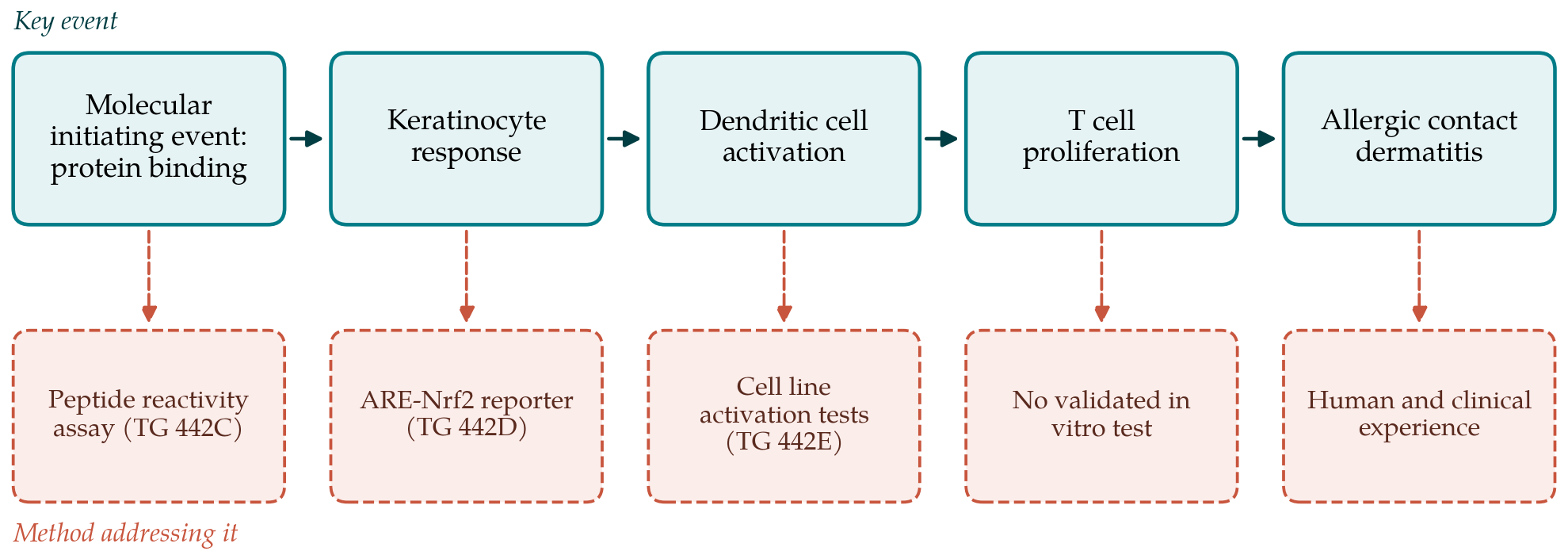
The pathway for skin sensitisation initiated by covalent binding to proteins was published by the OECD in 2012 and is the reference description of the biology (OECD, 2012). It begins with the molecular initiating event, the formation of a covalent adduct between an electrophilic chemical and nucleophilic amino acid side chains, chiefly the cysteine thiol and the lysine amine, in skin proteins. The second key event is the response of keratinocytes, including induction of genes under the control of the antioxidant response element through the Keap1-Nrf2 system. The third is activation and maturation of dendritic cells, with upregulation of surface markers such as CD86 and CD54. The fourth is antigen presentation to naive T cells in the draining lymph node and their proliferation. The adverse outcome is allergic contact dermatitis on subsequent exposure.
What made the pathway useful was not that it was new biology but that it was agreed. Once the key events were defined and accepted, a test could be judged by whether it measured a key event reliably rather than by whether it predicted an animal result, and several tests addressing different events could be combined in a defensible way. Figure 1 shows the correspondence between the key events and the methods now available.
3. The Animal Tests That Are Being Replaced
The guinea pig tests detect sensitisation by inducing it and then eliciting a visible dermal reaction, which is scored by eye. They are long, use many animals and give a result that is categorical rather than graded. The local lymph node assay, developed in the late 1980s and defended at length by Kimber and Basketter (1992), measures proliferation in the draining auricular lymph node after topical application and gives a dose-response from which a potency estimate can be derived. It uses fewer animals, avoids the elicitation phase and became the preferred animal method.
Both tests have limits that are relevant to their replacement. False positives occur with irritants and with some surfactants, concordance with human experience is good but not complete, and the potency categories derived from the local lymph node assay rest on a comparison with human data that is itself imperfect (Basketter et al., 2014). The non-animal methods are therefore not being compared with a gold standard. They are being compared with a reference method of known and finite accuracy, a point that the validation literature has had to confront directly (Hoffmann et al., 2018).
4. The Three Guideline Methods
Three OECD test guidelines now cover the first three key events, and each descends from a method published in the research literature. Table 1 sets them out with what each measures and its principal limitation.
| Guideline | Key event | What is measured | Principal limitation |
|---|---|---|---|
| TG 442C (DPRA) | Protein binding | Depletion of cysteine and lysine peptides | Misses pro- and pre-haptens (Gerberick et al., 2004) |
| TG 442D (KeratinoSens) | Keratinocyte response | Luciferase under an ARE promoter | Cytotoxicity confounds the signal (Emter et al., 2010) |
| TG 442E (h-CLAT) | Dendritic cell activation | CD86 and CD54 on THP-1 cells | Poorly soluble substances are hard to test (Ashikaga et al., 2006) |
| TG 442E (U-SENS, IL-8 Luc) | Dendritic cell activation | CD86 expression or IL-8 reporter output | Variable performance across chemical classes |
| TG 497 | Several, combined | A fixed rule applied to two or three method outputs | Applicability domain is defined by the training set |
| TG 429 (LLNA) | T cell proliferation | Lymphocyte proliferation in the draining node | Uses animals; retained for potency and for difficult substances |
The direct peptide reactivity assay is purely chemical. Synthetic peptides containing cysteine or lysine are incubated with the test substance and the remaining peptide is measured by liquid chromatography (Gerberick et al., 2004). Because no cells are involved, substances that become electrophilic only after metabolism or air oxidation are missed, and this is the clearest known gap in the method.
The ARE-Nrf2 luciferase test method uses an immortalised keratinocyte line carrying a luciferase gene under the control of an antioxidant response element (Emter et al., 2010). The theoretical basis is strong: electrophiles modify cysteines on Keap1, Nrf2 escapes degradation and the target genes are induced, which is the same sensing chemistry as the molecular initiating event (Natsch, 2010). Interpretation requires care because cytotoxic concentrations also raise the signal, and the guideline imposes a viability criterion for that reason.
The human cell line activation test uses the monocytic THP-1 line as a surrogate for dendritic cells and measures CD86 and CD54 by flow cytometry (Ashikaga et al., 2006). Two further methods for the same key event, one based on the U937 line and one on an interleukin-8 reporter, sit in the same guideline.
5. Defined Approaches
No single method predicts the apical endpoint well enough to stand alone, and early practice was to combine them in a weight-of-evidence judgement, which is defensible but not reproducible between assessors. A defined approach fixes both the inputs and the rule for combining them, so that the same data always give the same conclusion. The best known are the two-out-of-three approach, which takes the majority verdict of peptide reactivity, keratinocyte and dendritic cell results, and the sequential testing strategies that add an in silico prediction. Kleinstreuer et al. (2018) assessed a range of these against the curated database compiled by Hoffmann et al. (2018) and found several performing at least as well against human data as the local lymph node assay does.
That assessment led to OECD Test No. 497, adopted in 2021, which describes defined approaches that are accepted internationally for hazard identification and, for some, for potency categorisation (OECD, 2021). Its adoption marked the point at which a regulator could accept a non-animal conclusion without case-by-case argument. The guideline is explicit that each approach has an applicability domain determined by the substances used to build and evaluate it, and that results outside that domain need additional reasoning.
Two practical consequences follow. A testing programme now begins with the question of which defined approach a substance is suitable for, rather than with the choice of an animal test, and the in silico component has acquired regulatory weight that structure-activity predictions did not previously carry. Negative results have also become harder to set aside. Where an approach is applicable and all its component methods return a negative call, the absence of an animal study is no longer treated as a data gap, which is the change that matters most to those compiling registration dossiers.
6. What Remains Difficult
Potency is the hardest remaining problem. Classification under the globally harmonised system distinguishes strong from other sensitisers, and quantitative risk assessment for consumer products needs more than that: an estimate of the dose per unit area below which induction is unlikely. The animal methods supply a dose-response from an intact immune system; the in vitro methods supply concentrations in culture medium that must be related to what reaches viable epidermis. Approaches that combine kinetic modelling of skin penetration with in vitro potency measures are being developed and are not yet settled practice.
Pre- and pro-haptens remain a gap. Substances such as some fragrance terpenes become sensitising after autoxidation, and others after enzymatic conversion in skin. Peptide reactivity assays miss both classes by design, and the cellular assays capture them only partly because the lines used have limited metabolic competence. Reconstructed human epidermis models offer a route forward, since they retain more of the barrier and some metabolic activity.
Three further categories sit awkwardly. Poorly soluble substances and inorganic materials, including metal salts and nanomaterials, challenge assays designed for soluble organic electrophiles. Mixtures, which is what most products are, raise the question of whether the components can be tested separately and the results combined. And the fourth key event has no validated in vitro counterpart, so the system as a whole rests on the assumption that a substance triggering the first three events in vitro will trigger T cell proliferation in vivo. That assumption is well supported but it is an assumption.
7. Implications for Practice and for the Three Rs
The practical position is that hazard identification for skin sensitisation can now be done without animals for a wide range of substances, and that this is accepted by regulators in several jurisdictions. Potency assessment is partly there. Difficult substances still generate requests for animal data, and the local lymph node assay has not disappeared from the guidelines.
Seen against the framework proposed by Russell and Burch (1959), the achievement is a replacement rather than a refinement, and it was reached by understanding the mechanism rather than by finding a better animal surrogate. That is the general lesson other endpoints are trying to draw from this one. Whether it transfers is uncertain: skin sensitisation has an unusually well-defined molecular initiating event and a short pathway, and endpoints such as repeated-dose systemic toxicity have neither.
There is also an institutional lesson. The methods described here did not reach the guidelines because any one laboratory promoted them, but because industry consortia, agencies and validation bodies assembled shared reference databases and agreed in advance what adequate performance would look like. The curated set described by Hoffmann et al. (2018) was as necessary to the outcome as any individual assay, and endpoints without such a resource have progressed more slowly.
8. Conclusion
Skin sensitisation assessment has moved from whole-animal testing to a mechanistically grounded set of chemical and cellular methods combined under fixed rules, and the move was made possible by an agreed adverse outcome pathway rather than by any single assay. The system identifies hazard well, handles potency partly and has known gaps for pro-haptens, insoluble substances and mixtures. The honest summary is that animal use for this endpoint has been largely but not wholly replaced, and that closing the remaining gaps calls for better models of skin metabolism and better ways of relating in vitro concentrations to exposure of the living epidermis.
Conflict of interest
To be declared by the author(s) before publication.
Funding
To be declared by the author(s) before publication.