1. Introduction
Continuous positive airway pressure was introduced for the respiratory distress syndrome of the newborn by Gregory et al. (1971), and the nasal prong system described by Wung et al. (1975) made it a bedside treatment. In the bubble variant the expiratory limb of the circuit ends under water, and the depth of immersion sets the pressure. The apparatus is simple, has no moving parts beyond the gas source, and gives the nurse a visible sign that pressure is being delivered. Systematic reviews of trials in preterm infants show that CPAP reduces respiratory failure and the need for mechanical ventilation when compared with oxygen alone (Ho et al., 2020).
The World Health Organization recommends CPAP for preterm infants with respiratory distress syndrome (WHO, 2015), and its more recent guideline states that a bubble system may be preferred to other pressure sources (WHO, 2022). Inexpensive devices have been developed for hospitals without piped gas (Brown et al., 2013), and an evaluation in a Malawian neonatal ward reported better survival among infants treated with one of them than among those given nasal oxygen (Kawaza et al., 2014). Reviews of experience in low- and middle-income countries are encouraging but note that most reports come from tertiary hospitals (Martin et al., 2014; Thukral et al., 2016).
District newborn units are a different environment, and the written protocol is where the difference first shows. This article proposes a way of adapting a bubble CPAP protocol for such a unit. It describes a procedure and the reasoning behind it. The procedure is proposed and has not been validated here, and no unit's results are reported.
2. Why Protocols Do Not Travel
A CPAP protocol is a set of instructions that rests on unstated assumptions about the place where it will be used. It assumes that air and oxygen can be blended to a chosen concentration, that oxygen saturation is displayed continuously for each infant, that a chest radiograph can be obtained within the hour, that a doctor is on site at night, and that an infant who fails CPAP can be intubated in the next room. Lissauer et al. (2017) cautioned that introducing nasal CPAP where these supports are missing can do harm, and that staffing and monitoring matter as much as the device. Duke (2014) made a similar point for clinicians working with improvised circuits. A systematic review of implementation in sub-Saharan Africa found that shortages of trained nurses, consumables and reliable oxygen and power, and uncertainty about which infants to treat, were recurrent barriers (Kinshella et al., 2020).
Adaptation is therefore more than simplification. Removing steps that a unit cannot perform leaves gaps in safety. The task is to identify what each instruction is for and to find another way of achieving that purpose with the means available, or to decide that the purpose cannot be met and narrow the group of infants treated. Models of knowledge translation describe this as adapting knowledge to the local context before it is put to use (Graham et al., 2006).
3. The Adaptation Procedure
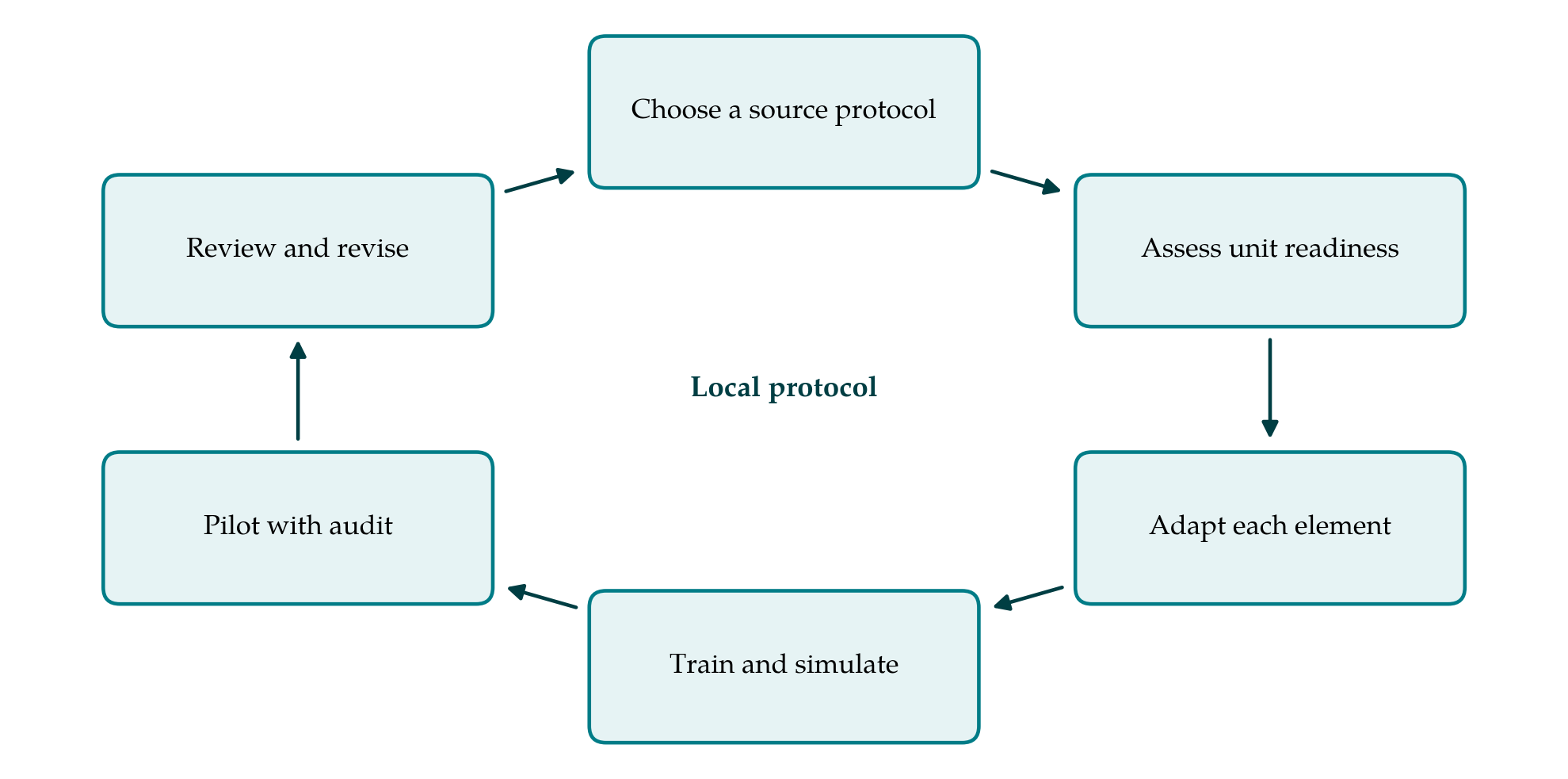
The procedure has six stages, shown in Figure 1 as a cycle because the protocol is expected to be revised after use. It is carried out by a small working group that should include the nurse in charge of the newborn unit, a clinician responsible for newborn care, the person who maintains equipment and, where possible, a representative of the referral hospital that receives transfers.
3.1. Stage 1: Choose a source protocol
The group starts from an existing document and not from a blank page. The most suitable source is the national newborn guideline or the protocol of the referral hospital to which the unit sends infants, since shared definitions make transfer and feedback easier. WHO guidance on oxygen therapy and on care of the preterm infant supplies the clinical principles against which the source is checked (WHO, 2016; WHO, 2022). The group lists every instruction in the source protocol as a separate line so that each can be examined.
3.2. Stage 2: Assess the readiness of the unit
Readiness is assessed by walking through the unit at different times of day with the list in hand. The questions are concrete. How many hours of electricity are lost in an ordinary week, and is there a backup? Is oxygen supplied by concentrator, cylinder or pipeline, and can its concentration be reduced? How many pulse oximeters with neonatal probes work today? How many nurses are on duty at night, and for how many infants? Which sizes of nasal prongs are in stock, and who orders them? How long does a transfer to the referral hospital take, and what support can be given on the way? The answers define the limits within which the protocol must operate.
3.3. Stage 3: Adapt each element
Each line of the source protocol is then placed in one of three groups: kept as written, rewritten to achieve the same purpose by other means, or removed with a matching restriction on eligibility. Table 1 sets out the elements that most often fall into the second group. The principle throughout is that the adapted instruction must be something a nurse working alone at night can carry out.
| Element | Assumption in the source protocol | Adaptation to consider |
|---|---|---|
| Eligibility | Gestation and radiograph define the diagnosis | Weight band plus a bedside respiratory severity score |
| Gas source | Blended air and oxygen at any concentration | Document what the device delivers; titrate to oximetry |
| Monitoring | Continuous oximetry for every infant | Scheduled observations with shared oximeter; fixed observation chart |
| Nasal interface | Full range of prong sizes always available | Stock list with reorder level; nasal inspection at every observation |
| Failure | Blood gas criteria; ventilation on site | Clinical criteria; early call to referral hospital |
| Weaning | Stepwise reduction guided by blood gases | Clinical stability over a set period, then trial off |
| Family | Parents visit at fixed hours | Mother present; feeding and skin-to-skin contact planned |
Eligibility is the element with the greatest consequences. Referral-centre protocols define candidates by gestational age and radiographic findings. A district unit often knows neither with confidence. A weight band and a bedside score are workable substitutes: the retraction score of Silverman and Andersen (1956) and the clinical score of Downes et al. (1970) were both designed to grade neonatal respiratory distress by observation. The group must also state who is not treated in the unit. Infants who are apnoeic or gasping, those with major congenital anomalies of the airway or gut, and those below a weight at which the unit has no realistic prospect of success are examples for discussion, and the lower limit should be agreed with the referral hospital.
The oxygen source needs explicit attention. Preterm infants are vulnerable to oxygen toxicity, and retinopathy of prematurity is a recognised consequence of unrestricted oxygen. Some low-cost and improvised systems deliver whatever concentration the concentrator or cylinder supplies, while others entrain room air. The protocol should record what the unit's device does, require pulse oximetry whenever supplemental oxygen is given, and state the saturation range to be maintained according to national guidance (WHO, 2016). If oxygen concentration cannot be reduced and oximetry is not available, that is a reason to limit eligibility and not a detail to be passed over.
Starting pressure and its upper limit are normally kept as in the source protocol, which will usually begin at about 5 cm H2O and allow modest increases. What changes is the instruction for checking that the pressure is delivered: continuous bubbling, a water level topped up to the mark, prongs that fit the nostrils without blanching the skin, and a closed mouth or chin support. Nursing care is written as a short bundle performed at each observation. It includes inspection of the nasal septum, because pressure injury from prongs is common and largely preventable (Fischer et al., 2010), an open orogastric tube to vent the stomach, attention to humidification, and positioning.
Failure and referral complete the adapted protocol. Without blood gases, failure has to be defined clinically: rising respiratory score, saturation that cannot be held in range, recurrent apnoea, or exhaustion. The protocol should name the point at which the referral hospital is telephoned, and that point should come before the infant is in extremis, because transfer takes time and an infant on CPAP is difficult to move. Pneumothorax is a known complication of CPAP (Ho et al., 2020) and the protocol should say what the unit will do if sudden deterioration suggests it.
3.4. Stage 4: Train and simulate
The draft is tested first on a manikin. Each nurse and clinician assembles the circuit, selects and fixes prongs, starts treatment, completes the observation chart and responds to scripted problems: the bubbling stops, the saturation falls, the power fails. Simulation exposes instructions that are ambiguous or cannot be followed with the equipment as stored, and the draft is corrected. Implementation reports describe turnover and rotation of trained staff as a persistent threat to competence (Kinshella et al., 2020), so the plan should include new staff and periodic refreshers.
3.5. Stage 5: Pilot with a simple audit
The protocol is introduced for a defined period with a register that records, for every infant started on CPAP, the weight, the respiratory score at the start, whether oximetry was used, the duration of treatment, nasal injury, suspected pneumothorax, the outcome and whether the protocol was followed at each decision point. The register serves safety and learning. It is not a research dataset, and it should be short enough to be completed.
3.6. Stage 6: Review and revise
At the end of the pilot the group reviews the register and the experience of staff and mothers. Departures from the protocol are treated as information about the protocol before they are treated as failings of individuals. Small changes are made and tested in turn, in the manner of the plan-do-study-act cycle used in quality improvement (Langley et al., 2009). The revised document is dated, shared with the referral hospital and scheduled for review.
4. Fitting the Procedure to Practice
A district unit has little spare time, and the procedure is designed to be completed in a few meetings and one or two training sessions. Three points help it to succeed. The adapted protocol should fit on a single wall chart with the observation chart beside it. One person, normally the nurse in charge, should be named as its owner. And the referral hospital should be involved from the first stage, because its staff will receive the infants who fail and are well placed to give feedback on the condition in which they arrive.
The presence of the mother deserves a place in the protocol. Infants on CPAP can be fed expressed breast milk by tube and, when stable, can be held in skin-to-skin contact with the circuit secured. A mother at the cot side is also likely to notice when bubbling stops or prongs slip. WHO guidance on the care of preterm infants treats CPAP and kangaroo mother care as complementary (WHO, 2022).
5. Limitations and What Remains to Be Shown
This article sets out a procedure and offers no evidence that following it improves care. A protocol produced in this way could be compared with an unadapted one on measures of adherence, on the frequency of nasal injury and of treatment without oximetry, and on the timing of referral. Such comparisons would be feasible within a network of district hospitals. Effects on mortality would need far larger numbers and a controlled design, and the evidence for benefit from bubble CPAP at district level is itself still limited (Thukral et al., 2016).
The procedure also has structural limits. No protocol can compensate for an absent oxygen supply or a night shift of one nurse for thirty infants, and the honest result of the readiness assessment may be that CPAP should not yet be offered. Bedside respiratory scores were devised in settings unlike those considered here, and their performance as selection tools for district-level CPAP has not been established. The substitutes proposed in Table 1 are starting points for local discussion and are not recommendations for treatment.
6. Conclusion
Bubble CPAP is simple apparatus applied to fragile patients, and the protocol that governs it has to fit the unit in which it is used. The cycle proposed here asks a district team to take a trusted source protocol, test each instruction against what the unit can reliably do, rewrite or restrict where it cannot, rehearse the result, and audit a pilot. Its value has yet to be demonstrated. It is offered as a structured way of doing openly what many units already do informally, and of making the compromises visible to those who must work within them.
Conflict of interest
To be declared by the author(s) before publication.
Funding
To be declared by the author(s) before publication.