1. Introduction
On a weekday afternoon in many Irish parishes a group of people in their sixties, seventies and eighties meets in a hall or a church to sing. Some sang in the church choir for decades; some have never sung in company before. There is a conductor, sometimes paid and often not, a box of folders, a kettle. Groups of this kind have multiplied with the support of local arts offices, Active Retirement associations and health promotion schemes, and they are regularly cited as an answer to loneliness in the countryside.
The research that underwrites that claim is mostly about outcomes. It asks whether people who sing together report better health or mood than people who do not, and it has produced encouraging if uneven answers. What it seldom describes is the choir itself as a setting: the friendships and frictions, the unspoken rules about who sits where, the work of the few who keep it going. Small's term musicking is a reminder that a rehearsal consists of relationships as well as sounds (Small, 1998). Those relationships are what this design sets out to study.
The article proposes a single-case study of a community choir for older adults in rural Ireland, with its social life as the object. A case study proper needs a real choir and fieldwork with its members; what is offered here is the design for one. The procedure below has not been carried out. It is intended for a researcher, a postgraduate student or a community music practitioner planning such a study.
2. Background
Three bodies of work inform the design: evidence on group singing in later life, writing on rural ageing in Ireland, and theory about participation in music.
2.1. Group singing in later life
Cohen and colleagues followed older adults in a professionally led chorale and a comparison group in the United States and reported better self-rated health and morale among the singers (Cohen et al., 2006). A randomised trial in England found that community singing groups improved mental health-related quality of life in older people (Coulton et al., 2015). The scoping review prepared for the World Health Organization places these studies within a wider body of evidence on the arts and health and notes the variable quality of that evidence (Fancourt and Finn, 2019).
Studies closer to the present question look at the social mechanism. Pearce and colleagues compared adult education classes in singing with classes in other subjects and found that singers felt close to their group sooner, which the authors called an ice-breaker effect (Pearce et al., 2015). Creech and colleagues, studying active music-making among older people in England, linked it to a sense of purpose, control and social affirmation (Creech et al., 2013). Qualitative work with a choir for adults living with disadvantage showed how membership can supply a valued identity (Dingle et al., 2013). None of these studies was set in the Irish countryside.
2.2. Rural ageing and participation in music
Rural Ireland has an older age profile than its cities, a scattered pattern of housing, and heavy dependence on the car. Post offices, creameries, shops and public houses that once served as meeting places have closed in many districts, while the parish, the Gaelic Athletic Association club and voluntary associations remain strong. The framework of old-age exclusion developed by Walsh and colleagues identifies social relations, services and mobility, and neighbourhood and community among its domains (Walsh et al., 2017). A choir touches each of them, and a study of its social life has to look outward to transport and venue as well as inward to the rehearsal.
Two ideas help to frame what to look for. Turino distinguishes participatory performance, where the aim is to involve everyone present, from presentational performance, prepared by one group for another (Turino, 2008). A choir of older adults usually does both, and the balance between them shapes who feels welcome. Putnam's distinction between bonding ties among people who are alike and bridging ties across social divisions (Putnam, 2000) raises a second question: whether the choir deepens existing parish networks or brings in people who stood outside them, such as recent arrivals, returned emigrants and the recently bereaved.
3. The Proposed Design
The design is a qualitative single-case study in the sense set out by Yin, suited to "how" and "why" questions about a present-day phenomenon that cannot be separated from its setting (Yin, 2018). It is also what Stake calls an intrinsic case study: the choir is studied for its own sake and for the detail it can offer, not as a sample from which to generalise (Stake, 1995). The guiding question is how the choir is organised as a social world and what part it plays in the lives of its members and in its locality.
3.1. Bounding the case and gaining access
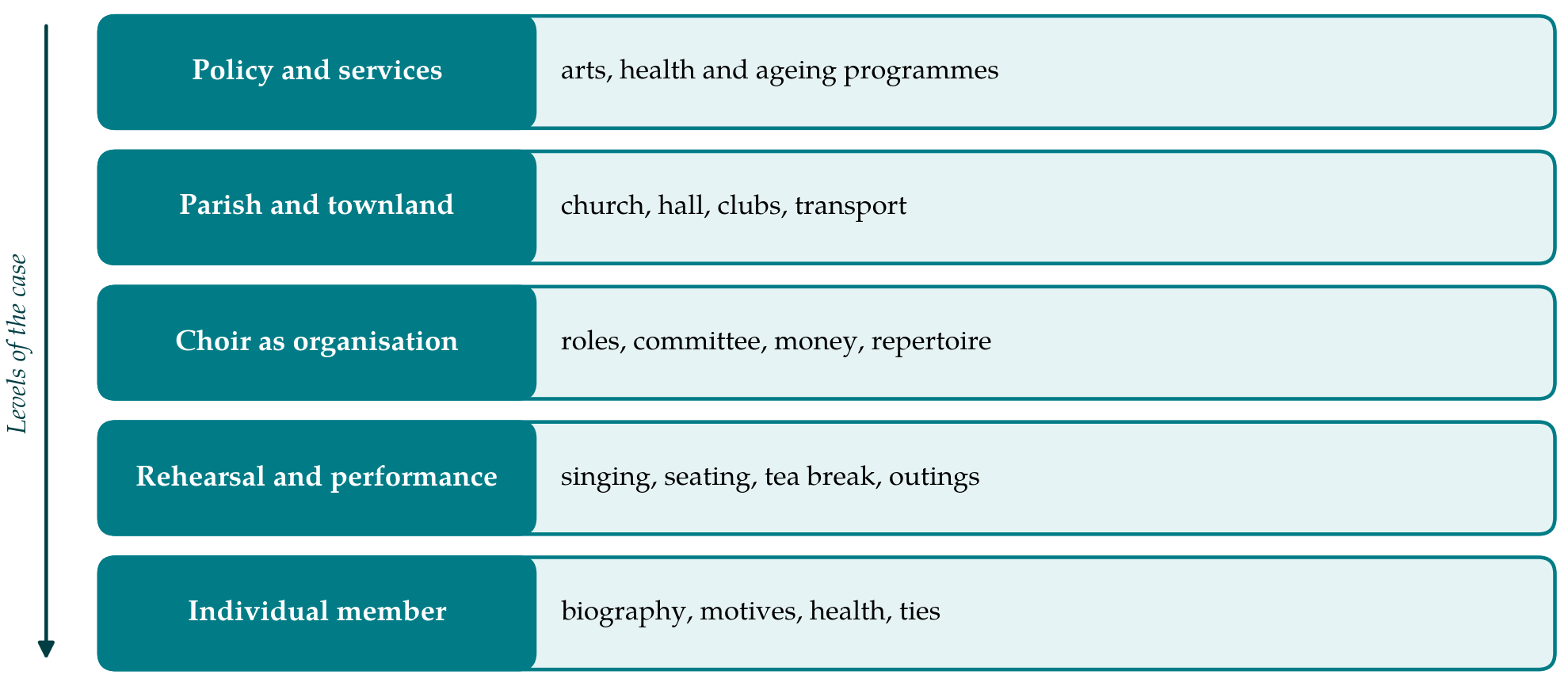
The case is one choir, followed for one full choir year from the autumn return to the summer break, so that the Christmas season, any festival or competition, funerals and the annual meeting all fall within the fieldwork. Figure 1 shows the case as a set of nested levels, from the individual member out to the policies and services that fund or house the group. The unit of analysis is the choir; members, rehearsals and the surrounding parish are embedded units within it.
A suitable choir is one that describes itself as open to older adults without audition, meets regularly, and is based in a village or open countryside and not in a commuter town. Access should be negotiated in stages: first with the conductor and committee, then with the whole membership at a rehearsal, with time allowed for the group to discuss the request in the researcher's absence. The researcher should expect to be asked to sing, and should decide beforehand how to record the effects of doing so.
3.2. Sources of evidence
Case study method depends on several sources that can be checked against one another. Table 1 lists the six proposed here. Participant observation of rehearsals, tea breaks, performances and outings is the core, written up the same day as fieldnotes that separate description from interpretation (Emerson et al., 2011). Attention goes to arrivals and departures, seating, who helps whom with music or mobility, how mistakes and absences are treated, how the conductor addresses the group, and what is talked about when the singing stops.
| Source | What is collected | What it contributes |
|---|---|---|
| Participant observation | Fieldnotes on rehearsals, breaks, concerts and outings across the year | Routines, roles and interaction as they happen |
| Member interviews | Semi-structured conversations with members of varied age, sex and length of membership | Motives, meanings and personal histories of singing |
| Leader and committee interviews | Conductor, accompanist, officers and venue holder | How the choir is run, funded and kept going |
| Former and non-members | A small number who left or chose not to join | Barriers, exclusions and the limits of welcome |
| Documents | Programmes, minutes, attendance books, notices, grant forms | Organisational history and public face |
| Brief descriptive measures | Three-item loneliness scale; six-item social network scale | Description of the membership, not outcome testing |
Semi-structured interviews follow once the researcher is known to the group. Members are chosen for variety in age, sex, length of membership, distance travelled and living situation, and the conductor, accompanist and committee officers are interviewed about the running of the choir. The design also includes a few people who have left or who decided against joining, since a study that speaks only to current members will overstate how open the group is. Documents such as concert programmes, minutes and attendance books give a history against which memories can be set.
Two short instruments are suggested for describing the membership: the three-item loneliness scale developed for large surveys (Hughes et al., 2004) and the six-item version of the Lubben Social Network Scale (Lubben et al., 2006). They are offered to members once, on a voluntary basis, and are used only to characterise the group alongside age and household details. With one choir and no comparison group they cannot show that singing changed anything, and the design does not ask them to.
3.3. Analysis and trustworthiness
Fieldnotes, transcripts and documents are analysed together using thematic analysis as described by Braun and Clarke: familiarisation, coding, the search for themes, review, definition and writing (Braun and Clarke, 2006). Coding begins inductively and is then set against the ideas introduced earlier, participatory and presentational performance and bonding and bridging ties, to see where they fit the material and where they fail. Analysis runs alongside fieldwork so that early readings can be tested in later observation and interviews.
Credibility rests on the measures set out by Lincoln and Guba: prolonged engagement, triangulation across sources, deliberate search for cases that contradict the emerging account, an audit trail of analytic decisions, and checking of interpretations with participants (Lincoln and Guba, 1985). A reflexive journal records the researcher's position, which will differ sharply for a local and an outsider, a singer and a non-singer. Reporting should follow the consolidated criteria for qualitative research so that readers can judge how the study was done (Tong et al., 2007).
4. Ethics in a Small Community
The study requires approval from a research ethics committee before any contact with members, and the handling of recordings and personal data must comply with the General Data Protection Regulation. Consent is sought from each person individually and is treated as continuing: it is revisited at intervals, and anyone may ask that a remark or an episode be left out of the notes. Members who do not wish to take part are simply not written about, which is practicable in observation if agreed with the group at the outset.
Some members may be living with cognitive impairment. Irish law presumes capacity, and the Assisted Decision-Making (Capacity) Act 2015 requires that people be supported to make their own decisions. The researcher should therefore plan for simple written and spoken explanations, unhurried conversations, and the involvement of a trusted person where the member wishes it, and should not exclude people on the ground of diagnosis alone.
Anonymity is the hardest promise to keep. In a parish, a choir can be recognised from its repertoire, its conductor's habits or a single remembered concert, and members will recognise one another in any quotation. Pseudonyms and altered details help only so far. The design therefore asks the choir to decide collectively whether it wishes to be named, offers each interviewee the chance to review quotations, and treats material about illness, bereavement and conflicts within the group as reportable only in general terms.
5. Limitations and What Remains to Be Shown
This is a proposed design and has not been applied here. Its practical value depends on matters that only use will reveal: whether a choir will accept a researcher for a year, whether those who left can be found and will talk, and whether older members find the two questionnaires acceptable or intrusive. A pilot period of a few weeks in a different choir would test the observation guide and interview schedule before the main fieldwork.
A single case cannot be generalised in the statistical sense. What it offers is a detailed account from which readers may judge the relevance to settings they know, and concepts that later comparative work can test. The design says nothing about whether singing improves health; that question belongs to trials. It also centres on those who are well enough and mobile enough to attend, so that the people most isolated in a rural district, those without transport or confidence to come through the door, appear only at its edges.
6. Conclusion
A community choir for older adults is a musical ensemble, a voluntary organisation and a weekly social occasion at once, and in rural Ireland it may be one of few such occasions within reach. The design proposed here treats that social life as worth describing in its own right, through a year of observation, interviews with those inside and outside the group, documents and a light descriptive use of two established scales. Carried out with care for consent and anonymity, a study of this kind would add to the trial literature an account of how such a choir is made and kept going by the people who belong to it.
Conflict of interest
To be declared by the author(s) before publication.
Funding
To be declared by the author(s) before publication.