1. Introduction
Raw materials were a staple of strategic thought for most of the twentieth century and then, for a generation, largely dropped out of it. Open commodity markets, falling real prices and the end of the Cold War made stockpiles look like an expensive habit. The subject has returned because the technologies on which governments now stake their climate and industrial plans are intensive in metals. An assessment by the International Energy Agency concluded that a low-carbon energy system requires far more minerals per unit of capacity than the fossil system it replaces (IEA, 2021), and a World Bank study reached a similar conclusion for lithium, graphite and cobalt in particular (Hund et al., 2020).
What turns a question of supply into a question of statecraft is geography. The deposits are where geology put them, and the plants that turn ore into usable material have clustered in few countries, China foremost among them (Gulley et al., 2018). Importing governments have responded with lists of critical minerals, legislation and partnerships; exporting governments have responded with restrictions designed to capture more of the value chain. Each side describes its measures as defensive.
This article reviews the published literature on that interaction. It asks how criticality is understood, where in the supply chain power arises, which policy instruments are in use, and what the evidence says about the leverage that mineral dominance provides. It reports no new data.
2. Scope and Approach
The review is narrative. It draws on peer-reviewed work in resource economics, industrial ecology and international political economy, on books that have shaped the debate, and on primary legal and official sources where an argument turns on what a law or ruling says. Sources were chosen for their standing in these fields and their relevance to the four questions above; no systematic search was run and no claim to completeness is made. The term critical minerals is used as governments use it, to cover metals and industrial minerals alike.
3. What Makes a Mineral Critical
Criticality is a judgement, not a property of an element. The framework that most later work adopts was set out by a committee of the United States National Research Council (2008), which plotted minerals on two axes: the risk of a supply restriction and the impact such a restriction would have. Graedel et al. (2015) extended the approach to the metals and metalloids of the periodic table and added a third dimension for environmental implications. Their analysis drew attention to a feature that matters for policy: many of the metals at issue are recovered as by-products of others, so their supply responds weakly to their own price.
The geological survey literature makes a complementary point. Scarcity in the earth's crust is rarely the constraint; the rare earth elements are not rare in that sense (Schulz et al., 2017). The constraint lies in the small number of deposits that can be worked economically, the long lead times of new mines, and the environmental burden of separation and refining. Lists of critical minerals therefore differ between jurisdictions and change over time, because the industrial structure and the trading relationships of the assessor enter the calculation. Bazilian (2018) argues that energy scholars were slow to see that the transition exchanges dependence on fuels for dependence on materials.
4. Where Concentration Arises
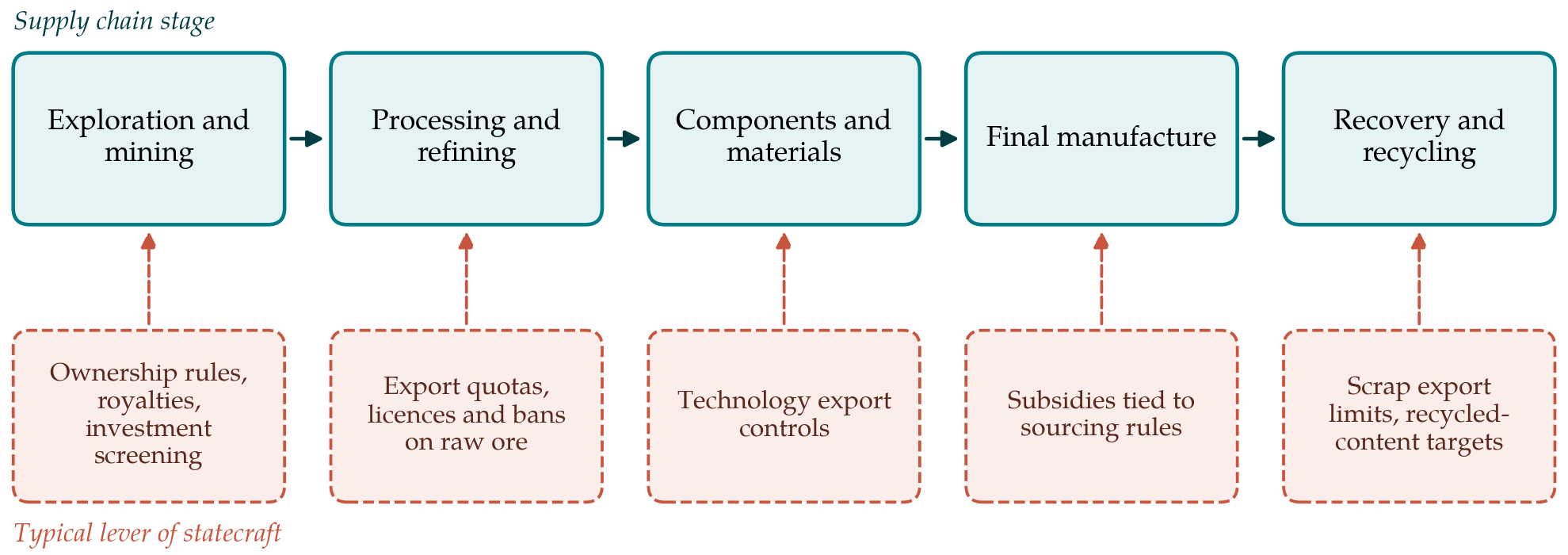
A supply chain for a battery or a permanent magnet passes through several stages, and concentration differs at each. Figure 1 sets out the stages together with the kind of government lever most often associated with each in the literature reviewed below.
4.1. The mine
Mining is concentrated by geology: cobalt in the Democratic Republic of the Congo, nickel in Indonesia, lithium in Australia and the salt flats of South America. The governance literature has long observed that mineral wealth is a mixed blessing for the states that hold it (Ross, 1999), and recent work stresses that the social and environmental costs of the transition fall heavily on mining regions (Sovacool et al., 2020). Klinger (2017) shows for rare earths that the location of production reflects where pollution is tolerated as much as where ore is found.
4.2. The midstream
Processing is concentrated by policy and investment. China's position in rare earth separation was built over decades through state support, lower regulatory costs and consolidation of the industry (Wübbeke, 2013), and a similar pattern holds for the refining of battery materials. Olivetti et al. (2017) examined the lithium-ion battery chain and identified cobalt, with its concentrated mining and refining, as the most exposed link. The midstream is where an importer's alternatives are fewest, since ore from a friendly mine may still have to pass through a rival's refinery.
5. Instruments of Mineral Statecraft
The classical account of how trade becomes influence is that of Hirschman (1945): a state gains power over partners that would find it costly to do without the relationship. Baldwin (1985) catalogued the techniques, positive and negative, by which governments exploit such positions, and Krasner (1978) studied how the United States pursued raw materials investments abroad as a matter of national interest. The contemporary restatement is the theory of weaponized interdependence, in which control of a hub in a network confers the ability to choke off flows (Farrell and Newman, 2019). Table 1 groups the instruments now in use by the type of state that employs them.
| Instrument | Typical user | Stated purpose | Representative source |
|---|---|---|---|
| Export quotas and duties | Dominant processor | Conservation; support for domestic downstream industry | WTO, 2014 |
| Bans on raw ore exports | Resource-rich producer | Force processing to locate at home | Humphreys, 2013 |
| Critical mineral lists and benchmarks | Importing bloc | Set targets for domestic capacity and diversification | European Union, 2024 |
| Stockpiles | Importing state | Buffer against short interruptions | National Research Council, 2008 |
| Due diligence rules | Importing state or bloc | Exclude minerals linked to conflict or abuse | OECD, 2016 |
| Outward investment and offtake deals | Importer or processor | Secure ownership or long-term supply abroad | Krasner, 1978 |
5.1. Producer and processor instruments
Humphreys (2013) described a new mercantilism in metals: export restrictions, state ownership and bilateral resource deals replacing reliance on open markets. China's rare earth export quotas and duties were the leading example. They were challenged by the United States, the European Union and Japan, and the Appellate Body of the World Trade Organization upheld the finding that they could not be justified as conservation measures (WTO, 2014). The quotas were withdrawn, but the episode showed both the reach and the limits of trade law. More recent Chinese measures take the form of export licensing, as with the controls on gallium and germanium announced in 2023, which rest on security grounds and are harder to litigate. Indonesia's ban on the export of unprocessed nickel ore, also contested at the World Trade Organization, pursues a developmental aim: to oblige foreign firms to build smelters and battery plants in the country.
5.2. Importer instruments
Importers have turned to industrial policy. The European Union's Critical Raw Materials Act sets benchmarks for 2030 for the share of annual consumption of strategic raw materials to be met from extraction, processing and recycling within the Union, and for the maximum share to come from any single third country (European Union, 2024). The United States has tied consumer tax credits for electric vehicles to the origin of battery minerals and has joined other consuming countries in a Minerals Security Partnership. Due diligence standards form a further strand. The guidance of the OECD (2016) on minerals from conflict-affected areas has been given legal force in both American and European law for tin, tantalum, tungsten and gold, and the model is being extended to battery materials. These measures are presented as ethical safeguards, though they also shape which suppliers can reach which markets.
6. How Much Leverage Does Dominance Confer
The central dispute in the literature is whether mineral dominance translates into coercive power. The test case is the autumn of 2010, when shipments of rare earths from China to Japan were disrupted during a diplomatic confrontation over a detained fishing captain. Kalantzakos (2018) reads the episode as a demonstration of what control of a critical input can do and as a warning that went partly unheeded. Gholz (2014) draws the opposite lesson. In his account the interruption did little lasting harm, because buyers drew down inventories, manufacturers redesigned products to use less of the affected elements, and new sources outside China came into production once prices rose.
Both readings can be reconciled with the general literature on economic coercion. Drezner (1999) argued that sanctions extract the largest concessions from allies and the smallest from adversaries, who expect future conflict and so refuse to yield. A mineral embargo against a rival should on that logic achieve little politically while teaching the target to diversify. Mancheri et al. (2019) found that Chinese policies themselves altered the resilience of the rare earth supply chain, in part by provoking substitution and new supply elsewhere. Overland (2019) goes further and lists the geopolitics of critical materials among the exaggerated fears about the energy transition, on the ground that minerals, unlike fuels, are not consumed in use and can be recycled.
The sceptical case has limits of its own. Substitution and new mines take years, and the adjustment that followed 2010 was helped by the small size of the rare earth market. A restriction on a material with larger volumes and a longer project pipeline might not be absorbed so easily. Leverage, in short, appears to be strongest in the short run and at the processing stage, and to decay as it is used. That is a narrower claim than either alarm or dismissal, and it is the one the evidence best supports.
7. Gaps and Future Work
Three areas are thinly covered. The first is the agency of producer states. Much of the literature treats mineral-rich countries as terrain on which great powers compete, yet export bans and local processing requirements are strategies in their own right, and their success or failure in moving up the value chain has received less study than the anxieties of importers. The second is the durability of consumer coalitions. Partnerships among importing states assume a shared interest that may not survive competition for the same limited projects. The third is the interaction between security measures and sustainability standards, which can reinforce one another or work at cross purposes when the cleanest supplier is not the most trusted one (Sovacool et al., 2020).
There is also a methodological gap. Criticality assessments are produced by engineers and geologists, analyses of statecraft by political scientists, and the two seldom share measures. A common account of how concentration at a given stage maps onto bargaining power would allow the claims on each side of the leverage debate to be tested with more discipline than has so far been possible.
8. Conclusion
The literature supports a measured view. The minerals of the energy transition are concentrated in ways that create dependence, and governments on every side are acting on that fact with instruments that Hirschman would have recognised. The record of the one clear attempt at mineral coercion suggests that markets and engineers erode such leverage within a few years, while the trade rules that once constrained export restrictions are losing their grip as measures are recast in the language of security. Processing capacity, more than ore in the ground, is where the contest is decided. Research that treats producer states as strategists and that joins technical criticality assessment to political analysis would improve on what is now known.
Conflict of interest
To be declared by the author(s) before publication.
Funding
To be declared by the author(s) before publication.