1. Introduction
Smoke from cooking fires has been recognised as a public health problem for decades. Bruce et al. (2000) set out the evidence that indoor pollution from biomass and coal was associated with acute lower respiratory infection in children and chronic lung disease in adults, and later comparative risk assessments placed household air pollution among the leading environmental causes of death and disability (Smith et al., 2014). The World Health Organization responded with guidelines on household fuel combustion that set emission targets for stoves and advise against the use of unprocessed coal and kerosene in the home (WHO, 2014).
Acting on this knowledge locally requires a way of finding the households at greatest risk. A district that wishes to target clean fuel subsidies, to advise families of children with recurrent pneumonia, or to judge whether a stove programme has changed anything needs information at household level. The information usually available is a single census or survey question on the main fuel used for cooking. This article proposes a tool that collects more than that question while remaining short enough for routine use. It is a methodological proposal and reports no survey results.
2. Background
Three findings from exposure research define the problem the tool is meant to address.
2.1. Fuel type alone is a weak proxy
Exposure depends on what is burned, in what device, where, for how long, with what ventilation and with whom nearby. Ezzati and Kammen (2001) showed in rural Kenya that individual exposure was shaped by time spent close to the fire and by peaks during lighting and stirring, so that members of one household differed widely. A review for the research community concluded that reliance on fuel category had limited the field and that better exposure assessment was its most pressing methodological need (Clark et al., 2013). At the same time, modelling work in India found that a small number of household characteristics, including fuel, kitchen location and ventilation, explained a useful share of the variation in measured kitchen concentrations (Balakrishnan et al., 2013). Questionnaire and observation data are therefore imperfect but informative.
2.2. Households use several stoves and fuels
Families that acquire a cleaner stove rarely abandon the old one. They use each for the tasks it suits, a pattern known as stove stacking (Ruiz-Mercado et al., 2011). The consequence for health is serious, because the relation between fine particle exposure and disease is steep at low concentrations and flattens at high ones, so that modest continued use of a traditional fire can cancel much of the benefit of a clean one. Large trials of improved biomass stoves and of liquefied petroleum gas have reported smaller health effects than hoped, and incomplete reduction of exposure is one of the explanations offered (Smith et al., 2011; Clasen et al., 2022). A tool that records only the primary fuel will miss stacking entirely.
2.3. Measurement is informative but demanding
Gravimetric sampling of fine particulate matter over a full day is the reference method and requires pumps, filters, a microbalance and return visits. Carbon monoxide is far easier to measure with small electrochemical monitors and has often been used as a surrogate for particles, although the relation between the two varies with fuel and stove and is weaker for personal exposure than for kitchen concentration (Northcross et al., 2010). Temperature loggers fixed to stoves give an objective record of use over weeks (Ruiz-Mercado et al., 2012). Low-cost optical particle sensors have become widely available, but their readings depend on the type of smoke and on humidity and need local calibration. The World Bank's Multi-Tier Framework shows how survey and measurement information can be combined into ordered tiers of access to clean cooking (Bhatia and Angelou, 2015).
3. The Proposed Tool
The tool is built for a single household visit by one fieldworker with a tablet or paper form, timed where possible to coincide with the preparation of a main meal. It has four components, set out as five modules because the interview is divided in two. Figure 1 shows their content, and Table 1 gives the rationale for each module.
| Module | What is recorded | How it is collected | Basis |
|---|---|---|---|
| A. Fuels and stoves | Every fuel and device used in the past week, by task | Interview with main cook | Ruiz-Mercado et al., 2011 |
| B. Time and place | Where cooking happens, duration, who is present | Interview with main cook | Ezzati and Kammen, 2001 |
| C. Kitchen observation | Enclosure, openings, chimney or hood, stove condition, soot | Structured checklist | Balakrishnan et al., 2013 |
| D. Brief measurement | Carbon monoxide near the cook during a cooking event | Portable monitor, optional | Northcross et al., 2010 |
| E. Exposure tier | Ordered category from lowest to highest expected exposure | Rule applied to modules A to D | Bhatia and Angelou, 2015 |
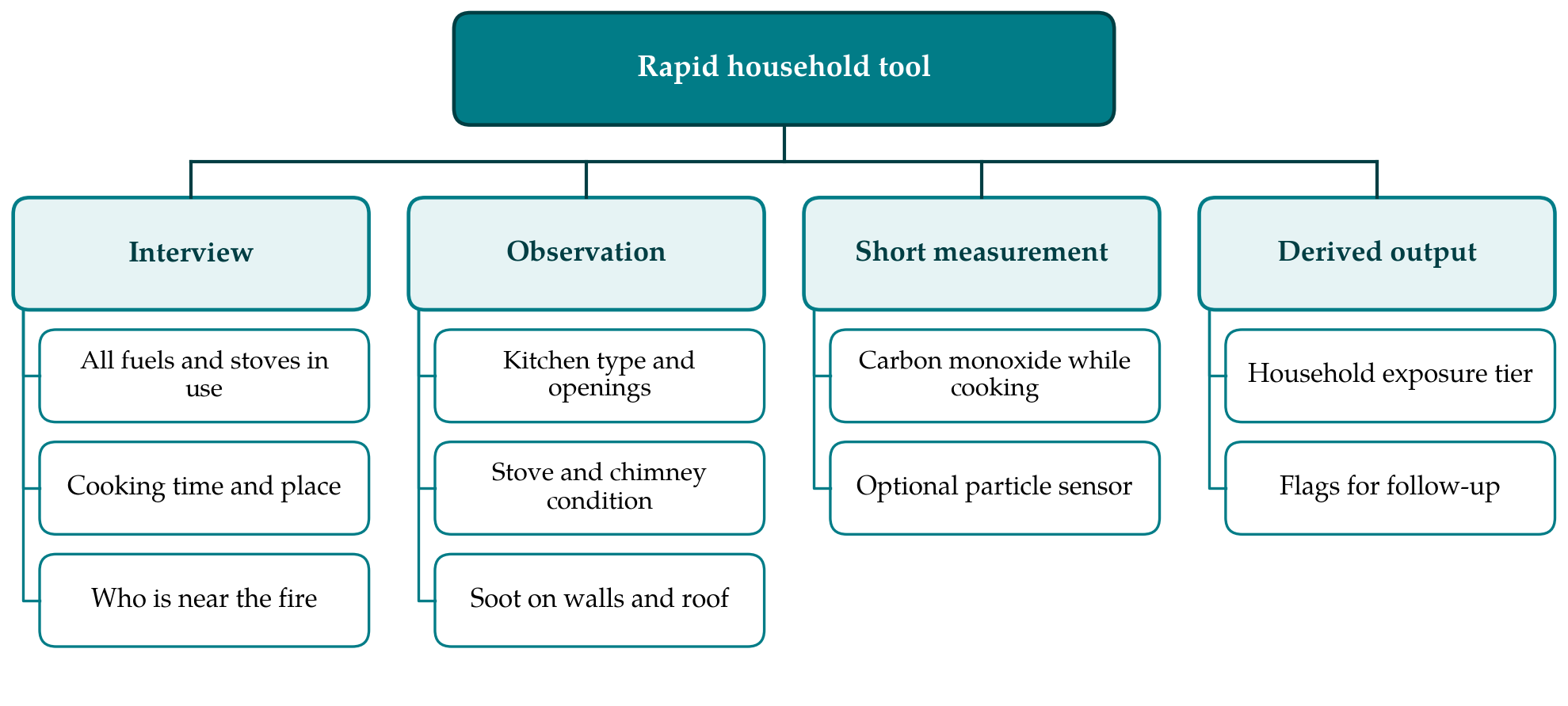
3.1. Module A: Fuels and stoves
The interview is addressed to the person who does most of the cooking. Instead of asking for the main fuel, the fieldworker asks the respondent to name every device used in the past seven days for cooking, heating water, heating the room and lighting, and for each device the fuel and the tasks it served. A photograph card of locally common stoves helps identification. Secondary uses are prompted explicitly: the fire kept for a staple dish that needs long simmering, the kerosene lamp, the charcoal brazier brought indoors on cold evenings. The output is a list from which stacking can be read directly.
3.2. Module B: Time and place of cooking
The second set of questions locates cooking in space and time. The respondent indicates whether cooking is done in the main living room, a separate room, a detached building or the open air, and whether this changes with the season. Duration is asked meal by meal for the previous day, which is easier to recall than a typical day. The fieldworker then records who is usually within arm's reach of the stove while it is alight, with specific prompts for infants carried on the back, young children, and older or unwell relatives who stay indoors.
3.3. Module C: Structured observation
Observation does not depend on recall and is less open to the wish to give an approved answer. The checklist covers the construction of the cooking space, the number of windows and doors that open to the outside and whether they are open at the time, the presence and state of a chimney or hood, visible leaks or cracks in the stove, and soot on walls and roof. Each item has defined response categories with pictures in the fieldworker's guide. Where a stove said to be the main one is cold and clean while another is warm and blackened, the discrepancy is noted and not resolved by the fieldworker.
3.4. Module D: Optional brief measurement
Where monitors are available, carbon monoxide is recorded at the cook's breathing height for the length of the cooking event under way during the visit, together with a short period before lighting. The reading is treated as an ordinal indicator of the event observed and not as an estimate of daily exposure. Programmes with access to calibrated particle sensors may add them on the same terms. Any quantitative reading reported against a health-based value should use the current guideline levels, which for fine particulate matter are an annual mean of 5 and a 24-hour mean of 15 micrograms per cubic metre (WHO, 2021), and should make clear that a single short measurement cannot show compliance with either.
3.5. Module E: Deriving an exposure tier
The final step assigns each household to one of a small number of ordered tiers. The proposed rule is deliberately simple and transparent. The lowest tier is reserved for households that used only gas, electricity or another fuel that is clean at the point of use during the week. Households that stack a clean fuel with a polluting one are placed above them, and those relying on solid fuels or kerosene are graded by whether cooking is outdoors, in a ventilated separate kitchen, or in an enclosed living space. A flag is added when an infant or a person with chronic respiratory illness is routinely near the fire. The tiers are ordinal labels. They carry no implied concentration and should not be converted to one.
4. Sampling and Fieldwork
The tool can be attached to any household survey. For a stand-alone district assessment, a two-stage cluster design with villages or enumeration areas chosen with probability proportional to size is the conventional choice, and the simplified method described by Bennett et al. (1991) gives a practical way to set the number of clusters and households for a required precision. Because cooking moves outdoors in dry weather and indoors in rain or cold, the season of fieldwork must be recorded and, where resources allow, the survey repeated in a contrasting season.
Fieldworkers should speak the local language and be trained on the photograph cards and the observation categories until they classify the same kitchens alike. Entering a kitchen and asking who stands by the fire are intrusive acts. Consent should be sought from the cook as well as the household head, visits should be timed to suit the household, and the fieldworker should be prepared to give basic, locally approved advice if asked what the family can do.
5. Limitations and What Remains to Be Shown
The tool has not been applied or validated, and several of its assumptions may fail. Three properties would need to be established. The first is reliability: whether two fieldworkers visiting the same household assign the same observation categories and tier, which can be assessed with chance-corrected agreement statistics (Cohen, 1960), and whether a repeat visit some days later gives the same result. The second is validity: whether tiers are ordered in the same way as measured exposure in a subsample of households monitored by a reference method, a question of agreement and not merely of correlation (Bland and Altman, 1986). The third is usefulness: whether district teams actually use the results. General guidance on developing and testing measurement instruments applies throughout (Streiner et al., 2015).
Some limits are inherent. A single visit cannot capture day-to-day and seasonal variation. Exposure away from the home, from neighbours' fires, traffic or waste burning, is not assessed, and in dense settlements it may be large. Respondents may under-report fuels they believe the interviewer disapproves of. The tool classifies households, whereas disease risk attaches to individuals. It is intended for targeting and monitoring at programme level and should not be used to estimate the health risk of any particular person.
6. Conclusion
Between the single fuel question of a national survey and the personal monitors of a research trial there is room for an instrument that a district can use. The tool proposed here asks about every fuel and stove, places cooking in space and time, looks at the kitchen, measures briefly where it can, and reduces the result to an ordered tier with its reasoning visible. Each element is drawn from published exposure research. Whether the combination is reliable between observers, tracks measured exposure and helps programmes reach the households that most need cleaner cooking has yet to be demonstrated, and the studies needed to find out are modest in scale.
Conflict of interest
To be declared by the author(s) before publication.
Funding
To be declared by the author(s) before publication.