1. Introduction
A smooth cubic surface over the complex numbers is rational, and a smooth cubic threefold is not, by the theorem of Clemens and Griffiths (1972) on the intermediate Jacobian. For smooth cubic hypersurfaces X in P5 the situation is stranger than either case. Some of them are rational, a fact already known to Fano (1943), and it is widely expected that the very general one is not, yet no smooth cubic fourfold has been proved irrational. The methods that settle dimension three give nothing here, because a cubic fourfold has no odd cohomology and therefore no intermediate Jacobian to obstruct rationality.
What a cubic fourfold does have is a middle cohomology group of K3 type. The Hodge numbers of H4(X) are 0, 1, 21, 1, 0, so that after a shift of weight the primitive part resembles the second cohomology of a K3 surface with one extra algebraic class. Beauville and Donagi (1985) made the resemblance geometric by showing that the variety of lines on X is a hyperkähler fourfold deformation equivalent to the Hilbert square of a K3 surface. Since then the guiding idea has been that X should be rational exactly when an actual K3 surface can be found inside this picture.
Cubic fourfolds containing a plane are the family in which the K3 surface is visible to the naked eye, with one complication: it comes with a Brauer class. This review is organised around that twisted K3 surface. It is a narrative review of the published literature, written for readers who know the basic theory of K3 surfaces as presented by Huybrechts (2016), and it draws on the earlier survey of Hassett (2016) for the general framework. It reports no new results.
2. Special Cubic Fourfolds and the Divisor of Discriminant Eight
Hassett (2000) called a cubic fourfold special when it contains an algebraic surface whose class is not a multiple of h2, the square of the hyperplane class. Such a fourfold carries a saturated rank two lattice K of algebraic classes in H4(X, Z) that contains h2, and the discriminant d of K is the basic invariant. Hassett proved that the special cubic fourfolds of discriminant d form an irreducible divisor Cd in the twenty-dimensional moduli space, and that Cd is non-empty exactly when d is greater than 6 and congruent to 0 or 2 modulo 6. The description rests on the Torelli theorem of Voisin (1986).
The smallest admissible value is d = 8, and it is realised by fourfolds containing a plane P. The intersection numbers are h2·h2 = 3, h2·P = 1 and P·P = 3, which gives discriminant 9 − 1 = 8. It is worth recalling that Voisin's proof of the Torelli theorem itself passes through this divisor, so that C8 has been a laboratory for the whole theory from the start. Table 1 places it among the other divisors of small discriminant that have an explicit geometric description, together with what is known about K3 surfaces and rationality on each.
| d | A general member contains | Associated K3 surface | Rationality |
|---|---|---|---|
| 8 | A plane | Twisted K3 surface of degree 2 | Rational on countably many sub-loci (Hassett, 1999) |
| 12 | A rational cubic scroll | None, twisted or untwisted | Unknown |
| 14 | A quartic scroll or a quintic del Pezzo surface | K3 surface of degree 14 | All members rational (Bolognesi et al., 2019) |
| 20 | A Veronese surface | None, twisted or untwisted | Unknown |
| 26 and 38 | Surfaces with a congruence of 5-secant conics | K3 surfaces of degree 26 and 38 | All members rational (Russo and Staglianò, 2019) |
The third column of the table reflects two numerical conditions. Hassett showed that the orthogonal complement of K is Hodge isometric, up to a twist, to the primitive cohomology of a polarised K3 surface of degree d if and only if d is not divisible by 4, by 9, or by any odd prime congruent to 2 modulo 3. The values 14, 26 and 38 pass this test; the value 8 fails it. Huybrechts (2017) found the weaker condition that governs twisted K3 surfaces: in the prime factorisation of d/2, every prime congruent to 2 modulo 3 must occur with even exponent. Since 8/2 = 4, discriminant 8 satisfies the twisted condition, whereas 12 and 20 satisfy neither.
3. The Quadric Surface Fibration and Its Twisted K3 Surface
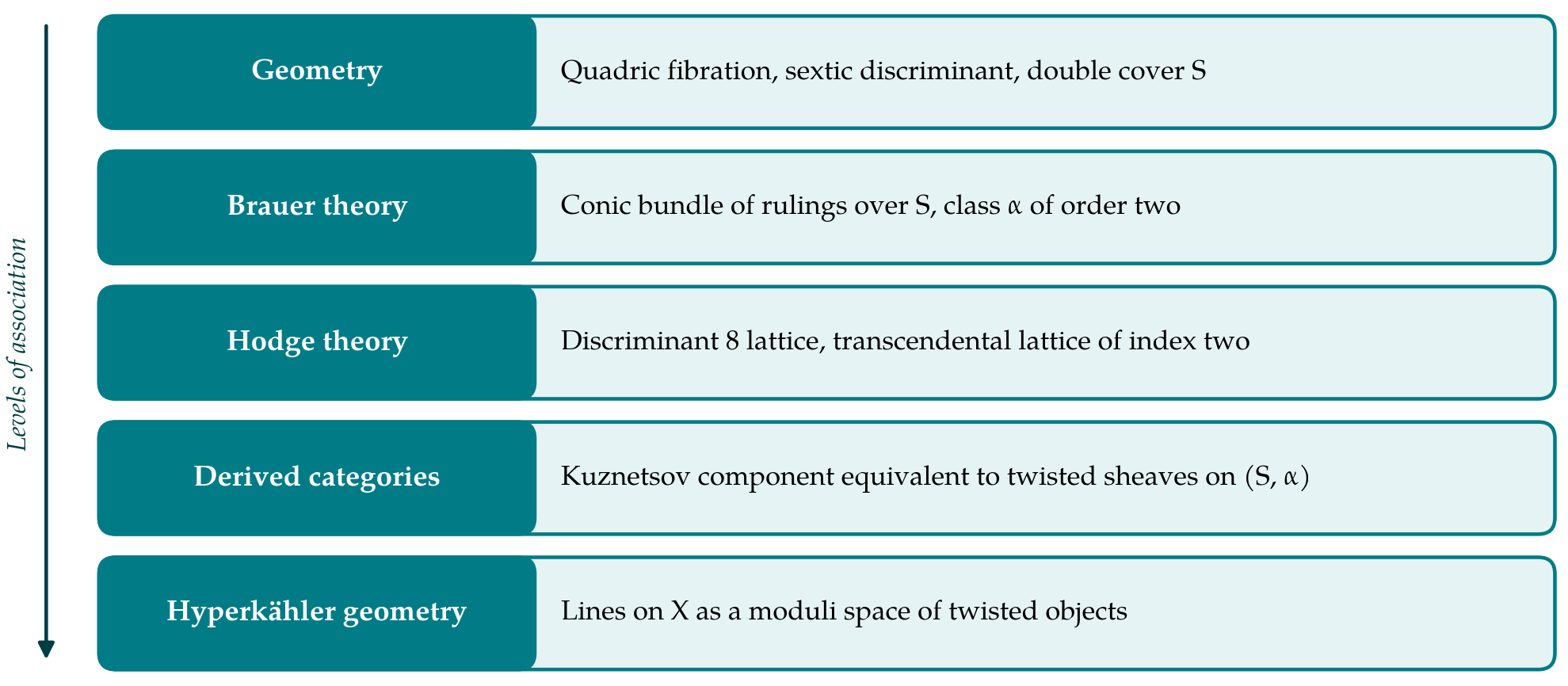
Let X contain a plane P. The three-dimensional linear spaces through P are parametrised by a second plane P2, and each of them meets X in the union of P and a residual quadric surface. Blowing up X along P therefore produces a morphism to P2 whose fibres are these quadrics. The fibre is singular over a plane curve C of degree six. If X contains no second plane meeting P, every singular fibre is a quadric cone with a single vertex and C is smooth (Voisin, 1986; Kuznetsov, 2010).
A smooth quadric surface has two families of lines and a quadric cone has one. Hence the rulings of the fibres are parametrised by the double cover S of P2 branched along C, which is a K3 surface of degree two when C is smooth. The lines themselves form a bundle of conics over S, that is, a Brauer-Severi variety of relative dimension one, and its class α in the Brauer group of S has order at most two. The pair (S, α) is the twisted K3 surface associated with the pair (X, P). van Geemen (2005) showed that the Brauer classes of order two on a general K3 surface of degree two fall into three types, each with its own projective model, and that the classes arising from cubic fourfolds containing a plane make up exactly one of the three.
Figure 1 summarises the levels at which this pair is tied to the fourfold. The remaining sections of the review take the levels in turn, starting from the most classical one, where the Brauer class decides whether the fibration has a rational section.
4. The Brauer Class and the Classical Rationality Criterion
A quadric surface over a field is rational as soon as it has a rational point. Applied to the generic fibre of the fibration, this says that X is rational whenever the fibration admits a rational section. By a theorem of Springer on quadratic forms, a rational multisection of odd degree is enough. The lines of one ruling through the points of a section trace out a section of the conic bundle over S, and conversely, so the existence of a rational section is equivalent to the vanishing of α.
Hassett (1999) turned this into a lattice-theoretic statement. Write Q for the class h2 − P of the residual quadric. If X carries an algebraic surface T whose intersection number with Q is odd, then T meets the generic fibre in a zero-cycle of odd degree and X is rational. The condition cuts out countably many divisors inside C8, their union is dense in C8, and this produced new rational cubic fourfolds beyond the classical Pfaffian examples. For a very general member of C8 the algebraic classes are spanned by h2 and P, every intersection number with Q is even, and α is not zero.
It was natural to ask whether the vanishing of α is also necessary for rationality. Auel et al. (2014) showed that it is not. They studied the fourfolds that contain both a plane and a quintic del Pezzo surface, which lie in the intersection of C8 and C14, and found a component of that intersection whose general member is Pfaffian, hence rational, while its Brauer class is non-trivial. The fibration then has no rational section, and rationality comes from a different construction altogether. The example is a warning that α measures the rationality of one particular fibration and not of the fourfold.
5. Hodge Theory and Derived Categories
On the Hodge-theoretic side, the relation between X and S is slightly weaker than an isometry. The transcendental lattice of a general X in C8 is not isometric to that of S, since discriminant 8 fails Hassett's condition, but it embeds in it with index two, and the embedding is the kernel of the homomorphism to Z/2 defined by α (Voisin, 1986; van Geemen, 2005). This is the standard way in which a Brauer class modifies a Hodge structure of K3 type, and it is the model for the general notion of an associated twisted K3 surface studied by Huybrechts (2017).
The categorical side begins with the semiorthogonal decomposition of Kuznetsov (2010). The bounded derived category of any smooth cubic fourfold contains the three line bundles O, O(1) and O(2) as an exceptional collection, and their orthogonal complement AX is a triangulated category whose Serre functor is the shift by two and whose Hochschild homology is that of a K3 surface. Kuznetsov conjectured that X is rational if and only if AX is equivalent to the derived category of an actual K3 surface.
For fourfolds containing a plane the component AX can be computed. The derived category of a quadric fibration is governed by its sheaf of even Clifford algebras (Kuznetsov, 2008). Under the assumption that no second plane meets P, that sheaf is an Azumaya algebra on the double cover S representing α, and the outcome is an equivalence between AX and the derived category of α-twisted coherent sheaves on S (Kuznetsov, 2010). When α vanishes the component is the derived category of S, in agreement with the conjecture and with Hassett's criterion. The example of Auel and co-authors is also consistent with it: there the twisted category on S is equivalent to the untwisted derived category of a different K3 surface, of degree 14.
The two conjectural criteria were compared by Addington and Thomas (2014). They proved that if AX is equivalent to the derived category of a K3 surface then X lies in some Cd with d satisfying Hassett's condition, and that the converse holds for general members of those divisors. The converse was extended to every member by Bayer et al. (2021), using stability conditions on Kuznetsov components, and the twisted analogue was treated by Huybrechts (2017). For a fourfold containing a plane the upshot is clean. The component AX is always of twisted K3 type, and it is of untwisted K3 type precisely when X lies on a further divisor Cd of admissible discriminant.
6. The Fano Variety of Lines
The hyperkähler fourfold F(X) of lines on X offers a third view of the same structure. Macrì and Stellari (2012) proved that for a cubic fourfold containing a plane and satisfying the genericity assumption above, F(X) is isomorphic to a moduli space of stable objects in the derived category of α-twisted sheaves on S. A general line on X does not meet P and projects to a line in P2, and the object attached to it is, roughly, a twisted sheaf supported over the preimage of that line in S. The result explains in modular terms why F(X) is deformation equivalent to a Hilbert square, and it shows that the Brauer class is an intrinsic feature of the hyperkähler geometry and not an artefact of the projection.
The variety of lines also enters the rationality problem through the Grothendieck ring of varieties. Galkin and Shinder (2014) derived a relation in that ring between the Hilbert square of X and F(X) and deduced that, if the class of the affine line were not a zero divisor, the variety of lines of a rational cubic fourfold would be birational to the Hilbert square of a K3 surface. The hypothesis was later shown to fail in general, so the argument does not prove irrationality, but the conclusion it points to agrees with the Hodge-theoretic and categorical expectations and has shaped the form in which the conjectures are now stated.
7. Rationality: What Is Proved and What Is Expected
Proven rationality results outside C8 concern divisors whose discriminant satisfies Hassett's condition. Pfaffian cubic fourfolds are rational by classical constructions going back to Fano (1943) and revisited by Beauville and Donagi (1985), and Bolognesi et al. (2019) showed that every member of C14 is rational, not only the general one. Russo and Staglianò (2019) added the divisors C26 and C38 by means of congruences of conics that are 5-secant to a suitable surface. The specialisation theorem of Kontsevich and Tschinkel (2019) guarantees that rationality passes to smooth limits, so the rational locus in moduli is a countable union of closed subvarieties.
Inside C8 every fourfold currently known to be rational either has trivial Brauer class or lies on one of the divisors just mentioned. The conjectures predict that this is the complete list up to further admissible discriminants: a fourfold containing a plane should be rational exactly when its Kuznetsov component is equivalent to the derived category of an untwisted K3 surface. In particular the very general member of C8, whose twisted K3 surface cannot be untwisted, should be irrational. Nothing of this kind has been proved.
The analogy with other quadric surface bundles makes the gap more striking. Hassett et al. (2018) exhibited families of quadric surface bundles over rational surfaces in which the very general member is not even stably rational while rational members are dense, using a Brauer class as an unramified invariant together with the specialisation method of Voisin (2015). For a smooth cubic fourfold no such invariant survives. Auel et al. (2017) showed that the unramified cohomology of degree three of a cubic fourfold containing a plane is universally trivial, so the class α, although non-zero on S, leaves no trace in the invariants that currently detect stable irrationality.
8. Open Questions
The first open question is the obvious one: to prove that some cubic fourfold containing a plane is irrational. Because rationality specialises, it would suffice to treat a single smooth member whose Kuznetsov component is not of untwisted K3 type, and C8 is the divisor where the available structure is richest. A second question is to turn the categorical conjecture into a usable obstruction, that is, to show that the Kuznetsov component, or some invariant extracted from it, is constrained by a rational parametrisation in the way an intermediate Jacobian is in dimension three.
A third group of questions concerns the degenerate members that most of the theorems above exclude. When X contains two planes meeting along a line, the discriminant sextic acquires singular points, the double cover has rational double points, and the even Clifford algebra is no longer Azumaya. The correct replacement for (S, α) in this setting, and its relation to the minimal resolution of the double cover, is understood in examples but not systematically. Finally, the role of the two other types of Brauer class in van Geemen's classification suggests looking for parallel dictionaries on other fourfolds of K3 type, where the corresponding rationality questions are equally open.
9. Conclusion
A cubic fourfold containing a plane determines a K3 surface of degree two with a Brauer class of order two, and the literature reviewed here shows that this single object accounts for the classical rationality criterion, the Hodge structure, the K3 category and the variety of lines of the fourfold. The Brauer class is the difference between the divisor C8 and the divisors on which rationality has been established. Its vanishing gives rationality, its non-vanishing does not exclude it, and the conjectures of Hassett and Kuznetsov say precisely when it can be removed by passing to another K3 surface. Whether a fourfold with an essential twist is irrational remains the central unanswered question of the subject.
Conflict of interest
To be declared by the author(s) before publication.
Funding
To be declared by the author(s) before publication.