1. Introduction
Comparative theology in its contemporary form is the practice of doing theology from within one tradition by way of sustained study of another. Clooney (2010) describes it as faith seeking understanding that is rooted in a particular tradition and ventures from that base into learning from one or more others, for the sake of fresh insight into both. Its typical product is a close reading of paired texts, a Hindu commentary beside a Christian one, a Buddhist treatise beside a scholastic question, after which the theologian reports what has been learned.
The field defined itself partly by contrast. Fredericks (1999) argued that the theology of religions had reached an impasse. The familiar options of exclusivism, inclusivism and pluralism, set out as a typology by Race (1983), each claimed to settle the standing of other religions before anyone had studied them, and comparative theology offered a way of proceeding without such a prior settlement. The proposal has been productive. It has also encouraged a habit of leaving one question unasked: when the other tradition says something that the theologian's own tradition denies, what follows for what the theologian should believe.
This article contends that the question cannot be left aside and that comparative theology has, close to hand, the means to address it. The argument is about method. It takes no position on which religious claims are true.
2. How Comparative Theology Handles Conflict at Present
The literature on method is rich in descriptions of attitude and comparatively thin on epistemic norms. Cornille (2008) identifies the conditions under which dialogue between traditions is possible as humility about one's own grasp of truth, commitment to a tradition, recognition of interconnection, empathy and hospitality toward the truth of the other. In a later work she classifies the kinds of learning that comparison
yields:
intensification,
rectification,
recovery,
reinterpretation,
appropriation
and reaffirmation (Cornille, 2020). These are valuable categories. Several of them, rectification and reaffirmation above all, presuppose that the theologian has judged a claim in one tradition against a claim in the other. The classification names the outcome of that judgement and does not say by what standard it was made.
Hermeneutical accounts have a similar shape. Moyaert (2014) draws on Ricoeur to describe the encounter with the religious other as an exercise in interpretive hospitality that is always fragile and exposed to misunderstanding. The account explains well how a reader can receive an unfamiliar text. It gives less guidance about the moment at which reception meets contradiction. Critics from outside the hermeneutical approach have noticed the gap. Nicholson (2011) argues that comparative theology cannot escape the oppositional and political dimension of religious identity by declining to pronounce on other traditions, since the refusal is itself a position. Much earlier, Griffiths (1991) maintained that when representatives of a religious community recognise that their doctrines are incompatible with those of another, they are obliged to engage in argument about them, and that avoiding such argument does not show respect.
3. The Argument
The case for a clearer account can be put in three steps. First, comparative theology is a truth-seeking practice. Its practitioners say that they learn from the other tradition, and learning is the acquisition of truth or understanding, not only of information about what others think. Second, learning across traditions regularly brings the theologian up against conflict. A Christian reader of Advaita Vedanta meets the denial of any final distinction between the self and ultimate reality. A Christian reader of Madhyamaka meets the denial of intrinsic existence, applied to everything, where Christian doctrine speaks of a creator who depends on nothing. Third, a truth-seeking practice that meets conflict owes an account of how the conflict bears on belief. Without one, the selection of what to appropriate and what to set aside is unaccountable, and readers cannot tell learning from preference.
The third step is the contentious one. It may be said that the comparative theologian simply follows the norms of the home tradition, which already contain criteria of orthodoxy. That reply settles what the tradition permits, and it leaves open whether the theologian's confidence in the tradition's claims should change on finding that learned, sincere and reflective people in another tradition hold otherwise. This is exactly the question that epistemologists have examined under the heading of disagreement.
4. What the Epistemology of Disagreement Offers
The philosophical debate concerns what a person should do on discovering that someone equally informed and equally capable has reached a contrary conclusion. Table 1 sets out the principal views and what each would imply for a comparative theologian.
| View | Central claim | Source | Implication for the comparative theologian |
|---|---|---|---|
| Conciliationism | Disagreement with a peer requires moving toward the peer's view | Christensen, 2007; Elga, 2007 | Confidence in contested doctrines should fall after serious study |
| Suspension of judgement | Peers who share evidence cannot both be reasonable; both should suspend | Feldman, 2007 | Contested doctrines should be held as open questions |
| Steadfast view | One may keep a belief if one has in fact reasoned well | Kelly, 2005 | Conflict alone gives no reason to revise |
| Rarity of peers | Acknowledged peers with the same evidence are seldom found | King, 2012 | The theologian must say why the other is or is not a peer |
| Partisan justification | Insight into the grounds of belief can warrant holding firm | Pittard, 2019 | Holding firm requires stating the insight relied on |
Three features of this debate are of direct use. The first is the distinction between conciliatory and steadfast responses. Conciliationists hold that the bare fact of peer disagreement is evidence that one may have erred and that confidence should be reduced accordingly. Defenders of steadfastness reply that what matters is the first-order evidence and how well each party has assessed it. Comparative theologians already take up positions along this line without naming them. A scholar who reports that study of another tradition has unsettled a doctrine is conciliating, and a scholar who reports reaffirmation is holding steadfast.
The second feature is the analysis of peerhood. Philosophers disagree about how often the idealised condition of equal evidence and equal competence is met, and King (2012) argues that it is met rarely. Religious cases are especially hard, because the parties differ about what counts as evidence, including the standing of scripture, tradition and religious experience. De Cruz (2019) reviews the application of the debate to religion and shows that the central issue is whether one has reasons, independent of the dispute itself, for regarding the other as less reliable. Comparative theology is unusually well placed here. Years of reading another tradition's texts with its commentators supplies just the kind of detailed knowledge of the other party's reasoning that abstract discussions of peerhood lack.
The third feature is the recognition that religious disagreement is seldom about a single proposition. Pittard (2019) argues that disputes between outlooks reach down to the standards by which the dispute would be assessed, and that a believer may be justified in holding firm when there is real insight into the grounds of belief. Whether or not that argument succeeds, it shows the form an answer must take: it must say what the insight is. The matrix in Figure 1 uses these distinctions to separate four stances a comparative theologian may adopt.
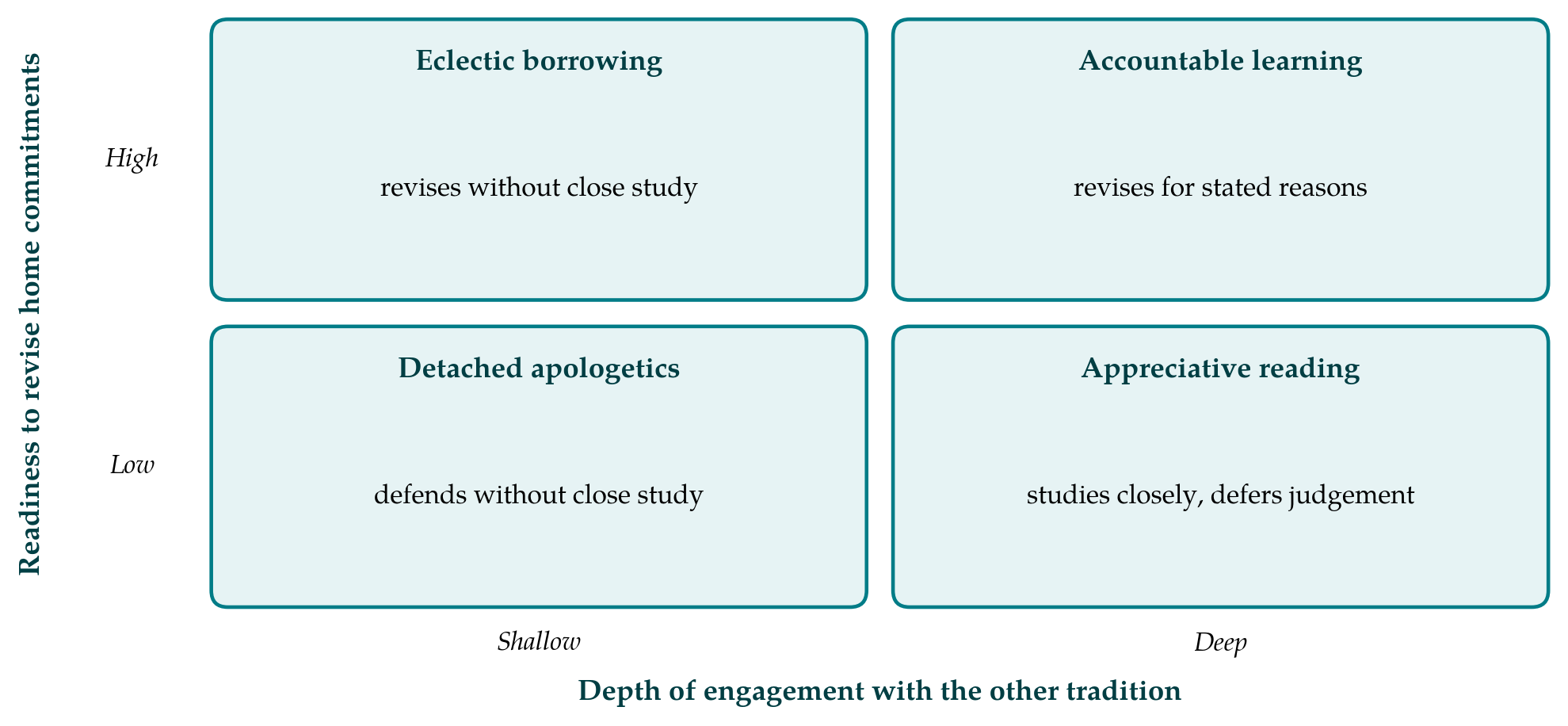
The upper right quadrant describes the practice this article commends. The lower right describes much existing work, which is learned and generous and stops short of saying what the conflict it has uncovered implies. The two left-hand quadrants are the failures that comparative theology was founded to avoid.
5. Three Objections
It may be objected that attention to disagreement brings back the theology of religions and its general verdicts. It does not. The typology of exclusivism, inclusivism and pluralism concerns whole religions and their saving efficacy. The pluralist hypothesis of Hick (1989) and the defence of exclusivism by Plantinga (1995) are answers at that level. The account proposed here is local. It asks, of a particular claim met in a particular text, whether it conflicts with a particular home commitment and what weight that conflict carries. Such judgements can be made one at a time, and they do not add up to a verdict on a religion.
A second objection draws on the cultural-linguistic account of doctrine. If, as Lindbeck (1984) proposed, doctrines function as rules of a community's speech and practice and not primarily as propositions, then apparent contradictions between traditions may be no more than differences of grammar, and the apparatus of disagreement has nothing to grip. The objection has force where it applies, and it should be applied case by case. Deciding whether two statements conflict or merely differ is itself part of the account being asked for. Comparative theologians make that decision constantly. The request is that they make it in the open.
A third objection is that epistemic peerhood across traditions cannot be established, so the philosophical models are idle. The difficulty is real, and it cuts both ways. If peerhood cannot be affirmed, it cannot be denied without argument either, and a theologian who treats the other tradition's thinkers as a source of learning has already granted them considerable standing. The virtues Cornille lists point the same way: humility and hospitality toward another's truth make little sense if that other is assumed in advance to be unreliable.
6. Implications for Practice
The proposal can be stated as three undertakings for any comparative study. The author should state what the other tradition's text is taken to claim, in terms its own interpreters would accept. The author should say where, if anywhere, that claim conflicts with a commitment of the home tradition, and whether the conflict is one of proposition, of practice or of the framework within which either makes sense. And the author should say what epistemic weight the conflict is given, whether the response is revision, reaffirmation or suspended judgement, and on what grounds.
None of this requires a comparative theologian to become an epistemologist or to adopt one of the views in Table 1. It requires that an implicit judgement be made explicit. The gain is accountability. Readers in the home tradition can see why a doctrine has been reinterpreted, and readers in the other tradition can see whether they have been understood and can answer. A field that describes itself as learning across borders has an interest in making its learning open to checking from both sides.
7. Conclusion
Comparative theology was right to resist verdicts on other religions delivered before those religions had been studied. The resistance has hardened in places into reticence about conflict as such, and that reticence weakens the field's claim to be seeking truth. A clearer account of religious disagreement, built with tools that the epistemology of disagreement already provides and informed by the detailed knowledge that comparative study produces, would let practitioners say what they have learned, what they continue to deny, and why. That is a modest addition to method, and it would make the results of comparison easier to trust.
Conflict of interest
To be declared by the author(s) before publication.
Funding
To be declared by the author(s) before publication.