1. Introduction
Cholera is an acute watery diarrhoea caused by toxigenic Vibrio cholerae of serogroups O1 and O139. It spreads through water and food contaminated with faeces, has a short incubation period measured in hours to a few days (Azman et al., 2013), and can kill a previously healthy adult by dehydration within a day of the first symptoms. Prompt rehydration reduces deaths to a very small proportion of cases, and that contrast between a lethal disease and a simple remedy is what makes the quality of the response decisive (Clemens et al., 2017).
Low-lying coastal districts face a particular risk. V. cholerae persists in brackish and estuarine waters in association with plankton, so that an environmental reservoir exists independently of human cases (Colwell, 1996). Flooding then adds the conditions for transmission: latrines overflow, wells and boreholes are submerged, piped supplies fail, and families move into crowded shelters. Epidemics after natural disasters arise chiefly from displacement and the loss of water and sanitation, not from the disaster itself (Watson et al., 2007).
A district that has come through such an outbreak has learned things that no manual contains, but the learning is seldom captured in a usable form. This article proposes a protocol for doing so. It describes a procedure and the reasoning behind it, and reports no outbreak, no data and no application of the protocol.
2. Background
An after-action review is a structured, qualitative examination of the actions taken in response to a real event, carried out with the people who took them, to identify what worked, what did not, and why. The method came from military practice and was adopted in public health as one of the voluntary components of the monitoring and evaluation framework that supports the International Health Regulations (WHO, 2016). The World Health Organization's guidance describes several formats, from a short debrief to a mixed-method review with interviews and working groups, and recommends that a review take place soon after the event while memories and records are fresh (WHO, 2019).
Experience with the method has shown recurring weaknesses. Reviews tend to produce long lists of observations that restate known problems, they stop at description without asking about cause, and their recommendations lack owners and deadlines. Stoto et al. (2019) argue that reviews improve when they concentrate on a few critical moments and apply root cause analysis to each. The protocol below takes that advice as its starting point and adapts it to cholera, for which the technical standards of an adequate response are unusually well defined in the roadmap and field manual of the Global Task Force on Cholera Control (GTFCC, 2017; GTFCC, 2019).
3. The Proposed Protocol
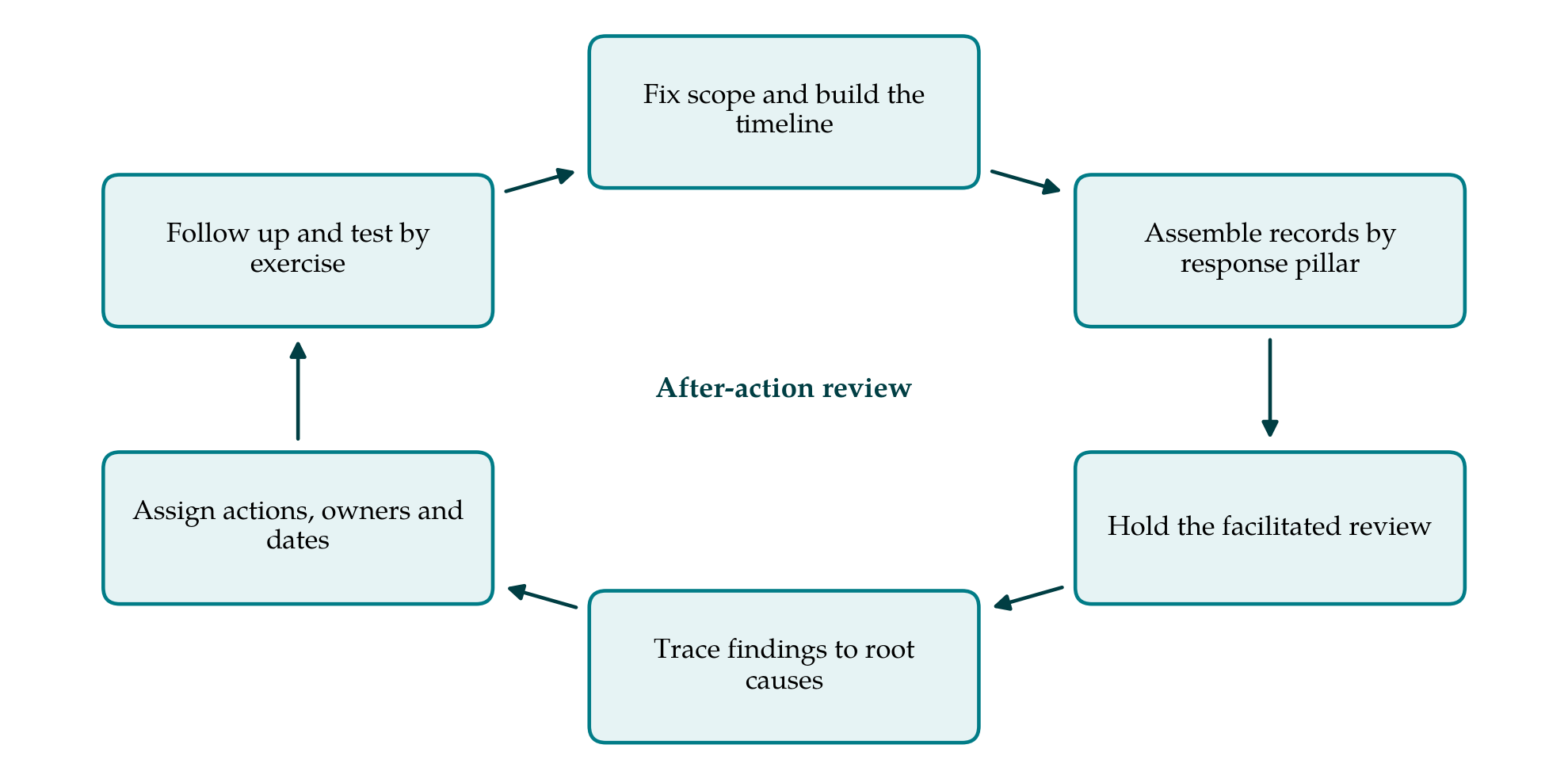
The protocol has six steps that form a loop, since the last step feeds the preparedness plan against which the next response will be reviewed. Figure 1 shows the sequence. The review is intended to be led by the district health office, with a facilitator from outside the district where one can be found, and to be completed within a few weeks.
3.1. Step 1: Fix the scope and reconstruct the timeline
The review begins by stating which event is under examination, between which dates and within which administrative boundaries. A single timeline is then built from the line list, laboratory register, alert log, situation reports and meeting minutes. It should record at least the onset of symptoms in the earliest known case, the first alert received by the health system, laboratory confirmation, notification to the next level, the first response actions, the peak, and the last case.
Intervals on this timeline are compared with explicit targets. The 7-1-7 metric offers a ready set: detection within seven days of emergence, notification within one day of detection, and completion of early response actions within seven days of notification (Frieden et al., 2021). Delay in detecting cholera has been shown to be the main determinant of how large an outbreak becomes in fragile settings (Ratnayake et al., 2020), so the review should give this interval most attention. The intervals that miss their targets become the critical moments around which the remaining steps are organised.
3.2. Step 2: Assemble records under six response pillars
Evidence is gathered before anyone is asked for an opinion. The protocol sorts it under six pillars that correspond to the main lines of a cholera response. Table 1 lists them with the central review question and the records to be collected for each. The questions are framed against published standards so that the discussion starts from a shared reference and not from personal impressions.
| Pillar | Central review question | Records to assemble |
|---|---|---|
| Surveillance and alert | How long from first case to alert, and what delayed it? | Line list, alert log, community reports |
| Laboratory confirmation | Were rapid tests and culture available when needed? | Laboratory register, stock cards, transport log |
| Case management | Could patients reach rehydration quickly and safely? | Treatment unit registers, referral notes, supply records |
| Water, sanitation and hygiene | Was safe water restored where cases clustered? | Water quality tests, distribution lists, maps |
| Oral cholera vaccination | Was a campaign requested, and was timing useful? | Request forms, campaign reports |
| Coordination and communication | Who decided what, and did communities receive clear advice? | Minutes, situation reports, messages issued |
The technical yardsticks come from the literature. For case management, the Sphere standards and the cholera field manual expect the case fatality ratio in treatment facilities to be kept below one per cent (Sphere Association, 2018; GTFCC, 2019). For water and sanitation, reviews of the evidence find that the commonly used interventions are plausible but have rarely been evaluated rigorously during outbreaks (Taylor et al., 2015), and that household chlorination and filtration work when households use them consistently, which depends on supply and follow-up (Lantagne and Yates, 2018). For vaccination, killed whole-cell oral vaccines give substantial protection for several years after two doses (Bi et al., 2017), so the question for the review is one of timing and targeting.
3.3. Step 3: Hold the facilitated review
Participants are drawn from every level that acted: community health workers, facility staff, the district rapid response team, the laboratory, water and sanitation officers, local government, partner organisations and, where possible, community representatives from affected villages. The working-group format in the World Health Organization guidance suits a district, with one group per pillar and a plenary to bring the findings together (WHO, 2019).
The facilitator presents the timeline and asks each group four questions about its critical moments: what was supposed to happen according to the plan, what did happen, what accounted for the difference, and what should be kept or changed. Ground rules state that the purpose is learning and not the attribution of blame, and that statements will not be linked to named individuals in the report. Junior staff and community members often hold the most relevant knowledge and are the least likely to speak in front of superiors, so groups should be arranged, and some views collected separately, with that in mind.
3.4. Step 4: Trace findings to root causes
Each important gap is examined by asking repeatedly why it occurred until an answer is reached that someone in the room, or at the level above, has the authority to change. A late alert, for example, might be traced through an unrecognised case definition to training that reached only facility staff. Reason's account of organisational accidents is a helpful guide here: failures at the front line usually rest on latent conditions set earlier by decisions about staffing, supply and procedure (Reason, 1997). The protocol asks reviewers to record for each finding both the immediate cause and the latent condition behind it, and to do the same for things that went well, since strengths that depended on one individual or one donor are also vulnerabilities.
Flood-related causes deserve a separate pass. Access roads cut by water, cold chain and sample transport interrupted, treatment units sited on ground that later flooded, and water points contaminated by saline or faecal intrusion are specific to the setting and are easily filed under general logistics. Recording them as their own category lets the district see which parts of its cholera plan assumed dry conditions.
3.5. Step 5: Agree a short action plan
Findings are converted into actions in the plenary. Each action has one owner, a completion date, a statement of the resources required and an indicator by which its completion can be checked. The protocol limits the plan to the handful of actions judged most likely to shorten the critical intervals identified in Step 1, because a long list disperses effort and is rarely completed. Where modelling and field experience suggest that rapid, localised action around early cases can curb transmission (Finger et al., 2018), actions that pre-position supplies and authority for such targeted interventions merit priority. Actions beyond the district's power are written as requests to the province or ministry and recorded separately.
3.6. Step 6: Follow up and test
The report is short, is shared with all participants and with the next administrative level, and is attached to the district cholera preparedness plan. Progress on actions is reviewed at a fixed interval by the district health management team. Before the next flood season a table-top or simulation exercise tests whether the changes hold, using a scenario drawn from the reconstructed timeline. This closes the loop: the exercise shows whether a lesson has been learned or merely written down.
4. Fitting the Protocol to District Practice
Three practical constraints shaped the design. The first is time. District staff return to routine duties as soon as an outbreak ends, so the facilitated review is planned for two days, with the timeline and records prepared beforehand by a small team. The second is the quality of records. Line lists kept under pressure have gaps, and dates of onset are often missing; the protocol treats the completeness of records as a finding in its own right and does not attempt statistical analysis that the data cannot bear. The third is hierarchy. A review led entirely by those whose decisions are under examination will be cautious, which is why an external facilitator and written ground rules are recommended.
The protocol is also meant to connect with national processes. Cholera is a notifiable event that may fall under the International Health Regulations (WHO, 2016), and countries pursuing the global roadmap are asked to identify priority areas for multisectoral interventions (GTFCC, 2017). A district review that documents where and why cases clustered after flooding supplies exactly the local evidence such planning requires.
5. Limitations and What Remains to Be Shown
This protocol has been assembled from guidance and published literature and has not been used in an outbreak. Its feasibility in a district with few staff is therefore untested, as is the central assumption that concentrating on timeline intervals yields more useful findings than an open discussion. Three things would need to be shown. One is whether districts complete the review and the action plan within the intended period. A second is whether the actions agreed are carried out, which can be checked from the follow-up records. The third, and the hardest, is whether subsequent responses are faster, since outbreaks differ and improvement cannot be attributed to a review with confidence.
After-action reviews also have inherent limits. They depend on recollection and on the willingness of participants to speak frankly, and they capture the views of those who attend. They are qualitative exercises and do not replace epidemiological investigation of the outbreak or formal evaluation of interventions. Readers should treat the protocol as a starting structure to be adapted and tested, not as an established standard.
6. Conclusion
Districts that face cholera after floods will face it again, and the interval between outbreaks is the only time available for learning. The protocol proposed here gives that learning a definite form: a timeline measured against explicit targets, evidence sorted under six response pillars, a facilitated discussion that asks why as well as what, and a short plan with owners that is later tested by exercise. Whether it produces better responses than present informal practice is an open question, and one that district teams and their partners are in a position to answer by trying it and reporting what they find.
Conflict of interest
To be declared by the author(s) before publication.
Funding
To be declared by the author(s) before publication.