1. Introduction
The Western Ghats run for about 1,600 km along the western edge of peninsular India and, together with Sri Lanka, form one of the global biodiversity hotspots recognised by Myers et al. (2000). No vertebrate group shows the endemism of the range more clearly than its amphibians. Several frog lineages occur nowhere else, among them the purple frog Nasikabatrachus sahyadrensis, whose discovery pointed to an ancient biogeographical link with the Seychelles (Biju and Bossuyt, 2003). Many of the endemic species are known from a single massif, and a good number from a band of a few hundred metres of elevation within it.
Amphibians are also the most threatened class of vertebrates, with declines recorded on every continent where they occur (Stuart et al., 2004). As ectotherms with permeable skin, they track the temperature and humidity of their surroundings closely. A warming climate is therefore expected to displace their suitable conditions towards higher ground. Across many taxa and regions, species have been moving to higher elevations at a median rate of about 11 m per decade (Chen et al., 2011), although that figure rests largely on temperate data.
This article reviews what is known about such shifts for the montane amphibians of the Western Ghats. It asks three things: whether upslope movement has been documented in the range, what indirect evidence bears on it, and what kind of work would settle the matter. The answer to the first is uncomfortable. The expectation of upslope displacement is well founded, but the direct evidence is very thin, and the reasons for that gap are themselves instructive.
2. Scope and Approach
This is a narrative review of the published literature. It draws on three bodies of work: studies of amphibian distribution along elevational gradients in the Western Ghats, resurvey studies of range shifts on other tropical and subtropical mountains, and the methodological literature on detecting shifts from historical records. No systematic search protocol was followed, and the review does not attempt a quantitative synthesis. Because studies from the Western Ghats that compare amphibian distributions between two periods are scarce, much of the argument proceeds by analogy, and the text tries to mark clearly where a statement is an observation from the range and where it is an inference from elsewhere.
3. The Montane Fauna and Its Elevational Structure
The range is not a continuous ridge. It is broken by low passes, the widest of which is the Palghat Gap, and its highest ground lies in the south, where the Nilgiri, Anamalai and Palani hills rise above 2,000 m and Anamudi reaches 2,695 m. Above roughly 1,500 m on these massifs the vegetation is a mosaic of stunted evergreen forest, known as shola, and montane grassland. Robin and Nandini (2012) describe these high plateaus as sky islands: cool, wet habitats separated from one another by warm valleys that most montane organisms cannot cross.
The amphibians of the sky islands are dominated by bush frogs of the genus Raorchestes, which lay eggs on land and develop directly into froglets without a free-swimming tadpole. Their diversity became apparent only recently. A single revision added twelve species to what was then called Philautus (Biju and Bossuyt, 2009), and descriptions have continued since. Phylogenetic work shows that closely related bush frog lineages replace one another across massifs and along slopes, and that both geographical barriers and elevational gradients have driven their diversification (Vijayakumar et al., 2016). Torrent frogs (Micrixalus), night frogs (Nyctibatrachus) and the tree frogs of the genus Ghatixalus add stream-dependent species to the high-elevation assemblage.
Field surveys confirm that composition changes sharply with altitude. An early synthesis related amphibian distribution along the range to latitude, rainfall seasonality and elevation (Daniels, 1992). Naniwadekar and Vasudevan (2007) sampled anurans along an elevational gradient in the southern Western Ghats and documented strong turnover between elevational zones. Narrow elevational ranges are what Janzen (1967) predicted for tropical mountains: where seasons differ little in temperature, organisms are selected for a narrow thermal tolerance, so a given difference in altitude is a stronger barrier than it would be at high latitudes. A fauna built in this way is, by the same reasoning, sensitive to a change in the temperature of each band.
4. The Regional Warming Signal
The national climate assessment reports that the annual mean surface air temperature over India rose by about 0.7 °C between 1901 and 2018 (Krishnan et al., 2020). With air temperature falling by roughly 5 to 6.5 °C for each 1,000 m of ascent, a rise of one degree corresponds to an upward displacement of isotherms of some 150 to 200 m. That simple arithmetic is the basis of most expectations of upslope movement, and it should be read with caution. Long temperature records from the high plateaus are few, so warming at the elevations where the endemic frogs live is mostly inferred from lowland stations and gridded products.
Temperature is also only part of the matter for an amphibian. Activity, calling and breeding in the Western Ghats are tied to the south-west monsoon, and direct-developing frogs depend on persistently moist leaf litter and vegetation. Work at Monteverde in Costa Rica linked the collapse of a highland frog assemblage to a rise in the height of the cloud base and a growing number of mist-free days (Pounds et al., 1999). Changes in mist frequency, in the length of dry spells and in the timing of the monsoon onset may thus matter as much on the sky islands as the mean temperature does, and they are harder to measure.
5. Evidence From Other Tropical Mountains
Global syntheses established that species distributions are moving in the direction expected under warming (Parmesan and Yohe, 2003; Chen et al., 2011). The most persuasive individual studies are resurveys, in which a transect sampled decades ago is sampled again with comparable methods. The repeat of the early twentieth-century small-mammal survey of Yosemite National Park is the standard example of the design, and showed upward shifts in the range limits of many species (Moritz et al., 2008). For tropical herpetofauna the closest analogue is the Tsaratanana Massif in Madagascar, where a resurvey after about a decade found upslope displacement of amphibians and reptiles and raised the prospect of extinction for summit endemics (Raxworthy et al., 2008).
Tropical birds provide the longest comparisons. On a ridge in the Peruvian Andes, a resurvey found that species had moved upslope, that ranges had contracted for those near the top, and that several ridge-top species could no longer be found (Freeman et al., 2018). The authors called the process an escalator to extinction. Colwell et al. (2008) had set out the underlying logic for the wet tropics: species at the summit face mountaintop extinction, species whose present and future ranges do not overlap face range-shift gaps, and the lowlands may lose species with nothing to replace them. Because the land area available shrinks with altitude on most mountains, a species that moves upslope successfully still ends with a smaller range (Forero-Medina et al., 2011).
These results apply to the Western Ghats with obvious force. The highest massifs top out below 2,700 m, the summit plateaus are small, and frogs restricted to the uppermost shola and grassland, such as Raorchestes resplendens on the Anamudi massif, have no higher ground available. Analogy is not evidence, however, and the remainder of this review considers what has been observed in the range itself.
6. What Is Known for Western Ghats Amphibians
To the knowledge of this review, no published study has yet resampled a historical amphibian transect in the Western Ghats and tested for a change in elevational limits. Three obstacles explain the absence. First, much of the montane fauna was described after 2000, so earlier records carry names that now cover several species. Secondly, older museum specimens and survey reports often give localities as a hill station or an estate, with no elevation precise enough to detect a shift of a hundred metres. Thirdly, the earliest quantitative gradient surveys are themselves recent, and the interval since they were made is short relative to the warming signal. Table 1 sets out the lines of evidence that bear on the question and the state of each.
| Line of evidence | What it can show | Status for the Western Ghats |
|---|---|---|
| Historical resurveys | Change in range limits between two periods | Not yet available; baselines imprecise (Tingley and Beissinger, 2009) |
| Gradient surveys | Present elevational ranges and turnover | Available for a few gradients (Naniwadekar and Vasudevan, 2007) |
| Phylogeography | Historical confinement of lineages to elevational bands | Well developed for bush frogs (Vijayakumar et al., 2016) |
| Thermal and water physiology | Tolerance limits and safety margins | Sparse; few species measured |
| Microclimate records | Conditions frogs experience in litter and canopy | Sparse; short series |
| Long-term monitoring | Trends in occupancy with detection accounted for | Beginning; needs occupancy designs (MacKenzie et al., 2002) |
The gradient surveys and the phylogeographic work give a baseline of a different kind. They show where lineages are now and suggest that many have stayed within particular climatic bands over long periods. That is consistent with limited capacity to tolerate conditions outside the band, though it does not prove it, since competition, breeding habitat and historical accident also confine species.
Physiological data would sharpen the inference. A global analysis found that the warm range edges of terrestrial ectotherms are predicted poorly by heat tolerance alone, in contrast to marine species (Sunday et al., 2012). On land, behaviour and water balance intervene. For a small direct-developing frog the limiting factor during a warm, dry spell is more likely to be desiccation of the adult or its egg clutch than lethal temperature. Critical thermal limits and rates of evaporative water loss have been measured for very few Western Ghats species, so the safety margins of the montane fauna are largely unknown.
Microhabitats complicate the picture further. Measurements in Philippine rainforest showed that tree holes, epiphytes and soil remain far cooler and more stable than the open air, and that frogs and lizards using them are shielded from extremes (Scheffers et al., 2014). Closed-canopy shola, with its deep litter and moss-laden branches, probably offers similar shelter. Montane grassland, tea fields and timber plantations do not. Whether a population experiences regional warming at full strength therefore depends heavily on the vegetation it lives in.
7. Interacting Pressures
Warming does not act alone. Figure 1 groups the possible responses of a montane frog population into three outcomes, shifting upslope, persisting in place and declining, with the conditions that favour each. Which outcome occurs depends as much on habitat and disease as on climate.
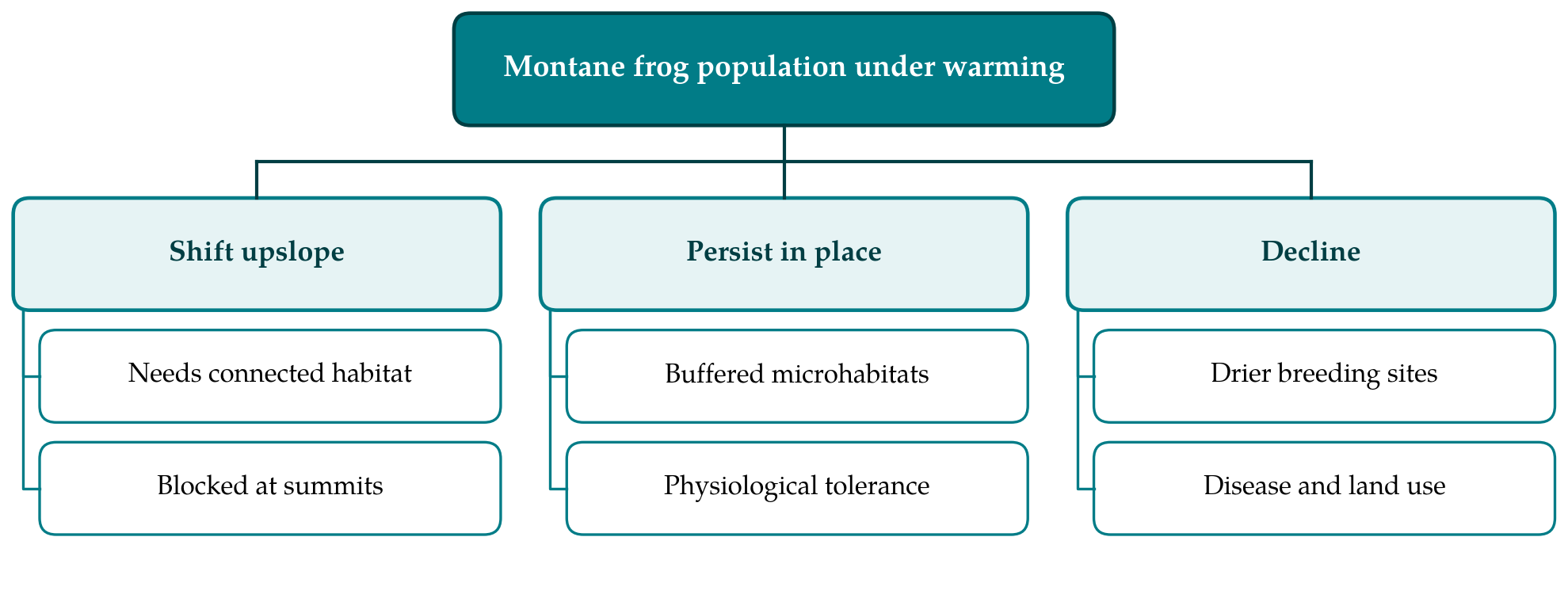
Disease is the most debated interaction. Pounds et al. (2006) proposed that warming had shifted montane conditions in the Neotropics towards the thermal optimum of the chytrid fungus Batrachochytrium dendrobatidis and so triggered extinctions of harlequin frogs. Later analysis questioned the mechanism and pointed instead to the effect of temperature variability on host defences (Rohr and Raffel, 2010). Whether the fungus interacts with climate on the sky islands of southern India is an open question that only combined pathogen and climate monitoring can answer.
Land use sets the stage for any shift. Tea, coffee, cardamom and exotic timber plantations occupy large parts of the middle and upper slopes, and reservoirs fill many valleys. A frog population can follow its climate upslope only through continuous suitable habitat, and for litter-dwelling species a few hundred metres of open plantation may be a complete barrier. Reviews of Southeast Asian herpetofauna reach the same view, that the effects of warming will be expressed through drying of breeding sites and loss of habitat connectivity more than through heat itself (Bickford et al., 2010).
8. What Detection Would Require
Detecting a shift from occurrence records is a statistical problem as much as a field one. Tingley and Beissinger (2009) show how differences in effort, location error and detectability between historical and modern surveys can produce apparent shifts or hide real ones. Frogs are a hard case, because the chance of recording a species on a given night varies enormously with rain, temperature and season. Occupancy models, which estimate detection probability from repeated visits and separate it from true presence (MacKenzie et al., 2002), are the accepted remedy, and they require that each site be visited several times within a season.
A credible monitoring design for the range would therefore have fixed transects spanning the full elevational extent of at least the Nilgiri, Anamalai and Agasthyamalai massifs, permanent plots at regular altitudinal intervals, repeated night searches and automated call recording within each monsoon, and temperature and humidity loggers placed in the microhabitats the frogs use. Voucher specimens and DNA barcodes are needed so that records survive future taxonomic revision. The gradient surveys already published, with their site coordinates, are the natural starting points, since each year that passes lengthens the interval over which change can be measured.
9. Gaps and Priorities
Four gaps stand out. The first is the baseline: existing gradient data need to be archived openly, with coordinates, effort and voucher numbers, before they are lost. The second is physiology, where measurements of thermal limits and water loss for a representative set of summit, mid-slope and widespread species would show which are closest to their limits. The third is microclimate, since regional temperature trends say little about conditions in shola litter. The fourth is the fate of summit endemics, for which no upslope refuge exists and for which management of the existing habitat, including the control of invasive woody plants in montane grassland, is the only option within the range.
Species distribution models are often used to fill such gaps, and they have value for ranking sites. Their projections for narrow endemics known from a handful of localities are fragile, however, and should not be mistaken for observations of change. Statements that Western Ghats amphibians are moving upslope are at present forecasts. They may well be correct, and the honest position is to label them as such.
10. Conclusion
The montane amphibians of the Western Ghats have the attributes that make a fauna vulnerable to warming: narrow elevational ranges, dependence on moisture, isolation on small summits and fragmented slopes below them. Resurveys from Madagascar, the Andes and elsewhere show what happens to comparable assemblages. For the Western Ghats itself, the published record does not yet contain a demonstrated elevational shift, mainly because reliable baselines are recent and the taxonomy has been in motion. The task for the coming decade is to repeat the first quantitative gradient surveys with methods that account for detection, and to pair them with physiological and microclimatic measurement, so that the question can be answered with data from the range.
Conflict of interest
To be declared by the author(s) before publication.
Funding
To be declared by the author(s) before publication.