1. Introduction
Myopia that begins in the early school years tends to progress until the late teens, and the earlier it starts the higher it ends. The concern is less the spectacles than the eye itself. Axial elongation stretches the retina and choroid, and the lifetime risks of myopic maculopathy, retinal detachment and glaucoma rise with the degree of myopia, without a threshold below which the eye is safe (Flitcroft, 2012). Projections by Holden et al. (2016) that about half of the world's population may be myopic by the middle of the century gave the subject urgency, and the argument that each dioptre of progression avoided reduces later risk has made modest treatment effects seem worth having (Bullimore and Brennan, 2019).
Atropine is the oldest pharmacological treatment for progressive myopia and the best studied. At full strength it is effective but leaves children with dilated pupils and no near focus, which limited its use to a few health systems. The finding that much weaker solutions retained part of the effect with few symptoms changed practice in East Asia first and then more widely (Wu et al., 2019). Low concentration atropine is now prescribed in many countries, in some under a licence and in others as an unlicensed compounded preparation.
This review addresses the three issues named in its title. They are linked. A concentration that slows myopia strongly but is followed by a loss of the gain on stopping may be no better over a childhood than a weaker one, and a treatment that may run for many years needs a safety record of matching length.
2. Approach of This Review
The article is a narrative review of the published literature. It relies on the randomised trials that define the field, their extension reports, published meta-analyses and the consensus and assessment documents of professional bodies. It was not conducted as a systematic review, and it does not pool results. Low concentration is used here in the sense common in the literature, meaning 0.05% and below, with 0.01% as the concentration most often studied. Effect sizes are described in words. Readers who need the figures for a particular trial should consult the original reports, since trials differ in age at entry, baseline progression, ethnicity and the outcome on which they were powered.
3. How Atropine May Act
Atropine is a non-selective antagonist at muscarinic acetylcholine receptors. The early rationale for its use was that it paralyses accommodation, which was thought to drive myopia. That explanation has been set aside. Atropine inhibits experimental myopia in the chick, whose ciliary muscle is striated and is not controlled by muscarinic receptors, so the effect cannot depend on accommodation. McBrien et al. (2013) review the alternatives: action at muscarinic receptors in the retina, choroid or sclera, effects on retinal dopamine release, and non-muscarinic mechanisms at the high tissue concentrations that topical dosing may produce. None has been established. The practical consequence is that concentration cannot be chosen from first principles and has had to be found by trial.
4. Dosing: What the Trials Show
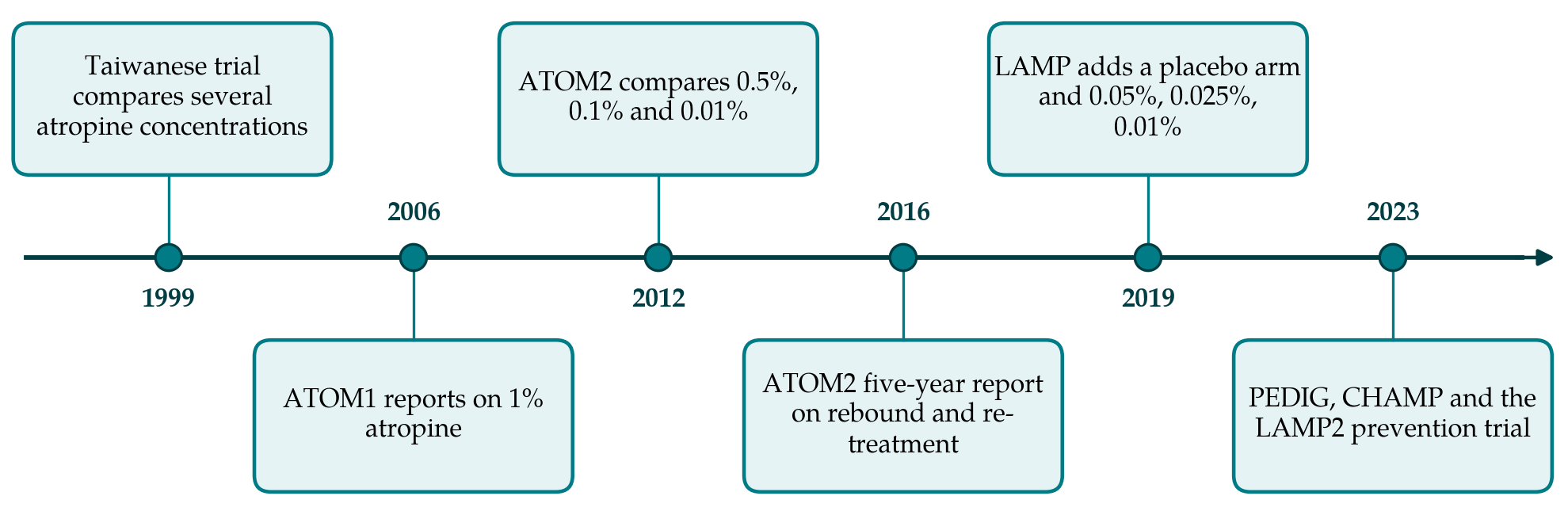
Figure 1 places the main trials in sequence. An early randomised comparison of several concentrations in Taiwan suggested that weaker solutions retained useful activity (Shih et al., 1999). The first Atropine for the Treatment of Myopia study (ATOM1) then showed in a placebo-controlled design that 1% atropine in one eye markedly slowed both refractive progression and axial elongation over two years (Chua et al., 2006).
4.1. From ATOM2 to LAMP
ATOM2 compared 0.5%, 0.1% and 0.01% given nightly to both eyes (Chia et al., 2012). All three slowed refractive progression in a concentration-dependent order, and the differences between them were small enough that 0.01%, with its minimal effect on pupil and accommodation, appeared the best compromise. Two features of the trial qualify that reading. It had no concurrent placebo group, so the lowest concentration was judged against a historical control from ATOM1, and the effect of 0.01% on axial length was slight. A treatment that changes refraction more than it changes eye length invites the question of whether the structural risk is being reduced.
The Low-Concentration Atropine for Myopia Progression (LAMP) study answered part of that question by randomising children in Hong Kong to 0.05%, 0.025%, 0.01% or placebo (Yam et al., 2019). The response was again ordered by concentration for both refraction and axial length, 0.05% was the most effective of the three, and 0.01% produced a small effect on refraction with little effect on axial elongation at one year. The second-year report, in which the placebo group was switched to 0.05%, maintained the ordering (Yam et al., 2020). All concentrations were well tolerated.
4.2. Placebo-controlled trials of the lowest concentrations
Trials of 0.01% against placebo have not agreed. A trial in Chinese children found a modest slowing of both refraction and axial length over one year (Wei et al., 2020), and a Japanese multicentre trial reported a similar modest effect over two years (Hieda et al., 2021). In an Australian cohort of mixed ancestry the effect was present in the first part of the study and no longer clear at two years (Lee et al., 2022). The trial run in the United States by the Pediatric Eye Disease Investigator Group found no significant benefit of 0.01% over placebo on either outcome (Repka et al., 2023). The three-year CHAMP trial, conducted in North America and Europe with a purpose-made formulation, found that 0.01% slowed progression and elongation, while the 0.02% arm showed a less consistent pattern across outcomes (Zadnik et al., 2023).
Table 1 summarises the trials. Several explanations for the disagreement have been proposed and none is proven. Iris pigmentation and ethnicity may alter drug binding and response. Formulation matters, since atropine in solution degrades at neutral pH and compounded products vary in strength and stability. Baseline progression differs between populations, and a slowly progressing control group leaves little effect to detect. Meta-analyses that predate the newer trials concluded that efficacy on refraction was broadly similar across concentrations while adverse effects rose with concentration (Gong et al., 2017). Those conclusions need to be read alongside the later placebo-controlled results and the distinction between refractive and axial outcomes, a point developed at length by Brennan et al. (2021).
| Trial and source | Setting | Comparison | Direction of findings |
|---|---|---|---|
| ATOM1 Chua et al., 2006 | Singapore | 1% versus placebo, one eye | Strong slowing of refraction and axial length |
| ATOM2 Chia et al., 2012 | Singapore | 0.5%, 0.1%, 0.01%; no placebo arm | Concentration-ordered effect; little axial effect at 0.01% |
| LAMP Yam et al., 2019 | Hong Kong | 0.05%, 0.025%, 0.01%, placebo | Concentration-ordered effect; 0.05% most effective |
| Wei et al., 2020 | China | 0.01% versus placebo | Modest slowing of both outcomes |
| ATOM-J Hieda et al., 2021 | Japan | 0.01% versus placebo | Modest slowing of both outcomes |
| WA-ATOM Lee et al., 2022 | Australia | 0.01% versus placebo | Early effect, not clear at two years |
| PEDIG Repka et al., 2023 | United States | 0.01% versus placebo | No significant benefit |
| CHAMP Zadnik et al., 2023 | North America, Europe | 0.01%, 0.02%, placebo | Benefit at 0.01%; less consistent at 0.02% |
5. Rebound After Stopping
Rebound means progression after cessation that is faster than would be expected in an untreated child of the same age. It was first documented after ATOM1. In the year after 1% atropine was stopped, treated eyes progressed faster than placebo eyes, and part of the earlier gain was lost (Tong et al., 2009). Some of the apparent refractive shift reflects the return of accommodative tone when cycloplegia wears off, but axial length data showed that true acceleration also occurred.
The washout phase of ATOM2 showed that rebound depended on concentration. Children who had used 0.5% or 0.1% progressed quickly after stopping, while those who had used 0.01% progressed least (Chia et al., 2014). When progressing children were then restarted on 0.01%, the group that had received 0.01% throughout ended five years with the least overall myopic progression, although axial length differences between groups were small (Chia et al., 2016). This result did more than any other to establish 0.01% in practice. It carries the limitation already noted, the lack of a contemporaneous untreated group across the five years.
LAMP examined the same issue with random assignment at the start of the third year to continue treatment or stop (Yam et al., 2022). Continued treatment was better than stopping at every concentration. Rebound after stopping was related to concentration but was small in absolute terms, and it was greater in younger children. The investigators concluded that stopping at a young age is inadvisable and that 0.05% remained the most effective regimen over three years even after allowing for rebound. How best to withdraw treatment is unresolved. Tapering the concentration or the frequency before stopping is widely practised and is reasonable on pharmacological grounds, but no randomised comparison of tapering against abrupt cessation is available to support a particular schedule.
6. Safety
Safety has to be considered on two time scales, the months and few years covered by trials and the decades that follow a childhood of treatment.
6.1. Short-term tolerability
The predictable effects of a muscarinic antagonist are pupil dilation, with glare and photophobia, and reduced accommodation, with blurred near vision. Both are concentration-dependent. In ATOM2 and LAMP the changes at 0.01% were small, few children needed photochromic or progressive-addition spectacles (Chia et al., 2012), and in LAMP vision-related quality of life did not differ from placebo (Yam et al., 2019). At 0.05% the pupil and accommodation effects were larger but were tolerated by most children. Allergic conjunctivitis and lid dermatitis occur and are more frequent at higher concentrations. Systemic anticholinergic effects such as flushing, dry mouth and tachycardia are recognised with full-strength drops in small children and have been rare in the low concentration trials. The technology assessment of the American Academy of Ophthalmology judged the evidence for short-term safety at low concentrations to be reassuring (Pineles et al., 2017).
6.2. Long-term safety
What remains uncertain is larger than what is known. The longest randomised follow-up runs to about five years, and no trial cohort has been followed systematically into adult life. Three theoretical concerns recur. A chronically larger pupil admits more short-wavelength light to the lens and retina over many years, and whether that has any consequence is unknown. Prolonged partial cycloplegia in childhood might alter the later course of accommodation or the age at which presbyopia is felt, and there are no data. Preserved formulations used nightly for years may affect the ocular surface. The International Myopia Institute report on interventions lists long-term safety among the principal unanswered questions (Wildsoet et al., 2019). The widespread use of atropine in Taiwan and Singapore over several decades without an evident signal of harm is some reassurance, but the absence of a signal where nobody has looked for one in a structured way is weak evidence.
A further safety issue is practical. Where no licensed low concentration product exists, drops are diluted or compounded locally, and the delivered concentration, pH, sterility and shelf life depend on the pharmacy. Variation of this kind may explain part of the inconsistency between trials and is a source of risk in routine care that the trials themselves do not capture.
7. Gaps and Future Work
Four gaps stand out. The first is the response in children of European and African ancestry, where placebo-controlled results conflict; a large multicentre trial in the United Kingdom was designed to address this (Azuara-Blanco et al., 2020). The second is the choice between 0.01% and higher low concentrations outside East Asia, where 0.05% has hardly been tested against placebo. The third is the management of stopping: when, at what age, and whether to taper. The fourth is prevention. The LAMP2 trial found that 0.05% reduced the incidence of myopia in children who were not yet myopic (Yam et al., 2023), which raises the prospect of treating children before the condition is present and makes the absence of long-term safety data more pressing still.
Judging response in an individual child is harder than the trial reports suggest. Progression slows with age whether or not treatment is given, so a child whose refraction changes little during a year of drops may or may not have benefited, and one who continues to progress may still be doing better than without them. Axial length measured by optical biometry is less affected by cycloplegia and more repeatable than refraction, which is why its routine use in follow-up is widely advocated. Agreed criteria for an inadequate response, and evidence on what to do when one is found, are lacking.
Future trials would be more useful if they reported axial length as a primary outcome alongside cycloplegic refraction, stated the formulation in full, followed children after cessation, and continued observation into adulthood through registries. Combination with optical interventions is being studied and falls outside the scope of this article.
8. Conclusion
Low concentration atropine slows myopia progression in many children, with an effect that increases with concentration within the low range and that is clearer for refraction than for axial length at 0.01%. The evidence is strongest in East Asian populations and inconsistent elsewhere. Rebound after stopping is real, grows with concentration and with younger age, and is small at the low concentrations studied, so that continued treatment through the years of fastest progression is better supported than early cessation. Short-term tolerability is good. Long-term safety has not been shown to be a problem and has not been shown to be assured, because the necessary follow-up does not yet exist. Prescribers and families are therefore making a decision with a known near-term benefit and an unquantified distant risk, and the literature supports saying so plainly.
Conflict of interest
To be declared by the author(s) before publication.
Funding
To be declared by the author(s) before publication.