1. Introduction
Mars has a carbon dioxide atmosphere with a surface pressure of only a few hectopascals, a surface of low thermal inertia and almost no ocean-like reservoir of heat. The ground and the air above it therefore warm and cool through a large range every sol, and the atmosphere answers with global oscillations locked to the Sun: the thermal tides. On Earth the tides are a small ripple on the surface pressure record. On Mars they are a leading feature of it, and they were among the first dynamical signals identified in the meteorological record returned from the surface (Leovy and Zurek, 1979).
Dust is the other defining element of Martian weather. Fine mineral particles are present in the air at all seasons, they absorb sunlight efficiently, and their heating shapes the temperature structure of the whole lower atmosphere (Gierasch and Goody, 1972). Storms that raise dust range from local events lasting a sol or two to planet-encircling storms that veil the surface for months, and the largest do not occur every year (Zurek and Martin, 1993). A comprehensive account of the dust cycle is given by Kahre et al. (2017).
The two subjects meet in a simple way. Tides are driven by heating, dust controls the heating, and tidal winds near the ground contribute to the stress that lifts dust. A loop of this kind invites the suggestion that tides help to start storms and not only respond to them. This review considers how well that suggestion is supported. It asks what theory predicts, what the observations show at the time of onset, and what numerical models add, and it separates the points on which the literature agrees from those still in dispute.
2. Scope and Approach
This is a narrative review of the published literature. It draws on the theoretical papers that adapted tidal theory to Mars, on analyses of lander and orbiter data, and on modelling studies that include dust lifting and transport. It is selective and does not attempt a complete catalogue of the field. The emphasis is on the lower atmosphere, taken here as the layer from the surface to a few scale heights, where lifting occurs and where the surface pressure signal of the tides is set. Tides in the upper atmosphere, which matter for aerobraking and for escape, are mentioned only where they bear on the lower levels. No new data or simulations are reported.
3. Thermal Tides in a Thin and Dusty Atmosphere
Classical tidal theory treats the tides as small oscillations of a stratified atmosphere on a rotating sphere, forced by periodic heating. The horizontal structure of each oscillation is described by Hough functions, the solutions of Laplace's tidal equation, and each has an equivalent depth that fixes whether it propagates vertically or stays confined near the level at which it is forced (Chapman and Lindzen, 1970). The theory carries over to Mars with little change because the planet's rotation period is close to that of Earth.
3.1. Classical theory applied to Mars
Zurek (1976) gave the first full treatment of the Martian diurnal tide. He showed that the component that follows the Sun propagates vertically in the tropics, with a vertical wavelength of a few tens of kilometres, and is trapped at higher latitudes. A short vertical wavelength means that heating at different heights partly cancels, so the surface pressure response of the diurnal tide depends on how the heating is distributed with height and on conditions near the ground. The semidiurnal tide behaves differently. Its main mode has a very long vertical wavelength and a broad meridional structure, so that heating through a deep layer adds coherently. A deep, planet-wide layer of absorbing dust is exactly the forcing to which it responds best.
This difference has a practical consequence that runs through the literature. The amplitude of the semidiurnal surface pressure oscillation behaves as an integrated measure of dust heating over much of the planet, whereas the diurnal amplitude is more sensitive to regional conditions and to the interference of several wave components. Sounding from orbit has since confirmed large diurnal temperature tides aloft (Lee et al., 2009) and has shown that the semidiurnal tide is prominent through the middle atmosphere in all seasons, with water ice clouds adding to the forcing supplied by dust (Kleinböhl et al., 2013).
3.2. Migrating and non-migrating components
Tides that move westward with the Sun are called migrating. Mars also has unusually strong non-migrating tides, which arise because the planet's large-scale topography and its surface thermal properties vary with longitude and modulate the solar forcing. The most discussed is an eastward-travelling diurnal Kelvin wave. A comprehensive model simulation by Wilson and Hamilton (1996) found that this wave lies close to a resonance of the atmosphere and can reach large amplitude, and that the sum of migrating and non-migrating components makes the tidal surface wind much stronger at some longitudes than at others. Table 1 summarises the main components and the way each bears on dust lifting.
| Component | Character | Relevance to storm onset | Representative sources |
|---|---|---|---|
| Migrating diurnal tide | Propagates vertically in the tropics; short vertical wavelength | Sets the daily cycle of near-surface wind; sensitive to regional heating | Zurek, 1976 |
| Migrating semidiurnal tide | Very long vertical wavelength; broad in latitude | Amplitude tracks planet-wide dust heating; adds to surface wind as dust deepens | Leovy and Zurek, 1979 |
| Diurnal Kelvin wave | Eastward, non-migrating, close to resonance | Makes tidal wind and pressure amplitude vary with longitude | Wilson and Hamilton, 1996 |
| Topographically modulated tides | Tied to basins, volcano flanks and broad slopes | Reinforce slope winds in preferred lifting regions | Wang et al., 2003 |
| Cloud-forced tides | Driven by absorption in water ice clouds | Alter the tidal background on which dust forcing acts | Kleinböhl et al., 2013 |
| Tides during high dust loading | Amplitudes grow; phases shift earlier or later | Evidence that a feedback is under way | Guzewich et al., 2016 |
4. How Dust Leaves the Surface
Lifting on Mars is hard. Because the air is so thin, the friction velocity needed to set sand grains moving is roughly an order of magnitude greater than on Earth, and such winds are uncommon (Greeley and Iversen, 1985). Particles of dust size are harder still to move directly, since cohesive forces between small grains rise as their weight falls. The usual view is that dust is raised mainly when saltating sand grains strike the surface, and that convective vortices supply a steady background of dust at times when the mean wind is too weak (Kok et al., 2012).
Two properties of this process matter for the present question. Lifting is a threshold phenomenon, so that a modest increase in wind stress can turn a quiet surface into a source. And the stress depends on the total wind, which is the vector sum of every circulation present: the seasonal mean flow, slope winds, travelling weather systems and the tides. Circulation models with a dust cycle represent lifting by wind stress and by dust devils with separate parameterisations, and the simulated storms are sensitive to the threshold chosen (Newman et al., 2002). A tidal wind that is too weak to raise dust alone may still decide whether the sum crosses the threshold.
5. Evidence Linking Tides to Storm Onset
Three kinds of observation bear on the link: pressure records at the surface, images and soundings from orbit, and the temperature and opacity climatologies that place individual storms in their seasonal setting.
5.1. Surface pressure records
The Viking landers recorded pressure through two planet-encircling storms in 1977. Leovy and Zurek (1979) found that the semidiurnal pressure oscillation grew abruptly at the start of each storm and decayed as the dust settled, in step with the opacity measured from the surface, and they presented this as direct evidence of coupling between tides and dust. Calculations of the effect of global dust on the circulation reached a compatible result: heavy dust loading strengthens both the overturning circulation and the tides (Haberle et al., 1982).
Later landers have refined the picture. At Gale crater the diurnal and semidiurnal pressure amplitudes follow the seasonal cycle of dust, with the semidiurnal amplitude the better tracer of column opacity (Guzewich et al., 2016). The planet-encircling storm of 2018 was observed from the floor of the same crater, where the tidal amplitudes rose sharply as the storm arrived (Guzewich et al., 2019). The InSight lander added a pressure sensor of much higher sensitivity and a continuous record that resolves the tidal harmonics together with shorter-period phenomena (Banfield et al., 2020). These records establish the response of tides to dust beyond reasonable doubt. Taken alone they do not show that tides came first.
5.2. Orbital imaging and sounding
Daily global imaging from Mars Global Surveyor made it possible to watch storms begin. Cantor et al. (2001) catalogued the storms of 1999 and showed that local events cluster along the edges of the seasonal polar caps and in a few low-latitude regions. The clearest case for a tidal role came from storms that originate with frontal systems in the northern mid-latitudes and are carried southward across the equator through the lowland channels of Acidalia, Arcadia and Utopia. Wang et al. (2003) combined images, temperature soundings and a circulation model and concluded that such a storm develops when the southward wind behind a front coincides in local time with the southward phase of the tidal wind, so that the two add.
The planet-encircling storm of 2001 has been reconstructed in similar detail. It began with local storms near the Hellas basin early in southern spring, expanded eastward, and was then sustained by secondary lifting centres far from its origin (Strausberg et al., 2005). Thermal infrared sounding recorded the warming of the atmosphere over the following weeks and documented how different that year was from its neighbours (Smith, 2004). Hellas is a place where slope winds, the retreating cap edge and strong tidal modulation coincide, which is consistent with the idea that onset needs several circulations to add.
Multi-year climatologies give the seasonal setting. A gridded record of column dust opacity now spans many Mars years and shows a low-dust season around aphelion and a dusty season in southern spring and summer (Montabone et al., 2015). Within the dusty season, temperature soundings reveal three regional storms that recur in most years at similar times, the first of them often triggered by the cross-equatorial frontal storms described above (Kass et al., 2016). Regularity of this kind points to control by the seasonal circulation and its tides and away from purely random triggering.
5.3. The feedback between dust heating and tidal wind
The observations and the theory together suggest the loop drawn in Figure 1. Dust raised from the surface increases the absorption of sunlight in the air. The added heating strengthens the tides, and the semidiurnal tide in particular as the dust layer deepens and spreads. Stronger tides bring stronger near-surface winds at certain local times, the lifting threshold is crossed over a wider area, and more dust is raised. The loop is not specific to tides, since the overturning circulation and slope winds respond to dust heating in the same sense, but the tides respond fastest because they are forced directly by each day's heating.
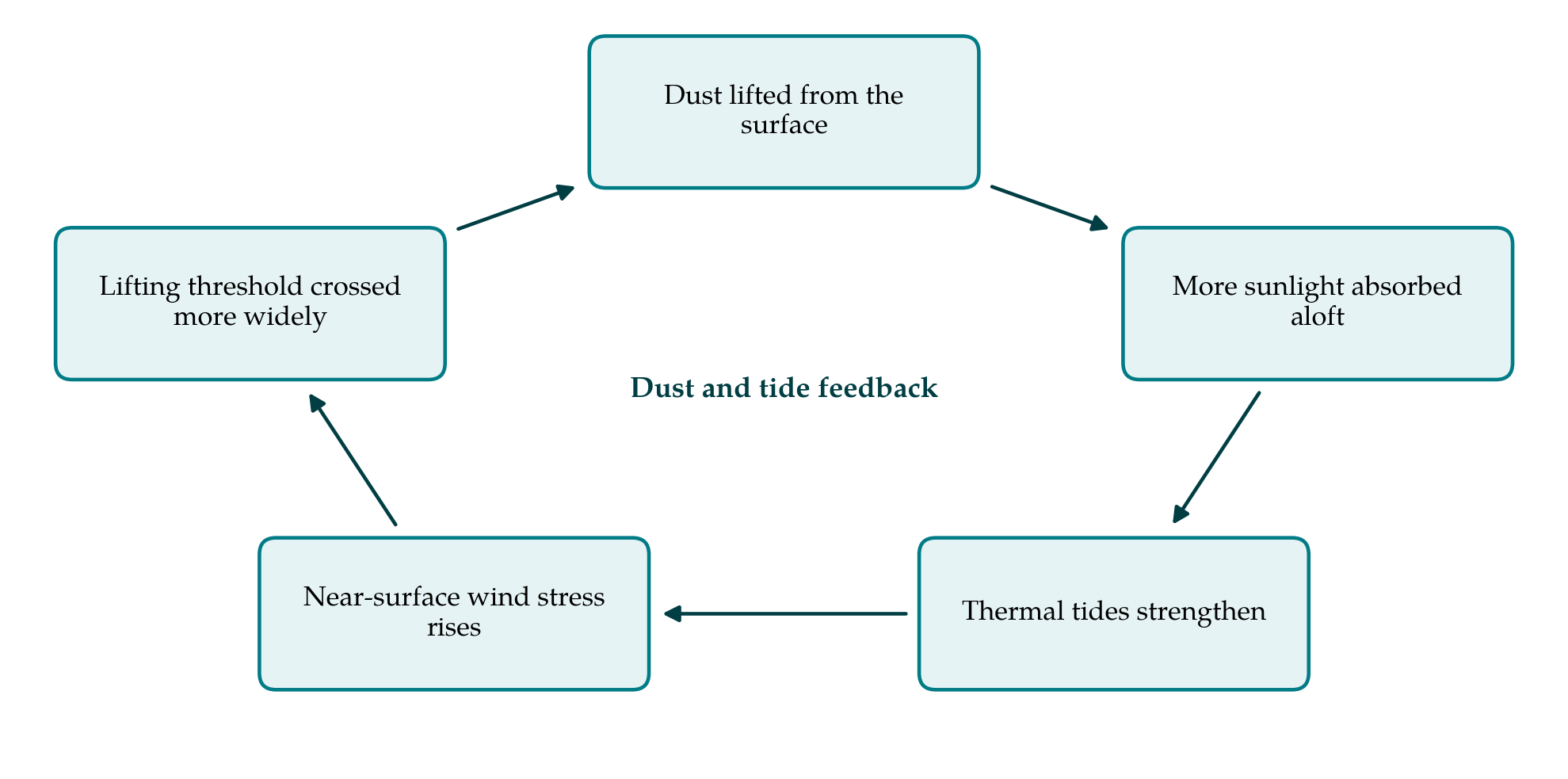
The loop also has brakes, and these explain why most storms stay small. Dust aloft shades the ground and stabilises the lowest layers, which weakens convection and the downward mixing of momentum. Lifting can exhaust the supply of loose material at a source. And the tidal wind is strong only for part of the sol, so that sustained growth needs other circulations to keep the stress high between tidal maxima.
6. What Circulation Models Show
General circulation models allow the pieces to be separated. The simulation of Wilson and Hamilton (1996) reproduced the Viking tidal record only when dust loading was raised to storm values and distributed deeply, which supports the reading of the semidiurnal tide as a measure of global dust. Models with interactive dust lifting go further. With a wind stress scheme and a suitable threshold, they generate storms spontaneously, including occasional global events, and some produce year-to-year variability without any change in external forcing (Basu et al., 2004). In such experiments the positive feedback on wind stress lifting is essential to storm growth, whereas dust devil lifting is self-limiting (Newman et al., 2002).
Models have limits that bear directly on the tidal question. Lifting occurs at gusts and on scales far below the grid, so the threshold in a model is a tuned quantity and not a measured one. Simulated tidal winds depend on the vertical distribution of dust, which most models prescribe or represent crudely, and on water ice clouds. A model can therefore show that tides are able to tip the balance toward onset without showing that they did so in any particular storm.
7. Gaps and Future Work
Three questions remain open. The first is causal order at onset. Pressure records show tides growing as dust arrives over a lander, but a lander samples one point, and the storm has usually started elsewhere. A network of surface stations with pressure and wind sensors, even a sparse one, would allow tidal wind to be compared with lifting at the source. The second concerns the near-surface wind itself. Almost all evidence about tidal winds is inferred from pressure, temperature or models, and direct wind measurements through a storm onset are rare.
The third question is interannual variability. Proposals include the slow redistribution of surface dust between source regions, intrinsic variability of the circulation, and a coupling between the planet's orbital motion and its rotation (Shirley, 2015). The last of these is debated. None of the proposals removes the need for a trigger in the right season, and for that the superposition of tides with fronts and slope winds remains the best documented mechanism. Continuous global sounding at several local times, which sun-synchronous orbiters cannot provide, would let the tides be separated cleanly from other variations and is perhaps the single most useful observational advance in prospect.
8. Conclusion
The literature gives a consistent account on two points. Thermal tides in the lower Martian atmosphere strengthen promptly when dust loading rises, the semidiurnal tide most reliably, and this response has been seen by every long-lived lander. Tidal winds also contribute to onset by adding to frontal, slope and seasonal winds at particular places and local times, as the cross-equatorial storms show most clearly. The stronger claim, that tides start large storms unaided, is not supported. They are better regarded as one necessary contributor to a threshold process, and as the fastest link in the feedback that lets a regional storm grow. Deciding how much of the year-to-year difference in storm activity they explain will need wind measurements at the surface and soundings that cover the full daily cycle.
Conflict of interest
To be declared by the author(s) before publication.
Funding
To be declared by the author(s) before publication.