1. Introduction
Plastic debris smaller than five millimetres, generally called microplastic, was first documented as a widespread contaminant in marine sediments and waters (Thompson et al., 2004). For some years the research that followed stayed at sea. Rillig (2012) pointed out that soils were likely to receive plastic particles too and that almost nothing was known about them there, and Nizzetto et al. (2016) later argued that farmland receiving sewage sludge could hold a burden of urban microplastic comparable to, or larger than, that estimated for the surface of the oceans. Agricultural soil is now regarded as a major long-term store of plastic particles, with consequences for soil function that are still being worked out (de Souza Machado et al., 2018a).
Water scarcity has made treated municipal wastewater an established irrigation source in arid and semi-arid regions, and policy encourages the practice. The World Health Organization's guidelines set out a risk-management framework for the safe use of wastewater in agriculture (WHO, 2006), and the European Union has adopted minimum quality requirements for reclaimed water used for irrigation (European Union, 2020). Both instruments are concerned chiefly with pathogens and conventional water quality parameters. Neither sets a requirement for plastic particles. Reclaimed water therefore reaches fields carrying whatever microplastic the treatment process has not removed, season after season, onto land that is expected to stay productive for generations.
This review asks what is known about that pathway. It considers which particles survive treatment, how irrigation delivers them to soil, whether they build up there, and what the consequences might be for soil and crops. It also considers why studies are so difficult to compare, since the answer to that question limits how firmly any of the others can be answered.
2. Scope and Approach
This is a narrative review of the published literature. It does not report a systematic search and makes no claim to completeness. Sources were chosen for their bearing on four linked topics: the fate of microplastics in wastewater treatment, the routes by which plastics enter agricultural soil, the behaviour of plastic particles once in soil, and their effects on soil properties, soil organisms and plants. Much of the relevant evidence was gathered for other purposes, in particular to study the application of sewage sludge to land. Where the review reasons from sludge to effluent it says so, because the two inputs differ in concentration, in particle size and in the way they are applied.
3. Microplastic in Municipal Wastewater
Municipal sewage gathers plastic particles from many small sources and concentrates them at a single point. What arrives at the treatment works, and what leaves it, determines the quality of the water later offered to farmers.
3.1. Where the particles come from
The best documented source is the laundering of synthetic textiles. Browne et al. (2011) matched the polyester and acrylic fibres found on shorelines to those shed by garments in domestic washing machines and identified sewage as the link between them. Napper and Thompson (2016) then showed that a single wash load can release very large numbers of fibres, with the amount depending on the fabric and the washing conditions. Other contributions include fragments from the breakdown of larger plastic items, manufactured beads from some personal care products and, where sewers also carry storm water, particles washed from roads and roofs. The mixture is dominated by fibres in most accounts, which matters for what follows because fibres behave differently from compact particles in both treatment and soil.
3.2. What treatment removes and what it passes
Conventional treatment is effective at taking microplastics out of the water. Carr et al. (2016) found that most particles were removed in the early stages of treatment, by skimming of floating material and by settling, and that plants with tertiary filtration discharged very few. Murphy et al. (2016) reported a similarly high removal efficiency at a large secondary treatment works but drew attention to the other side of the calculation: because the volume of effluent is so great, even a small residual concentration amounts to a very large number of particles released each day. The particles that remain in final effluent tend to be the smaller ones, and fibres are prominent among them.
Advanced final-stage technologies lower the residual further. Talvitie et al. (2017) compared membrane bioreactors, rapid sand filtration, dissolved air flotation and disc filters and found that all of them improved on conventional effluent, the membrane bioreactor most of all. Two qualifications apply. Removal is transfer and not destruction, so the particles taken out of the water end up in sludge. And the numbers reported depend heavily on the smallest particle size a study was able to detect. A critical assessment of studies on microplastics in water concluded that sampling and analysis were often of limited quality and that the smaller size classes were systematically under-reported (Koelmans et al., 2019). Effluent concentrations in the literature are therefore best read as lower bounds.
4. From Effluent to Field
How much of the residual load reaches the soil depends on what happens between the treatment works and the crop. Reclaimed water is often held in open reservoirs, where some particles may settle and others may be added from the air or from degrading liners and pipes. The irrigation method then acts as a final filter, or fails to. Surface methods such as flood and furrow irrigation deliver the water and everything suspended in it directly to the field. Drip systems require screen or disc filtration to protect the emitters from clogging, and that filtration can be expected to hold back the larger particles while passing the smallest. Figure 1 sets out the stages of the pathway and the process that dominates at each.
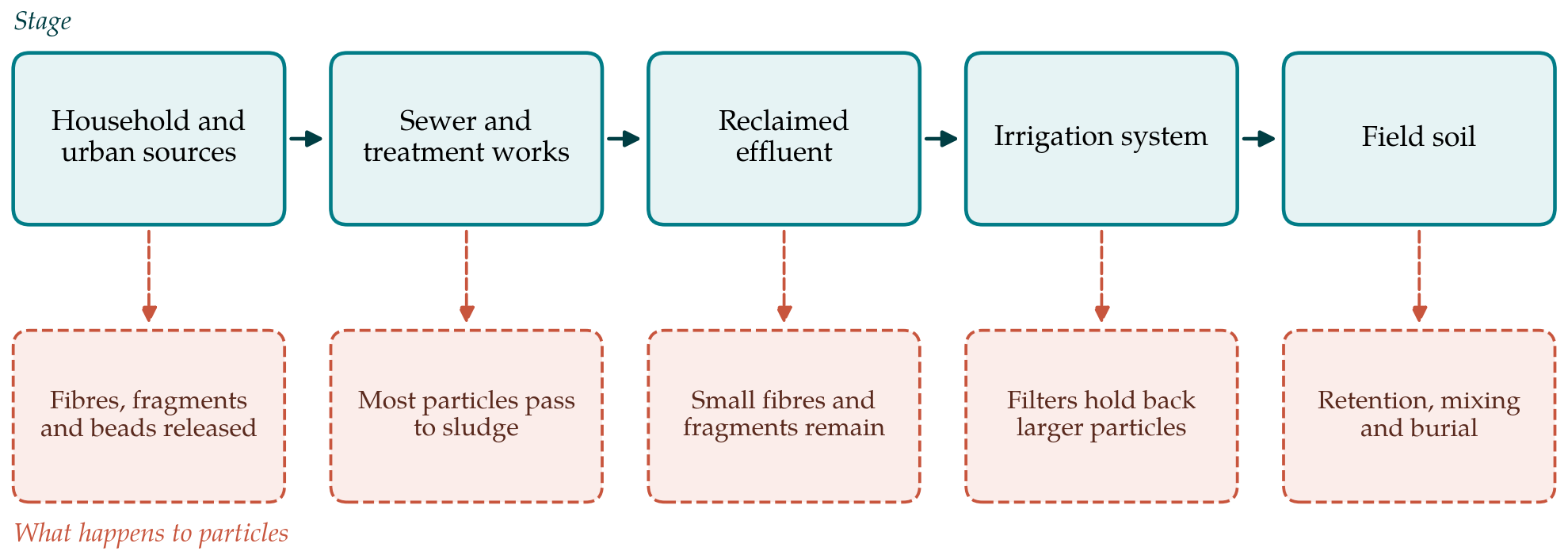
The cumulative input to a field is the product of the concentration in the water applied, the depth of irrigation each season and the number of seasons. Each irrigation adds little. The concern arises from repetition over decades on the same land, combined with the durability of the material. Irrigation with effluent is also only one of several ways in which plastic reaches farmland, and it has to be seen alongside the others. Table 1 compares the main pathways and the state of the evidence for each.
| Pathway | Nature of the input | State of the evidence | Representative sources |
|---|---|---|---|
| Sewage sludge and biosolids | Episodic and concentrated; fibres prominent | Clearest field evidence of build-up over time | Zubris and Richards, 2005; Corradini et al., 2019 |
| Treated wastewater irrigation | Continuous and dilute; small fibres and fragments | Few field studies; methods differ widely | Murphy et al., 2016; Talvitie et al., 2017 |
| Plastic mulch film | Fragmentation of film left in the field | Residues documented where mulching is intensive | Steinmetz et al., 2016 |
| Compost and digestate | Packaging fragments carried in biowaste | Particles demonstrated in the fertiliser products | Weithmann et al., 2018 |
| Atmospheric deposition | Diffuse; mainly fibres | Fallout measured at urban and suburban sites | Dris et al., 2016 |
The comparison is instructive. Sludge delivers a concentrated dose on the few occasions it is spread, whereas effluent delivers a dilute one many times a year. Mulch film fragments in place and produces mostly polyethylene pieces (Steinmetz et al., 2016), while compost and digestate made from household and commercial biowaste carry fragments of packaging (Weithmann et al., 2018). Fibres also arrive from the air (Dris et al., 2016). In any real field several of these inputs operate together, and a survey that finds plastic in an effluent-irrigated soil cannot attribute it to the irrigation water without knowing the history of the others.
5. Evidence of Accumulation in Soil
The strongest evidence that repeated inputs add up comes from land treated with sludge. Zubris and Richards (2005) found synthetic fibres in soils many years after the last recorded application and proposed them as a durable indicator that sludge had once been spread. Corradini et al. (2019) examined fields with documented application histories and found that microplastic content rose with the number of applications a field had received. These studies establish two points that carry over to irrigation: synthetic particles delivered in wastewater products persist in agricultural soil for years, and successive doses are additive.
For irrigation with treated effluent the direct field evidence is thinner. Surveys of irrigated plots exist, but they are few, they use different extraction and identification methods, and they seldom include matched plots that received other water. The inference that effluent irrigation leads to accumulation is therefore partly an argument from analogy. The analogy is reasonable, since the particles have the same origin and the same chemistry, yet it has limits. Effluent particles are smaller on average than those in sludge. Smaller particles are more mobile in the soil profile and are more likely to fall below the detection limit of the methods in common use, so a survey may understate what is present.
Once in the soil, particles are redistributed more than they are removed. Tillage mixes them through the plough layer. Soil fauna move them further: the earthworm Lumbricus terrestris draws plastic particles from surface litter into its burrows (Huerta Lwanga et al., 2016), and experiments with the same species showed downward transport of polyethylene particles, the smallest travelling furthest (Rillig et al., 2017). Losses occur through erosion and runoff and possibly by movement to depth through large pores, but these routes are poorly quantified, and degradation of the common polymers under soil conditions is slow. Hurley and Nizzetto (2018) identify the balance between retention and export as one of the main gaps in knowledge about plastics in soil.
6. Consequences for Soil and Crops
Experimental work indicates that plastic particles can change the physical environment of the soil. de Souza Machado et al. (2018b) added four types of particle to a loamy sand and found changes in bulk density, water holding capacity and the relationship between microbial activity and stable aggregates. Polyester fibres produced the most marked effects. That result is relevant here because fibres are the form most characteristic of wastewater. A fibre is not simply another soil particle: its length and flexibility allow it to become entangled with aggregates and to alter the pore space in ways a compact grain would not.
Effects on soil animals have been shown for earthworms, whose growth was reduced and mortality raised when the litter they fed on contained high proportions of polyethylene (Huerta Lwanga et al., 2016). For crops, the most striking finding is that plastic particles of submicrometre size can enter the roots of wheat and lettuce through the gaps that open where lateral roots emerge, and can then be carried to the shoots (Li et al., 2020). This demonstrates a mechanism of uptake. It does not show how much plastic of that size is delivered by irrigation water in practice or whether the amounts reaching edible tissue matter for the consumer.
A general caution applies to all of this work. Many experiments use concentrations higher than those so far measured in farmed soils, a single polymer in a regular shape, and exposure times of weeks or months. Field soils contain aged, irregular mixtures at lower concentrations and receive them over decades. The experiments identify what plastics are capable of doing. Whether they do it at the levels produced by effluent irrigation remains open (de Souza Machado et al., 2018a).
7. Methods and the Problem of Comparability
The procedures used to find microplastics were developed for water and beach sediment: sieving, flotation in a dense salt solution, and sorting under a microscope (Hidalgo-Ruz et al., 2012). Soil is a harder matrix. Organic matter floats with the plastic and has to be destroyed without damaging the polymers, and aggregates enclose particles that must first be released. Bläsing and Amelung (2018) reviewed the analytical options for soil and found no agreed standard. Hurley et al. (2018) tested several ways of removing organic matter from sludge and soil and recommended oxidation with Fenton's reagent as effective and gentle on the particles. Polymer identity is then confirmed by infrared or Raman spectroscopy, or the plastic is quantified as a mass by thermal methods that give no information on particle number or shape.
These choices shape the result. A study that counts particles down to a fraction of a millimetre cannot be set beside one that stops at one millimetre, and a count cannot be converted to a mass without assumptions about size and density. Quality assurance is a further weakness. Synthetic fibres from clothing and laboratory air contaminate samples readily, so procedural blanks, recovery tests and spectroscopic confirmation are needed, and the quality criteria proposed for water studies apply with equal force to soil (Koelmans et al., 2019).
8. Gaps and Future Work
The most useful next step would be long-term monitoring of paired plots, irrigated with reclaimed and with conventional water, in which the microplastic content of the water applied is measured alongside that of the soil. Such a design would allow a mass balance and would separate the contribution of irrigation from that of mulch, compost and atmospheric fallout. Established reuse schemes offer a second opportunity, since fields irrigated with effluent for decades already hold the record of past inputs if suitable reference soils can be found. In both cases agreed methods with a stated lower size limit are a precondition for results that can be compared.
There is also a question for those who set standards. Tertiary filtration lowers the particle load in reclaimed water, but it moves the particles into sludge, and sludge is itself widely applied to land. Judged across the whole system, a gain at one outlet may be a loss at another. Rules for water reuse do not yet address plastics, and the evidence reviewed here is not sufficient to say what a limit should be. It is sufficient to justify including microplastics in the monitoring of reuse schemes, so that the information needed for such a judgement begins to accumulate.
9. Conclusion
Treated wastewater brings a steady, dilute supply of small plastic particles to the fields it irrigates. The persistence of these materials and the experience with sludge-amended land make accumulation the expected outcome, although it has been measured directly in few places and with methods that resist comparison. Laboratory studies show plausible routes to harm through changes in soil structure, effects on soil fauna and uptake of the smallest particles by plants, without yet showing that field concentrations are high enough to produce them. Reuse of wastewater remains a sound response to water scarcity. The literature supports adding plastics to the list of things that reuse schemes measure, and it points to harmonised methods and long-term plots as the way to replace inference with observation.
Conflict of interest
To be declared by the author(s) before publication.
Funding
To be declared by the author(s) before publication.