1. Introduction
Hospitality has long been described as a people business, and the hotel as the place where that description is most literal. The arrival of robots in lobbies and corridors therefore attracts more attention than automation in a warehouse would. The Henn na Hotel in Nagasaki, which opened in 2015 with robots at reception and in the cloakroom, became the emblem of the trend, and its later decision to withdraw many of those machines became an emblem of its limits. Between those two moments a research literature formed quickly, encouraged by early agenda-setting papers that asked what tourism scholarship could contribute to the study of human-robot interaction (Tung and Law, 2017).
Two questions run through that literature. The first concerns guests: whether they accept robotic service, whether it raises or lowers satisfaction, and under what conditions. The second concerns staff: whether robots replace hotel workers, relieve them of drudgery, or change their jobs in ways that neither word captures. The two are seldom treated together, although a hotel manager deciding on a purchase has to answer both at once. This review considers them side by side.
2. Approach to the Literature
The article is a narrative review of published work in hospitality, tourism and service research. It builds on earlier syntheses of robotics in the sector (Ivanov et al., 2019; Tussyadiah, 2020) and adds the service management and marketing studies on which hospitality researchers draw. Sources were selected for their influence on the field and their relevance to hotels, and the selection is illustrative, not exhaustive. Self-service kiosks and chatbots are mentioned only where they share a mechanism with physically embodied robots, which are the subject here.
3. Robots in the Hotel Setting
A widely used definition treats service robots as system-based, autonomous and adaptable interfaces that interact, communicate and deliver service to an organisation's customers (Wirtz et al., 2018). In hotels the term covers machines that differ greatly in what they do and in how much the guest sees of them. Table 1 groups them by task. The grouping matters because findings about a humanoid receptionist do not transfer to a delivery cart, and many studies do not say clearly which kind of robot their respondents had in mind.
| Type | Typical tasks | Guest contact | Main issue raised in the literature |
|---|---|---|---|
| Delivery robot | Brings amenities and food to rooms | Brief | Novelty, speed and reliability in lifts and corridors |
| Reception or concierge robot | Greets, checks in, answers questions | Sustained | Humanlike appearance, conversation quality Murphy et al., 2019 |
| Porter robot | Carries and stores luggage | Brief | Functional performance and safety |
| Cleaning robot | Vacuums floors, disinfects surfaces | Minimal | Perceived hygiene, effect on housekeeping work |
| Kitchen or bar robot | Prepares drinks or simple dishes | Visual | Entertainment value, consistency |
| In-room assistant | Controls room settings, takes requests by voice | Sustained | Privacy and data use |
Ivanov et al. (2017) catalogued the adoption of robots and service automation across travel, tourism and hospitality firms and argued that the decision is at root an economic one, in which labour cost, availability of staff and the image of the brand are weighed against purchase and maintenance. That observation is a useful corrective to accounts that treat adoption as driven by guest demand alone.
4. Guest Acceptance and Satisfaction
Research on guests began with the question of acceptance and borrowed its first tools from information systems. The technology acceptance model, in which perceived usefulness and perceived ease of use predict intention to use (Davis, 1989), was soon judged too narrow for a technology that moves, speaks and occupies social space.
4.1. Acceptance models built for service robots
Wirtz et al. (2018) proposed a service robot acceptance model that adds social-emotional elements, such as perceived humanness and social presence, and relational elements, such as trust and rapport, to the functional core. Gursoy et al. (2019) set out a staged model in which social influence, hedonic motivation and anthropomorphism feed expectations of performance and effort, which in turn generate emotion and then willingness or objection. Lu et al. (2019) developed and validated a scale of willingness to integrate service robots into hospitality transactions. Belanche et al. (2020) organised the growing list of predictors under robot design, customer features and the characteristics of the service encounter. The shared message is that acceptance is an emotional and social judgement as much as a calculation of usefulness.
4.2. Humanlike appearance
Whether a hotel robot should look human is the most debated design question. The idea of automated social presence holds that a machine can make customers feel they are in the company of another social being, with consequences for how the service is experienced (van Doorn et al., 2017). The uncanny valley hypothesis warns that near-human likeness produces unease (Mori et al., 2012). Experimental work in service settings supports the warning: Mende et al. (2019) found that humanoid service robots elicited discomfort and compensatory consumer behaviour. In the hotel context, Tussyadiah and Park (2018) compared consumer evaluations of two robots of different form and showed that intention to adopt related to different attributes for each, and an analysis of online comments on humanlike hotel robots recorded fascination mixed with unease (Yu, 2020). Murphy et al. (2019) concluded that anthropomorphism should be treated as a set of separate cues to be matched to the task.
4.3. Service quality and the guest experience
Acceptance is a precondition for satisfaction and is not the same thing. Service quality in hotels has traditionally been assessed on dimensions such as reliability, responsiveness, assurance and empathy (Parasuraman et al., 1988), and robots perform unevenly across them. A delivery robot can be highly reliable and has no empathy to offer. Choi et al. (2020) compared perceptions of human staff and service robots and reported that human staff were rated more favourably on the quality of interaction. Tung and Au (2018) examined guest reviews of hotels that use robots and showed that guests describe their encounters in terms of embodiment, emotion and shared experience, in addition to function. Qiu et al. (2020) found that the contribution of robot attributes to the hospitality experience ran through rapport, between guest and robot and between guest and staff.
Two qualifications recur. Much of the positive response to robots reflects novelty, which fades with repeated exposure and cannot be the basis of a lasting service concept. And robots fail in ways that guests find hard to forgive when no member of staff is at hand to recover the situation. The pandemic altered the balance for a time: experimental studies conducted during it found that the salience of infection risk raised preference for robot-staffed hotels (Kim et al., 2021). Whether that preference has outlasted the emergency has not been established.
5. Staff Roles
The employee side of the question has received less study than the guest side, and what has been published is more often conceptual than empirical.
5.1. Substitution and augmentation
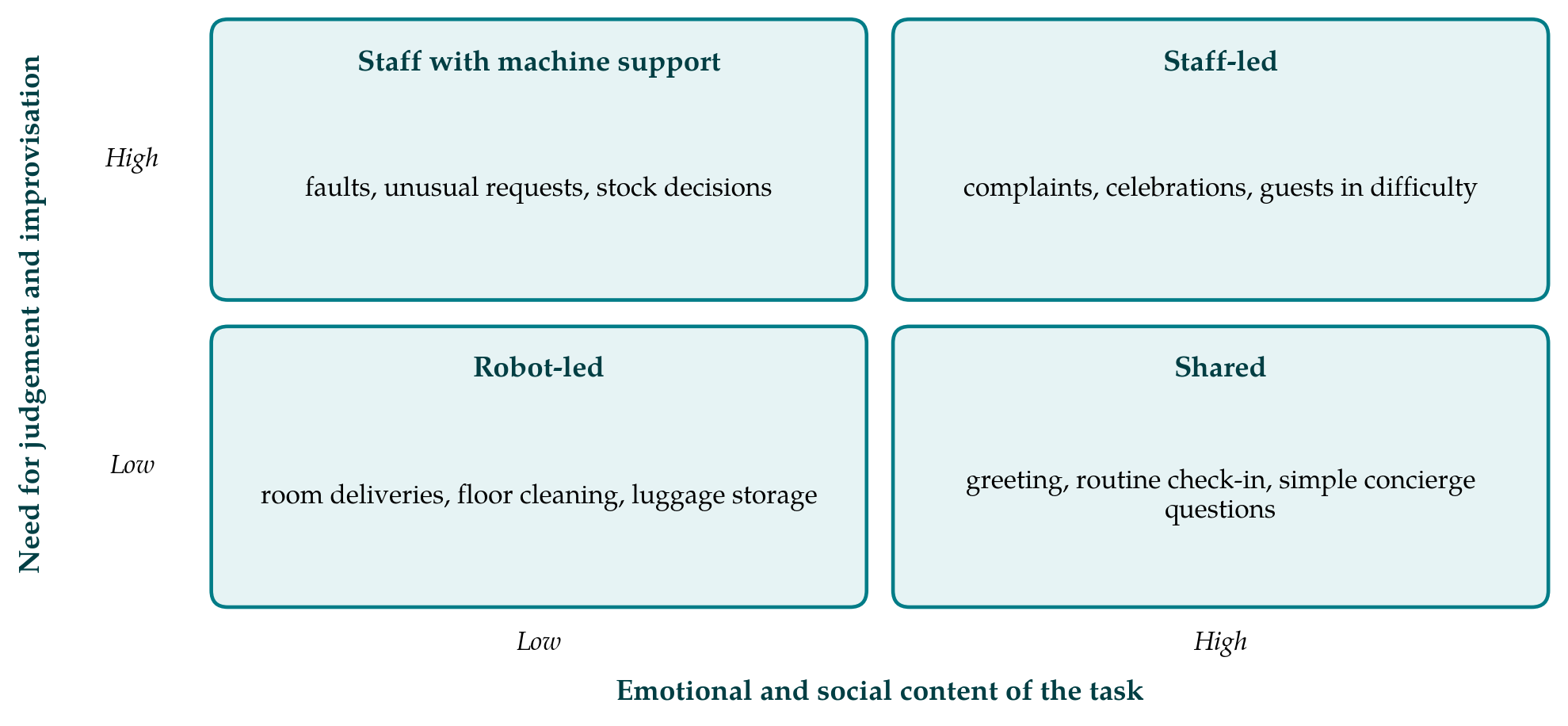
Forecasts of large-scale job loss to computerisation (Frey and Osborne, 2017) set the tone of public discussion. Service researchers have generally argued that replacement happens at the level of the task before the job. Huang and Rust (2018) distinguish mechanical, analytical, intuitive and empathetic intelligence and propose that artificial intelligence takes over tasks roughly in that order, leaving human workers to concentrate on the last two for as long as machines cannot perform them. Wirtz et al. (2018) reach a compatible conclusion: robots are likely to dominate cognitive and analytical tasks of low emotional complexity, people to retain tasks of high emotional and social complexity, and mixed teams to handle the remainder.
Hotel work fits this account unusually well, because it combines repetitive physical tasks with what Hochschild (1983) called emotional labour, the managed display of feeling that guests read as hospitality. Figure 1 arranges common hotel tasks by their emotional content and by the judgement they require. It is a reading of the literature and has not been tested as a model.
5.2. How employees see robots
The best-known empirical study of hotel employees found that awareness of artificial intelligence and robotics was positively associated with intention to leave, and that perceived organisational support weakened the association (Li et al., 2019). The result suggests that the first effect of robots on staff may be felt before any job is removed, through insecurity, and that it can be moderated by how the employer behaves. Qualitative accounts add that staff who work beside robots acquire new duties: loading and maintaining the machines, rescuing them when they stall, explaining them to guests and stepping in when they fail. These tasks are rarely written into job descriptions or training.
A related theme is the meaning that staff attach to their work. Hospitality employees commonly describe contact with guests as the rewarding part of the job and the physical routine as its cost. A robot that takes over night-time deliveries or corridor cleaning removes some of that cost, and on this reading is a welcome colleague. A robot stationed at the front desk takes the contact and leaves the routine, and is more likely to be resented. Which tasks are automated, and who is consulted about the choice, may therefore matter more to staff than the number of machines installed (Ivanov et al., 2019).
The redistribution has an uneven social profile. The tasks most open to automation, in housekeeping, portering and room service, are held disproportionately by workers with the least bargaining power, while the tasks that remain reward language skills and confidence in dealing with guests. A hotel that automates the back of house and concentrates its remaining staff in guest-facing roles may raise the skill demands of the average job while closing the entry-level positions through which many people join the industry.
6. Limits of the Evidence and a Research Agenda
Several weaknesses qualify what can be concluded. A large share of guest studies ask respondents to imagine a robot from a description, picture or video, and measure intention, which is a weak proxy for behaviour in a real stay. Studies based on online reviews observe real guests but only those motivated to write. Research sites are concentrated in East Asia and the United States, and cultural attitudes to robots differ. Robot types are often left unspecified. On the staff side, cross-sectional surveys of awareness and intention say little about what happens to hours, pay and tasks after installation.
The agenda that follows is practical. Field studies that track guest satisfaction scores before and after a robot enters service, with attention to repeat guests, would separate novelty from lasting value. Studies of failure and recovery in mixed human-robot teams would show how much staff presence a robot needs behind it. Longitudinal work with employees and their representatives would test the task-level account against the experience of housekeeping and front-office staff. Accessibility for older guests and guests with disabilities, and the handling of the data that robots collect in private rooms, deserve more attention than they have had (Tussyadiah, 2020).
7. Conclusion
The research reviewed here supports a measured view of service robots in hotels. Guests accept them, and sometimes enjoy them, where the task is functional and the contact short. Satisfaction with stays as a whole continues to depend on human staff, whose warmth, discretion and capacity to recover from failure robots do not yet supply. For employees the immediate effects are a change in the mix of tasks and a rise in insecurity that supportive management can reduce. The firmest conclusion concerns the evidence itself: it is rich in models of intention and thin in observation of operating hotels over time, and the questions that matter most to managers and workers will be settled only by studies of that kind.
Conflict of interest
To be declared by the author(s) before publication.
Funding
To be declared by the author(s) before publication.