1. Introduction
A sonic logo lasts two or three seconds. In that time it is supposed to do what a visual logo does on a page: identify the brand and bring some of its meaning to mind. Practitioners have written about the design of such sounds for two decades (Jackson, 2003), and academic interest has followed, though a review of the field found it fragmented and short of consumer-level evidence (Gustafsson, 2015). One reason is that the outcome is awkward to measure. A listener may hum a jingle without being able to name the advertiser, or feel that a chime is familiar without knowing why.
Standard practice relies on two questions. Unaided recall asks which brands' sounds the respondent can think of. Aided recognition plays a clip and asks whose it is. Both correspond to the components of brand awareness in Keller's (1993) model, and both are explicit: they require deliberate retrieval and a verbal report. Memory research has long distinguished this from implicit memory, in which earlier exposure affects later performance without conscious recollection (Schacter, 1987). Sound is a plausible carrier of the second kind. In a well-known field experiment, the nationality of background music in a shop shifted which wines were bought, while shoppers appeared unaware of any influence (North et al., 1999).
This article proposes a protocol for measuring sonic branding recall that adds two elements to the standard questions: implicit association tasks that use sound clips as stimuli, and a listening diary that records encounters with brand sounds in daily life. The protocol is a methodological proposal. No data are reported and the procedure has not been validated here.
2. Why Three Kinds of Evidence
Each of the three sources answers a different question and has a characteristic weakness. Explicit recall shows what a listener can retrieve and name, but it depends on motivation, on verbal labels and on the cues the questionnaire happens to offer. Early work on jingles found that music helps people remember advertising slogans mainly when other retrieval cues are scarce (Yalch, 1991), which implies that the wording of a recall question can itself change the result. Explicit measures also say nothing about whether the sound has acquired the meanings the brand intended.
The Implicit Association Test was devised to measure the strength of associations between concepts from the speed of sorting decisions, without asking the respondent to report them (Greenwald et al., 1998). It has been applied to brands, where it has predicted preference and behaviour and added to what explicit ratings explained (Maison et al., 2004; Brunel et al., 2004). Its stimuli are usually words or pictures. Nothing in its logic requires this, and short sounds can in principle be sorted in the same way.
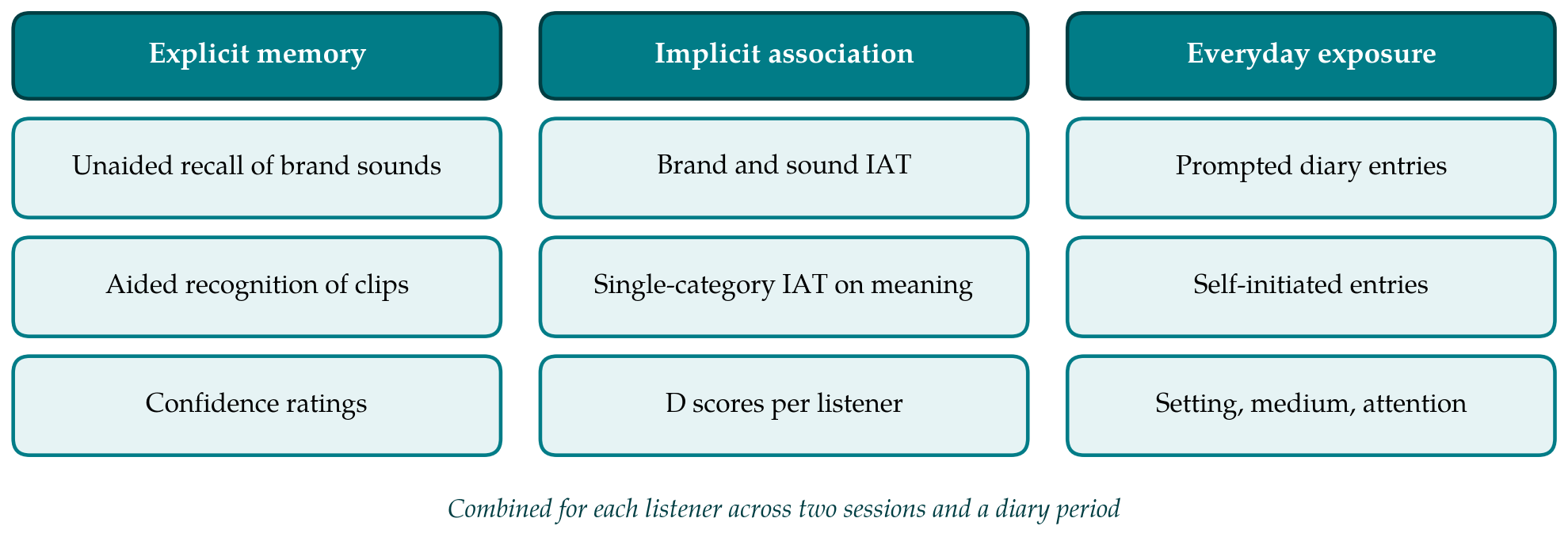
Neither kind of test shows how often, where or in what state of attention the listener has met the sound. Diary methods are designed for exactly that. They collect brief reports close to the events they describe and so reduce reliance on memory over long intervals (Bolger et al., 2003; Shiffman et al., 2008). Experience sampling has been used to describe how people use music in ordinary life (Sloboda et al., 2001), and the same approach can be pointed at brand sounds. Figure 1 sets out the three strands and the measures within each.
3. The Proposed Protocol
The protocol consists of a first test session, a diary period and a second test session. Its six steps are described below.
3.1. Step 1: State what is to be measured
Sonic branding recall is not one thing. The investigator should decide in advance which of three outcomes matter: whether listeners can retrieve the sound when given the brand, whether they can retrieve the brand when given the sound, and whether the sound evokes the attributes the brand claims. The first two concern linkage and the third concerns meaning. A study that covers all three should say which is primary.
3.2. Step 2: Select and match the audio stimuli
The stimulus set contains the focal sonic logo, the logos of competing brands in the category, and control sounds of similar length and character that belong to no brand. Clips are cut to a common length, equated for loudness and stripped of any spoken brand name. Design features of a sonic logo, such as the number of tones, are known to affect consumer response (Krishnan et al., 2012), so controls should resemble the brand sounds in instrumentation and length. Where testing is done online, a headphone screening task should precede everything else, because playback through laptop loudspeakers in a noisy room is not the same stimulus (Woods et al., 2017).
3.3. Step 3: Build the implicit association tasks
Two tasks are proposed. The first addresses linkage. It keeps the standard seven-block structure, in which two target and two attribute categories are sorted with two response keys (Greenwald et al., 1998). The targets are the focal brand and a comparison brand, represented by their names and visual logos. The attribute categories are replaced by two sets of sounds: variants and excerpts of the focal sonic logo, and matched sounds linked to the comparison brand. In one pairing the focal brand and its own sound share a key, and in the other they are split. If the sound is firmly tied to the brand, sorting should be faster in the first arrangement.
The second task addresses meaning. A brand sound often has no natural opposite, and for such cases the single-category variant of the test is appropriate, since it assesses associations with one target without a contrast category (Karpinski and Steinman, 2006). The focal sonic logo is the single target, and the attribute poles are word sets chosen from the brand's own positioning, for example words for warmth against words for coldness. Each sound must be identifiable before the response is due, so the response deadline should be set from pilot timings.
3.4. Step 4: Run the first session
The implicit tasks come before the explicit questions, so that naming brands does not prime the sorting. The order of the two pairings within each task is counterbalanced across respondents. The explicit part then follows the usual sequence, unaided recall before aided recognition, with a confidence rating for each recognition answer.
3.5. Step 5: Collect the listening diary
Between the sessions, respondents keep a diary on their own telephones for a fixed period of one to two weeks. Diary research distinguishes reports made at fixed intervals, reports made in response to a signal, and reports made whenever a defined event occurs (Bolger et al., 2003). The protocol uses the last two. A small number of signals each day, at varying times, ask what the respondent has been listening to or watching in the past hour, where, on what device and with how much attention. Separately, respondents are asked to make an entry whenever they notice a sound that they take to belong to a brand, naming the brand if they can. Entries must be completable in well under two minutes, since the burden of a diary is the chief cause of missing data (Shiffman et al., 2008).
The two entry types are deliberately different in what they miss. Prompted entries describe exposure opportunities without requiring that any brand sound was noticed. Self-initiated entries record noticing, and will undercount sounds that passed below awareness, which are the very exposures the implicit tasks are meant to detect. Table 1 summarises every measure in the protocol with its purpose, its timing and its principal weakness.
| Measure | Intended to capture | When taken | Main threat |
|---|---|---|---|
| Unaided recall | Sound retrieved from the brand | Both sessions | Relies on verbal labels and effort |
| Aided recognition | Brand retrieved from the sound | Both sessions | Guessing; mere familiarity |
| Brand-sound IAT | Strength of the sound-brand tie | Both sessions | Relative score; needs a comparison |
| Single-category IAT | Attributes evoked by the sound | Both sessions | Modest reliability; untested with audio |
| Prompted diary entry | Recent exposure and attention | Diary period | Missed prompts; fatigue |
| Self-initiated entry | Noticed brand sounds | Diary period | Reactivity; unnoticed events lost |
3.6. Step 6: Score and integrate
Association tasks are scored with the improved algorithm of Greenwald et al. (2003), which discards extremely slow trials, excludes respondents with an excess of implausibly fast responses, penalises errors and divides the difference between pairings by the respondent's own variability to give a D score. Diary entries are reduced to counts and proportions for each respondent: opportunities for exposure, noticed brand sounds, and correct attributions. The sources are then examined together. Because diary entries are nested within people, multilevel models are the natural tool (Bolger et al., 2003). The questions of interest are whether listeners with more recorded exposure show stronger implicit linkage at the second session, whether implicit and explicit measures agree, and what distinguishes listeners for whom they diverge.
Disagreement between the sources is expected and is informative. A listener who cannot name the brand but shows a strong implicit link has learned the pairing without being able to report it, which a recognition survey would score as a failure. The opposite pattern, confident recognition with no implicit link, may indicate a guess from the product category, or a sound known from publicity about the logo and not from repeated exposure. Diary records help to choose between such readings by showing how the listener came to hear the sound.
4. Fitting the Protocol to Practice
A full application is demanding, and commercial users may wish to take parts of it. The linkage task and the explicit questions can be run in a single online session of about twenty minutes and would already show whether a sound that scores poorly on recognition is nonetheless tied to the brand. The diary adds cost and should be reserved for questions about media planning, such as whether exposure in audio-only settings builds the association as well as exposure with pictures does. The number of respondents should be fixed by a power analysis based on the reliability of the tasks observed in piloting, not by convention. Respondents must be told that their listening habits are being recorded, and diary data should be stored apart from identifying details.
5. Limitations and What Remains to Be Shown
The protocol has not been tried. Its least certain element is the use of sounds as stimuli in association tasks. A sound unfolds in time, so the moment at which it can be identified varies from clip to clip, and that variation enters the response latencies on which the score depends. Piloting would have to show that auditory versions reach acceptable internal consistency and stability over time before any substantive use.
The wider debate about the test also applies. Its scores are relative, its reliability is lower than that of most questionnaires, and reviewers disagree about how well it predicts behaviour: one meta-analysis reports useful predictive validity across domains (Greenwald et al., 2009), while another, restricted to studies of discrimination, finds weak prediction (Oswald et al., 2013). An association between a sound and a brand is not evidence that the sound sells anything. Diaries bring their own problems. Keeping one draws attention to brand sounds and may change what is noticed afterwards, so the second session measures respondents who have been sensitised. A comparison group that completes both sessions without a diary would show the size of that effect.
6. Conclusion
Recognition questions alone give a narrow view of what a sonic logo has achieved. The protocol proposed here sets beside them an implicit measure of how firmly the sound is tied to the brand, an implicit measure of what the sound has come to mean, and a diary record of where and how it was heard. The three are meant to be read together, with disagreement between them treated as information. The auditory association tasks in particular are untested, and establishing their reliability is the first piece of work that anyone adopting the protocol should undertake.
Conflict of interest
To be declared by the author(s) before publication.
Funding
To be declared by the author(s) before publication.