1. Introduction
A person owed a few hundred pounds by a builder, a landlord or an online seller has a legal right and, very often, no sensible way of enforcing it. The classic account of the access to justice movement described successive waves of reform aimed at this problem: legal aid, representation of diffuse interests, and then a broader rethinking of procedures and forums so that ordinary disputes could be handled in proportion to their size (Cappelletti and Garth, 1978). Small claims courts belonged to that third wave. Online dispute resolution, usually shortened to ODR, is its most recent expression.
The scale of the unmet need is well documented. Surveys of legal need in many countries show that civil justice problems are common, that most people who experience them never reach a lawyer or a court, and that a substantial share simply give up (Genn, 1999; OECD and Open Society Foundations, 2019). The pattern holds across income groups and is sharpest among those with the fewest resources. Against that background, a process that can be started from a telephone, at any hour, without a lawyer and without a day off work has an obvious appeal.
Whether the appeal is borne out is the question this review addresses. It asks what the published literature says about ODR as a means of access to justice for low-value civil claims, where the evidence is firm, and where claims rest mainly on design intentions.
2. Scope and Approach
This is a narrative review. It draws on the principal monographs on ODR and online courts, on law review and socio-legal journal articles, and on official reports and legal instruments from England and Wales, Canada, the United States and the European Union, which are the jurisdictions most discussed in the English-language literature. Sources were selected for their influence on the debate and for the range of positions they represent. No claim is made to have identified every relevant study, and the review does not pool results. "Low-value" is used in the sense each system gives it: the small claims track in England and Wales covers most claims up to 10,000 pounds, and the European Small Claims Procedure, created by Regulation (EC) No 861/2007, now applies to cross-border claims up to 5,000 euros.
3. From Marketplace Tool to Public Justice
ODR began outside the courts. When strangers started trading with one another over the internet in the 1990s, neither litigation nor conventional mediation could deal with the resulting disputes at a cost that made sense, and the platforms built their own machinery. Katsh and Rifkin (2001) described the technology in these systems as a "fourth party" that does part of the work a human neutral would otherwise do: structuring communication, narrowing issues, proposing standard solutions. The marketplace systems came to handle tens of millions of disputes a year, most without human intervention (Katsh and Rabinovich-Einy, 2017).
Public bodies took notice. The European Union legislated for a consumer ODR platform linking traders, consumers and approved dispute resolution bodies (European Parliament and Council, 2013), building on a varied national landscape of consumer ombudsmen and complaint boards. The United Nations Commission on International Trade Law, unable to agree binding rules, issued non-binding technical notes describing a staged process of negotiation, facilitated settlement and a final stage (UNCITRAL, 2017). In England and Wales an advisory group of the Civil Justice Council proposed an internet-based court for claims up to 25,000 pounds with three tiers: online evaluation, online facilitation and online judges (Civil Justice Council, 2015). The review of the civil courts that followed adopted the idea in modified form and stressed that the new court should be designed for use without lawyers (Briggs, 2016).
The models now in operation differ in who runs them, whether participation is voluntary, and what happens when the parties do not agree. Table 1 summarises the main types discussed in the literature. The Civil Resolution Tribunal of British Columbia is the example most often cited of a fully public system: created by statute, it takes parties from a guided self-help tool through negotiation and facilitation to a binding decision, and its designers have described it as built around the user and not around the institution (Salter, 2017). Rabinovich-Einy and Katsh (2017) call such bodies "the new new courts", marking a second shift after the alternative dispute resolution movement of the late twentieth century.
| Model | Illustration | If no agreement is reached | Main access concern raised |
|---|---|---|---|
| Private marketplace system | Resolution centres of large online trading platforms (Katsh and Rabinovich-Einy, 2017) | Platform decides under its own rules | Rules and data controlled by the platform |
| Statutory online tribunal | Civil Resolution Tribunal, British Columbia (Salter, 2017) | Binding decision by a tribunal member | Users without internet access or confidence |
| Court-run online claim service | Online money claims service proposed for England and Wales (Briggs, 2016) | Case passes to a judge | Unrepresented parties facing complex law |
| Court ODR for minor matters | State court platforms in the United States (Prescott, 2017) | Hearing in the ordinary way | Defendants pressed by volume creditors |
| Cross-border consumer platform | European Union ODR platform (European Parliament and Council, 2013) | Consumer must turn to a court | Trader participation is voluntary |
| Staged model in soft law | UNCITRAL Technical Notes (UNCITRAL, 2017) | Left to the parties and provider | No binding standard of fairness |
4. What the Literature Says About Access
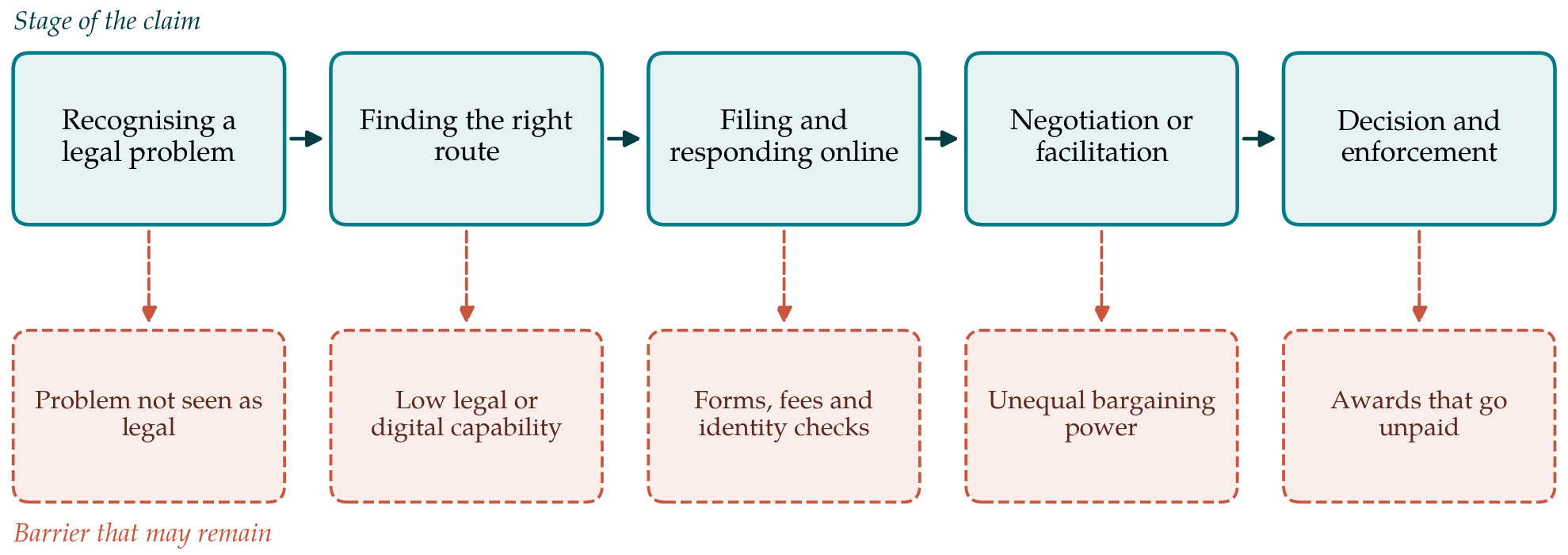
Access to justice is not one thing. A system may make it easier to start a claim and no easier to win one, or quicker to reach an outcome and no more likely that the outcome is right. Sandefur (2019) has argued that the measure should be the just resolution of people's problems and not their consumption of legal services or of court time. The literature is easier to read if the stages of a claim are kept apart, as in Figure 1, which sets beside each stage the barrier that writers most often say an online process leaves in place.
4.1. Cost, delay and convenience
The strongest claims for ODR concern transaction costs. Asynchronous communication removes travel and lost working time, and standardised online forms reduce the need for professional help with drafting. Susskind (2019) treats this as the central point: for low-value disputes the realistic alternative to an online court is no court at all, so the comparison should be with nothing and not with an idealised hearing. Prescott (2017) reports that state courts in the United States that adopted an online platform for minor matters saw cases close sooner and defaults fall, and Schmitz (2019) surveys early court projects in similar terms while warning that efficiency for the court is not the same as benefit to the litigant. The evidence here is the most developed, although much of it comes from the bodies that operate the systems.
4.2. Recognising a problem and finding the route
Disputes do not arrive ready-made. A grievance must first be perceived, attributed to someone and voiced before anything resembling a claim exists, and most potential claims fall away at one of those steps (Felstiner et al., 1980). People differ widely in whether they characterise a problem as legal at all and in their confidence about acting on it (Pleasence and Balmer, 2014). Guided pathways, which ask plain questions and return tailored information, are aimed squarely at this stage, and the first tier of the model proposed by the Civil Justice Council (2015) was devoted to it. What is not yet established is how far such tools reach people who would otherwise have done nothing, as opposed to serving those who were already inclined to act.
4.3. Procedural justice in an online setting
A long line of research holds that people judge legal processes less by whether they win than by whether they were heard, treated with respect and dealt with by a neutral authority whose motives they trust (Lind and Tyler, 1988; Tyler, 1990). Supporters of ODR argue that written, asynchronous exchange can give a nervous or inarticulate party a better chance to state a case than a hurried hearing. Critics doubt that typing into a form feels like being heard. Sela (2018) examined the question experimentally and found that perceptions of procedural justice depended on whether the neutral was presented as software or as a person and on the role it played, which suggests that design choices matter more than the medium as such. The body of work on this point remains small, and almost none of it follows real litigants through real claims.
4.4. Digital exclusion
An online route helps only those who can take it. People who lack a reliable connection, a suitable device, literacy in the language of the system or the confidence to transact online overlap heavily with those who already face the greatest legal need. The law reform body JUSTICE (2018) argued that assisted digital support, alternative channels and attention to the design of every screen are conditions of legitimacy for an online court and not optional extras, and Briggs (2016) accepted that the success of the proposed court would depend on such support. Reviews of this theme tend to agree on the principle. They have much less to say about how well the support works in practice, because excluded users are by definition hard to observe in the data a platform collects.
4.5. Repeat players and bargaining power
Galanter (1974) showed how parties who litigate repeatedly gain advantages over those who appear once: expertise, economies of scale, the ability to play for rules and not merely for the immediate result. Low-value money claims are dominated by repeat players, typically creditors pursuing individuals. A cheaper and faster process may therefore serve bulk claimants at least as much as the individual consumer the reforms have in mind, and a defendant who is nudged toward settlement through a screen has no one present to notice that a defence exists. Writers sympathetic to ODR accept the point and reply that data generated by the platform makes such patterns visible and correctable in a way a paper court never allowed (Katsh and Rabinovich-Einy, 2017). Whether operators use that capacity is an empirical matter on which little has been published.
4.6. Publicity, precedent and the quality of outcomes
The oldest objection to settlement-oriented processes is that they turn public questions into private bargains. Fiss (1984) argued that adjudication exists to give force to public values and that settlement, whatever its convenience, does not do that work. Resnik (2015) has traced how the movement of disputes into closed forums removes them from public view and weakens the means by which rights are articulated and enforced. ODR systems that steer most cases to negotiated outcomes are open to both criticisms, and to the further worry that an efficient process may produce quick results that do not track the legal merits. Defenders answer that open justice in a small claims hearing attended by nobody is largely notional, and that published decisions and aggregate data can supply a different kind of transparency (Susskind, 2019). The literature contains almost no direct study of whether online outcomes match what the substantive law would award.
5. Gaps and Directions for Future Work
Four gaps stand out. The first concerns non-users: evaluations report on those who complete an online process and say little about those who abandon it or never begin. The second is the counterfactual. Faster disposal is informative only if the comparison group is credible, and few published studies have one. The third is substantive accuracy, which would require independent assessment of a sample of outcomes against the governing law. The fourth is enforcement. A decision that is not paid is not a remedy, and the literature reviewed here has largely stopped at the point of decision.
There are also lessons in projects that did not last. The Dutch Rechtwijzer platform for separating couples, widely admired by reformers, was withdrawn in 2017 when it could not sustain itself financially, and the European Union has since legislated to close its consumer ODR platform after years of low use by traders. Neither episode shows that ODR fails, but both show that technical quality does not secure uptake, and that voluntary systems depend on the stronger party having a reason to take part. Future work would benefit from independent access to platform data, from designs that follow claimants beyond the decision, and from closer attention to defendants.
6. Conclusion
The literature supports a measured view. ODR lowers the cost and inconvenience of pursuing a small claim for people who are able and willing to use it, and well-designed systems can be experienced as fair. It has not been shown to reach those who are excluded from conventional justice by something other than cost, to redress the advantages of repeat players, or to deliver outcomes that follow the law. These are questions about institutions and evidence more than about technology, and they can be answered only if the bodies that run online systems open them to independent study.
Conflict of interest
To be declared by the author(s) before publication.
Funding
To be declared by the author(s) before publication.