1. Introduction
Maize grown under irrigation is a hungry crop, and the standard way of feeding it is to split the nitrogen: a portion at sowing and one or two top dressings of granular urea placed near the row at around knee height and again before tasselling. The practice is cheap and familiar, and it is also wasteful. Across cereal systems worldwide, the share of applied fertiliser nitrogen recovered in the crop has been put at about one third (Raun and Johnson, 1999), with the remainder lost by volatilisation, leaching and denitrification or held in the soil (Cassman et al., 2002; Ladha et al., 2005).
Against this background a liquid nano-urea, introduced commercially in India in 2021, has been offered to farmers as a foliar spray that can stand in for a bag of urea applied to the soil. Maize is among the crops for which substitution of top dressing is advised. This communication examines the proposition as a question of agronomy. It presents no new data. Its purpose is to state what is known, what would have to be true for the substitution to work, and what a trial must contain before the question can be regarded as answered.
2. The Arithmetic of Supply
Granular urea contains 46 per cent nitrogen, so a 45 kg bag supplies a little over 20 kg. The liquid product, as described in the critical assessment by Frank and Husted (2024), is labelled at 4 per cent nitrogen and sold in half-litre bottles, each of which therefore holds about 20 g. The two packages are presented as equivalent, yet they differ a thousandfold in the nutrient they contain. Even if several bottles were sprayed on a hectare, the nitrogen delivered would be counted in grams. The crop's requirement is counted in kilograms: maize takes up nitrogen slowly until about the sixth leaf stage and then rapidly through to silking and beyond (Ritchie et al., 1986), and the top dressings exist to meet that surge.
Efficiency cannot bridge the difference. If every atom of sprayed nitrogen entered the plant and every atom of soil-applied nitrogen were recovered at only the poor global average, the granular application would still supply several hundred times more nitrogen to the crop. A replacement claim therefore cannot rest on nutrient supply. It implies that the product acts in some other way, for example by stimulating root uptake or delaying senescence, and that implied mechanism is what needs evidence. Table 1 sets the two practices side by side.
| Feature | Granular urea top dressing | Foliar nano-urea spray |
|---|---|---|
| Nitrogen per application | Tens of kilograms per hectare | Grams per hectare at label concentration |
| Route into the plant | Root uptake after hydrolysis in soil | Through cuticle and stomata of wetted leaves |
| Main losses | Ammonia volatilisation, leaching, denitrification | Run-off from leaf, drift, incomplete penetration |
| Limits on rate | Cost and loss risk | Leaf scorch, spray volume, canopy access |
| Evidence base | Decades of response trials | Few independent trials; mechanism unconfirmed |
| Reasonable role | Primary in-season nitrogen source | Possible supplement, pending evidence |
3. What Is Known About Nitrogen Entering Through the Leaf
Leaves do absorb urea, and quickly. The molecule is small and uncharged, and it crosses the cuticle more readily than most nutrient salts (Fernández and Eichert, 2009). Foliar urea has a long record in cereals, where late sprays are used chiefly to raise grain protein, and the review by Gooding and Davies (1992) documents both the rapid uptake and the constraint: solutions concentrated enough to deliver much nitrogen scorch the leaf. The practical guidance that has followed treats foliar feeding as a means of correcting a deficiency or topping up at a critical stage, never as the main source of a nutrient required in large amounts (Fernández et al., 2013).
The nano-fertiliser literature offers reasons for interest and reasons for caution. Materials have been designed that release nitrogen slowly, among them a urea-hydroxyapatite hybrid applied to soil (Kottegoda et al., 2017), and reviews describe particle size, coating and surface charge as levers on uptake (Dimkpa and Bindraban, 2018; Raliya et al., 2018). The same reviews note that field evidence is thin. Kopittke et al. (2019) go further and argue that many reported benefits disappear when nano-products are compared with conventional fertilisers supplying the same nutrient in the same way. Urea is already fully soluble and already mobile in the leaf, so the advantage a nano-formulation could add is not self-evident.
4. What a Fair Field Comparison Requires
Much of the dispute arises from trial designs that cannot separate the possible explanations. A common layout compares the full recommended soil rate with a reduced soil rate plus nano-urea sprays. If the two yield alike, the result is read as proof of replacement. It may equally mean that the site did not respond to the last increment of nitrogen, which is likely on fertile irrigated land with a history of heavy fertiliser use. Figure 1 outlines the elements a comparison needs if it is to exclude that reading.
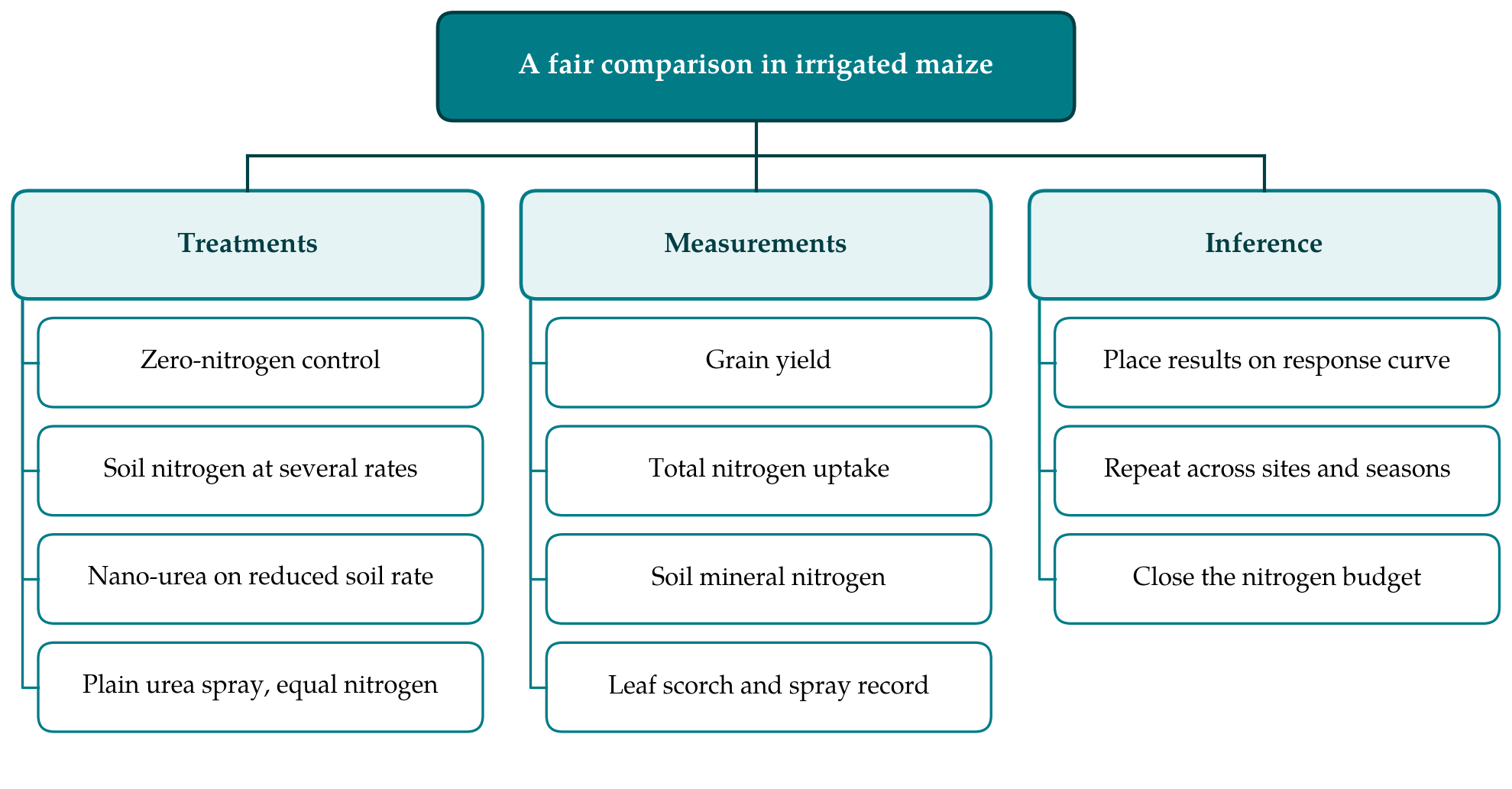
Beside the nano-urea treatment itself, four comparators are essential. A zero-nitrogen control shows whether the site responds at all. Soil nitrogen at several rates defines the response curve, against which a reduced rate with nano-urea can be located: the product has replaced fertiliser only if that treatment yields above the curve at its own soil rate. A spray of ordinary urea supplying the same few grams of nitrogen tests whether anything is specific to the nano form. A water spray controls for the pass itself. Yield alone is insufficient, so total nitrogen in grain and stover should be measured to show whether the crop obtained nitrogen it would otherwise have lacked, and soil mineral nitrogen before sowing and after harvest to show where it came from. A crop that yields well on reduced fertiliser by drawing down soil reserves has borrowed, and the loan falls due in later seasons.
5. Implications for Advisers and Growers
Until trials of this kind are published from a range of soils, the prudent position is plain. Reducing top-dressed nitrogen in maize on the expectation that a foliar spray will make up the difference exposes the grower to nitrogen deficiency during the weeks when ear size and kernel number are determined, and the loss may not show until harvest. Where current rates exceed crop need, they can be reduced on the evidence of a response curve or a leaf colour chart, with or without a spray. Nano-urea may yet prove useful as a supplement in particular situations, and nano-enabled fertilisers as a class deserve serious research. The burden of proof lies with the claim of substitution, which contradicts mass balance and has been questioned in detail on scientific grounds (Frank and Husted, 2024).
6. Conclusion
Foliar nano-urea and granular top dressing are not alternatives of similar size. One delivers grams of nitrogen and the other kilograms, to a crop that needs kilograms. Leaf uptake of urea is real, well understood and limited, and nothing yet published shows that a nano-formulation removes the limit. The question can be settled by experiments that include nitrogen response curves, equal-nitrogen spray controls and crop and soil nitrogen measurements. Recommendations to replace top dressing in irrigated maize should wait for them.
Conflict of interest
To be declared by the author(s) before publication.
Funding
To be declared by the author(s) before publication.