1. Introduction
A garment sold today carries a sewn-in label stating its fibre composition, as European law has long required (European Parliament and Council, 2011), together with care symbols and a country of origin. Everything else that might be known about it, including who spun the yarn, how the fabric performed in testing and whether a replacement zip can be obtained, stays in the brand's files or is never recorded at all. Once the garment leaves the shop, the brand's knowledge of it ends.
The Ecodesign for Sustainable Products Regulation changes that arrangement in principle. It establishes a framework under which product groups placed on the European Union market must meet ecodesign requirements and carry a digital product passport (European Parliament and Council, 2024a). The regulation followed the Circular Economy Action Plan (European Commission, 2020) and the textiles strategy, which set the aim that textile products on the Union market should be durable, repairable and recyclable (European Commission, 2022). The detailed rules for apparel are to come in delegated acts and are not yet settled.
Most commentary treats the passport as a compliance project. This Perspective takes a different view. Its claim is that the passport's main consequence for fashion will be conceptual: it alters what a brand is able to know, and is expected to say, about how long its garments last.
2. What a Product Passport Is
In the regulation's terms, a passport is a set of data specific to a product, accessible electronically through a data carrier such as a QR code or an embedded tag, and linked to a unique product identifier. Different parties are to have access to different parts of it. The framework anticipates information on durability, reparability, recycled content and substances of concern, and the same regulation introduces a prohibition on the destruction of unsold apparel and footwear by larger companies (European Parliament and Council, 2024a). The concept grew out of earlier proposals for material and product passports, reviewed by Adisorn et al. (2021) and Walden et al. (2021).
Two design choices in the framework matter for what follows. The passport is attached to the product and not to the transaction, so it stays valid whoever owns the garment. And the level at which products are identified, whether by model, by batch or by individual item, is left to the product-specific rules. A passport at model level can describe how a style was made and tested. Only identification of the single item allows a record of what later happened to that garment, such as a repair or a change of owner, and the textile sector has not yet agreed how far it wishes to go.
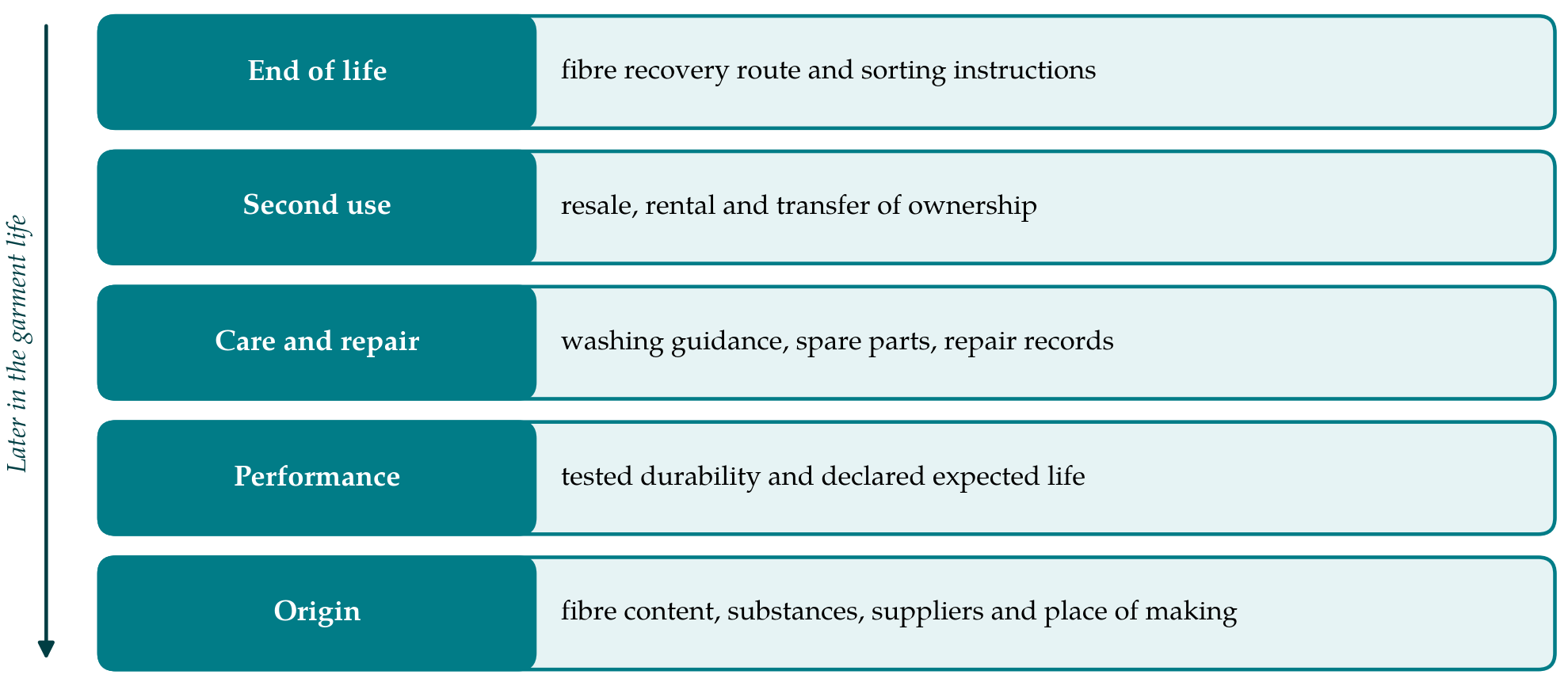
Figure 1 arranges the kinds of information a textile passport could hold according to the stage of the garment's life to which they relate. The lowest layer, origin and composition, extends what labels already do. The upper layers are new, and they are the ones that concern longevity.
3. The Argument: Longevity Becomes a Recorded Property
Extending the active life of clothing is widely regarded as one of the most effective ways to reduce its environmental burden, since the impacts of fibre production, dyeing and making are spread over more wears (WRAP, 2017; Niinimäki et al., 2020). The circular economy literature makes the same point in general terms: slowing the flow of products through longer use, repair and reuse generally preserves more value than recycling their materials (Stahel, 2016; Bocken et al., 2016). Fashion brands know this and say it in their sustainability reports. Three features of the passport bring it into their daily decisions. None of the three depends on shoppers studying data in a shop. They work through what the company itself is obliged to know, to state and to keep available.
3.1. Durability becomes comparable
A shopper cannot judge by inspection how a knit will pill or whether a seam will hold. The seller knows more than the buyer, and in such markets, as Akerlof (1970) showed, quality tends to go unrewarded because it cannot be told apart from its absence. Price and brand stand in as signals, and both are unreliable guides to how long a garment lasts. Standard test methods for abrasion, pilling, seam strength and colour fastness already exist and are used in buying offices every day; what is new is that the results would leave the technical file and travel with the product. If passports carry test results or durability classes set out in a common format, a durable garment can be identified as such before purchase. Design teams then have a reason to specify a better yarn or a stronger seam that does not depend on the customer taking it on trust. Rules against unsubstantiated environmental claims push in the same direction, since a durability promise will need evidence behind it (European Parliament and Council, 2024b).
3.2. The record outlives the sale
A passport persists. The identifier that a customer scans in the shop is the one a repairer scans years later to find the button specification, and the one a resale platform scans to confirm authenticity and composition. For the first time a brand's product information has an audience after the point of sale, and the garment's later career becomes visible to the company that made it. Table 1 sets out how each kind of passport information bears on thinking about longevity.
| Information type | What it could record | Question it puts to the brand |
|---|---|---|
| Composition and construction | Fibres, blends, trims, seam and fabric specification | Was this garment built to be worn many times? |
| Durability performance | Results of standard tests for abrasion, pilling, seam strength, colour fastness | How does it compare with competitors at the same price? |
| Care guidance | Washing, drying and storage advice specific to the product | Does our advice help or shorten its life? |
| Reparability | Availability of spare trims, repair instructions, service points | Can the usual failures be fixed, and by whom? |
| Use history | Repairs, resale and changes of owner, where recorded | What happens to our garments after year one? |
| End-of-life information | Disassembly notes and suitable recovery route | Did design choices for long life hinder recycling? |
Brands that have experimented with repair services, take-back and their own resale channels will find those activities easier to run and to account for when each garment can identify itself. Those that have not will find that others, including independent repairers and resellers, can now do so using information the brand was obliged to provide.
3.3. Longevity acquires an owner inside the firm
In most fashion companies nobody is responsible for how long products last. Designers answer for appeal, buyers for margin, technologists for conformity to a specification at the moment of delivery. A passport field has to be filled in by someone, checked by someone and defended if challenged. Organisations tend to manage what they are required to report, and a declared durability figure creates a line of accountability running from fibre selection to after-sales service that has not existed before.
4. Counter-Arguments
There are serious reasons to doubt that any of this will happen as described.
4.1. Passports may become ritual
Power (1997) described how audit regimes can produce elaborate verification without changing the thing verified. A passport could go the same way: fields populated with generic supplier declarations, durability stated at the minimum the rules allow, and a compliance team that never speaks to design. The risk is real, particularly if requirements are set low or enforcement is thin. The reply is that passport data, unlike most audit files, are exposed to customers, competitors and campaigners, and a record that can be read by outsiders is harder to keep empty.
4.2. Clothes are seldom discarded because they wear out
Research on clothing use shows that garments leave wardrobes for many reasons other than physical failure: poor fit, changed taste, boredom, or simply having too many (Laitala et al., 2015). Fletcher (2012) argued that durability is as much a product of what people do with clothes as of how the clothes are made. Klepp et al. (2020) caution that measuring lifespan through laboratory tests of strength captures only part of what determines years of wear. A passport built around test results could therefore reward robust garments that nobody wants to keep. This objection is the strongest of the four. It implies that brands should read the passport's later layers, on repair, resale and use, as carefully as its test data, and that regulators should avoid defining longevity as abrasion resistance alone.
4.3. The burden on small firms
Collecting data from several tiers of suppliers, maintaining identifiers and paying for testing is easier for a large company than for an independent label or a craft producer. If compliance costs are fixed, they fall hardest on the firms whose garments are often made in small runs and kept for a long time. Shared platforms, sector templates and proportionate requirements can soften the effect, though they will not remove it.
4.4. Information is not behaviour
Decades of labelling have shown that giving consumers information does not ensure that they act on it. Few shoppers will scan a code in a fitting room. Cooper (2005) observed that longer product lifetimes run against a retail model that depends on volume, and a passport does nothing directly to change that model. The more plausible channel of influence is institutional: buyers for resale platforms, public procurers, journalists, comparison services and regulators will read the data even where individual customers do not, and brands respond to those audiences.
5. Implications
If the argument holds, several things follow for practice. Design briefs will need to state an intended service life and the failure modes to be designed against, as engineers have long done for other consumer goods (Cooper, 2010). Technologists will be drawn into decisions earlier, since test performance becomes a public attribute. Merchandising will have to reckon with garments that remain traceable to the brand in second-hand markets, where a poorly made item advertises its maker for years. After-sales functions that fashion has largely lacked, such as spare trims and repair guidance, become part of the product.
For fashion education the implication is that longevity can be taught as a design variable with data attached, alongside the cultural understanding of why people keep clothes. For researchers the passport promises something that has been missing from the study of clothing lifetimes, namely records of what happens to identified garments over time, subject to the privacy of their owners. And for regulators the lesson of the counter-arguments is that the choice of what the passport must contain will shape what brands optimise.
6. Conclusion
A digital product passport is a record, and records do not mend seams. What the passport does is end the condition in which a garment's life after sale is invisible to the company that made it and unknowable to the person who buys it. Once durability is declared, compared and traceable, a brand can still choose to make clothes that do not last, but it can no longer do so unobserved. The shift in thinking this requires, from the product at the moment of sale to the product over its life, is the larger change, and brands that begin it before the detailed rules arrive will be better placed than those that wait for a compliance deadline.
Conflict of interest
To be declared by the author(s) before publication.
Funding
To be declared by the author(s) before publication.