1. Introduction
A singer in a kitchen gives twelve verses of a ballad, each to the same tune and none of them quite alike. The researcher who recorded her will later sit with headphones and a pencil, replaying two seconds at a time, and will have to decide for every note what pitch it was, how long it lasted, and whether the difference between verse three and verse seven is a variant worth writing down or the ordinary give of a living performance. The labour is considerable, and its results depend heavily on who is listening.
Computational tools can now take over part of the measuring. Pitch trackers return the fundamental frequency of a monophonic line frame by frame; onset detectors propose note boundaries; alignment algorithms find which moment in one recording corresponds to which moment in another. Surveys of automatic transcription are frank that fully automatic notation of real recordings is still unreliable, particularly outside the piano and outside equal temperament (Benetos et al., 2019). The opportunity for field researchers lies elsewhere: in semi-automatic work, where software measures and aligns and the researcher interprets.
This article proposes a workflow of that kind for solo or lightly accompanied oral repertoire, such as unaccompanied song, fiddle or flute tunes, and chant. It is written for researchers who know their repertoire well and their software less well. The workflow is put forward as a design. It has not been validated on a field collection in this article, and a later section states what validation would involve.
2. Background
Two discussions frame the design: the long argument within ethnomusicology about what a transcription is for, and the technical literature on pitch tracking and alignment.
2.1. Transcription as an interpretive act
Charles Seeger distinguished prescriptive notation, a set of instructions for performance, from descriptive notation, a record of what was performed, and argued that Western staff notation serves the second purpose poorly (Seeger, 1958). His remedy was a machine-drawn graph of pitch against time. Bartók's transcriptions of the Parry collection took the opposite route, loading the staff with microtonal signs and exact durations until the result recorded nearly everything and could be read by almost no one (Bartók and Lord, 1951). Ellingson's survey shows how each generation of transcribers has chosen a different point between those extremes (Ellingson, 1992).
The discipline has since grown more sceptical. Nettl treats transcription as one representation among several, shaped by the question being asked (Nettl, 2015), and others have asked who needs it at all once recordings can be published alongside the analysis. The workflow below accepts that critique. It treats notation as a reading aid tied to the audio by time stamps, so that every written note can be checked against the sound it summarises.
2.2. Pitch tracking and alignment
For a single melodic line, the YIN algorithm and its probabilistic successor pYIN estimate fundamental frequency reliably enough for analytical use (de Cheveigné and Kawahara, 2002; Mauch and Dixon, 2014). pYIN is built into Tony, a program designed for correcting pitch tracks and note segmentations by hand (Mauch et al., 2015), and is available as a plugin for Sonic Visualiser, a general viewer and annotator for music audio (Cannam et al., 2010).
Alignment rests on dynamic time warping, a dynamic-programming method first developed for matching spoken words uttered at different speeds (Sakoe and Chiba, 1978). Given two sequences of features, it finds the path of correspondences that minimises their accumulated difference. Müller's textbook explains its use for synchronising music recordings (Müller, 2015), and the librosa library offers it to anyone able to run a short Python script (McFee et al., 2015). For sung words, forced aligners trained on speech can place each syllable in time where an acoustic model for the language exists (McAuliffe et al., 2017).
3. The Proposed Workflow
The workflow has eight steps, shown in sequence in Figure 1. Table 1 lists the tools suggested for each and the file that each step should leave behind. The principle throughout is that the software proposes and the researcher decides, and that each decision is saved in a form another person can open.
| Step | Suggested tools | Decision left to the researcher | File kept |
|---|---|---|---|
| 1. Record and document | Field recorder, close microphone | Scope of consent; what counts as one item | Consent record, field notes |
| 2. Archive | Any audio editor for copies | File naming and identifiers | Unedited WAV masters |
| 3. Segment | Sonic Visualiser or ELAN | Where strophes and lines begin | Annotation tiers |
| 4. Track pitch and onsets | Tony or the pYIN plugin | Which frames are voiced; note boundaries | Corrected pitch track, note layer |
| 5. Tonal reference and scale | Pitch histogram in cents | Which peaks are scale degrees | Histogram, degree table |
| 6. Align | Dynamic time warping in librosa; forced aligner | Whether an alignment is musically right | Warping paths, aligned text |
| 7. Notate | music21 or a notation editor | Level of detail; how variants are shown | Score file with time stamps |
| 8. Review and deposit | Playback with performers | What performers accept or correct | Revised files, deposit record |
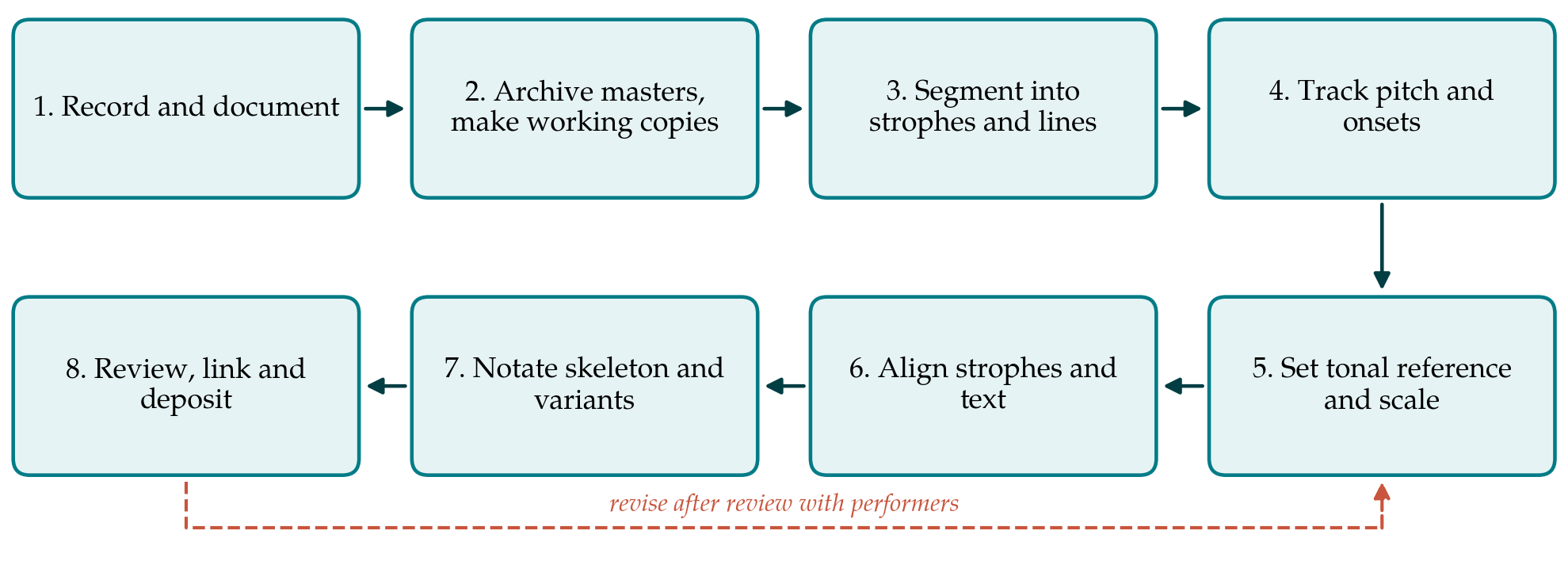
3.1. Recording, archiving and segmentation
Step one is the recording itself, made with informed consent that covers analysis, publication of excerpts and deposit. A close microphone on the singer or player, and as little room noise as the setting allows, does more for later pitch tracking than any processing. Spoken identification of performer, place, date and item at the head of each take costs seconds and saves confusion. Step two follows the guidelines of the International Association of Sound and Audiovisual Archives: masters are kept as uncompressed WAV files at 24-bit depth and a sampling rate of at least 48 kHz, never edited, with working copies made for analysis (IASA, 2009).
Step three divides each item into strophes and lines. This is done by ear in Sonic Visualiser, or in ELAN, an annotation tool built for time-aligned tiers of text (Wittenburg et al., 2006). A tier for strophes, one for lines and one for the words is enough to begin. Segmentation is an analytical claim about how the performer structures the piece, and where the performer has terms for the units, those terms should name the tiers.
3.2. Pitch, onsets and the tonal reference
In step four each strophe is passed through a pitch tracker and the result is corrected. Typical errors are octave jumps, pitches reported during consonants or breaths, and a second voice or drone captured in place of the melody. Tony was designed for this correcting pass and lets the user redraw a contour or merge and split notes while listening. Ornaments need a policy stated in advance: whether a slide into a note is one event or two, and how short a pitch must be before it is treated as a grace note.
Step five avoids forcing the pitches onto a piano keyboard. All corrected pitch values for a performance are converted to cents relative to an arbitrary reference and plotted as a histogram. The peaks show the pitches the performer returns to; the most stable, usually the final, is taken as the tonal reference and the others are expressed as intervals above or below it. A third that sits between major and minor then appears as what it is, instead of being rounded to the nearer semitone. The degree table produced here governs the notation in step seven.
3.3. Alignment, notation and review
Step six is where alignment earns its place. Each strophe is aligned by dynamic time warping to a reference strophe, using the corrected pitch contour as the feature. The warping path shows which notes correspond, so that differences of pitch at corresponding points can be listed as melodic variants and stretches or compressions of the path as rhythmic ones. Renditions by other performers, or by the same performer on another day, are aligned to the same reference. Where an acoustic model exists for the language, the text is aligned to the audio with a forced aligner and corrected by hand; where none exists, syllables are placed manually against the note layer.
In step seven the researcher writes a melodic skeleton for the tune and attaches the variants to it, strophe by strophe. A toolkit such as music21 can build the score from the note layer and keep the time stamp of each note (Cuthbert and Ariza, 2010). The level of rhythmic detail is a choice: for free-rhythm song, proportional spacing with onset times may be more honest than bar lines. Step eight returns the result to the performers, played back with the notation or the pitch graph on screen, and their corrections are entered before the audio, annotations and score are deposited together under the terms agreed in step one.
4. Fitting the Workflow to Field Conditions
Field recordings are seldom clean. Where several people sing together, where the melody instrument plays over a drone or a guitar, or where the room is loud, pitch tracking of the kind described degrades quickly, and the researcher should expect to do step four largely by hand or to limit the workflow to the solo items in a collection. Heterophonic and polyphonic textures are beyond it. The steps are separable, however, and segmentation, tonal reference and deposit remain useful when tracking is not.
Questions of ownership and control run through every step. Anthony Seeger has shown how poorly copyright law fits music held in common or by lineage (Seeger, 1992), and work on the ethics of music information retrieval points out that turning a community's songs into data creates new ways for them to be reused without consent (Holzapfel et al., 2018). The workflow therefore places consent at the first step and review at the last, and treats the decision about what is deposited openly as belonging to the performers. Tools serve fieldwork only for as long as the people recorded remain partners in it.
A practical point concerns where the work is done. Every tool named here runs offline on an ordinary laptop, so segmentation and a first pitch track can be made in the evening after a session while the performer is still nearby to answer questions. Doing so changes the next day's recording, because gaps and doubtful passages are noticed in time to ask for a repeat. It also means that files multiply quickly. A fixed naming scheme that carries the item identifier, the step number and a version through every annotation, pitch track and score file is dull to maintain and is the only thing that keeps a collection of several hundred items usable a year later.
5. Limitations and What Remains to Be Shown
The workflow is a proposal and has not been applied or validated here. Three things would need to be shown. The first is agreement: whether transcriptions produced this way by different researchers from the same recordings differ less than transcriptions made by ear alone. The second is effort, since correcting a poor pitch track can take longer than transcribing from scratch, and the balance will vary with recording quality. The third is acceptance, meaning whether performers recognise their own music in the result and whether the variants the alignment reports are differences they consider meaningful.
There are also limits that no test will remove. Dynamic time warping assumes that two renditions contain the same events in the same order; it copes badly when a singer inserts or omits a phrase, and such cases must be segmented first. Pitch histograms presuppose a stable tonal reference, which unaccompanied singers do not always keep across a long song. And a time-aligned score is still a reduction. It records pitch and timing and leaves out timbre, gesture, words unspoken and the occasion, which fieldnotes and the recording itself must carry.
6. Conclusion
Pitch tracking and audio alignment will not transcribe a field collection, but they can measure what the ear estimates and keep every written note attached to its sound. The eight-step workflow proposed here arranges freely available tools so that each supports a decision the researcher must still make and leaves a file that others can inspect. Its usefulness for a given repertoire is an open question that field researchers are best placed to answer, ideally by trying it on a small set of recordings alongside their usual practice and reporting where it helped and where it did not.
Conflict of interest
To be declared by the author(s) before publication.
Funding
To be declared by the author(s) before publication.