1. Introduction
An underground mine is ventilated to dilute diesel exhaust, blasting fumes and dust, to remove heat and to supply breathable air. The traditional design delivers to every working place the quantity needed for its worst case and keeps delivering it around the clock. Since a heading may be drilled, charged, blasted, mucked and then left idle within a day, much of that air does no useful work (McPherson, 1993). The cost is considerable. Primary and auxiliary fans, together with refrigeration where it is installed, commonly account for the largest share of a deep mine's electricity use (du Plessis et al., 2014).
Ventilation on demand, abbreviated VOD, supplies air where and when it is needed and reduces it elsewhere. The physical argument is simple. For a fan working on a fixed system resistance, pressure rises with the square of airflow and power with the cube, so cutting flow by a fifth roughly halves the power drawn (Hartman et al., 1997). The idea was tried in Canadian hard rock mines from the late 1990s (Hardcastle et al., 1999), and later accounts describe systems of increasing sophistication at deep nickel mines in the Sudbury basin (O'Connor, 2008; Bartsch et al., 2010).
The Zambian Copperbelt has several mines working well below a kilometre, with trackless diesel equipment, rising rock temperatures and long ventilation circuits. Mining is the largest consumer of electricity in Zambia, the grid relies heavily on hydroelectric stations on the Zambezi and Kafue rivers, and supply to all users has been curtailed in drought years. A method of cutting ventilation energy without cutting production is therefore of more than financial interest. This article proposes a planning framework for VOD at a deep Copperbelt copper mine. It describes no particular mine and reports no trial. It is a method, offered for application and testing.
2. Background
Practitioners distinguish several levels of VOD, which differ in how the system knows what air is needed. Figure 1 sets out the five that are commonly described, following Tran-Valade and Allen (2013). At the lowest level an operator in a control room starts, stops or slows fans and moves regulators remotely. Next comes scheduling by time of day, built around shift changes and blasting times. Event-based control responds to signals such as a blast being fired or a crusher starting. Tag-based control tracks vehicles and people and sums the airflow each zone requires. At the highest level, sensors for gases, temperature and airflow close the loop, and air is adjusted to hold measured conditions within limits.
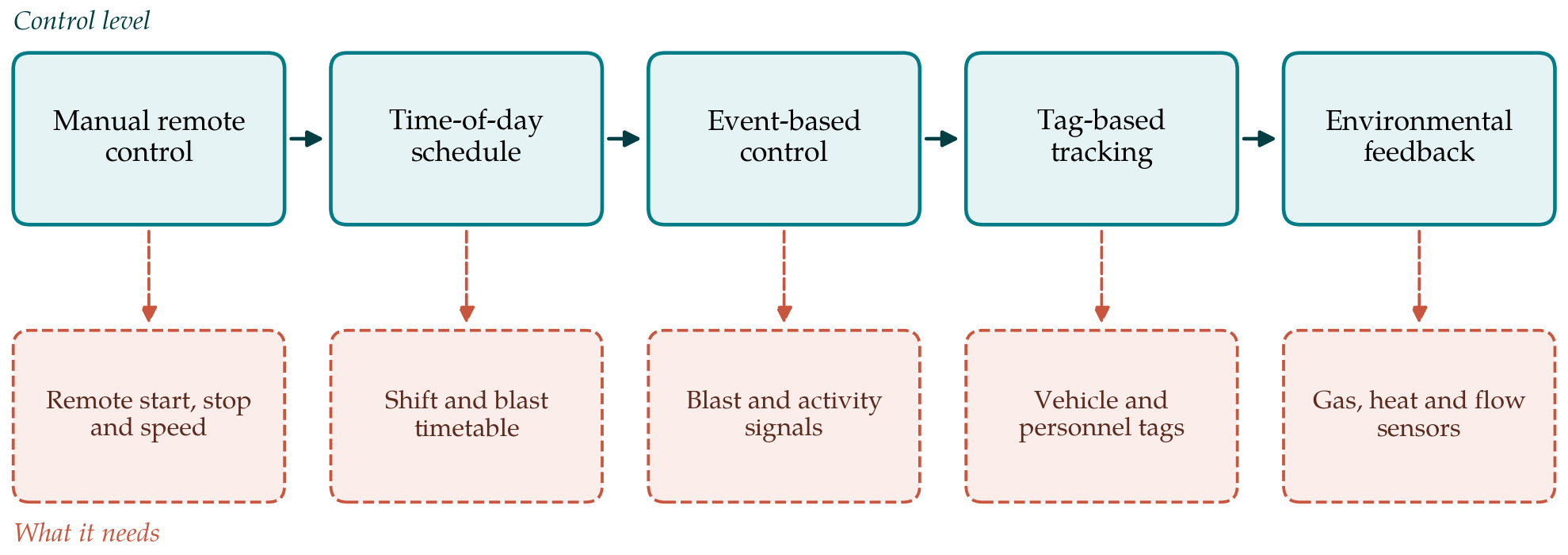
Two points from the published record bear on planning. First, the higher levels save more only if the lower ones work: a pilot trial reported by Hardcastle et al. (1999) framed the choice as control by quantity or by quality, that is by delivering a calculated volume or by holding measured contaminant levels, and the second plainly depends on sensors that stay accurate. Secondly, the large savings come from the primary fans, yet the easiest place to begin is with auxiliary fans in development headings, where the effect of a change is local (O'Connor, 2008). Reviews of ventilation optimisation note that integrating control of main fans, boosters and regulators over a whole network remains difficult (Acuña and Lowndes, 2014; Wallace et al., 2015).
The network itself is analysed with methods that go back to the iterative balancing scheme of Cross (1936), now embedded in commercial ventilation software that also models heat, moisture and contaminant transport. Formal optimisation of fan speeds under a time-of-use electricity tariff has been demonstrated in simulation by Chatterjee et al. (2015), which is relevant wherever the price or availability of power varies through the day.
3. The Proposed Framework
The framework has seven stages, taken in order. Each produces a document that the next stage needs, and each has a decision point at which the project can be stopped or scaled back.
3.1. Stage 1: Measured baseline and calibrated model
No saving can be claimed without a baseline. The first stage is a full pressure and quantity survey of the primary circuit, performance tests on the main and booster fans, a census of auxiliary fans, and metering of ventilation and refrigeration power over a period long enough to cover seasonal change. A temperature and humidity survey is carried out alongside. The measurements are used to calibrate a network model until predicted and measured airflows agree within a stated tolerance (McPherson, 1993). Leakage through old workings, common in mines with a long history, should be measured and not assumed, because air that leaks cannot be controlled.
3.2. Stage 2: Activity-based air demand
The second stage states, for every type of activity, how much air a working place needs and why. Table 1 lists the usual criteria. The quantity for a place at any moment is the largest of those that apply, not their sum. Diesel dilution is normally set as a unit airflow per kilowatt of rated engine power; a figure of 0.06 m3/s per kilowatt is used in several jurisdictions, and the value in the mine's own regulations governs. Diesel exhaust is classified as carcinogenic to humans (IARC, 2014), on evidence that includes a large cohort study of miners (Attfield et al., 2012), so this criterion should be treated as a floor and not as a target to be shaved. Engineering controls beyond dilution are reviewed by Bugarski et al. (2012).
| Criterion | Basis for the quantity | When it tends to govern | Source |
|---|---|---|---|
| Diesel exhaust dilution | Unit airflow per kilowatt of engines present | Loading and hauling with large machines | Bugarski et al., 2012 |
| Blast fume clearance | Volume to dilute and sweep fumes before re-entry | After firing, for a limited period | McPherson, 1993 |
| Heat removal | Airflow and cooling to hold a heat stress limit | Deep, hot sections; summer months | Brake and Bates, 2002 |
| Dust control | Minimum air velocity past the source | Crushers, tips, ore passes | McPherson, 1993 |
| Minimum velocity | Lowest flow that prevents layering and stagnation | Idle headings and long drifts | Hartman et al., 1997 |
| Occupancy without machines | Quantity per person set in regulations | Inspection, charging, service bays | Hartman et al., 1997 |
At depth, heat often overtakes diesel dilution as the governing criterion. Air warms by autocompression as it descends, by close to one degree Celsius of dry-bulb temperature for each hundred metres, before it meets any rock or machine. In a hot section, reducing airflow may raise the wet-bulb temperature past the limit even when gas levels are acceptable. The heat criterion should therefore be expressed through a recognised heat stress index, such as the thermal work limit of Brake and Bates (2002), and evaluated with the climate module of the network model.
3.3. Stage 3: Zoning and choice of control level
The mine is divided into zones that can be controlled independently: typically a production level, a development end, a workshop or a crusher chamber, each fed through a regulator or an auxiliary fan. For every zone the planner chooses a control level from Figure 1. The proposal here is to start low. Auxiliary fans on variable speed drives under schedule or event control are cheap and their failure is local. Tag-based control suits production levels with many vehicles. Environmental feedback is kept for zones where sensors can be maintained. Primary fans are brought in last, once the total demand signal from the zones has proved dependable.
3.4. Stage 4: Sensing, tracking and communications
VOD above the scheduling level depends on knowing where machines and people are and what the air is like. This needs an underground communications backbone, tag readers at zone boundaries, airflow monitors at regulators and fans, and gas and climate sensors at selected points. Sensor selection should be conservative. Electrochemical gas cells drift and are affected by humidity, and a sensor that reads low is more dangerous than no sensor. The plan should name who calibrates each instrument, how often, and what the control system does when a reading is missing or implausible.
3.5. Stage 5: Control logic and fail-safe defaults
The control philosophy is written before any software. Its rules should include a minimum flow for every zone that no automatic action can go below; a return to full design airflow on loss of communications, loss of tag data or sensor fault; a fixed clearance sequence after blasting that ends only on a confirmed gas reading; manual override available to the control room and locally; and limits on how fast fans may change speed, to avoid pressure surges and reversal of flow in parallel branches. Any change to these rules should pass through the mine's change management procedure, and the arrangements should be agreed with the Mines Safety Department before commissioning, since the regulations made under the mining legislation were written with constant ventilation in mind (Government of Zambia, 2015).
3.6. Stage 6: Simulation against the production schedule
Before equipment is bought, the calibrated model is run against a representative production schedule, zone by zone and hour by hour. Kocsis et al. (2003) described linking a mine activity simulation to a ventilation simulation for this purpose. The runs should check three things. They should confirm that every zone receives its demand in every state of the schedule, including the worst coincidence of activities. They should look for unintended recirculation or reversal when several regulators move together. And they should estimate the energy used, by applying the fan curves at each operating point and the tariff at each hour, with a range and not a single figure.
3.7. Stage 7: Staged commissioning and verification
The system is commissioned in one section first, with the rest of the mine unchanged. Savings are established by comparing metered energy with the Stage 1 baseline, adjusted for tonnes mined, metres developed and surface climate, so that a quiet month is not mistaken for an efficient one. Exposure monitoring for diesel particulate, gases and heat continues through the trial and is compared with the period before. Only when both the energy and the exposure records are satisfactory is the system extended. Operators, supervisors and safety representatives should be trained in what the system does and in how to override it.
4. Fitting the Framework to the Copperbelt
Four local conditions deserve particular attention. The first is power. Where supply is rationed, VOD becomes a tool for demand management as well as for saving energy, and the control logic can include a reduced-load mode agreed in advance, in which non-essential zones are cut back in a set order. The second is restart: after a power interruption the system must bring fans back in a safe sequence and treat the whole mine as uncleared until proved otherwise. The third is heat. In the deepest sections cooling, not diesel, will set the floor on airflow, and the scope for reduction there may be small. The fourth is maintenance. Hot, humid and dusty airways are hard on sensors and drives, and a system that outruns the capacity to maintain it will be switched to manual and stay there.
5. Limitations and What Remains to Be Shown
This framework is a proposal and has not been tested. The published experience on which it draws comes mostly from mines in a cold climate with different regulations, power prices and labour practices, and the reported savings are specific to those sites. For a Copperbelt mine the saving would have to be established by measurement, and three questions would need local answers: how much of the working day each zone is genuinely idle; how far heat limits the reduction that diesel criteria would allow; and whether sensors and tags can be kept working at an acceptable cost. The framework also says little about battery-electric equipment, which would lower the diesel criterion while leaving the heat criterion largely in place.
6. Conclusion
The case for ventilation on demand rests on a physical law and on a wasteful habit: fan power falls steeply as flow is reduced, and constant ventilation supplies a great deal of air to places where nothing is happening. For a deep copper mine on the Zambian Copperbelt the framework proposed here proceeds from measurement, through explicit demand criteria and cautious control design, to a verified pilot. Its guiding rule is that no saving is taken at the expense of the air a person breathes. Its usefulness can be judged only when a mine applies it and publishes what it finds.
Conflict of interest
To be declared by the author(s) before publication.
Funding
To be declared by the author(s) before publication.