1. Introduction
The Greenhouse Gas Protocol divides a company's emissions into three scopes: those from sources it owns or controls, those from the energy it buys, and all the rest that arise in its value chain (WRI and WBCSD, 2004). The third scope was optional in the original standard and was given its own rules only later, in a standard that sorts it into fifteen categories running from purchased goods and services to the use and disposal of sold products (WRI and WBCSD, 2011). For a manufacturer, a retailer or a logistics provider that subcontracts its haulage, this residual category is usually the largest of the three by a wide margin.
That fact has been known for a long time. Matthews et al. (2008) showed with input-output analysis that the direct and energy-related emissions of a typical industry are a minority of its total footprint, and Huang et al. (2009) found that a handful of upstream categories account for most of the remainder. What has been missing is consequence. A number that is estimated from spend, disclosed voluntarily and audited by nobody does not change what a buyer asks of a supplier.
The argument of this article is that consequence has now arrived, and that it will reach procurement contracts within one or two renewal cycles and not over the decade that the phasing-in of regulation might suggest. The reasoning is contractual more than regulatory, and it applies with particular force to logistics, where a shipper's transport emissions are by definition somebody else's fuel.
2. Why the Estimate Is No Longer Enough
Three developments have changed the status of the scope three figure. The first is disclosure standards with legal or quasi-legal force. The climate standard of the International Sustainability Standards Board requires an entity to disclose scope three emissions and to consider all fifteen categories in doing so (ISSB, 2023), and jurisdictions that adopt it bring that requirement into their own reporting law. The European Union's reporting directive subjects sustainability statements, including value chain emissions, to external assurance (European Union, 2022). California has legislated for scope three reporting by large companies doing business in the state (State of California, 2023). An assured figure needs evidence behind it.
The second development puts a price on the number. Under the European carbon border adjustment mechanism, importers of goods such as steel, aluminium, cement and fertiliser must report the emissions embedded in each consignment and, in the definitive period, pay for them (European Union, 2023). Actual data from the producing installation are preferred, and default values are set so as not to favour those who use them. An importer therefore has a direct financial reason to obtain verified data from its supplier, and a supplier with low emissions has a reason to provide them.
The third is voluntary commitment that has become hard to withdraw. Companies with targets validated under the Science Based Targets initiative must include scope three when it forms a large share of their footprint (SBTi, 2021), and the due diligence directive of the European Union, as adopted, asked large companies to put a climate transition plan into effect (European Union, 2024). A target that covers suppliers' emissions cannot be met by re-estimating them with the same industry averages. As Hertwich and Wood (2018) document, supply chain emissions of industry have grown faster than direct emissions, so the gap between target and estimate widens if nothing is done.
3. From Spend-Based Averages to Supplier-Specific Data
Most scope three inventories today are built by multiplying money spent in each purchasing category by an emission factor for that category. The method is cheap and complete, and it has a fatal property for management purposes: the only way to lower the result is to spend less. Choosing a cleaner supplier, or helping an existing supplier to cut its emissions, has no effect on a figure that does not know who the supplier is. Studies of what companies disclose have found reported scope three inventories to be partial and inconsistent between firms in the same sector (Blanco et al., 2016).
The alternative is primary data: the supplier's own measurement of the emissions attributable to the goods or services it delivers. For freight, a recognised method now exists in the form of an international standard for quantifying emissions across transport chains (ISO, 2023). Kaplan and Ramanna (2021) go further and propose that emissions be passed from supplier to customer with each sale, in the manner of cost accounting, so that every firm records only what its immediate suppliers transfer to it. Whether or not that proposal is adopted, the direction is the same. The buyer needs a number from each significant supplier, produced by a stated method and open to checking, and it needs it every year.
4. What Will Be Written Into Contracts
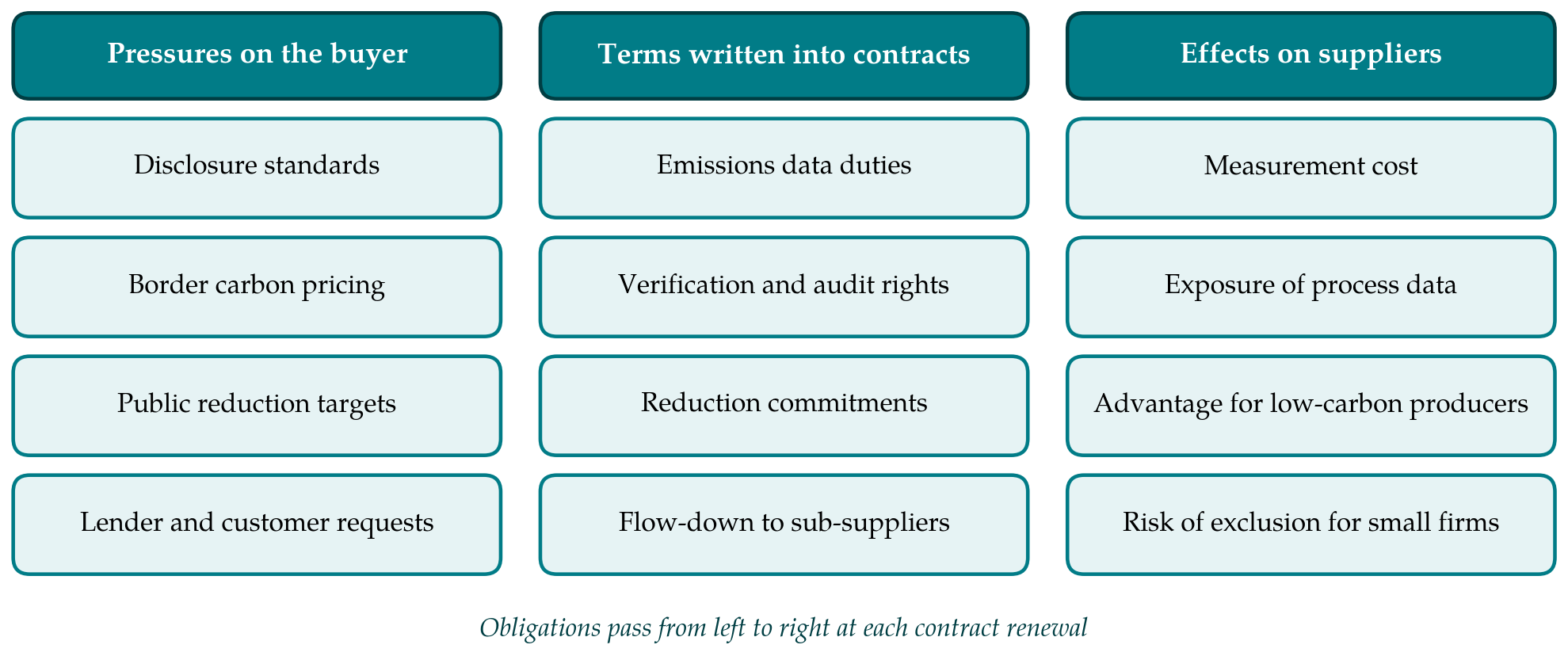
A buyer cannot compel a supplier to measure anything except by agreement. The supply contract, and the tender documents that precede it, are therefore where emissions accounting becomes operational. Table 1 lists the kinds of clause that follow from the requirements described above, and Figure 1 shows how pressure on the buyer is converted into terms and then into effects on suppliers.
| Type of clause | What it asks of the supplier | Main difficulty |
|---|---|---|
| Data provision | Report emissions per unit supplied, by a named method, on a fixed date | Allocation between customers and products |
| Verification | Accept third-party assurance or buyer audit of the figures | Cost; access to commercially sensitive process data |
| Reduction commitment | Meet an emissions intensity target or adopt a validated target | Baseline setting; investment needs of the supplier |
| Price linkage | Accept price adjustment tied to reported emissions or carbon costs | Volatile carbon prices; disputes over measurement |
| Flow-down | Impose equivalent duties on its own suppliers | Weak leverage over distant tiers |
| Remedies | Corrective plan, then reduced volume or termination | Proportionality and enforceability |
Data provision is the foundation. A workable clause specifies the boundary, the method, the unit of output, the reporting date and the form of the return. The hardest technical question is allocation: a supplier with one furnace and forty customers must divide its emissions among them, and different rules give different answers. Verification clauses borrow from quality and social compliance practice, with the difference that energy and process data reveal a supplier's cost structure, so confidentiality terms will be bargained over.
Reduction commitments and price linkage change the commercial relationship more deeply. A buyer that asks for lower emissions is asking for investment, and the contract has to say who pays and over what term. Longer contracts, shared savings and buyer-supported finance are the obvious instruments. Caro et al. (2013) show analytically that when several firms can each influence the same emissions, holding more than one of them responsible for the same tonne may be needed to induce the right effort, so overlapping obligations along a chain are not necessarily a defect.
5. Why This Will Happen Sooner Than Expected
The case for speed rests on the mechanics of contracting. Regulations name thresholds and phase-in dates, and commentary tends to read those dates as the timetable for everyone. The companies directly in scope, however, need supplier data before their own first reporting year, and they collect it through terms inserted at the next tender or renewal. Supply and transport contracts commonly run for one to three years. Within a single cycle, a requirement addressed to a few thousand large companies becomes a condition of sale for their first-tier suppliers.
The flow-down clause then repeats the process. A first-tier supplier that has promised product-level data cannot produce it without figures from its own material and transport providers, and it will ask for them on the same terms it has accepted. The requirement thus travels along the chain at the pace of commercial renewal and reaches firms that no regulator has addressed. Evidence on information requests points the same way: Jira and Toffel (2013) found that suppliers were more likely to share climate information when several buyers asked for it and when buyers showed that they would use it. Each new requesting buyer raises the response rate for all of them.
A further accelerant is competition among suppliers. Once emissions per unit are reported in a comparable form, they become an award criterion like price and lead time. A carrier or a component maker with a lower figure has every reason to volunteer it, and rivals who withhold theirs will be assumed to have something to hide. Disclosure that begins as an obligation becomes a sales argument.
6. Objections
The strongest objection is that regulators are stepping back. The climate disclosure rule adopted in the United States in 2024 left out the scope three requirement that had been proposed (SEC, 2024) and has not taken effect, and the European Union moved in 2025 to postpone and narrow its reporting and due diligence directives. This is a real change, and it will slow the mechanism for companies whose only motive was compliance. It does not remove the border carbon charge, the investor standard, the validated targets or the requests that suppliers receive from customers in other jurisdictions. A supplier serving several large buyers needs only one of them to insist.
A second objection is that the data are too poor to bear contractual weight. Supplier-specific figures vary with allocation rules, and lower tiers are the least transparent and often the most emissions-intensive part of a chain (Villena and Gioia, 2020). The objection is sound as a description and weak as a prediction. Contracts routinely rely on imperfect measures, provided the method is specified and applied consistently, and early clauses are likely to reward disclosure and improvement over time before they penalise absolute levels.
The third objection concerns small suppliers, who lack the staff to measure and the leverage to refuse. Here the concern is justified. A requirement designed for large companies arrives at a small haulier or workshop as a spreadsheet from each customer in a different format. Without common templates and simplified methods, the likely result is either invented numbers or the exclusion of capable small firms from supply chains.
7. Implications for Procurement and Logistics Practice
If the argument is right, several things follow for managers. Emissions data should be specified as a deliverable in tenders now, with the method named, so that the first years are spent improving data and not arguing about definitions. Requests should be aligned with what other buyers in the sector ask, since a supplier facing one format is more likely to answer accurately than one facing twenty. Category managers will need enough carbon accounting to judge whether a reported figure is plausible. And buyers that want reductions and not merely reports will have to offer something in return: contract length, volume, technical help or a share of the cost.
For suppliers and logistics providers the implication is that measurement capability is becoming a condition of market access. Those who can produce credible figures per shipment or per unit early will find it used in their favour. For researchers, the open questions are empirical: which clause designs produce reductions and which produce only paperwork, and how the burden is distributed along the chain.
8. Conclusion
Scope three accounting is moving from an annual estimate to a set of figures that buyers must be able to trace to named suppliers. The supply contract is the only means of obtaining those figures, and contracts turn over quickly and replicate their terms down the chain. For that reason the effect on procurement will outrun the formal timetables of regulation, even where those timetables are being relaxed. The practical task for the next few years is to make the resulting clauses consistent, proportionate and useful for reducing emissions.
Conflict of interest
To be declared by the author(s) before publication.
Funding
To be declared by the author(s) before publication.