1. Introduction
Many questions asked of graph data are questions about small structures. A biologist wants to know which wiring patterns recur in a regulatory network more often than chance would predict (Milo et al., 2002). A chemist wants the substructures shared by a set of active compounds. An analyst of a payment network wants every instance of a suspicious cycle. Each task requires finding the occurrences, usually called embeddings or matches, of one or more pattern graphs inside a data graph, and the tasks differ mainly in whether the patterns are given in advance or must be discovered.
These problems are grouped under the name graph pattern mining. They are expensive for a reason that no implementation can remove: deciding whether one graph contains another as a subgraph is NP-complete (Garey and Johnson, 1979), and the number of matches of even a small pattern can exceed the size of the data graph by many orders of magnitude. Progress has therefore come from pruning the search, avoiding repeated work and using hardware well, not from better worst-case bounds.
This review traces that progress in two parts, algorithms and systems, and then sets out the scalability limits that remain. Its purpose is to help a reader judge what current tools can be expected to do and where a new workload is likely to fail.
2. Scope and Approach of the Review
The article is a narrative review of the published literature on exact and approximate mining of subgraph patterns in static graphs. It concentrates on work that introduced an idea later adopted widely, and it relies on earlier surveys for breadth: Jiang et al. (2013) cover frequent subgraph mining algorithms in detail, and Ribeiro et al. (2021) cover subgraph counting. No systematic search was performed and no performance figures are reproduced, since results reported on different hardware, graphs and patterns cannot be set side by side with any confidence. Graph neural approaches to pattern counting and the mining of temporal graphs fall outside the scope.
3. Problem Variants and Their Complexity
Two settings must be kept apart. In the transactional setting the input is a collection of many small graphs, such as molecules, and a pattern is frequent if it occurs in at least a given number of them. Support counts graphs, not embeddings, so one occurrence per graph is enough. In the single-graph setting the input is one large graph and support must be defined over embeddings. Counting embeddings directly breaks the property on which all frequent pattern mining depends, namely that a pattern can be no more frequent than its subpatterns. Bringmann and Nijssen (2008) proposed the minimum image based support, which takes for each pattern vertex the number of distinct data vertices it maps to and then the minimum over pattern vertices. The measure is anti-monotone and cheap to compute, and it is now the usual choice.
A second distinction concerns what is asked for. Frequent subgraph mining discovers patterns. Subgraph matching lists the embeddings of a given pattern. Motif or graphlet counting returns the number of occurrences of every pattern up to a small size, and clique listing is the special case of complete patterns. A further choice is whether matches are induced, so that the data graph has no extra edges among the matched vertices, or merely edge-preserving. Systems differ in which of these they support natively, and a benchmark for one says little about another.
4. Algorithmic Foundations
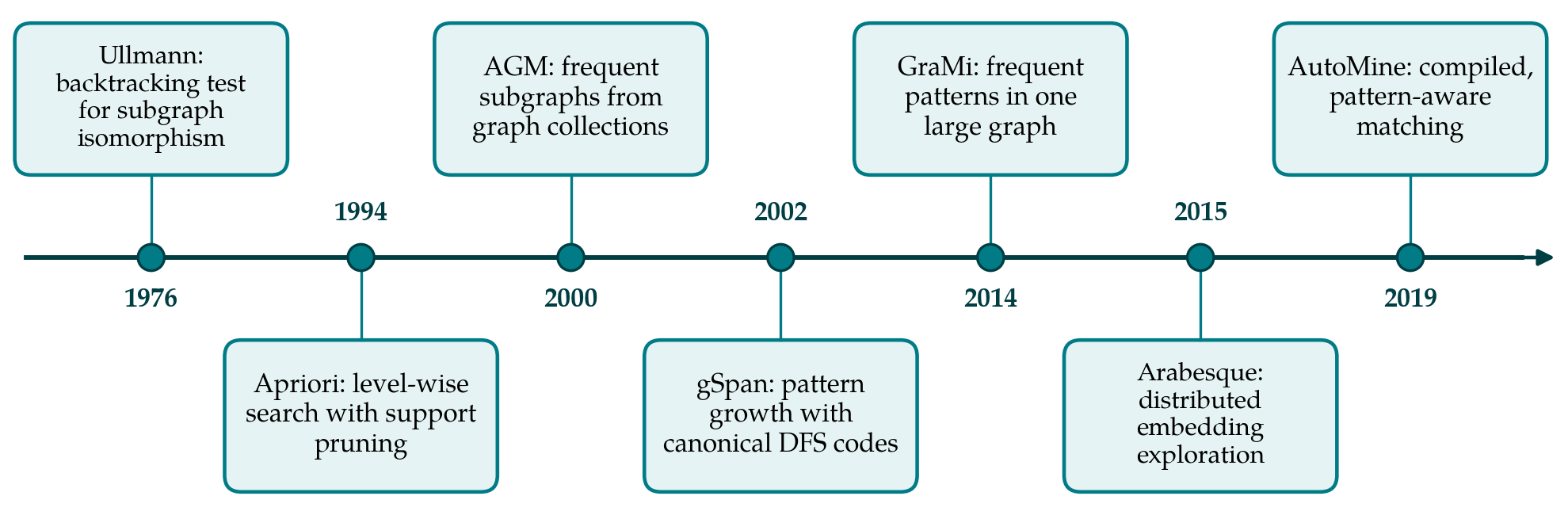
The algorithms on which present systems rest were developed over roughly four decades. Figure 1 marks the contributions that the remainder of this section and the next describe.
4.1. Matching a single pattern
The backtracking procedure of Ullmann (1976) extends a partial mapping one pattern vertex at a time and prunes candidates whose neighbourhoods cannot be matched. Almost every later matcher is a refinement of it. VF2 added feasibility rules that examine the frontier of the partial mapping and reduced memory use enough to handle graphs with thousands of vertices (Cordella et al., 2004). Later work concentrated on the order in which pattern vertices are matched and on filtering candidate sets before the search begins, since a poor order can make the same search slower by orders of magnitude.
A separate theoretical line treats a pattern as a join query in which each pattern edge is a relation. Ngo et al. (2018) gave join algorithms whose running time is bounded by the largest possible output for the query, a guarantee that conventional pairwise join plans do not meet; the triangle query is the standard example. These worst-case optimal joins extend one variable at a time by intersecting adjacency lists, which is exactly what vertex-at-a-time backtracking does, and the result gave matching systems a principled account of why that strategy works.
4.2. Discovering frequent patterns in graph collections
Frequent subgraph mining borrowed its first design from itemset mining. Apriori generates candidate itemsets of size k + 1 from frequent ones of size k and discards any candidate with an infrequent subset (Agrawal and Srikant, 1994). AGM applied the scheme to graphs represented by adjacency matrices, growing patterns by a vertex at each level (Inokuchi et al., 2000), and FSG grew them by an edge (Kuramochi and Karypis, 2001). Both pay for candidate generation, which must join pairs of patterns and detect duplicates through canonical labelling, and for repeated isomorphism tests during support counting.
Pattern-growth methods removed candidate generation. gSpan assigns each pattern a canonical code derived from depth-first traversals and extends a pattern only along its rightmost path, so that the search space becomes a tree in which each pattern is visited once (Yan and Han, 2002). CloseGraph reports only closed patterns, those with no superpattern of equal support, and thereby shrinks the output considerably (Yan and Han, 2003). Gaston orders the search so that paths are enumerated first, then trees, then cyclic graphs, which defers the costly isomorphism work to the stage where it is unavoidable (Nijssen and Kok, 2004).
4.3. Mining a single large graph
Kuramochi and Karypis (2005) were among the first to mine frequent patterns in one sparse graph, using support measures based on sets of non-overlapping embeddings, which are themselves hard to compute. GraMi changed the formulation. It models the question of whether a pattern reaches the support threshold as a constraint satisfaction problem and stops searching as soon as enough distinct images have been found for every pattern vertex, so that the full set of embeddings is never enumerated (Elseidy et al., 2014). Avoiding enumeration wherever a decision or a count suffices has since become a general design principle.
4.4. Approximate counting
Where exact enumeration is out of reach, counts can be estimated. Colour coding assigns random colours to vertices and counts only matches whose vertices are all coloured differently, which can be done by dynamic programming for tree-like patterns (Alon et al., 1995). Sampling methods draw edges, paths or neighbourhoods and scale the counts observed. The survey by Ribeiro et al. (2021) classifies these estimators and notes that their accuracy guarantees weaken for rare patterns, which are often the patterns of interest.
5. Systems for Mining at Scale
General graph processing frameworks were not built for this workload. Pregel popularised the vertex-centric model, in which each vertex exchanges messages with its neighbours in synchronised rounds (Malewicz et al., 2010). The model suits computations whose state is proportional to the graph, such as PageRank. Pattern mining produces intermediate state proportional to the number of partial embeddings, and encoding those as messages overwhelms both memory and network. Dedicated systems followed, and Table 1 groups them into three generations.
| Generation | Core idea | Representative systems | Characteristic limit |
|---|---|---|---|
| Vertex-centric adaptation | Encode partial matches as messages between vertices | Pregel-style frameworks (Malewicz et al., 2010) | Message volume grows with embeddings |
| Embedding-centric, distributed | Enumerate embeddings level by level; filter with user code | Arabesque (Teixeira et al., 2015); Fractal (Dias et al., 2019) | Stores or recomputes many embeddings; canonicality checks |
| Embedding-centric, out-of-core | Express extension as relational joins streamed from disk | RStream (Wang et al., 2018) | Disk volume of intermediate tuples |
| Embedding-centric, accelerated | Extend and filter embeddings in bulk on CPU and GPU | Pangolin (Chen et al., 2020) | Device memory bounds embedding lists |
| Pattern-aware, compiled | Generate nested set-intersection loops for each pattern | AutoMine (Mawhirter and Wu, 2019); GraphPi (Shi et al., 2020) | Plan quality; many patterns to compile |
| Pattern-aware, interpreted | Derive matching order and symmetry breaking from the pattern | Peregrine (Jamshidi et al., 2020) | Assumes the graph fits in memory |
Arabesque introduced the embedding as the unit of computation. The system enumerates all embeddings of size k, passes each to a user-defined filter and process function, and extends the survivors to size k + 1, distributing the work across machines and compressing the stored embeddings (Teixeira et al., 2015). The interface is simple and general, but the system explores every connected subgraph up to the target size whether or not it can match the pattern of interest, and it must test each embedding for canonicality to avoid counting it more than once. Fractal kept the model and replaced stored embeddings with depth-first recomputation from compact state, which trades processor time for memory (Dias et al., 2019). RStream took the opposite route on a single machine, expressing extension as a relational join over edge streams on disk (Wang et al., 2018).
The second shift was to let the pattern guide the search. AutoMine compiles each pattern into nested loops over set intersections and differences of adjacency lists, which is the worst-case optimal join strategy made concrete, and schedules the loops to share work between patterns (Mawhirter and Wu, 2019). Peregrine analyses the pattern at run time to obtain a matching order and a set of ordering constraints on the matched vertices; these constraints break the pattern's symmetries so that each match is produced once and no canonicality test is needed (Jamshidi et al., 2020). GraphPi searches over combinations of matching order and symmetry-breaking restrictions with a cost model and uses inclusion-exclusion to count without enumerating the innermost loops (Shi et al., 2020). Pangolin showed that the extend and filter steps can be run in bulk on graphics processors when embedding lists fit in device memory (Chen et al., 2020).
6. Unresolved Scalability Limits
Pattern-aware systems made small patterns on large graphs routine. They did not change the shape of the problem, and five limits persist in the literature.
6.1. Output size and pattern size
The number of embeddings of a pattern with k vertices can grow as a polynomial of degree k in the size of the graph. Every exact enumerator is bound by that output. Published evaluations consequently stay with patterns of a handful of vertices, and each additional vertex typically multiplies the running time on a skewed graph. Counting techniques that avoid the innermost enumeration push the boundary outward by a level or so; they do not remove it. For frequent subgraph mining the difficulty is compounded, because the number of candidate patterns also grows super-exponentially with size and each requires its own support computation.
6.2. Degree skew
Real graphs have a few vertices of very high degree. Set intersections involving their adjacency lists dominate the running time, and the work attached to one such vertex can exceed that of millions of ordinary ones. Orienting edges from low to high degree helps for cliques and for some other symmetric patterns. For general patterns the remedy is less clear, and skew also undermines parallel scaling, since a static division of start vertices leaves most workers idle while a few finish the heavy tasks. Work stealing and fine-grained task splitting reduce the imbalance at the price of coordination overhead.
6.3. Symmetry and duplicate elimination
A pattern with many automorphisms is found many times unless the search is restricted. Ordering constraints solve this for small patterns, but the choice of constraints interacts with the matching order, the best combination depends on the data graph, and searching for it grows costly as the pattern gets larger. For discovery tasks the system must also decide whether two patterns encountered along different paths are the same, which is graph canonisation, a problem with no known polynomial-time algorithm for general graphs.
6.4. Distribution
Pattern search follows edges unpredictably, so a partitioned graph forces either remote adjacency lookups or replication of neighbourhoods. Systems that replicate the whole graph on every machine avoid the lookups and scale only until the graph outgrows one machine's memory. Systems that partition must ship partial embeddings or fetch adjacency lists on demand, and both make communication the bottleneck. No published design handles a graph larger than a single node's memory with the efficiency that the in-memory, pattern-aware engines achieve on smaller inputs.
6.5. Comparability of evaluations
Systems are evaluated on overlapping but different sets of graphs and patterns, with induced or non-induced semantics, with or without labels, and sometimes counting what a competitor enumerates. A reported speed-up may therefore reflect a different problem as much as a better engine. The field lacks a workload definition of the kind that decision-support benchmarks gave to relational systems, one that fixes the semantics, covers labelled and unlabelled graphs and includes patterns chosen to stress skew and symmetry.
7. Directions for Further Work
Three directions seem the most promising responses to these limits. The first is approximation with usable guarantees: estimators whose error can be bounded for the rare patterns that applications care about, and systems that expose the trade between accuracy and cost to the user. The second is incremental mining. Most production graphs change continuously, and recomputing pattern counts after each batch of edge updates wastes the previous result; restricting the search to matches that involve a changed edge is conceptually simple but complicates symmetry breaking and support maintenance. The third is tighter integration with query processing. Since pattern matching is a join, optimisers that combine worst-case optimal and conventional join operators, and that reason about labels and predicates through statistics, could bring to mining the cost-based planning it currently lacks.
8. Conclusion
Graph pattern mining has advanced through a steady accumulation of pruning ideas: canonical codes that visit each pattern once, support measures that permit early termination, matching orders derived from the pattern, and symmetry breaking that eliminates duplicate matches before they are generated. Systems built on these ideas handle small patterns over very large graphs on a single well-provisioned machine. The limits that remain are structural. They concern output size, skew, symmetry in larger patterns, distribution and the comparability of results, and they are more likely to yield to approximation, incremental computation and better planning than to further tuning of exact enumeration.
Conflict of interest
To be declared by the author(s) before publication.
Funding
To be declared by the author(s) before publication.