1. Introduction
Knowledge of where species occur is incomplete for most tropical animals, a deficiency that conservation biogeographers have named the Wallacean shortfall (Whittaker et al., 2005). Fruit bats illustrate it well. The family Pteropodidae contains close to two hundred species across Africa, Asia, Australia and the Pacific; many are known from few localities, and the first global action plan for the group identified the lack of basic distributional data as an obstacle to assessing their status (Mickleburgh et al., 1992). Because these bats disperse seeds and pollinate trees of ecological and economic value (Fujita and Tuttle, 1991), the gaps matter beyond the bats themselves.
Lowland forest is where the gaps are closing fastest and where the habitat is disappearing fastest. Surveys of remnant patches regularly turn up species not previously listed for a district, a state or a country, and these are published as new distribution records. This note concerns the form such a report should take. It presents no new record. Its subject is the evidence and information that make a record verifiable, and the caution needed in drawing conclusions from it.
2. Why Documentation Standards Matter
A published locality has a long afterlife. It is copied into checklists, aggregated in biodiversity databases and used to draw the range polygons from which extent of occurrence is calculated under the IUCN Red List criteria (IUCN, 2012). A single outlying point can enlarge that extent considerably and so alter a threat category. If the identification was wrong, the error spreads with the record and is seldom traced back. Fruit bats are prone to such errors because several widespread genera contain species that differ by small margins in forearm length, dentition or pelage, and because genetic surveys have revealed deeply divergent lineages within what were treated as single Southeast Asian species (Francis et al., 2010). A name applied in the field may not survive re-examination, and re-examination requires that something was kept.
3. Levels of Evidence
Records differ in what they leave behind for others to check. Figure 1 arranges the usual forms of evidence in order of strength. A sighting of bats at a fruiting tree leaves nothing. Photographs can be decisive for species with unmistakable external characters, but many pteropodids cannot be told apart from images, and a photograph without a scale or measurements often cannot settle even the genus. An animal that is measured, photographed, sampled for tissue and released provides a record that can be tested genetically. A voucher specimen deposited in a public collection, with tissue and a sequence linked to it, is the only form that permits every later question to be asked.
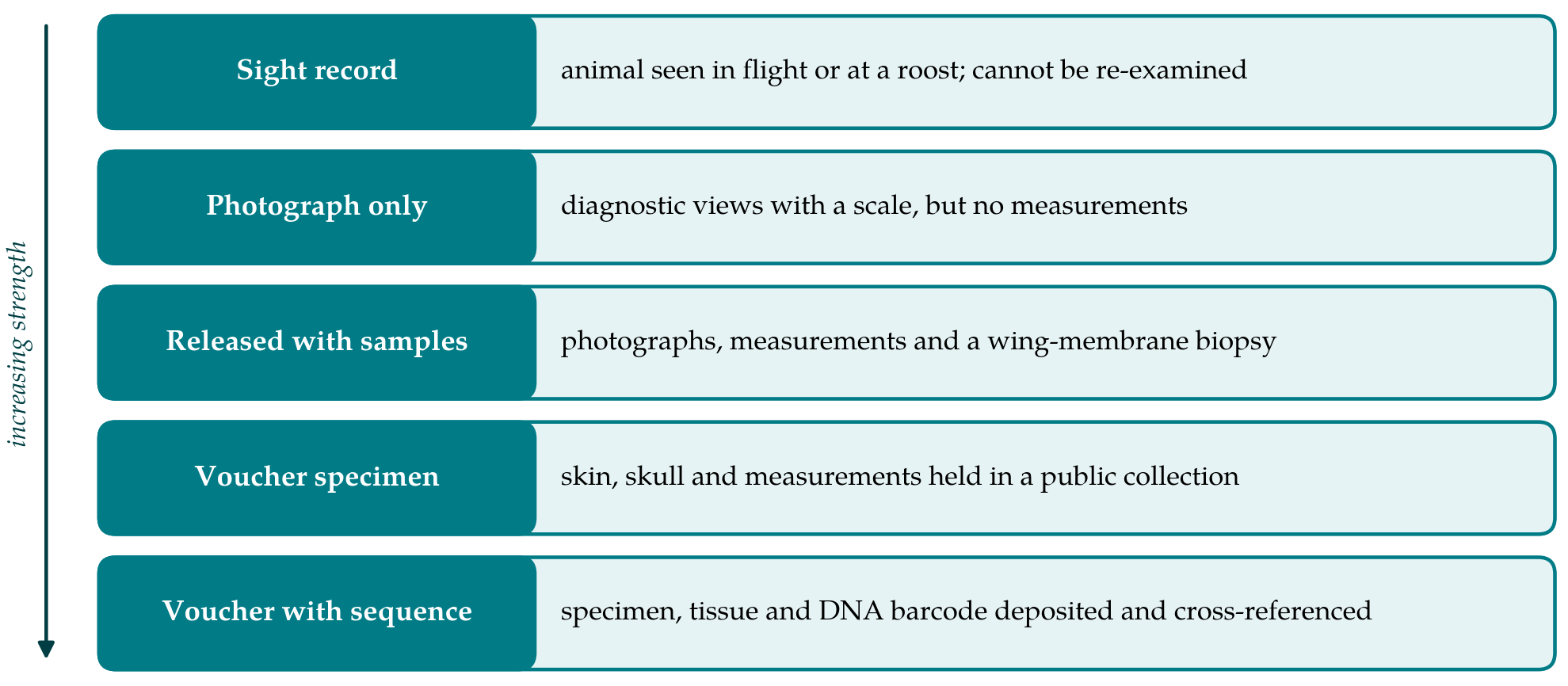
The choice between releasing and collecting is an ethical and legal one as well as a scientific one. Professional guidelines accept the collection of vouchers where it is justified, permitted and limited to what the question requires (Sikes et al., 2016). For a first record of a species that belongs to a taxonomically difficult group, one or two vouchers are normally defensible. For a threatened species that is readily identified, a biopsy and photographs may be the better course. Whatever is decided, the report should state it and give the permit under which the work was done.
4. What the Report Should Contain
Table 1 lists the elements that allow a reader to verify and reuse a record. Most are routine in good field practice (Kunz and Parsons, 2009); the purpose of setting them out is that short notes frequently omit one or more.
| Element | Minimum to report | Reason |
|---|---|---|
| Identification | Diagnostic characters used and the species they exclude | Shows how similar species were ruled out |
| Measurements | Forearm length, body mass, sex, age class, reproductive state | Allows comparison with published ranges |
| Voucher or sample | Collection name and catalogue number; sequence accession | Makes the record re-examinable |
| Locality | Coordinates, datum, uncertainty, elevation, place name | Permits accurate mapping |
| Capture details | Date, method, net height, effort | Indicates how detectable the species was |
| Habitat | Patch size, forest type, condition, nearest continuous forest | Needed to interpret the record |
| Context | Nearest previous records and their sources | Defines what is new |
Two of these deserve comment. Identification by DNA barcode, the comparison of a standard fragment of the mitochondrial cytochrome c oxidase I gene with a reference library (Hebert et al., 2003), is now inexpensive and should accompany morphological identification wherever a sample exists. It is only as good as the library: a match to a reference sequence that was itself misidentified proves nothing, so the report should name the reference sequences and say whether they derive from vouchered material. Locality data should follow a recognised standard. Georeferencing guidelines explain how to record coordinates with their datum and uncertainty (Chapman and Wieczorek, 2006), and the Darwin Core terms provide field names under which the record can pass into shared databases without loss (Wieczorek et al., 2012).
5. Interpreting a Record From a Forest Fragment
A new locality invites the phrase "range extension", which implies that the species has moved. More often it has simply been found. Fruit bats do not use the laryngeal echolocation that lets insectivorous bats be surveyed with acoustic detectors, so they are recorded mainly by netting, and ground-level nets miss species that forage in the canopy. A species may therefore have been present throughout a region and unrecorded for want of canopy nets or of any survey at all. The report should describe earlier survey effort in the area, so that readers can judge whether absence from previous lists means anything.
Fragmentation complicates the reading further. Pteropodids are strong fliers and many cross open country between feeding sites, so an individual netted in a small patch may roost and breed elsewhere. Reviews of bat responses to fragmentation find that outcomes vary widely among species and depend on the surrounding matrix as much as on patch size (Meyer et al., 2016). One capture does not show that a fragment supports a population. Evidence that would, such as pregnant or lactating females, juveniles, repeated captures across seasons or a located roost, should be reported if available and its absence acknowledged if not. Claims about the conservation value of the patch ought to be proportionate to that evidence.
6. Conclusion
A distribution record is a small contribution that others will build on, and it should be made to bear the weight. For fruit bats in fragmented lowland forest that means an identification supported by stated characters, measurements and where possible a sequence; a voucher or sample lodged where it can be consulted; a locality recorded to a published standard; and an interpretation that separates what was observed from what is inferred about range or population. Editors and reviewers can help by asking for these elements as a condition of publication.
Conflict of interest
To be declared by the author(s) before publication.
Funding
To be declared by the author(s) before publication.