1. Introduction
Farm power in South Asia has shifted from animals and hand labour to engines within two generations, and it has done so largely through hiring. Farm machines are indivisible, and a holding of one or two hectares cannot use a tractor or a combine for more than a few days a year. Where such farms have mechanised, it is because owners of machines sell services to their neighbours (Binswanger, 1986; Pingali, 2007). Pump sets, threshers, power tillers and four-wheel tractors all spread in this way, through markets for services that planners did little to design.
Private hiring does not reach every farmer or every operation. Owners serve their own land first, and specialised machines with a short season, such as zero-till drills, are slow to attract private investment. Indian policy has therefore supported custom hiring centres and farm machinery banks with capital subsidies, and has named cooperatives and farmer groups among the eligible operators (Government of India, 2014). A centre owned by its users promises service at cost and priority for members who would otherwise wait at the back of a private owner's queue.
Whether the promise is kept depends on decisions taken before any machine is bought: which operations to serve, how many machines of what size, what to charge and how to ration service at peak times. This article proposes an ordered procedure for those decisions. It is written for cooperative managers, promoting agencies and lenders. It reports no application to an actual centre, and the reasoning behind each step is drawn from published methods.
2. Background
The framework rests on three bodies of knowledge: the economics of machinery hire, the agronomy of the rice-wheat calendar and the theory of cooperative governance.
2.1. Hire markets and their limits
Service markets allow machine capacity to be matched to many small plots, and in China they have grown to the point where combine teams follow the harvest across provinces (Yang et al., 2013). The same literature records failures of supply-led models. In Ghana, state-supported mechanisation centres equipped with large tractors struggled to achieve the utilisation needed to cover their costs, while private owner-operators serving neighbours expanded (Diao et al., 2014). Hiring also has an inherent weakness for time-critical work. Every farmer in a locality wants the same operation in the same fortnight, and a farmer who hires bears the cost of waiting, which is one reason farmers who can afford it prefer to own (Allen and Lueck, 2002). Rental frictions of this kind help explain why machine capacity and farm size remain poorly matched (Foster and Rosenzweig, 2022).
2.2. The rice-wheat calendar
The dominant rotation of the plains places a wet-season rice crop before a winter wheat crop, with a turnaround that is short everywhere and shortest where long-duration rice is grown (Timsina and Connor, 2001). Wheat sown after its optimum date loses yield as grain filling is pushed into rising spring temperatures, a relationship established experimentally for north-west India (Ortiz-Monasterio et al., 1994). Zero tillage, in which wheat is drilled directly into rice stubble, shortens the turnaround and lowers cultivation costs, and its spread in the region has depended on service providers who own the drill (Erenstein and Laxmi, 2008; Keil et al., 2016). Timeliness is therefore the main product that a hiring centre sells in this system, and capacity planned on annual averages will fail at the moment it is needed.
2.3. Cooperative ownership
Jointly owned machinery is a shared resource with familiar hazards. Members have an incentive to use a machine hard and maintain it little, to demand priority at the peak, and to resist charges high enough to replace the fleet. Cook (1995) classified these as free-rider, horizon and control problems in cooperatives generally. Ostrom (1990) found that groups managing shared resources successfully had clear membership boundaries, rules matched to local conditions, monitoring by the users themselves and graduated sanctions. A machinery centre needs each of these in operational form.
3. The Proposed Framework
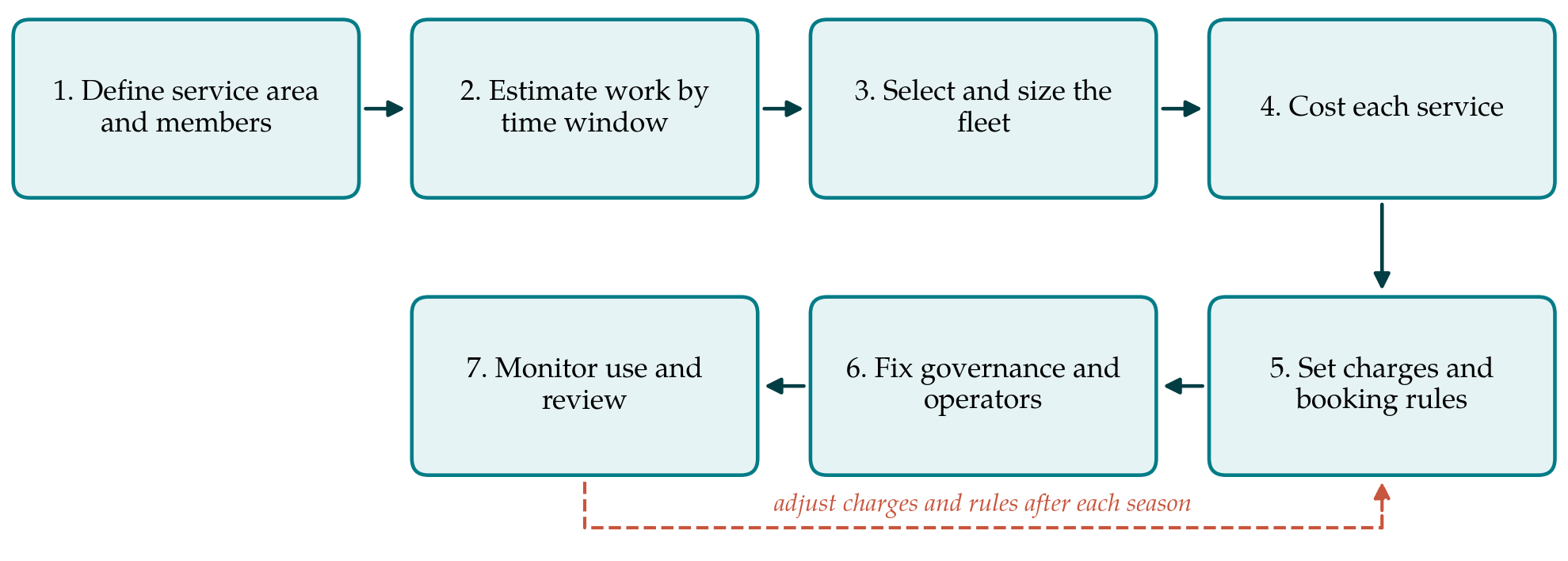
The framework has seven steps, taken in order and repeated each year. Table 1 lists the information each step requires and what it should produce, and Figure 1 shows the sequence with its annual review loop. The steps are then described one by one.
| Step | Information needed | Output |
|---|---|---|
| 1. Service area and members | Member list, holdings, plot access, cropping pattern | Map and register of area to be served |
| 2. Work by time window | Crop calendar, operations per crop, workable days | Hectares per operation in each window |
| 3. Fleet selection and sizing | Field capacity of candidate machines, tractor power | Number and size of each machine |
| 4. Costing | Purchase prices, subsidy, fuel, repairs, wages, interest | Cost per hour and per hectare; break-even use |
| 5. Charges and booking | Costs from step 4, local private hire rates | Tariff, booking and priority rules |
| 6. Governance and operators | By-laws, available operators and mechanics | Roles, logbooks, maintenance fund, audit |
| 7. Monitoring and review | Logbooks, accounts, service requests not met | Annual utilisation report and revised plan |
3.1. Step 1: Define the service area and membership
The centre should begin from a register of the members it will serve, with the area each cultivates, the crops grown and the location and access of plots. Travel between scattered plots consumes machine time that earns nothing, so a compact area served well is preferable to a wide one served late. The register also settles in advance who is entitled to member rates and priority, which is the boundary condition on which the later rules depend.
3.2. Step 2: Estimate the work in each time window
For each crop the operations to be offered are listed, such as primary tillage, puddling, sowing, spraying, harvesting, threshing and residue handling, together with the calendar window in which each must be completed. Multiplying the members' crop areas by the operations gives the hectares of work falling in each window. The number of days within a window on which fieldwork is actually possible is smaller than the calendar length, because of rain, wet soil and breakdowns, and should be estimated conservatively from local experience (Witney, 1988).
3.3. Step 3: Select and size the fleet
Machinery management texts give the effective field capacity of an implement, in hectares per hour, as forward speed in kilometres per hour multiplied by working width in metres and by field efficiency, divided by ten (Hunt, 2001; ASABE, 2006). Typical ranges of speed and field efficiency for each class of machine are tabulated in the engineering standards (ASABE, 2011). The number of units required for an operation is the hectares to be covered in its window divided by the product of field capacity, working hours per day and workable days. The calculation is made for the tightest window, which in this system is usually wheat sowing, and tractors are then matched to the implements they must pull. Machines that serve several operations or seasons deserve preference, because annual use is what spreads fixed cost.
3.4. Step 4: Cost each service
Ownership costs comprise depreciation, interest on the capital invested, insurance and housing. They accrue whether or not the machine works. Operating costs comprise fuel, lubricants, repairs and maintenance, and the operator's wage. Standard procedures estimate each from purchase price, expected life and annual hours (ASABE, 2006; Hunt, 2001). Costing should be done twice, at the subsidised price the cooperative pays and at the full price that replacement will eventually require. Dividing annual ownership cost by the margin between the hire charge and the operating cost per hour gives the break-even hours of use, the single most informative number for judging whether a machine belongs in the fleet.
3.5. Step 5: Set charges and booking rules
Charges should recover full cost at the utilisation expected from step 2, and should be compared with local private rates. A charge far below the private rate invites excess demand and resale of the service, and one above it loses members. Rules for the peak matter as much as the tariff. Options include serving bookings in order of receipt with a deposit, rotating priority among hamlets from year to year, or capping the area any one member can book in the first days of a window. Service to non-members at a higher rate can raise utilisation outside the peak without displacing members during it.
3.6. Step 6: Establish governance and operator arrangements
Each machine needs a named operator, a logbook recording hours, area, fuel and the member served, and a schedule of routine maintenance. Operators paid partly by the area completed and held responsible for avoidable damage have reason to work quickly and carefully. A fixed share of every hire charge should go to a maintenance and replacement fund that the committee cannot divert to other uses. Logbooks and accounts should be open to members and examined annually by someone outside the committee, which gives practical effect to the monitoring that Ostrom (1990) identified as a condition of durable collective management.
3.7. Step 7: Monitor utilisation and review
At the end of each season the hours worked by each machine are compared with its break-even hours, and requests that could not be met on time are counted alongside them. A machine that falls well short of break-even is a candidate for sale or for wider hiring out, and unmet requests in a window indicate where capacity should be added. The plan for the following year is revised accordingly.
4. Fitting the Framework to Local Conditions
Conditions differ sharply along the plains. In the north-west, holdings are larger, tractor ownership is widespread and combine harvesting is general, so a cooperative centre adds most by supplying specialised equipment for residue management, direct seeding and land levelling that individual owners lack. In the eastern plains, holdings are smaller and more fragmented, private service providers are fewer, and a centre may need to offer basic tillage and sowing as well (Keil et al., 2016). Evidence from Bangladesh indicates that machinery adoption follows infrastructure and access to credit as much as farm characteristics (Mottaleb et al., 2016), which implies that the same plan will perform differently where roads, repair services and fuel supply are weak. A centre in such a location may need to hold its own stock of spares and train its own mechanic.
The framework should also be applied with the private market in view. A cooperative centre that duplicates services already supplied competitively by local owners will struggle for work. One that fills gaps, or that restrains hire rates where a single owner dominates, has a clearer reason to exist.
5. Limitations and What Remains to Be Shown
The framework is proposed and has not been validated here. Its engineering components are standard, but the field efficiencies and repair costs published in the standards derive mostly from larger farms in other regions, and their fit to small, irregular plots in the plains needs checking against logbook data. The governance provisions are inferred from general principles. Which booking rule members regard as fair, and whether a ring-fenced replacement fund survives a poor season, are empirical matters. A useful test would follow centres planned in this way for several seasons and record utilisation against break-even, timeliness of sowing for members, the state of the replacement fund and the distribution of service across small and large members.
Two wider limits should be stated. The procedure takes the cropping pattern as given, although the availability of machines may itself change what members grow. It also treats subsidy as a parameter and does not ask whether subsidised cooperative ownership is a better use of public money than support for private service providers, a question on which the comparative literature is divided (Diao et al., 2014).
6. Conclusion
A cooperative custom hiring centre is a small business selling timeliness to its owners, and it should be planned as one. The seven steps proposed here move from the work to be done, through the fleet and its costs, to the rules that govern who is served and how the machines are kept. None of the steps is new in itself. The contribution is to place established machinery management calculations and principles of collective governance in a single sequence that a promoting agency can follow and a lender can check. The framework now needs to be tried, and its results reported, before it can be recommended as more than a reasoned proposal.
Conflict of interest
To be declared by the author(s) before publication.
Funding
To be declared by the author(s) before publication.