1. Introduction
Egg production has grown fastest in the regions where the climate suits the hen least. Across South and Southeast Asia, West and East Africa and much of Latin America, commercial layers bred in temperate countries for high output are housed in buildings with open sides, a roof, wire netting and curtains. The design is cheap, needs little electricity and works well for much of the year. During hot spells it leaves the flock exposed to air that is both warm and moist, and the losses that follow are large enough to have been counted even in countries with temperate summers (St-Pierre et al., 2003).
The subject has been reviewed many times, usually for poultry in general and often with the broiler in mind (Lin et al., 2006; Yahav, 2009; Lara and Rostagno, 2013). The laying hen in an open-sided house deserves separate treatment for two reasons. Her productive life is long, so she meets heat repeatedly and cannot be marketed early to escape it, and the shell of every egg depends on an acid-base balance that panting disturbs. The house, for its part, rules out the tunnel ventilation and pad cooling on which much published advice is built.
2. Approach of the Review
This is a narrative review of the published literature. It relies on the standard reference work on poultry in hot climates (Daghir, 2008), on earlier reviews, and on primary studies that illustrate a mechanism or test a measure in laying hens. Work on broilers is cited where the physiology is shared. No claim is made to have searched the literature exhaustively, and measures that require an enclosed house are mentioned only for contrast.
3. How Heat Affects the Laying Hen
A hen has feathers and no sweat glands. Within her comfort zone she loses heat mainly by convection, conduction and radiation from the comb, wattles, shanks and unfeathered skin. As air temperature approaches body temperature these routes fail, and she depends on evaporation from the respiratory tract by panting. Evaporation in turn depends on the water vapour content of the air, which is why a humid afternoon is more dangerous than a dry one at the same temperature, and why indices that combine temperature, humidity and air velocity describe the load on the bird better than temperature alone (Tao and Xin, 2003). The behavioural and endocrine responses are described in detail by Renaudeau et al. (2012).
Two consequences matter most for egg production. The first is a fall in feed intake, which reduces the supply of energy, amino acids and calcium. Classic chamber studies showed egg output, egg weight and shell thickness declining as temperature rose, with constant heat more damaging than a cycle that allows a cool night (de Andrade et al., 1977; Emery et al., 1984). A meta-analysis of the laying hen literature confirmed the pattern across many experiments (Mignon-Grasteau et al., 2015), and later work added suppressed immune responses to the list (Mashaly et al., 2004).
The second consequence is specific to shell formation. Panting removes carbon dioxide faster than it is produced, blood pH rises, and the bird enters respiratory alkalosis (Marder and Arad, 1989). Ionised calcium in the blood falls (Odom et al., 1986), intestinal calcium uptake is impaired (Mahmoud et al., 1996), and the calcium-binding protein calbindin is reduced in the shell gland and intestine of heat-exposed hens (Ebeid et al., 2012). Thin shells in hot weather are therefore more than a matter of hens eating less limestone.
4. The Open-Sided House as a Thermal Environment
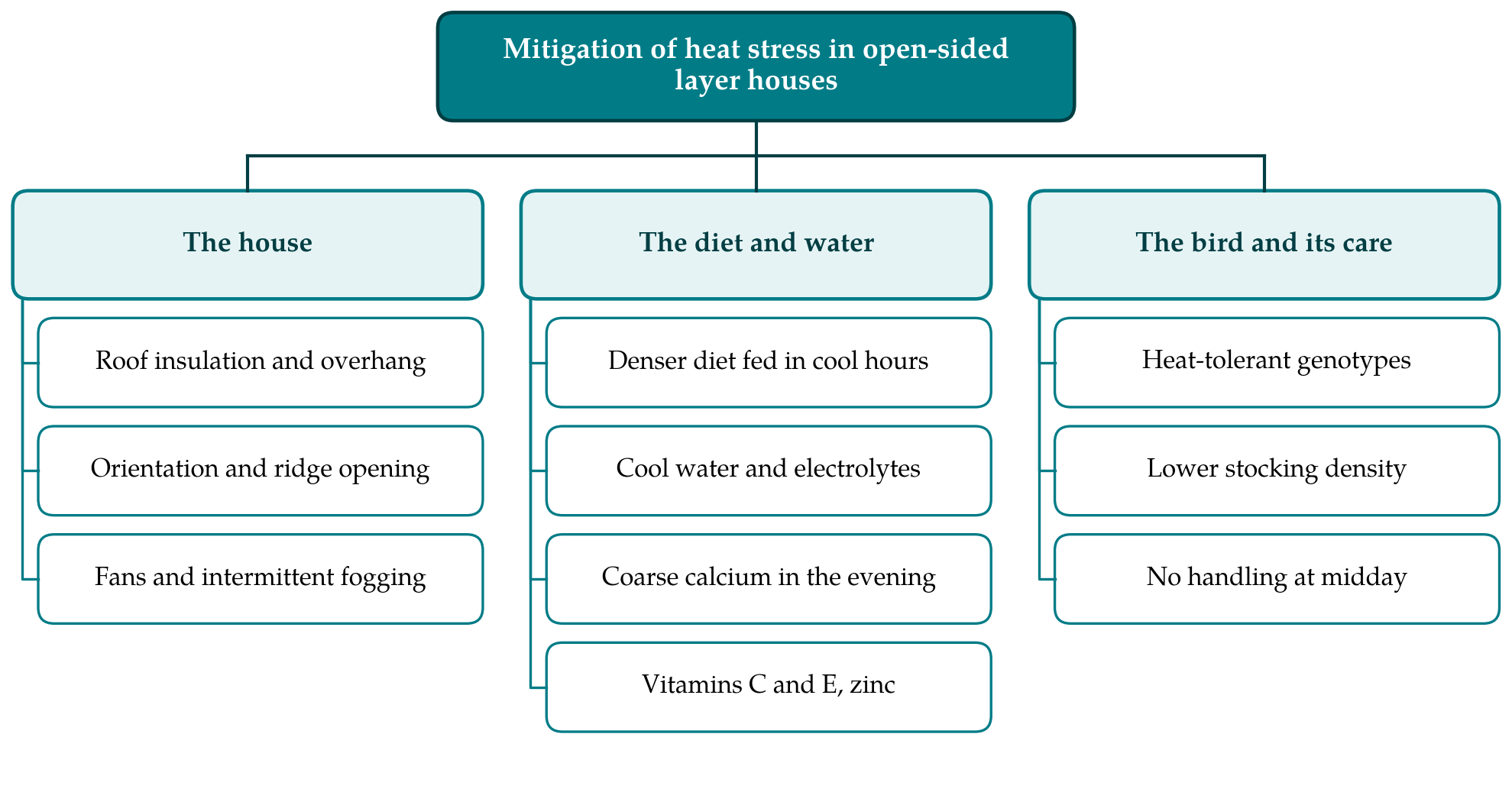
In a naturally ventilated house the inside temperature tracks the outside temperature, and the best the building can do is avoid adding to it. Heat is added by solar radiation through the roof and low sun through the sides, and by the birds themselves. It is removed by whatever breeze passes through. The design principles set out by Czarick and Fairchild (2008) follow from this: a narrow house with its long axis running east to west, a high and insulated or reflective roof with generous overhang, an open ridge, sides free of obstruction, and ground cover instead of bare soil around the building. Figure 1 places these building measures beside the nutritional and bird-related ones discussed below.
5. Measures Acting on the House
The roof is the first place to look. An uninsulated metal roof in full sun radiates heat down onto the birds for most of the day, and hens in upper cage tiers receive the most. Insulation beneath the sheeting, a reflective outer surface, or a second skin all reduce this load, and none requires electricity. Thatch and other traditional materials insulate well but bring problems of hygiene and durability. Shade trees help if they do not block the wind.
Air movement is the second. Moving air strips the warm, moist layer from around the bird and restores some convective heat loss even when the air is warm. In an open house the breeze cannot be relied on in the still hours of early afternoon, when it is needed most, so circulation fans directed along the bird zone are the most generally useful powered addition (Czarick and Fairchild, 2008). Their value falls as air temperature approaches body temperature, since convection then has little to offer.
Evaporative cooling by fogging or misting lowers air temperature at the cost of raising humidity. In a dry climate the exchange is favourable. In the humid tropics the room for it is narrower, though not absent, because relative humidity is usually at its lowest during the hottest hours. Fogging is best run intermittently, with fans, during that window, and stopped when the air nears saturation; otherwise it wets the litter and manure and hinders the panting bird (Daghir, 2008). Reducing the number of hens per cage or per unit of floor lowers the heat produced inside the house and opens paths for air, and it is one of the few measures available at no capital cost.
6. Measures Acting on Feed and Water
Nutritional measures aim to restore what reduced appetite takes away and to ease the metabolic cost of feeding. Table 1 lists them with the building measures and gives the main limit of each under humid conditions. The oldest advice is to raise nutrient density so that a smaller meal still carries the daily requirement, and to shift feeding towards the cool of early morning and evening. Fat has a lower heat increment than carbohydrate or protein, which is the rationale for adding it to diets fed in hot weather. Excess protein is costly to metabolise, which argues for meeting amino acid needs with a well-balanced protein instead of a high crude protein level (Gous and Morris, 2005; Balnave and Brake, 2005).
| Measure | How it acts | Main limit in humid tropics | Source |
|---|---|---|---|
| Roof insulation or reflective roof | Cuts radiant heat reaching the birds | Capital cost; upkeep of coatings | Czarick and Fairchild, 2008 |
| Circulation fans | Restores convective heat loss | Little benefit near body temperature; power supply | Tao and Xin, 2003 |
| Intermittent fogging | Cools air by evaporation | Raises humidity; wet litter | Daghir, 2008 |
| Lower stocking density | Less heat produced, freer air flow | Fewer eggs per house | Lin et al., 2006 |
| Denser diet, cool-hour feeding | Maintains nutrient intake | Does not remove heat load | Balnave and Brake, 2005 |
| Electrolytes and cool water | Supports acid-base balance and intake | Responses inconsistent | Balnave and Brake, 2005 |
| Vitamins C and E, zinc | Counter oxidative stress | Benefit varies between trials | Sahin et al., 2009 |
| Heat-tolerant genotype | Lower heat production or better heat loss | Lower output in cool conditions | Mérat, 1986 |
Water is the hen's main coolant and the vehicle for most short-term supplements. Intake rises sharply in heat, and hens drink more when the water is cool, so shaded and insulated tanks and buried supply lines are simple improvements. Bicarbonate and other electrolytes have been given in feed or water to offset the alkalosis of panting and to support shell formation; the reviews agree that responses are real in some trials and absent in others, and that feeding or lighting patterns which let hens consume calcium and bicarbonate during shell formation matter to the outcome (Balnave and Brake, 2005).
Heat increases oxidative stress, and antioxidant nutrients have been studied for that reason. Hens synthesise ascorbic acid, but supplementation has been reported to help under heat in a number of studies, with considerable variation between them (Whitehead and Keller, 2003). Supplementary vitamin E reduced the fall in egg production in hens exposed to heat (Bollengier-Lee et al., 1998), and zinc has been reviewed in the same context (Sahin et al., 2009). These supplements are inexpensive and unlikely to do harm at conventional levels. They should be regarded as support for a flock whose environment has already been attended to.
7. Measures Acting on the Bird
Commercial strains differ in how they respond to heat. Comparisons of layer lines under controlled heat exposure have found differences in production, behaviour and physiological response (Franco-Jimenez et al., 2007; Mack et al., 2013), which suggests that the choice of strain is a management decision in hot regions and not only a matter of peak output. Major genes that reduce feather cover, of which naked neck is the best studied, improve heat loss and have long been proposed for tropical production (Mérat, 1986). Local breeds and their crosses tolerate heat better but lay fewer eggs, and the balance between the two depends on the market.
Day-to-day management completes the picture. Vaccination, beak treatment, transfer and any other handling should be kept out of the hot hours. Lighting programmes can be arranged so that hens eat in the cool part of the day. Body weight and uniformity at point of lay deserve attention, because a pullet that starts production underweight has little reserve when appetite falls.
8. Gaps and Future Work
The physiology is well described; the field evidence is not. Most trials of nutritional measures were run in climate chambers at constant or simply cycled temperatures, with hens exposed for weeks instead of a full laying year, and humidity is often unreported. Building measures are supported more by engineering principles and extension experience than by controlled comparisons in layer houses (Nawab et al., 2018). Three kinds of study would be especially useful: comparisons of roof and fan options in working open-sided houses with temperature, humidity and air speed logged at bird level; trials that combine measures, since farmers never apply one alone; and economic analyses that set the cost of each measure against eggs recovered under local prices. The interaction of heat with the longer laying cycles now being adopted also needs study, since older hens already have weaker shells, and so does the cost of running fans and foggers where the electricity supply is unreliable.
9. Conclusion
For laying hens in open-sided tropical houses, heat stress cannot be removed, only reduced, and the order in which measures are taken matters. The literature supports dealing first with the roof and with air movement at bird level, then using fogging where and when the air can absorb moisture, then adjusting diet density, feeding time, water temperature and calcium supply to protect intake and shell quality. Supplements and strain choice add to these and do not replace them. Much of this guidance rests on sound physiology and limited field testing, and well-recorded trials on commercial farms in the humid tropics would do more to improve it than further chamber experiments.
Conflict of interest
To be declared by the author(s) before publication.
Funding
To be declared by the author(s) before publication.