1. Introduction
The fall armyworm, Spodoptera frugiperda (J.E. Smith), is a noctuid moth native to the tropical and subtropical Americas whose larvae feed on a very wide range of plants, with a strong preference for maize and other grasses (Montezano et al., 2018). Outbreaks were first reported from Nigeria, São Tomé, Benin and Togo in early 2016 (Goergen et al., 2016). Within about two years the insect had been confirmed across most of sub-Saharan Africa, a rate of spread with few precedents among crop pests. Early assessments warned of heavy losses in the staple cereal of much of the continent (Day et al., 2017).
The first response of governments and farmers was chemical. Emergency procurement programmes distributed whatever products were at hand, and surveys of smallholders in Ethiopia and Kenya found that most of those who took any action sprayed a synthetic insecticide (Kumela et al., 2019). That response met an insect with one of the longest records of resistance of any lepidopteran pest. Strains from the southern United States were already tolerant of carbamates, organophosphates and pyrethroids three decades ago (Yu, 1991), and resistance to newer chemistry and to Bt maize followed in Puerto Rico and Brazil.
Whether a given product will work in an African maize field therefore depends partly on which resistance alleles came with the invaders, and partly on which have been selected since. This review sets out what the published record says on both points and where it is silent.
2. Scope and Approach
This is a narrative review of the published literature. It draws on the molecular studies that identified resistance mechanisms in American populations of the pest, on the genotyping and genome sequencing studies that included material collected in Africa, and on the wider literature on resistance genetics and management. It does not report new bioassays or genotypes, and it makes no claim to have retrieved every relevant paper. Insecticide groups are named according to the mode of action scheme of the Insecticide Resistance Action Committee (Sparks and Nauen, 2015). The term allele is used for a heritable variant at a named locus; resistance that rests on changes in enzyme activity is treated separately because it seldom maps to a single diagnostic variant.
3. The Invasion and Its Genetic Consequences
The resistance profile of an invasive population is set first by its founders. Two host-associated strains of fall armyworm are recognised in the Americas, a corn strain and a rice strain, distinguished by mitochondrial and Z-linked markers. Nagoshi et al. (2018) found that moths from the northern part of sub-Saharan Africa mostly combine a mitochondrial haplotype typical of the rice strain with a nuclear marker typical of the corn strain, an arrangement that is uncommon in the western hemisphere, and that the same pattern recurs from country to country. The simplest reading is a recent introduction from a restricted source followed by rapid dispersal.
Two consequences follow for resistance. A narrow founding population carries only a sample of the alleles present in the source region, so mechanisms that are common in Brazil or Puerto Rico need not be present in Africa at all. And an insect that mixes freely over long distances will carry any allele that is present, or that later arrives or arises, across national borders within a few generations. Resistance in this species is a regional matter, and data from one country bear on its neighbours (Tay et al., 2023).
4. Target-Site Alleles
Most of the diagnostic markers available for fall armyworm are point mutations in the proteins that insecticides bind. Such changes are a general feature of resistance evolution in insects, and the same positions recur across unrelated pests (ffrench-Constant, 2013). Table 1 lists the variants documented in S. frugiperda; the paragraphs below take them in turn.
| Target | Variants reported | Compounds affected | Source |
|---|---|---|---|
| Acetylcholinesterase (ace-1) | A201S, G227A, F290V | Organophosphates and carbamates (group 1) | Carvalho et al., 2013 |
| Voltage-gated sodium channel | T929I, L932F, L1014F | Pyrethroids (group 3A) | Carvalho et al., 2013 |
| Ryanodine receptor | I4734M | Diamides (group 28) | Boaventura et al., 2020a |
| ABC transporter C2 | Frameshift insertion that truncates the protein | Cry1F protein of Bt maize | Banerjee et al., 2017 |
| Detoxifying enzymes | Raised activity or expression; no single diagnostic allele | Several groups | Yu et al., 2003 |
4.1. Acetylcholinesterase
Organophosphates and carbamates inhibit acetylcholinesterase at the synapse. Working with a chlorpyrifos-resistant strain from Brazil, Carvalho et al. (2013) identified three amino acid substitutions in the ace-1 gene, A201S, G227A and F290V, at positions known from other insects to reduce inhibition. These are the variants most consistently found outside the Americas. A survey of field collections from several continents, African material among them, reported ace-1 substitutions at appreciable frequency (Boaventura et al., 2020b), and whole-genome sequencing of moths from Malawi and Uganda alongside Chinese and Brazilian samples found the same class of variant (Guan et al., 2021). Populations that invaded China, which are thought to derive from the African introduction, show the same pattern (Zhang et al., 2020).
4.2. The voltage-gated sodium channel
Pyrethroids act on the voltage-gated sodium channel, and knockdown resistance arises from substitutions in its second domain. The pyrethroid-selected Brazilian strain studied by Carvalho et al. (2013) carried T929I, L932F and L1014F. In contrast to the acetylcholinesterase variants, these have been rare in subsequent field surveys even in Brazil, and they were not detected in the African and Asian material examined by sequencing (Boaventura et al., 2020b; Guan et al., 2021). Their absence from a sample does not make pyrethroids reliable. Knockdown resistance is typically recessive, so a rare allele hides in heterozygotes, and much of the pyrethroid tolerance recorded in this species is enzyme-based.
4.3. The ryanodine receptor
The diamides, chlorantraniliprole and flubendiamide among them, activate the ryanodine receptor of muscle and became the mainstay of fall armyworm control in Brazilian maize. Laboratory selection of a field population produced very high resistance to chlorantraniliprole with cross-resistance to other diamides, inherited as an autosomal and incompletely recessive trait (Bolzan et al., 2019). The strain carries an isoleucine to methionine substitution, I4734M, in the receptor's transmembrane region, at the position equivalent to a mutation already known from diamide-resistant diamondback moth (Boaventura et al., 2020a). The early genotyping and sequencing studies did not find this allele in African collections. Diamides have since been promoted widely on the continent, which makes the receptor an obvious locus to watch.
5. Resistance to Bt Proteins
Maize expressing insecticidal proteins from Bacillus thuringiensis is a principal tool against the pest in the Americas, and the fall armyworm supplied one of the clearest cases of field failure. In Puerto Rico, populations became resistant to maize producing Cry1F within a few years of its introduction, and the trait proved to be autosomal and highly recessive (Storer et al., 2010). Banerjee et al. (2017) traced it to an insertion in the gene for the ABCC2 transporter, a receptor for the toxin in the midgut, which produces a truncated protein, and they designed a DNA test for the allele. Cry1F resistance also evolved in Brazil (Farias et al., 2014), where several different disruptions of the same gene have since been described.
In sub-Saharan Africa the matter is at present largely prospective, since Bt maize has been grown commercially for many years only in South Africa and has been approved or tested in a small number of other countries. The Puerto Rican insertion was not found in the African genomes examined by Guan et al. (2021). Global experience with Bt crops shows that resistance evolves fastest where the dose is not high for the target species and refuges are scarce (Tabashnik et al., 2013), and the fall armyworm is inherently less susceptible to some Cry1 proteins than the stem borers for which the first African events were chosen.
6. Resistance Without a Single Marker
Figure 1 sets the target-site alleles beside the other main route to resistance, the enhanced breakdown or sequestration of the insecticide before it reaches its target. Biochemical work on resistant strains from Florida showed raised activities of microsomal oxidases, esterases and glutathione S-transferases, together with a less sensitive acetylcholinesterase, in the same insects (Yu et al., 2003). The genome of the species contains large families of the genes concerned, in keeping with a larva that feeds on many chemically defended plants (Gouin et al., 2017).
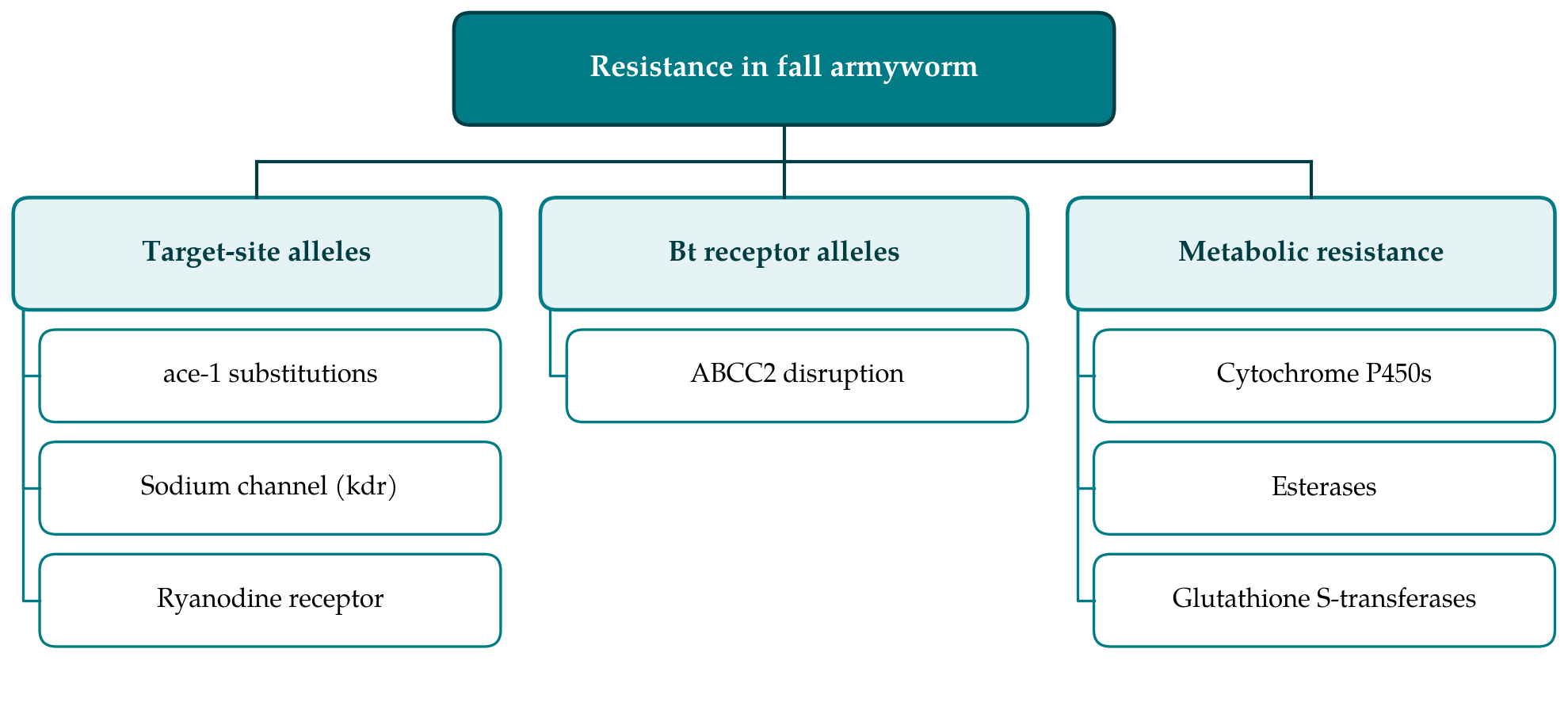
Metabolic resistance is harder to monitor than a point mutation. Cytochrome P450-mediated resistance usually reflects over-expression or duplication of one or more genes, and the gene responsible differs between species and sometimes between populations (Nauen et al., 2022). No validated DNA marker for such resistance exists for fall armyworm in Africa. Its contribution has to be inferred from bioassays, from the effect of synergists such as piperonyl butoxide, and from expression studies, all of which need live insects and laboratory capacity.
7. What the African Record Shows
Taken at face value, the published genotypes give a fairly consistent account. The lineage that colonised Africa carried ace-1 substitutions, which fits with reports of reduced susceptibility to organophosphates in invasive populations (Zhang et al., 2020). It did not carry, at a frequency the early surveys could detect, the sodium channel, ryanodine receptor or ABCC2 alleles described from the Americas. Populations in Puerto Rico and Mexico, by comparison, show field-evolved resistance to a broad range of synthetic insecticides (Gutiérrez-Moreno et al., 2019).
The limits of that account are considerable. The African samples in the published studies come from few countries, were collected within the first years of the invasion, and are small in relation to the area they stand for. Samples of that kind cannot exclude a recessive allele at low frequency, which is exactly the condition from which resistance emerges. West and Central Africa, where the pest was first seen, and the large maize areas of southern Africa are poorly represented. Nor can any of these studies speak to selection since they were done.
Selection pressure in African maize differs from that in Brazil in ways that cut both ways. Most maize is grown by smallholders who spray seldom or not at all, and unsprayed fields and wild grasses act as a refuge for susceptible insects. Against this, where spraying does occur the choice of product is often narrow and repeated, dose and coverage are variable, and the same few modes of action are used on neighbouring vegetable crops. The classical analysis of Georghiou and Taylor (1977) identified exactly these operational factors, together with the number of generations a year and the dominance of the allele, as the determinants of how fast resistance evolves.
8. Gaps and Future Work
Three gaps stand out. The first is geographic: baseline susceptibility data and allele frequencies are needed from each of the main maize belts, collected to a common protocol so that results can be compared. The second is temporal. A single survey says little; the informative quantity is the change in frequency between seasons at fixed sites. The third is mechanistic. Genotyping for the alleles in Table 1 is inexpensive and can be run on dead moths from pheromone traps, but it sees only known variants at known loci, and it should be paired with periodic bioassays so that resistance arising by another route is not missed.
The integrated pest management guidance prepared for the continent already recommends rotating modes of action, scouting before spraying and conserving natural enemies (Prasanna et al., 2018). Monitoring would give that advice a factual basis, country by country, and would show whether rotation is being followed in practice. Because the insect moves between countries, the results are of most use when they are shared across the region and promptly.
9. Conclusion
The fall armyworm did not reach Africa as a susceptible insect. The published evidence indicates that the founding population carried acetylcholinesterase variants that blunt organophosphates and carbamates, and enzyme systems capable of degrading several other groups. Alleles for knockdown resistance, diamide resistance and Cry1F resistance, all documented in the Americas, were not found in the early African samples, but those samples were too few and too early to show that the alleles are absent or will remain so. The tools to look for them exist and are not costly. What is missing is their regular use across the maize belts of the continent.
Conflict of interest
To be declared by the author(s) before publication.
Funding
To be declared by the author(s) before publication.