1. Introduction
A conventional inhibitor must occupy its site for as long as an effect is wanted, so exposure has to be maintained above a threshold throughout the dosing interval. A degrader works by a different logic. It brings the target protein into contact with an E3 ubiquitin ligase, ubiquitin chains are transferred to the target, the proteasome destroys it, and the degrader is free to act again. Loss of the protein lasts until the cell resynthesises it, which uncouples the duration of effect from the concentration of the drug. The principle was first shown with a chimeric molecule that used a peptide to recruit a ligase complex to methionine aminopeptidase 2 (Sakamoto et al., 2001).
Progress then waited on chemistry. Peptide-based recruiters were unsuitable as drugs, and the field became practical only when small ligands for ligases were available. Structure-guided work produced hydroxyproline-derived binders of the von Hippel-Lindau protein (Buckley et al., 2012), and separate work identified cereblon as the protein through which a class of immunomodulatory agents acts (Ito et al., 2010). Those agents were later shown to make cereblon ubiquitinate transcription factors that are not among its usual substrates (Krönke et al., 2014), which established that a small molecule can redirect a ligase. Bifunctional compounds built from these ligands degraded bromodomain proteins and kinases at low doses in animals (Winter et al., 2015; Bondeson et al., 2015).
Degraders of the androgen and oestrogen receptors are now given orally in trials, and the field has acquired a body of practical knowledge about what can and cannot be designed (Békés et al., 2022). This review asks how far that knowledge amounts to rules, why oral absorption is attainable for molecules of this size, and what is left for the formulator to solve.
2. Scope and Approach
This is a narrative review of the published literature on bifunctional degraders, with occasional reference to monovalent glue compounds where the comparison is useful. It draws on the primary reports that fixed the main design principles, on analyses of degrader property space, on perspectives written from a drug metabolism and pharmacokinetics standpoint, and on the general literature on oral delivery of poorly soluble compounds. Sources were selected for their influence on current practice rather than by a formal protocol, and no counts of records screened are claimed. Clinical efficacy and safety lie outside the scope. The article reports no data of its own.
3. What Is Known About Designing a Degrader
Three parts are chosen when such a molecule is designed: the ligand that binds the protein to be removed, the ligand that engages the ligase, and the linker between them. Each choice has a consequence downstream, and the consequences are not confined to potency in cells. Table 1 collects the main design variables with the effect each has on the prospect of giving the compound by mouth.
| Design variable | What is decided | Bearing on oral delivery | Source |
|---|---|---|---|
| Ligase ligand | Cereblon or von Hippel-Lindau binder | Cereblon binders are smaller and carry fewer donors | Maple et al., 2019 |
| Target ligand | Affinity, size, exit vector | Tight binding is not required, so mass can be saved | Bondeson et al., 2018 |
| Linker | Length, rigidity, polarity | Governs folding, permeability and metabolic soft spots | Atilaw et al., 2021 |
| Three-part complex | Cooperativity and geometry | An efficient complex allows lower exposure | Gadd et al., 2017 |
| Hydrogen bond donors | How many stay exposed to water | Fewer exposed donors favour membrane passage | Klein et al., 2020 |
| Solid form | Crystalline or amorphous | Sets dissolution rate and the need for an enabling form | Baghel et al., 2016 |
3.1. The two ligands
Although the human genome encodes several hundred E3 ligases, nearly all well-studied degraders recruit one of two. Schapira et al. (2019) set out the reasons: cereblon and the von Hippel-Lindau protein are broadly expressed, accept a range of induced substrates, and have tractable ligands. The choice carries physicochemical weight. Cereblon binders are compact glutarimide derivatives, whereas the peptidomimetic binders of the von Hippel-Lindau protein are larger and contain more amide bonds and donors. In the survey of degrader property space by Maple et al. (2019), compounds built on cereblon ligands sat closer to the region occupied by oral drugs, and the degraders that reached oral clinical use recruit cereblon.
On the target side, the finding that most altered practice is that binding strength and degradation correlate poorly. Bondeson et al. (2018) linked a promiscuous kinase inhibitor to ligase ligands and observed that only a subset of the kinases it bound were removed, while some that it bound weakly were removed efficiently. Selectivity came from whether a productive complex could form. A designer may therefore prefer a modest, small target ligand to a potent, heavy one, which is a useful liberty when every atom added worsens the physical properties of the finished molecule.
3.2. Linker and complex geometry
The linker was once treated as inert spacing. Structural work changed that view. The complex formed between a degrader, the von Hippel-Lindau protein and a bromodomain showed extensive contacts between the two proteins, with the degrader stabilising an interface that does not otherwise exist, so that the compound bound the pair more tightly than either partner alone (Gadd et al., 2017). Positive cooperativity of this kind explains why small changes in linker length or attachment point can abolish activity while leaving both binary affinities intact. It also sets a limit on rational design: the geometry that matters is a property of the complex, and it is still largely found by making and testing series rather than predicted.
A further consequence is kinetic. Degradation depends on how long the complex survives, on the accessibility of lysine residues on the target surface, and on the processivity of ubiquitin transfer. Because a single degrader molecule can act repeatedly, the exposure needed in tissue may be lower than for an inhibitor of the same protein, which is part of why molecules with unpromising properties have nonetheless worked in animals. The counterpart is the well-known loss of activity at high concentration, where separate two-part complexes with each protein outnumber the productive three-part species.
4. Why Oral Absorption Is Possible At All
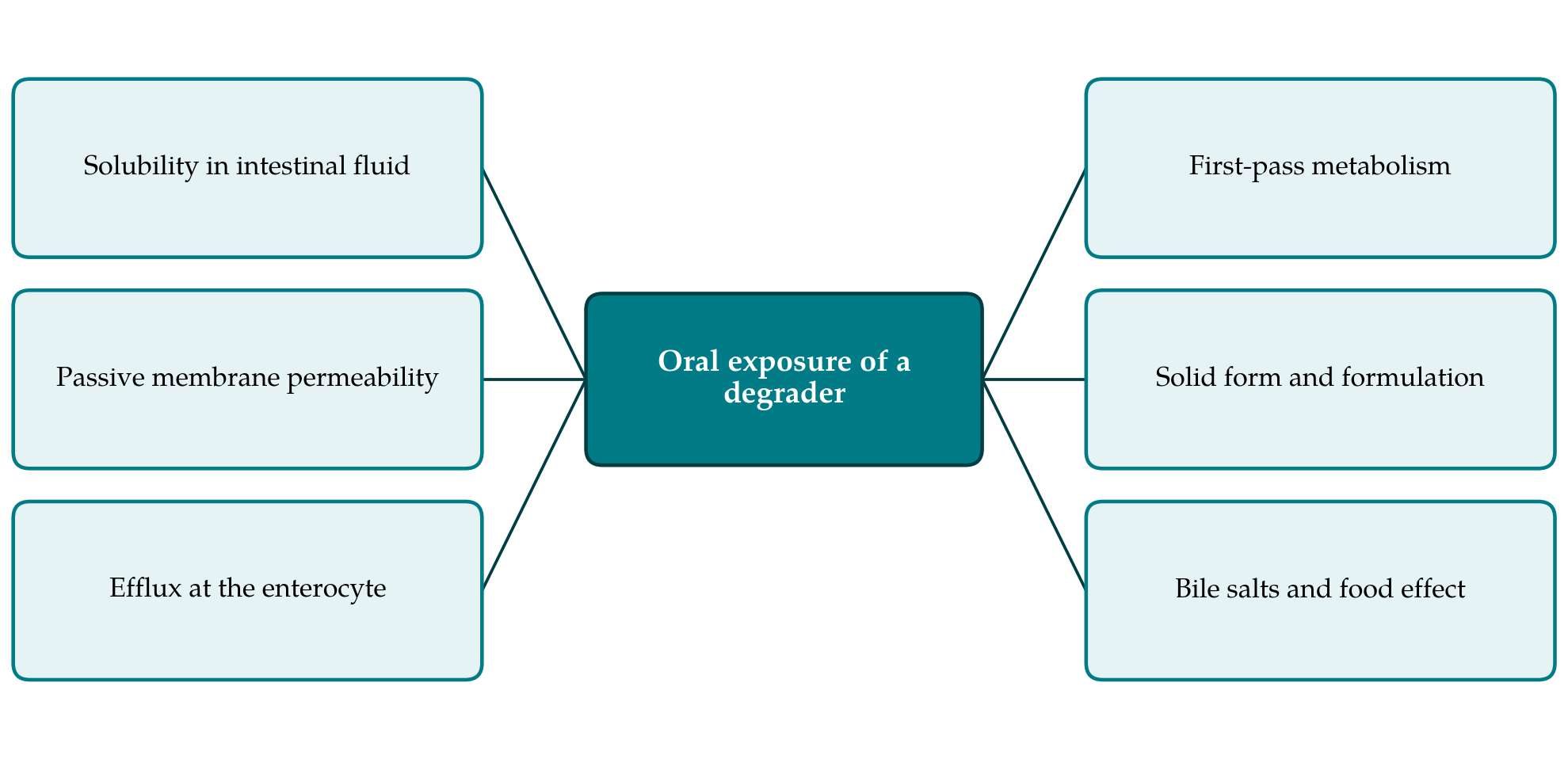
Most degraders exceed every threshold of the rule of five of Lipinski et al. (1997), often by a wide margin in molecular weight and polar surface area. Yet oral exposure is achieved. The explanation that has gathered most support comes from work on other large oral compounds, notably cyclic peptides, where permeability tracks not total polarity but the number of hydrogen bond donors left exposed to water (Over et al., 2016). A molecule that can fold so that its donors satisfy each other presents a comparatively greasy surface to the membrane and unfolds again in water. Figure 1 summarises the factors that together set oral exposure for a compound of this class.
Direct evidence that degraders behave this way comes from conformational studies. Atilaw et al. (2021) examined a bromodomain degrader by nuclear magnetic resonance in solvents of differing polarity and found that it adopted folded conformations with internal hydrogen bonds in the less polar medium and extended conformations in water. Klein et al. (2020) showed that masking or removing exposed donors in a series improved permeability, and Poongavanam et al. (2022) review the wider conformational literature as it applies to this chemical space. The practical rules that follow are modest but real: minimise exposed donors, allow the linker enough flexibility to fold, prefer the smaller ligase ligand, and measure permeability in an assay that does not assume a rigid molecule.
Permeability is not the only barrier. Many degraders are substrates of efflux transporters at the enterocyte, so that the fraction crossing the epithelium is lower than a cell-free assay suggests, and the amide and ether functions common in linkers are open to oxidative metabolism in gut wall and liver. Pike et al. (2020) and Cantrill et al. (2020) discuss the resulting programme of work from a drug metabolism standpoint, including the point that permeability and solubility assays developed for conventional drugs can mislead when applied to compounds of this size.
5. Formulation Hurdles
What reaches the formulator is typically a high-melting solid of low aqueous solubility, often with poor wetting and a slow intrinsic dissolution rate, to be given at a dose far above what dissolves in the available intestinal fluid. The compound is frequently a weak base, so that release in the stomach is followed by a risk of precipitation on entering the duodenum. Food, by raising bile salt and lipid concentrations, can change exposure considerably, and a large positive food effect is awkward in patients who are unwell.
Two families of enabling formulation dominate. In an amorphous solid dispersion the compound is held in a polymer in the non-crystalline state, so that it dissolves to a supersaturated concentration which the polymer then sustains; the approach is mature for poorly soluble drugs generally (Newman et al., 2012; Baghel et al., 2016). In a lipid-based system the compound is presented already dissolved in a mixture of lipids and surfactants that disperses on contact with gastrointestinal fluid (Pouton, 2006); the limit here is solubility in the vehicle itself, which is often disappointing for large, high-melting solids. Choosing between the two, and setting the dissolution test that discriminates between candidate forms, remains largely empirical for this class, and published accounts are few by comparison with the medicinal chemistry literature.
6. Gaps and Future Work
Three gaps stand out. The first is predictive: there is no reliable way to say in advance which linker will produce a cooperative complex, so series are still made and screened. The second is the scarcity of comparable physicochemical data. Permeability, solubility and stability for degraders are measured in different laboratories under different conditions, and a shared set of assays and reporting conventions would allow property trends to be separated from assay artefacts. The third concerns the dosage form. Very little has been published on solid-state behaviour, on polymer selection for these molecules, or on how the food effect responds to an enabling formulation, and that literature will have to be built if oral degraders are to be developed as routinely as conventional drugs.
A fourth matter sits between chemistry and pharmaceutics and belongs to neither alone. The exposure a degrader needs is not fixed by its potency in a biochemical assay, because the depth of protein loss, the rate at which the cell replaces the protein, and the capacity of the compound to act repeatedly all enter the calculation. Until that relationship is described for more targets, the formulator is asked to improve a number whose required value nobody can state. Settling it is a shared problem, and progress on it would do as much for oral degraders as a further increment in permeability.
7. Conclusion
The design of bifunctional degraders has reached the point where the main variables are identified and their consequences understood in outline: the ligase ligand sets much of the physicochemical burden, the target ligand need not bind tightly, and the linker decides whether a cooperative complex forms. Oral absorption, once thought improbable for molecules of this size, is explained principally by conformational folding that hides hydrogen bond donors. The weakest part of the published record is pharmaceutical. Until solid-form behaviour, enabling formulations and food effects for this class are described as thoroughly as the chemistry has been, each new oral degrader will be developed with less guidance than its chemistry deserves.
Conflict of interest
To be declared by the author(s) before publication.
Funding
To be declared by the author(s) before publication.