1. Introduction
Maize in the lowland and mid-altitude tropics is grown mostly without irrigation, and the rains on which it depends are erratic. A dry spell that coincides with flowering can remove most of the grain yield of a crop that looked healthy three weeks earlier. Breeding for tolerance to such spells has been a declared aim of public maize programmes for decades, and the methods developed at CIMMYT, which rest on managed stress trials in a rain-free season and on secondary traits such as the anthesis-silking interval, produced steady gains in tropical populations (Bolaños and Edmeades, 1996; Edmeades et al., 1999). The price of that progress is time. Each cycle of phenotypic selection under managed drought takes at least one dry season, and usually more once testcrosses have to be made and evaluated.
Genomic selection was proposed as a way to predict the genetic merit of an individual from dense markers spread across the whole genome, without first identifying which markers matter (Meuwissen et al., 2001). Simulations for maize suggested early on that the approach could outperform marker-assisted recurrent selection for traits controlled by many genes (Bernardo and Yu, 2007), and the argument for crops in general was set out by Heffner et al. (2009). For drought tolerance the attraction is plain: if selection candidates can be ranked from a leaf sample, several cycles can be completed in an off-season nursery between one round of stress trials and the next.
Everything in that argument turns on accuracy. A prediction that correlates weakly with true breeding value yields little gain however fast the cycle turns, and one that looks accurate in a favourable validation exercise may fail when the target environment differs from the one that supplied the training data. This review asks what is known about the accuracy of genomic prediction for drought tolerance in tropical maize, and in particular how well it holds across field environments that contrast in water supply.
2. Scope and Approach
The article is a narrative review of the published literature. It draws on the theoretical papers that define prediction accuracy, on methodological work in genomic prediction for plants, and on empirical studies in tropical and, where instructive, temperate maize. No formal search protocol was applied and no new data are presented. Sources were chosen because they are widely cited, because they report experience from breeding programmes working under drought, or because they introduced a method now in routine use. The emphasis falls on grain yield under water deficit and on the secondary traits used alongside it, since these are the targets that breeding programmes actually select for.
3. What Accuracy Measures and What Limits It
Accuracy is the correlation between the genomic estimated breeding value and the true breeding value. The true value is never observed, so empirical studies report predictive ability, the correlation between predictions and phenotypes held back from the model, and sometimes divide it by the square root of heritability to approximate accuracy. The distinction matters under drought, where heritability is often low and the correction is correspondingly large and uncertain. In the breeder's equation accuracy multiplies selection intensity and the additive genetic standard deviation, and the product is divided by cycle length (Falconer and Mackay, 1996). Genomic selection pays when the loss in accuracy relative to field testing is smaller than the saving in time.
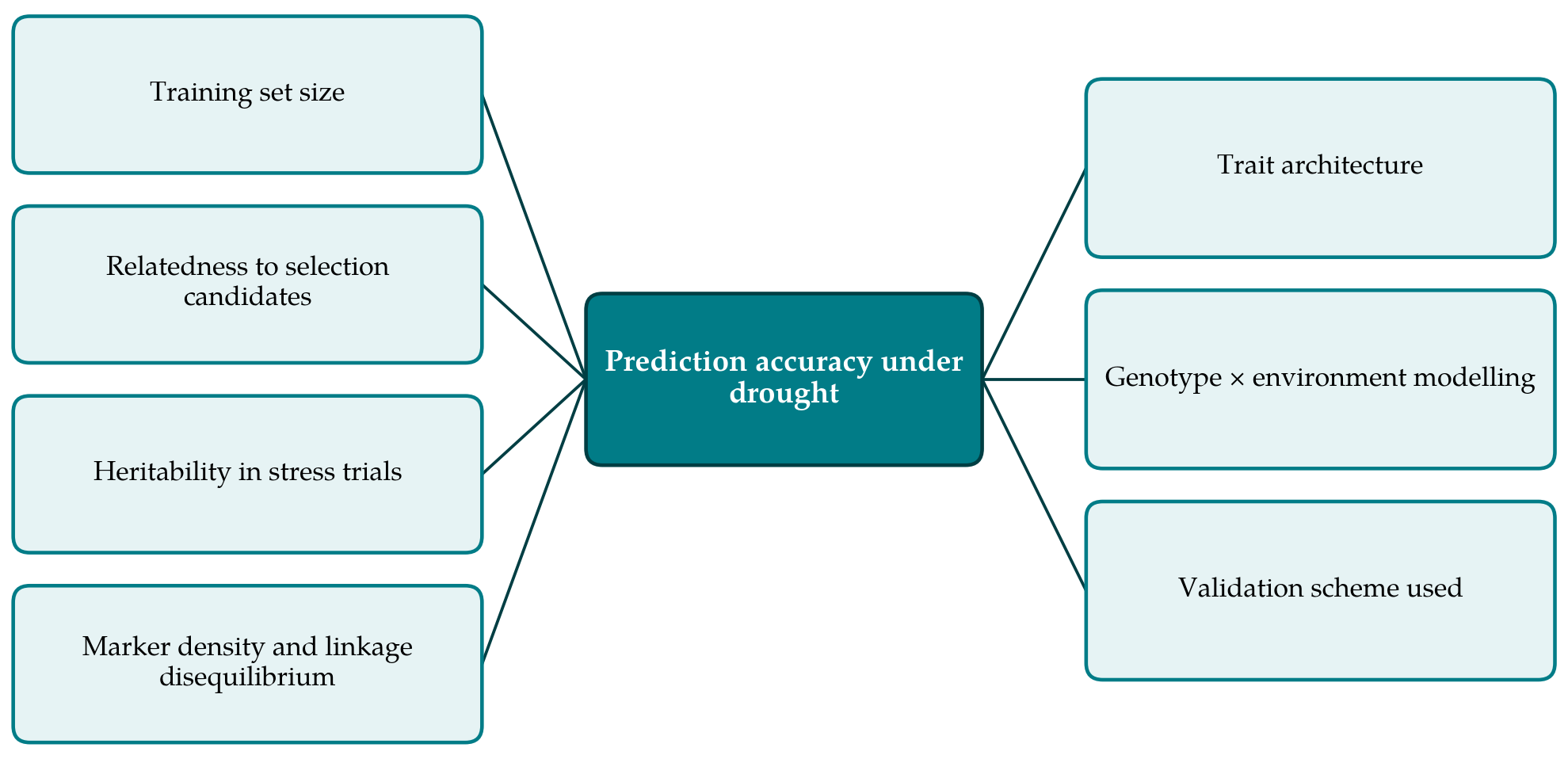
A deterministic expression derived by Daetwyler et al. (2008) shows what sets the ceiling. Expected accuracy rises with the number of phenotyped individuals in the training set and with the heritability of their records, and falls as the number of independent chromosome segments that must be estimated increases. That last quantity is small in a biparental family, where long blocks are inherited intact, and large in a diverse panel. Habier et al. (2007) added a point that is easy to overlook: markers capture pedigree relationships as well as linkage disequilibrium with causal loci, so a good part of the accuracy seen when training and validation sets are close relatives reflects kinship and decays quickly as relatedness falls. Figure 1 gathers the factors that the theory and the empirical work identify.
The statistical model is, by comparison, a minor influence for a trait as polygenic as grain yield. Ridge regression and its equivalent based on a genomic relationship matrix (VanRaden, 2008), the Bayesian regressions with heavier-tailed priors, and kernel methods have been compared many times, and reviews of that work conclude that differences among them are usually small next to the effects of population and trait (de los Campos et al., 2013). In biparental maize populations the simplest model performed about as well as the more elaborate ones (Lorenzana and Bernardo, 2009).
4. Drought Phenotyping as the Source of Training Data
A prediction model can be no better than the phenotypes it is trained on. The managed stress protocols described by Bänziger et al. (2000) were designed to raise the repeatability of drought trials: sowing in a reliably dry season, withdrawing irrigation so that stress falls at flowering or during grain filling, and keeping fields uniform enough that differences among plots reflect genotype. Even so, genetic variance for yield tends to shrink faster than error variance as stress deepens, and heritability falls with it. This is why secondary traits with higher heritability and a strong genetic correlation with yield under stress, above all a short anthesis-silking interval, were adopted as selection aids (Bolaños and Edmeades, 1996).
Two consequences follow for genomic selection. Training data from severe stress carry less information per plot, so more plots or more sites are needed to reach a given accuracy. And drought is not one environment. Stress at flowering, stress during grain filling and drought combined with heat rank genotypes differently; Cairns et al. (2013) found that tolerance to combined drought and heat in tropical maize was largely distinct from tolerance to either stress alone. A model trained in one stress scenario is therefore predicting a partly different trait when applied to another. Field phenotyping with proximal and aerial sensors offers a route to larger and better characterised training sets, although its use in routine selection is still developing (Araus and Cairns, 2014).
5. Evidence From Maize Breeding Populations
The empirical record can be read in three parts: prediction within biparental families, prediction across families and in diverse panels, and realised gain from selection on genomic estimates. Table 1 summarises how each of the main factors has been found to act and gives representative sources.
| Factor | Effect reported in the literature | Representative sources |
|---|---|---|
| Training set size | Accuracy rises with more phenotyped lines, with diminishing returns | Daetwyler et al., 2008; Lorenzana and Bernardo, 2009 |
| Relatedness | High within families, low or erratic across unrelated families | Habier et al., 2007; Riedelsheimer et al., 2013 |
| Population structure | Inflates apparent accuracy in pooled, diverse sets | Windhausen et al., 2012 |
| Stress level of trials | Lower heritability under severe stress reduces predictive ability for yield | Bänziger et al., 2000; Zhang et al., 2015 |
| Marker platform | Dense sequencing-based markers help little within families, more across them | Elshire et al., 2011; Zhang et al., 2015 |
| Environment modelling | Borrowing information across correlated environments improves prediction | Burgueño et al., 2012; Jarquín et al., 2014 |
5.1. Within biparental families
Most early applications in tropical maize trained and predicted within a single cross. Linkage blocks are long, relatedness is uniform, and a few hundred markers are enough to track them. Zhang et al. (2015) examined biparental tropical populations evaluated under water-stressed and well-watered conditions with both low-density markers and genotyping-by-sequencing, the method introduced by Elshire et al. (2011). Their results illustrate a pattern that recurs in the literature: flowering traits are predicted more reliably than grain yield, yield under stress is harder to predict than yield with adequate water, and the gain from denser markers inside a family is limited. The practical drawback of the within-family design is that every new cross needs its own training set, which means a season of phenotyping before any prediction can be made.
5.2. Across families and in diverse panels
Breeders would prefer a model trained once on historical data and applied to new crosses. The evidence here is sobering. Windhausen et al. (2012) tested prediction of testcross performance in a diverse set of tropical lines evaluated in stressed and unstressed environments and showed that much of the apparent accuracy came from differences between subpopulations; within subpopulations and within biparental families predicted from the diverse set it was low. Riedelsheimer et al. (2013) reached a compatible conclusion with interconnected crosses: prediction of a family was dependable when half-sib families sharing a parent were in the training set and unreliable, sometimes negative, when only unrelated families were. The lesson generally drawn is that training populations should be built around the parents in current use and refreshed as those parents change (Crossa et al., 2017).
5.3. Realised gain from rapid cycling
Accuracy estimated by cross-validation is an indirect measure. The direct one is genetic gain after selection on predictions alone. Beyene et al. (2015) carried eight biparental populations in sub-Saharan Africa through cycles of rapid genomic selection for yield under managed drought and compared the resulting hybrids with those from conventional pedigree selection; the genomic route delivered the larger gain per unit of time. Vivek et al. (2017) reported similarly encouraging results for drought tolerance in tropical maize adapted to Asia. Both studies used closed populations in which selection candidates descended directly from the training generation, the situation in which theory predicts the method should work best. They do not show that the same gain would be obtained with a broader training set.
6. Carrying Predictions Across Contrasting Environments
Breeding programmes test in several environments and select for a target population of them. Three families of model have been developed to use such data. The first treats performance in each environment as a correlated trait and estimates a genetic covariance among environments, which allows information to flow from well-tested lines to sparsely tested ones (Burgueño et al., 2012). The second splits marker effects into a part common to all environments and a part specific to each (Lopez-Cruz et al., 2015); it is simple to fit and works best when environments are positively correlated. The third replaces the environment label with measured covariates such as temperature, radiation and water balance, and models the interaction of markers with those covariates (Jarquín et al., 2014).
How much these models help depends on the question asked. Burgueño et al. (2012) distinguished two validation designs that have since become standard. In the first, lines have never been tested anywhere and are predicted from relatives. In the second, lines have been tested in some environments and are predicted in others. Multi-environment models bring large improvements in the second design, because a line's own records in a correlated environment are informative, and much smaller ones in the first. A third and harder design, predicting an entirely new environment, is the one that matters when a drought trial fails or when a variety is sent to a region with no testing history, and only models built on environmental covariates can address it at all.
For drought the correlation between environments is the heart of the matter. Genetic correlations between well-watered and severely stressed trials are often weak, and a model that pools them without regard to that fact will predict the average environment and neither extreme. Grouping trials by measured stress pattern, and not by location name, is the approach advocated by those who combine crop growth models with genomic prediction (Cooper et al., 2014). It demands soil and weather data of a quality that many tropical testing networks do not yet record.
7. Gaps and Future Work
Several gaps limit what can be concluded. Published accuracies are difficult to compare because studies differ in validation design, in whether they report predictive ability or accuracy, and in how heritability was estimated. A common reporting standard that stated the relatedness between training and validation sets and the stress level of each trial would make the literature far more useful. Second, most evidence comes from populations developed by international centres and their partners; little is published from national programmes working with their own germplasm and smaller budgets, where genotyping cost per line weighs more heavily.
Third, the environmental characterisation needed for covariate-based models is sparse, and without it the prediction of new environments remains largely untested in the tropics. Fourth, long-term effects have received little attention. Rapid cycling on a fixed training set erodes the relationship between that set and the candidates with each generation, and it narrows genetic variance; how often models must be retrained, and how diversity should be managed during rapid cycling, are open questions. Finally, drought rarely arrives alone. Models trained on managed drought under moderate temperatures may transfer poorly to farmers' fields where heat and low soil fertility act together.
8. Conclusion
The published record supports a measured view. Genomic prediction of drought tolerance in tropical maize is accurate enough within families and closed populations to raise gain per year when it is used to add selection cycles between field evaluations. It is not yet a substitute for stress trials, and predictions for unrelated material or for uncharacterised environments should be treated with caution. Reported accuracies need to be read alongside the validation scheme that produced them. Progress now depends less on new statistical models than on well-run managed stress sites, training sets that track the parents in use, and routine recording of the environment in which each trial was grown.
Conflict of interest
To be declared by the author(s) before publication.
Funding
To be declared by the author(s) before publication.