1. Introduction
A building in a hot climate gains heat through its roof and walls for most of the day, and where air conditioning is used that gain is paid for in electricity at the hours when the grid is most heavily loaded. Traditional construction in such regions answered the problem with mass: thick masonry or earth walls that absorb the day's heat and release it at night. Modern construction is lighter, and framed or thin concrete envelopes respond quickly to outdoor conditions. Passive cooling strategies try to restore some of the lost protection through shading, reflective surfaces, ventilation and heat storage (Givoni, 1994; Santamouris and Kolokotsa, 2013).
Phase change materials, usually abbreviated PCM, offer storage without mass. A layer a centimetre or two thick that melts within the comfort range can take up as much heat over that narrow interval as a far thicker layer of concrete, because the heat goes into the phase transition and not into a temperature rise. General accounts of the materials and their applications are available in several widely cited reviews (Zalba et al., 2003; Farid et al., 2004; Sharma et al., 2009) and in the monograph by Mehling and Cabeza (2008).
Reviews devoted to buildings have multiplied since (Khudhair and Farid, 2004; Baetens et al., 2010; Zhou et al., 2012). Most of the experimental evidence they summarise comes from temperate or Mediterranean sites. The present article reads that literature with one question in view: what it implies for envelopes in climates where cooling dominates and where nights offer limited relief.
2. Approach of the Review
This is a narrative review. Sources were chosen from the established review literature on latent heat storage in buildings and from the experimental and numerical studies that those reviews most often rely on, with preference for work on walls, roofs and masonry units and for studies that address cooling. No systematic search was carried out and no quantitative synthesis is attempted. Reported savings depend so strongly on climate, building type and operation that pooling them would mislead; the aim is to set out the reasoning that connects material, component and climate.
3. Materials for Envelope Use
The classification proposed by Abhat (1983) is still the usual starting point: organic materials, inorganic materials and eutectic mixtures of either. For passive cooling the candidates are those that melt somewhere between the low twenties and the low thirties Celsius, with higher values considered for external layers. Table 1 summarises the classes as they are assessed in the building literature (Cabeza et al., 2011; Kalnæs and Jelle, 2015).
| Class | Examples | Strengths | Limitations |
|---|---|---|---|
| Paraffins | n-Octadecane, commercial paraffin blends | Chemically stable, little supercooling, wide choice of melting points | Low thermal conductivity, flammable, derived from petroleum |
| Fatty acids and esters | Capric, lauric and palmitic acids; butyl stearate | Bio-based sources, melt congruently, mix into eutectics | Mild corrosiveness, odour, cost |
| Salt hydrates | Calcium chloride hexahydrate, sodium sulfate decahydrate | High storage density per volume, non-flammable, inexpensive | Supercooling, phase segregation, corrosion of metals |
| Eutectic mixtures | Binary fatty acid blends, salt hydrate mixtures | Melting point can be tuned to the application | Sparse property data, long-term behaviour less known |
| Shape-stabilised composites | Paraffin in a polymer or porous mineral matrix | No leakage when molten, easy to handle | Lower latent heat per unit mass of product |
Paraffins dominate the building studies because they are forgiving. They melt and freeze repeatably, show little supercooling and do not attack most container materials. Their thermal conductivity is low, of the order of 0.2 W/m·K, which slows charging and discharging, and they burn. Salt hydrates store more heat per unit volume and do not burn, but many melt incongruently and separate over repeated cycles, and they tend to supercool before solidifying. Fatty acids occupy a middle position and have attracted interest as materials from renewable feedstocks.
The choice of transition temperature matters more than the choice of class. A material that melts too low is liquid all day in summer and stores nothing; one that melts too high never melts indoors. Reviews agree that the optimum depends on the climate, on where the layer sits in the envelope and on whether the space is conditioned (Soares et al., 2013; Akeiber et al., 2016). Real materials also melt over a range and freeze over a slightly different one, so a single melting point from a data sheet is a poor description of how a product will behave.
4. Methods of Incorporation
The earliest approach was to put the material straight into ordinary building products. Hawes et al. (1993) described gypsum wallboard and concrete blocks loaded with organic PCM by direct addition during mixing or by immersing the finished porous product in the melt. Both methods are cheap. Both leave the material free to migrate, and leakage, staining and interaction with the host matrix were recognised early as limits on their use.
Encapsulation was the response. In microencapsulation the material is enclosed in polymer shells a few micrometres across, which can be blended into plaster, gypsum or concrete like a fine aggregate. Schossig et al. (2005) developed plasters and boards of this kind and followed them in test rooms, and Cabeza et al. (2007) built concrete cubicles containing microencapsulated PCM and compared them with plain concrete cubicles under a Mediterranean summer. Microcapsules solve leakage and give a very large heat transfer surface. They also displace binder, which lowers the strength of concrete, and the shells must survive mixing.
Macroencapsulation places the material in pouches, tubes, panels or the cavities of masonry units. Salt hydrates, which cannot be microencapsulated easily, are normally used this way. The container is a heat transfer barrier and the low conductivity of the material inside becomes the limiting resistance, so thin flat geometries are preferred. Shape-stabilised composites, in which a polymer or porous mineral holds the molten material by capillarity, are a further option described in the product-oriented reviews (Kalnæs and Jelle, 2015).
5. Placement Within the Envelope
Where the layer sits determines what it can do. Figure 1 arranges the design choices in four columns: the material, its containment, its position and the route by which stored heat is removed. A reading across the columns gives a design; the review literature on walls shows that not every combination has been tested (Kuznik et al., 2011).
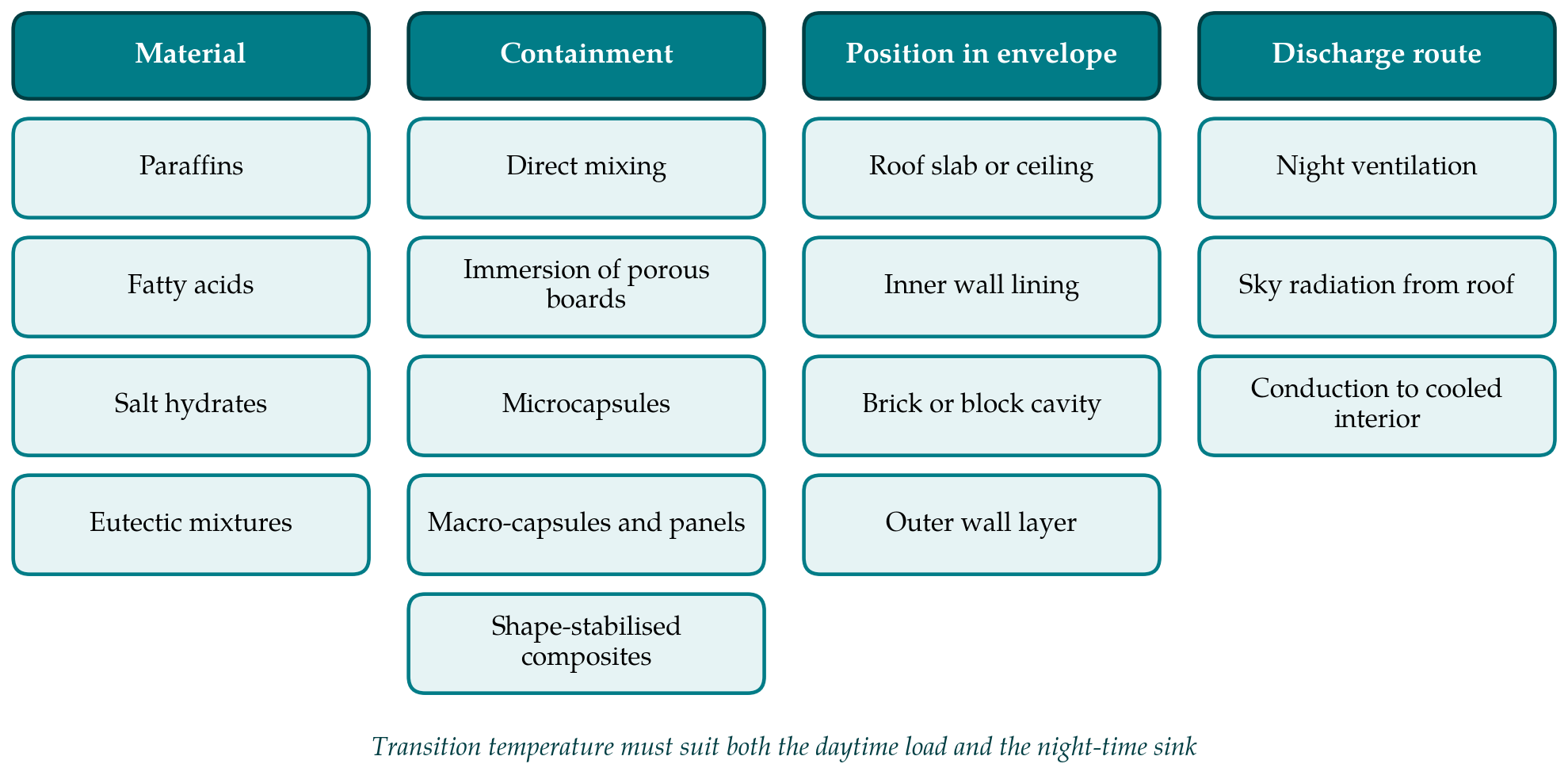
A layer on the inner face of a wall or ceiling couples directly to room air. It absorbs internal and solar gains during the day and is the natural position where night ventilation is available to cool it. This is the arrangement of PCM wallboard and plaster. A layer near the outer face, or within a roof build-up above the insulation, works differently. It intercepts the solar heat wave before it reaches the interior, and it can reject part of what it stored back to the outside after sunset.
Masonry offers an intermediate position. Castell et al. (2010) added macroencapsulated PCM to cubicles of conventional and alveolar brick and reported lower peak indoor temperatures in free-floating operation and lower cooling energy use when the cubicles were conditioned. Alawadhi (2008) analysed numerically a brick with cylindrical holes filled with PCM for hot conditions and found that the heat flux reaching the indoor surface fell as the quantity of material rose and when it was placed toward the centre of the brick. Roofs deserve the attention, since in low-rise buildings at low latitude they receive the largest solar load.
6. The Discharge Problem in Hot Climates
A latent store only works if it is emptied before the next day. In a temperate summer the night air is cool enough to solidify a material that melts in the mid-twenties. In a hot humid or hot arid city in midsummer the night minimum may sit above that temperature for weeks. The material then stays liquid and behaves as a thin layer of ordinary, rather poorly conducting, liquid. This incomplete solidification is the limitation most consistently reported in studies of passive cooling with PCM (Akeiber et al., 2016; Soares et al., 2013).
Several responses appear in the literature. One is to choose a higher transition temperature for hot sites, accepting that the layer then reduces peak heat flow without holding the interior at a comfort temperature. A second is to place the material where it can lose heat outward, to the night sky from a roof or to outdoor air from a ventilated cavity. A third is to give up strict passivity: forced night ventilation, or operation alongside air conditioning, where the PCM shifts and flattens the cooling load without replacing the plant. In a conditioned building the indoor surface is held near the set point, so an inner layer with a transition just above it can discharge to the room during off-peak hours.
Seasonal variation complicates each of these. A transition temperature that suits the hottest month may be wrong for the shoulder seasons, when passive measures have the best chance of avoiding mechanical cooling altogether. Proposals to use two materials with different transition temperatures follow from this, at the price of halving the quantity active at any one time.
7. Modelling and Characterisation
Almost all predictions of seasonal benefit come from simulation, so the quality of the models and of their input data sets the reliability of the field. Phase change in a wall is usually handled by the enthalpy method or by an effective heat capacity that varies with temperature, solved on a fixed grid (Voller, 1990). Whole-building tools have adopted such schemes; Tabares-Velasco et al. (2012) verified and validated the finite-difference PCM model of EnergyPlus and gave guidance on time step and node spacing. Saffari et al. (2017) reviewed the use of these tools for passive cooling and noted how sensitive the results are to climate and control assumptions.
The input that causes most trouble is the enthalpy-temperature curve. Differential scanning calorimetry uses milligram samples and a heating rate that smears the transition, and the result depends on both. The T-history method of Yinping et al. (1999) was devised to measure larger samples under conditions closer to use. Günther et al. (2009) compared the methods and set out the accuracy required for building applications. Hysteresis and supercooling are rarely represented in whole-building models, although both affect whether the material completes its cycle.
8. Durability, Fire and Cost
An envelope component is expected to last for decades, which implies many thousands of melting cycles. Thermal cycling tests exist for most candidate materials, but exposure in a roof under strong sun combines cycling with high peak temperature and ultraviolet load on containers, and long field records are few. Organic materials raise the fire load of the component, and the building reviews note that fire-retardant additives or protective facings are needed for paraffin products (Baetens et al., 2010; Kalnæs and Jelle, 2015). Cost is seldom reported in a way that allows comparison with the alternatives of extra insulation, reflective roofing or external shading, which in a hot climate are the measures against which a PCM layer has to justify itself.
9. Gaps and Future Work
The review points to several needs. Field measurements over full cooling seasons in hot arid and hot humid locations are scarce in comparison with numerical studies, and they are the only way to test whether simulated discharge is achieved in practice. Studies should report the fraction of the material that actually changes phase each day, since energy savings alone do not show whether the latent capacity was used. Comparisons should be made against a well-insulated, reflectively finished reference and not against a bare lightweight wall. Enthalpy curves measured on the product as installed, with hysteresis, should accompany published results. Work on non-flammable and bio-based materials with transition temperatures suited to hot sites, and on containment that tolerates roof temperatures, would widen the choice available to designers.
10. Conclusion
Latent heat storage can give a lightweight envelope some of the thermal inertia of heavy construction, and the materials and incorporation methods to do so are established. What the literature does not support is the transfer of results from temperate test sites to hot climates without adjustment. There the benefit depends on whether the material can be solidified each night, and that depends on transition temperature, position in the envelope and the availability of a heat sink. A PCM layer in a hot climate is best regarded as one measure among several, to be designed with shading, insulation, reflective surfaces and ventilation, and to be judged on measured seasonal performance.
Conflict of interest
To be declared by the author(s) before publication.
Funding
To be declared by the author(s) before publication.