1. Introduction
Most of the enterprises that women run in rural India are very small. A woman stitches blouses on a machine bought with a group loan, keeps two buffaloes and sells the milk to a cooperative, rolls incense sticks on piece rate, or sells vegetables from the front of her house. These activities are started without a business plan, are financed from savings, kin and self-help groups, and are run alongside unpaid domestic work. Whether they last is a matter of real consequence for household income and for the standing of the woman who runs them.
Effectuation theory seems, at first reading, to have been written for this situation. Sarasvathy (2001) contrasted causal reasoning, which begins with a goal and selects means to reach it, with effectual reasoning, which begins with given means and lets goals emerge from what those means make possible. A person with little money, a known set of skills and a dense local network who begins with what she has is, on the face of it, behaving effectually. The attraction of the theory for scholars of microenterprise is easy to understand.
The fit should not be assumed. Effectuation was derived from the reasoning of experienced founders who had built substantial companies, and its central claim concerns how experts handle uncertainty (Dew et al., 2009). Starting from scarce means because no alternative exists is a different thing from choosing a means-driven logic. This review examines what is known about effectual logic and survival among women-led microenterprises in rural India, where the evidence is firm, where it is borrowed from other settings, and where it is missing.
2. Scope and Approach
This is a narrative review of the published literature. It draws on three strands: the theoretical and empirical work on effectuation published in entrepreneurship journals, the development economics literature on microenterprise in South Asia and comparable settings, and research on gender and social context in Indian enterprise. Sources were chosen for their standing in each strand and their relevance to the question, and no claim is made to exhaustive coverage. Where a study was conducted in an urban Indian setting or in a neighbouring country, that is stated, because much of what is said about rural women rests on evidence gathered elsewhere.
3. Effectuation and Its Evidence Base
An assessment of how well the theory travels has to begin with what it claims and how well those claims are supported in the settings where it was developed.
3.1. The core principles
The theory is usually summarised in five principles (Sarasvathy, 2008). The bird-in-hand principle holds that founders start from who they are, what they know and whom they know. The affordable loss principle holds that they commit only what they are prepared to lose and do not calculate expected returns. The crazy quilt principle describes building the venture through commitments from self-selected stakeholders. The lemonade principle treats unexpected events as inputs. The pilot-in-the-plane principle expresses the underlying stance: the future is shaped by action and need not be predicted, a position its authors present as suited to new and unstable markets in particular.
3.2. Measurement and performance
Empirical work followed slowly. Perry et al. (2012) described the field as still at an early stage and called for studies that test relationships and do not merely illustrate the concept. The most widely used survey instrument, developed by Chandler et al. (2011), treats causation as a single dimension and effectuation as a composite of experimentation, affordable loss, flexibility and pre-commitments, with pre-commitments shared between the two logics. A meta-analysis that coded earlier venture studies for effectual principles found that means, partnerships and the leveraging of contingencies were positively related to new venture performance, while affordable loss showed no clear relationship (Read et al., 2009).
Two features of this evidence matter here. The outcome studied is nearly always performance among surviving firms, such as sales growth or perceived success, and seldom survival itself. And the samples are drawn overwhelmingly from technology ventures and small firms in North America and Europe. A later structured review confirmed that the literature had grown quickly but remained uneven in how it defined and measured the construct (Grégoire and Cherchem, 2020).
3.3. Critiques
The theory has drawn pointed criticism. Arend et al. (2015) argued that effectuation describes what some entrepreneurs do without explaining when it works, why, or compared with what, and that it has not been tested against serious alternatives. A second difficulty is overlap with neighbouring ideas. Bricolage, defined by Baker and Nelson (2005) as making do by recombining resources at hand, was developed from firms in resource-poor environments and covers much of the same ground as the means-driven principle. Fisher (2012) compared the behaviours each theory predicts and found substantial common ground. For subsistence enterprise this overlap is a practical problem, because the same observation can be claimed by either theory.
4. Women-Led Microenterprise in Rural India
The second strand comes from economists and development scholars, who seldom use the word effectuation but have studied the constraints on small enterprise with considerable care.
4.1. Subsistence enterprise and returns to capital
Schoar (2010) distinguished subsistence entrepreneurs, who run a business to provide an income for the household, from transformational entrepreneurs, who aim to build a growing firm, and argued that the two groups rarely convert into one another. Field experiments support the distinction for women in particular. Grants given at random to microenterprise owners in Sri Lanka produced high average returns for men and returns close to zero for women (de Mel et al., 2009). A randomised evaluation of group microcredit in Hyderabad found that access to loans raised business investment among households that already had a business but did not transform consumption or measures of women's decision-making (Banerjee et al., 2015). Both studies are urban, and both warn against assuming that more means lead simply to more enterprise.
4.2. Norms, caste and the household
Why returns differ is partly a matter of social restriction. Jayachandran (2015) reviews how norms about female mobility, seclusion and the division of household labour limit women's economic activity in South Asia. A training experiment with clients of a women's bank in Ahmedabad found that the effect of business training depended on the social group to which a woman belonged, with the most restricted groups gaining least (Field et al., 2010). Analysis of Indian enterprise census data shows that businesses owned by women and by members of disadvantaged castes are smaller and more often run for survival than those of other owners (Deshpande and Sharma, 2013). Reviews of training programmes across developing countries report modest effects and note that few evaluations follow firms for long enough to measure survival well (McKenzie and Woodruff, 2014).
4.3. Collective structures
Rural Indian women seldom start alone. Self-help groups, federations and cooperatives supply savings, credit and a forum, and the national rural livelihoods programme has made the self-help group the standard channel for enterprise support. A systematic review of economic self-help group programmes found positive effects on several dimensions of women's empowerment (Brody et al., 2015). Collective ownership through cooperatives can create both income and standing for members, and work in Bangladesh describes how an intermediary organisation assembles resources where formal institutions are weak (Mair and Marti, 2009). Table 1 summarises the strands reviewed so far and what each contributes.
| Strand | What it establishes | Limit for this question | Representative sources |
|---|---|---|---|
| Effectuation theory | Experts under uncertainty reason from means, not goals | Derived from experienced founders in rich economies | Sarasvathy, 2001; Dew et al., 2009 |
| Effectuation and performance | Several principles relate positively to venture performance | Performance of survivors, seldom survival | Read et al., 2009; Chandler et al., 2011 |
| Bricolage and voids | Resource-poor actors recombine what is at hand | Overlaps with the means principle | Baker and Nelson, 2005; Mair and Marti, 2009 |
| Microenterprise experiments | Capital and training have weaker effects for women | Mostly urban; logic of action not observed | de Mel et al., 2009; Field et al., 2010 |
| Gender and context | Household and norms shape what women may decide | Rarely linked to venture outcomes | Kabeer, 1999; Brush et al., 2009 |
| Firm closure | Closure and failure are different events | Little evidence on rural Indian women | Headd, 2003; McKenzie and Paffhausen, 2019 |
5. Reading Effectuation Through the Rural Indian Context
Placing the two strands side by side shows where the theory fits and where it strains. Context, as Welter (2011) argued, is not background to entrepreneurship but part of what determines who may act and how. The gender-aware framework of Brush et al. (2009) adds the household and the wider institutional environment to the usual list of market, money and management. Figure 1 sets each effectual principle against the form it is likely to take for a woman running a microenterprise in a village.
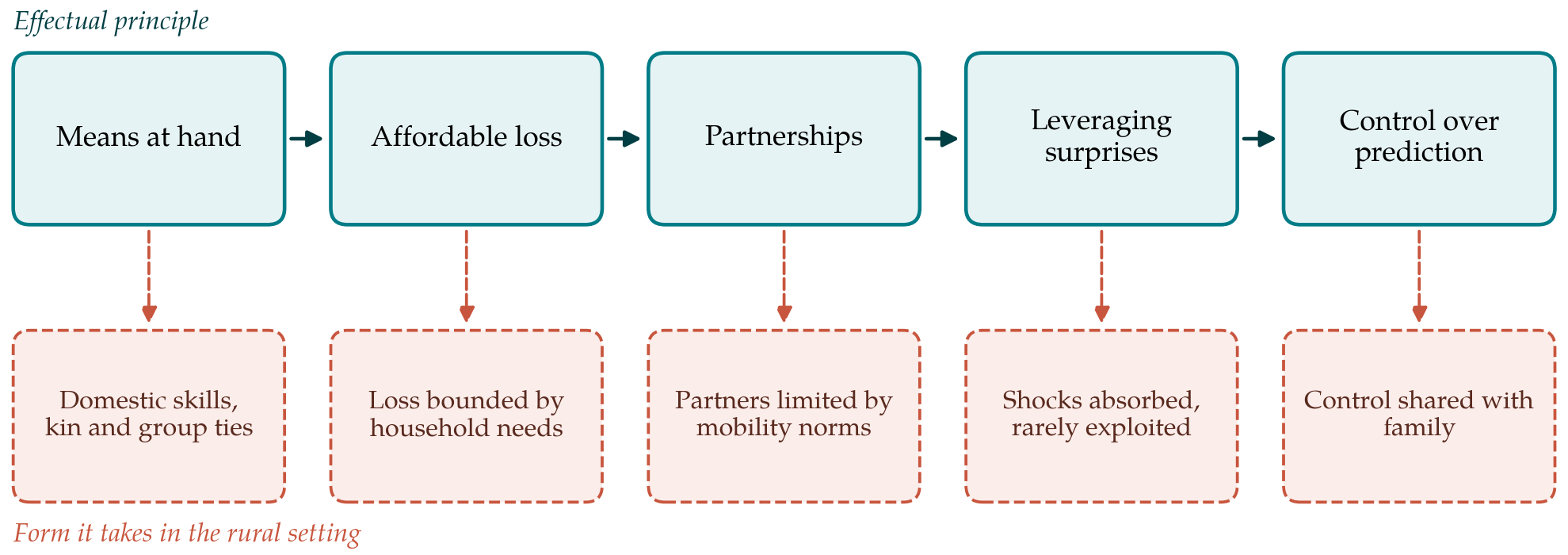
The means principle fits in form but not in spirit. A rural woman's means are the skills that domestic life has given her, the ties of kin and neighbourhood, and membership of a group. Studies of subsistence marketplaces in South India describe businesses built almost entirely on such relationships (Viswanathan et al., 2010). The result is that many women in one village start the same few activities, so a means-driven start leads to crowded local markets and not to the novel opportunities that the theory associates with experts.
Affordable loss also changes meaning. In the original account the founder decides what she is willing to lose. Where business money and household money are one pool, the affordable loss is set by school fees, illness and the claims of relatives, and the decision may not be hers alone. Kabeer (1999) distinguished access to resources from the agency to use them, and the distinction applies directly: a woman may hold a loan in her name and have little say in how it is risked. The same holds for the control principle, which presumes an actor free to shape events.
Partnerships and contingencies are constrained in parallel ways. The stakeholders available to a woman whose movement outside the village is limited are those already near her, and the self-help group is often a given partner and not a chosen one. Surprises in this setting are more often shocks, such as a failed monsoon or a medical emergency, than openings, and a household with thin reserves absorbs them by drawing down the business. Effectual language can describe all of this, but description is not evidence that effectual reasoning improves the chance of lasting.
6. Survival as an Outcome
Survival is a harder outcome to interpret than it appears. Headd (2003) showed with United States data that a large share of owners whose firms had closed regarded the business as successful at closure, and concluded that closure and failure should be kept apart. Work that pooled panel surveys of small firms from developing countries found that such firms close at high rates, and that the reasons include illness, family obligations and better opportunities elsewhere as well as losses (McKenzie and Paffhausen, 2019).
For women in rural India the point is sharper. An enterprise may stop when its owner marries and moves, gives birth, takes up seasonal farm work or hands the activity to a relative. It may also persist for years at a scale that yields very little, because no alternative use of her time is permitted. Persistence of that kind is not evidence of a sound venture, and closure for these reasons says nothing about the logic by which the business was run. Any study that relates effectuation to survival must record why an enterprise ended and what its owner did next.
7. Gaps and Directions for Research
The first gap is measurement. Existing scales ask the respondent how she decided, in abstract terms that presuppose literacy, a clear boundary between firm and household, and sole authority. Instruments for this population would need to be built from fieldwork, administered orally in the local language, and designed to separate a means-driven start chosen from one imposed. They would also need to distinguish effectuation from bricolage and from plain necessity, which the present literature does not do.
The second gap is design. Cross-sectional surveys of surviving enterprises cannot show whether a logic of action preceded survival or was reported in hindsight. Panel studies that enrol enterprises at or near start-up, for example through self-help group federations, and follow them through several agricultural cycles would allow survival to be modelled with the reasons for exit recorded. Qualitative work alongside such panels would show how decisions are actually shared within households.
The third gap is the unit of analysis. Much rural women's enterprise is collective or embedded in a group, and effectuation has been theorised for the individual founder. Whether groups reason effectually, and whether group membership substitutes for or strengthens individual effectual behaviour, are open questions. Finally, programme designers who teach effectual principles in livelihood training should treat that as a hypothesis to be evaluated and not as established practice.
8. Conclusion
Effectuation offers a vocabulary that describes how many rural Indian women begin and run their enterprises, and that descriptive fit explains its appeal. The published evidence does not yet show that effectual logic raises the survival of these enterprises. The theory's empirical base lies in other populations and other outcomes, its measures assume a discretion that gender norms and pooled household finances often remove, and survival is an ambiguous yardstick where exit is frequently a family decision. Progress depends on instruments built for the setting, on panels that follow enterprises from the start, and on treating the household and the group, as well as the individual, as the place where entrepreneurial reasoning happens.
Conflict of interest
To be declared by the author(s) before publication.
Funding
To be declared by the author(s) before publication.