1. Introduction
The fourteenth round of the community experiment known as CASP, held in 2020, was the first in which a prediction method produced models of single protein chains that were, for most targets, competitive with experiment (Kryshtafovych et al., 2021). The method was AlphaFold (Jumper et al., 2021). Within a year its developers had released models for nearly the whole human proteome (Tunyasuvunakool et al., 2021), an independent group had published a comparable approach (Baek et al., 2021), and a public database had begun to fill with predictions that now number in the hundreds of millions (Varadi et al., 2022). Language-model methods have since extended coverage to metagenomic sequences with no close relatives (Lin et al., 2023).
Structural biologists absorbed this development quickly and, on the whole, critically. The larger group affected is the much greater number of biochemists, cell biologists and geneticists who do not determine structures and who now meet them constantly. For this readership a ribbon diagram has always meant that somebody measured something. That is no longer a safe reading. The argument of this article is that a predicted structure should be handled as a well-informed hypothesis, with everything that the word implies about testing, and that the habits which follow from this are easy to adopt.
2. What a Prediction Is
A predictor of the AlphaFold type takes an amino acid sequence, gathers related sequences into an alignment, and passes both through a neural network trained to reproduce the experimental structures in the Protein Data Bank (Berman et al., 2000). Its output is a set of coordinates together with estimates of its own error. Nothing in the procedure simulates the physical process of folding, and nothing in it observes the molecule. The model is a statistical inference: given what proteins with similar patterns of sequence variation have been seen to look like, this is the most probable arrangement.
Inferences of this kind can be very good, and for well-folded domains with many homologues they usually are. They are also bounded by their training. The archive is rich in soluble, crystallisable, single-state proteins and thin in transient complexes, flexible assemblies and membrane proteins in native lipid. A method trained on it will be most reliable where experiment has been most successful and least reliable where it has struggled. One commentator described the result as having reached the frontier of the single structure: the methods return one conformation for a sequence, whereas the biology frequently depends on several (Lane, 2023).
3. Confidence Scores Are Part of the Hypothesis
The predictors report how far they should be believed. AlphaFold assigns each residue a value on a scale from 0 to 100, the predicted local distance difference test or pLDDT, which is its estimate of the agreement it would achieve with an experimental structure on a standard local measure (Mariani et al., 2013). It also reports a predicted aligned error for every pair of residues, which indicates how confidently the relative position of two parts of the chain is known. A model can have high local confidence throughout two domains and no confidence at all in how they sit against each other.
These scores are routinely discarded. Figures are drawn in a single colour, or coloured by secondary structure, and the reader cannot tell a confidently placed helix from a ribbon drawn through a region where the model has in effect declined to answer. Low pLDDT is itself informative, since it correlates with intrinsic disorder (Ruff and Pappu, 2021), but the long arcs of low-confidence chain in a rendered model are artefacts of the need to put atoms somewhere and carry no information about shape. Table 1 summarises what a prediction offers for the questions biochemists most often bring to it, and what remains to be established by other means.
| Question put to the model | What the prediction offers | What still needs evidence |
|---|---|---|
| Overall fold of a domain | Usually reliable where local confidence is high | Side-chain detail at functional sites |
| Arrangement of domains | A guide only where predicted aligned error is low | Orientation in solution or in the complex |
| Ligand or cofactor site | Often a pocket of the right shape, modelled empty | Occupancy, pose and induced changes |
| Effect of a point mutation | Little: models of variants look alike | Stability and activity of the variant |
| Disordered region | Low confidence flags probable disorder | Ensemble behaviour and binding-coupled folding |
| Protein-protein interface | A candidate interface with its own scores | That the proteins bind, and how |
| Alternative conformations | Typically one state only | Which states exist and when |
4. Where Predictions Are Known to Mislead
The limits are documented and specific. A comparison of predictions with experimental crystallographic maps found that even models of very high confidence differed from the experimental density more than two independently determined structures of the same protein differ from each other, and its authors stressed that predictions take no account of the ligands, covalent modifications and surroundings that shape the real structure (Terwilliger et al., 2024). The title of that study, which called predictions valuable hypotheses, supplies the thesis of this article.
Other cases follow the same logic. Single-residue substitutions that are known to destabilise or unfold a protein generally yield predicted models indistinguishable from the wild type, because the evolutionary signal that drives the prediction is barely changed by one position (Buel and Walters, 2022). Proteins that switch between two folds are usually returned in one of them (Chakravarty and Porter, 2022). Predicted complexes are less accurate than predicted monomers (Evans et al., 2021), and a plausible-looking interface is not in itself evidence that two proteins bind. The most recent generation of methods models nucleic acids, ligands and modified residues directly (Abramson et al., 2024), which widens the range of hypotheses on offer without altering their status. A community assessment of applications reached the measured conclusion that predicted models are useful across many tasks provided their confidence estimates are respected (Akdel et al., 2022).
5. Three Objections
The first objection is that experimental structures are models too. This is true. A crystal structure is an interpretation of electron density, and the history of the field includes seriously wrong interpretations that survived peer review (Branden and Jones, 1990). The difference is one of accountability to data. An experimental model is deposited with the measurements it was built to explain, and anyone can ask how well it explains them. A prediction for a protein with no experimental structure has no such data to answer to. Its confidence scores are forecasts of agreement with an experiment that has not been done.
The second objection is that predictions are accurate enough for most purposes. For many purposes they are: choosing domain boundaries for expression constructs, placing known variants on a fold, phasing diffraction data, interpreting a cryo-EM map of moderate resolution. These are uses in which the model guides an experiment or is checked against one. The objection fails for uses in which the model replaces the experiment, as when a catalytic mechanism, a binding mode or the effect of a patient variant is asserted from the coordinates alone. The accuracy that matters there is local and chemical, and it is the kind least assured.
The third objection is practical. Requiring validation of every model, it is said, would forfeit the speed that makes prediction valuable. Nothing in the present argument requires that. A hypothesis does not have to be confirmed before it is used; it has to be labelled, and the conclusions drawn from it have to be proportioned to its support. The cost is a sentence in the methods and some restraint in the discussion.
6. Working With Predictions as Hypotheses
A simple sorting helps. Any structural statement in a manuscript can be placed by two questions: how confident is the model in the region concerned, and is there evidence from outside the model that bears on it? Figure 1 sets out the four resulting situations. Where confidence is high and independent evidence agrees, whether from mutagenesis, cross-linking, spectroscopy, a homologous experimental structure or a low-resolution map, the prediction can serve as a working model. Where confidence is high and there is no outside evidence, the prediction is a hypothesis in the strict sense, and the useful thing to do is to state what observation would contradict it. Where confidence is low, the model should not be the basis of a structural claim, whatever else is known.
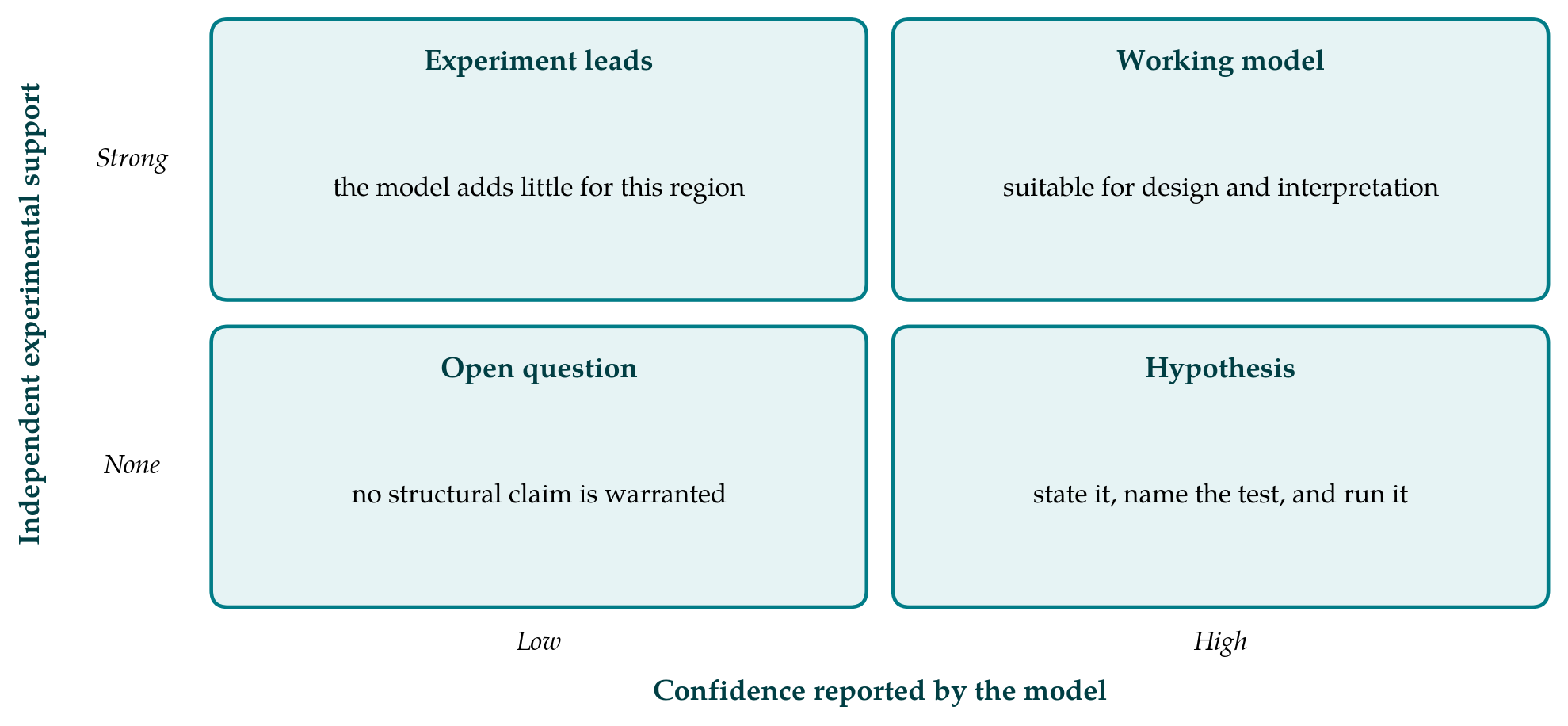
The predicted model earns its place by suggesting the experiment. A confident pocket proposes residues to mutate. A proposed interface predicts which substitutions should abolish binding and which should not. Two domains with uncertain relative orientation invite a measurement of distance in solution. Used this way the method shortens the path to a decisive test, which is what a good hypothesis has always done, and it is the role that early commentary on the method anticipated for it (Jones and Thornton, 2022).
7. Implications for Reporting and Teaching
Several conventions would make the status of predicted structures plain at little cost. Figures showing a predicted model should say so in the legend and should display the per-residue confidence, either by colour or in an accompanying panel. Methods sections should name the software and version, the database release or the settings used, and whether templates were supplied, since the same sequence can give different models under different conditions. Regions of low confidence should be omitted from figures or marked as unmodelled, as disordered segments are in experimental structures. Statements about mechanism or binding that rest on a prediction alone should be worded as proposals. Reviewers and editors can ask for these things as routinely as they ask for resolution and refinement statistics.
Teaching needs the same adjustment. Students now meet predicted structures before they learn how experimental ones are obtained, and the distinction has to be taught explicitly: what electron density is, what a confidence score forecasts, and why an image of a protein is a claim that can be wrong.
8. Conclusion
Structure prediction is one of the real advances of recent biochemistry, and treating its output as hypothesis takes nothing away from it. A hypothesis that is right most of the time, arrives in seconds and tells the experimenter where it is unsure is an extraordinary instrument. It becomes a liability only when it is mistaken for a result. The remedy lies in labelling, in showing the confidence the method itself supplies, and in letting the strength of a conclusion follow the strength of the evidence, which is the standard biochemists already apply to every other kind of model they use.
Conflict of interest
To be declared by the author(s) before publication.
Funding
To be declared by the author(s) before publication.