1. Introduction
Breeds such as the Sahiwal, Gir, Red Sindhi and Tharparkar of South Asia, or the Kenana and Butana of Sudan, were shaped by generations of herders in hot climates with seasonal feed. They carry resistance to ticks and the diseases ticks transmit, they tolerate heat, and they keep producing on forage that would not sustain a high-yielding cow of temperate origin. The global assessments of animal genetic resources record that many such breeds are in decline, chiefly through unplanned crossbreeding and replacement with a handful of international breeds (FAO, 2015). A breed that farmers do not find profitable will not be conserved by exhortation, and improving its milk yield through selection is one of the few measures that work with farmers' interests.
Selection in a small population has a cost. Genetic gain comes from giving the best animals more offspring than the rest, and in a few generations those animals appear on both sides of most pedigrees. Inbreeding rises, genetic variation is lost, and the performance and fertility of inbred animals tend to fall. The breeder of a large commercial population can afford to give this problem modest attention for a while. The breeder of a population numbering a few thousand cows, of which only some hundreds are recorded, cannot.
This review examines the methods that animal breeding science offers for obtaining gain while holding inbreeding to an acceptable rate, and asks how well they suit small indigenous dairy populations in which recording is thin and resources are limited.
2. Approach
The article is a narrative review of the published literature. It covers the theory of inbreeding and effective population size, the development of methods that constrain inbreeding during selection, the consequences of genomic selection for both gain and diversity, and writing on breeding programmes for low-input systems. Sources were chosen for their influence and relevance. No systematic search was conducted and no new data are reported. Much of the evidence for the methods comes from simulation and from large dairy and pig populations, and the review indicates where conclusions are being carried over to indigenous cattle by inference.
3. The Two Quantities Being Traded
Annual genetic gain is the product of selection intensity, accuracy of selection and additive genetic standard deviation, divided by the generation interval. For dairy cattle Rendel and Robertson (1950) partitioned it over four pathways of transmission, from sires and dams to sons and daughters, and showed that most of the progress comes through the selection of bulls. Each lever has a counterpart in inbreeding. Raising intensity means fewer parents. Raising accuracy with family information means that relatives are selected together, a tendency identified by Robertson (1961) and made stronger by best linear unbiased prediction, which uses the records of all relatives. Shortening the generation interval leaves the rate of inbreeding per generation unchanged but raises it per year.
The inbreeding coefficient of an animal is the probability that the two alleles at a locus are identical by descent. What matters for management is its rate of increase. In an idealised population the rate per generation equals one divided by twice the effective population size, and with unequal numbers of males and females the effective size is governed by the rarer sex (Wright, 1931). A herd served by a few bulls therefore has a small effective size however many cows it contains. Guidelines issued by FAO advise keeping the rate of inbreeding below one per cent per generation, equivalent to an effective size of at least fifty (FAO, 1998). The figure is a ceiling for populations at risk and not a target; a lower rate leaves more room for later selection.
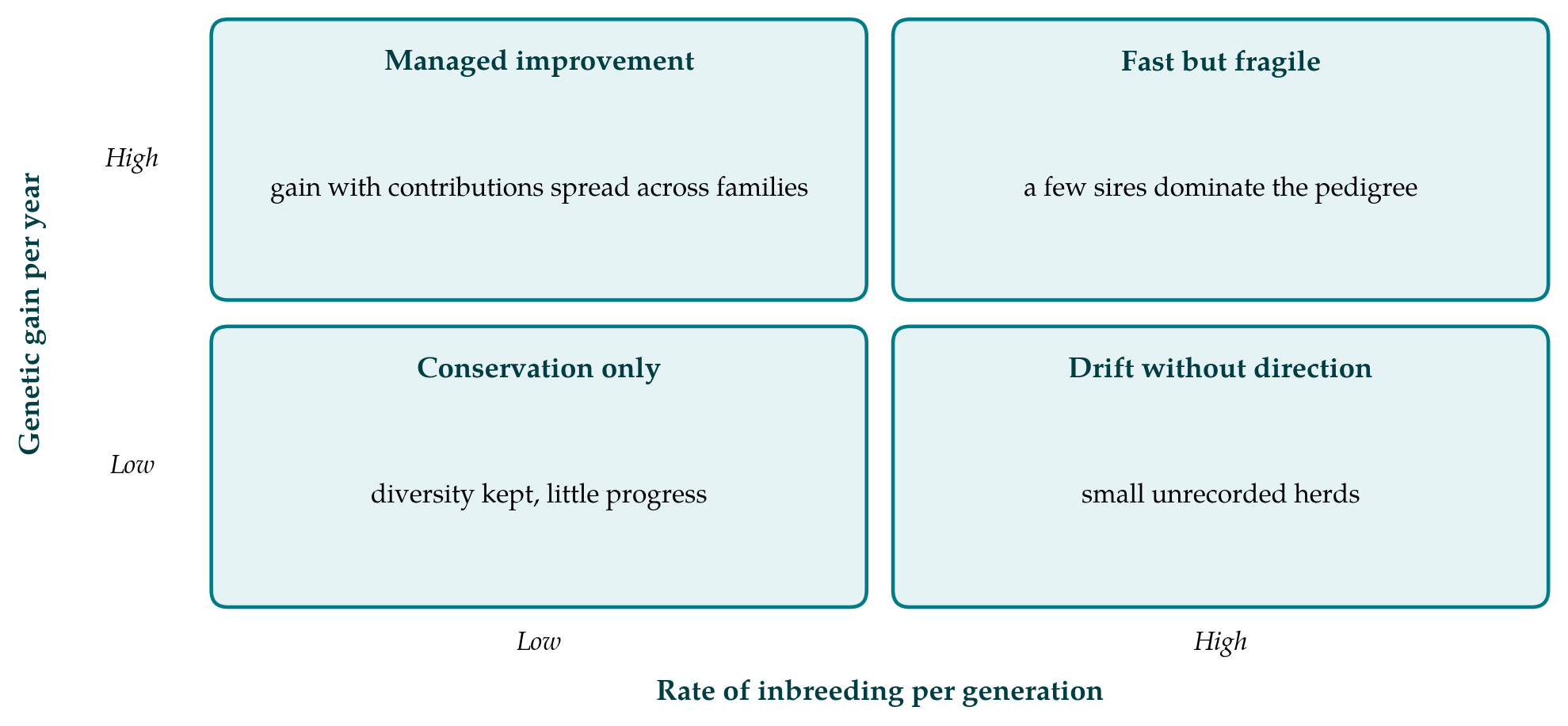
Inbreeding matters for two reasons. The immediate one is inbreeding depression: recessive deleterious alleles become homozygous, and traits related to fitness and production decline (Charlesworth and Willis, 2009). A meta-analysis across livestock species confirmed that the effect is general, if variable in size between traits and populations (Leroy, 2014). The longer-term reason is that the loss of variation limits future response and removes rare alleles, which in an adapted breed may be the very ones that justify conserving it. Figure 1 sets out the four situations in which a population can find itself when gain and the rate of inbreeding are considered together.
4. Why Small Indigenous Populations Are a Special Case
The textbook dairy programme assumes pedigree and milk recording on a large cow population, artificial insemination, and progeny testing of young bulls. Indigenous breeds seldom have these. Herds are small and scattered, cows are often milked with the calf at foot, natural service by a village bull is common, and parentage is unrecorded. Where insemination exists, semen may come from a very small number of bulls held at a government station, which concentrates the male pathway further. Rege et al. (2011) describe these constraints and argue that breeding strategies must be designed around them and not imported unchanged. Reviews of programmes in low-input systems, mostly for small ruminants, attribute past failures to schemes that were too complex for the institutions meant to run them (Kosgey et al., 2006). The breeding goal is also wider than milk, since the adaptive traits that define the breed must at least be maintained.
5. Tools for Managing the Balance
Four groups of tools are available, and they differ greatly in the information they need. Table 1 compares them. They are complementary: simple rules can be applied at once, and the more refined methods added as recording improves.
| Approach | How it works | Information needed | Key sources |
|---|---|---|---|
| Rules on parent numbers | Use enough sires; limit sons per sire and service period | Sire identity only | FAO, 1998; FAO, 2013 |
| Minimum coancestry | Choose parents to minimise average kinship; no selection for merit | Pedigree or markers | Caballero and Toro, 2000 |
| Optimum contribution selection | Maximise merit of parents subject to a ceiling on kinship | Breeding values and pedigree | Meuwissen, 1997; Woolliams et al., 2015 |
| Planned mating | Pair chosen parents to avoid close relatives | Pedigree or genomic kinship | Pryce et al., 2012 |
| Genomic management | Measure and constrain kinship at marker level | Genotypes on candidates | Sonesson et al., 2012 |
5.1. Rules on numbers and family structure
The oldest and simplest measures act on the number of parents and the spread of their contributions. Using more bulls, replacing each bull with one of his sons, limiting the number of sons selected from any one sire and rotating bulls between villages before their daughters reach breeding age all raise effective size without any computation. FAO guidelines for populations at risk are built on such rules (FAO, 1998; FAO, 2013). Their weakness is that they are blunt. They restrict selection uniformly, and the gain forgone may be larger than necessary. Their strength is that they need only the identity of sires, which is the one piece of pedigree a village scheme can usually record.
5.2. Optimum contribution selection
The modern solution is to treat the problem as one of constrained optimisation. Wray and Goddard (1994) and Meuwissen (1997) showed how to find the contributions of candidates to the next generation that maximise the average breeding value of parents while keeping their average coancestry, and hence the rate of inbreeding, at a predefined level. Grundy et al. (1998) refined the procedure so that the constraint holds over generations. Simulations in these papers consistently found more gain than truncation selection at the same rate of inbreeding. The theory of long-term genetic contributions explains why: the method directs selection towards the Mendelian sampling term, the part of an animal's merit that is not shared with its relatives (Woolliams et al., 2015). Freely available software now puts the calculation within reach of any programme with a computer. The requirement is a pedigree deep enough to compute kinship and breeding values of reasonable accuracy, which is precisely what many indigenous populations lack.
5.3. Planned mating
Once parents and their contributions are chosen, the pairing of bulls and cows can be arranged to avoid matings between close relatives. This lowers the inbreeding of the next generation and delays its rise, although it does little to change the long-term rate, which is set by contributions. Mating plans that use genomic relationships have been shown to reduce progeny inbreeding at small cost in merit (Pryce et al., 2012). In a village setting the equivalent is the plain rule that a bull is not used in the herd where his daughters stand.
5.4. Genomic information
Genomic selection estimates breeding values from dense markers (Meuwissen et al., 2001) and allows young bulls to be chosen without progeny testing, which shortens the generation interval sharply (Schaeffer, 2006). Its effect on inbreeding cuts both ways. Because markers reveal the Mendelian sampling term of each animal, full and half sibs are no longer selected together as often, and the rate of inbreeding per generation is expected to fall (Daetwyler et al., 2007). But generations turn over faster, so the rate per year can rise, and selection concentrates on particular chromosome segments in a way that pedigree kinship does not detect. Sonesson et al. (2012) concluded that genomic selection requires genomic control of inbreeding, and experience in large dairy breeds, reviewed by Howard et al. (2017), supports the caution.
For small indigenous populations the difficulty lies elsewhere. Accuracy of genomic prediction depends on a reference population of genotyped animals with reliable records, and the number of such animals needed is large, the more so when heritability is low (Goddard and Hayes, 2009). A breed with a few hundred recorded cows cannot assemble one of useful size. Genotyping may nevertheless earn its keep in other ways: verifying or reconstructing parentage where none is recorded, and supplying the relationship matrix that optimum contribution methods need (VanRaden, 2008).
6. Breeding Scheme Designs
The tools operate inside a scheme, and for small populations two designs dominate the literature. In a nucleus scheme, recording and selection are concentrated in one or a few herds, often on an institutional farm, and bulls or semen flow out to village herds. Nicholas and Smith (1983) showed that with embryo transfer a small nucleus could match the gain of a progeny-testing programme, though the inbreeding implied by their design drew attention to the need for explicit control. An open nucleus, which admits outstanding cows from village herds, raises effective size and keeps the nucleus connected to the conditions under which the breed must perform.
Community-based breeding programmes take the opposite starting point: the farmers' own herds are the breeding population, objectives are set with the community, and recording is kept to what members can sustain (Mueller et al., 2015). Published examples concern mainly sheep and goats. Transfer to dairy cattle is harder, because generation intervals are long, a herd holds few cows and milk recording is laborious. In either design, storing semen from a broad sample of bulls gives a reserve from which lost lines can later be restored, and it is a cheap insurance.
7. Gaps and Future Work
The clearest gap is evidence from the populations in question. Estimates of inbreeding depression, of genetic parameters for milk under low-input management and of realised rates of inbreeding are scarce for indigenous dairy breeds, and what is known has been borrowed from temperate breeds in intensive systems. Second, optimum contribution methods have been validated where pedigree is deep; how they behave with shallow and partly wrong pedigrees, or with kinship estimated from low-density markers alone, deserves study in conditions that resemble the field. Third, the organisational side is under-researched. Which recording designs farmers will maintain, how bull exchange between villages can be administered, and who bears the cost, will decide outcomes more than the choice of algorithm. Finally, where crossbreeding continues alongside pure breeding, the two need to be planned together so that the purebred population retains enough cows to sustain selection.
8. Conclusion
The conflict between genetic gain and inbreeding is well understood, and the means of managing it have been available for a generation. Setting a ceiling on the rate of inbreeding and then maximising gain beneath it is the accepted principle, and it applies to an indigenous breed of a few thousand cows as much as to a global one. The methods differ in what they demand. Rules on sire numbers and rotation can begin wherever sires are identified. Optimum contributions and genomic tools become usable as pedigree, recording and genotyping accumulate. For most indigenous dairy breeds the limiting step is therefore neither theory nor software but the building of a recorded population, and that is where effort is best spent first.
Conflict of interest
To be declared by the author(s) before publication.
Funding
To be declared by the author(s) before publication.