1. Introduction
Central banks already issue digital money, but only to banks. Reserves are electronic claims on the central bank held by a restricted set of institutions, and the public holds central bank money only as notes and coin. A retail central bank digital currency (CBDC) would change this by making an electronic central bank liability available to everyone. The classification proposed by Bech and Garratt (2017) placed such an instrument alongside cash and reserves according to who may hold it, who issues it and whether it is electronic, and the joint statement of principles by a group of central banks later set out the conditions under which issuance would be consistent with monetary and financial stability (Bank for International Settlements, 2020).
Motives for issuance vary: payment efficiency, financial inclusion, resilience and the declining use of cash all feature in official accounts (Auer et al., 2022). Monetary policy is seldom the leading motive, yet it is where the consequences may be largest, because a widely held CBDC is a new asset on household balance sheets and a new liability on the central bank's. An early report by central bank committees concluded that the implications for transmission would depend on design and could be substantial (Committee on Payments and Market Infrastructures and Markets Committee, 2018).
The question takes a particular form in economies where banks dominate financial intermediation. Where firms borrow mainly from banks and banks fund themselves mainly with retail deposits, anything that changes the price or stability of deposits changes the supply of credit. This review examines what the literature says about that link. It covers many emerging economies and also the bank-based systems of continental Europe and East Asia.
2. Scope and Approach
This is a narrative review of published theoretical, quantitative and policy work on retail CBDC and monetary transmission. It concentrates on contributions that state their mechanisms explicitly and that have shaped the debate among central banks, and it does not attempt an exhaustive or systematic survey. Wholesale CBDC, restricted to financial institutions, is left aside, as are the technical questions of ledger design reviewed by Auer and Böhme (2020). The review first recalls how transmission works in bank-dominated systems, then takes the proposed mechanisms in turn, and then considers the design choices that govern their strength.
3. Transmission Where Banks Dominate
The standard account of monetary transmission through banks distinguishes several channels. In the model of Bernanke and Blinder (1988), bank loans and bonds are imperfect substitutes, so that policy affects spending through the supply of loans as well as through the bond rate. The broader credit channel described by Bernanke and Gertler (1995) adds the effect of policy on borrowers' balance sheets. Evidence that the lending channel operates through bank liquidity was provided by Kashyap and Stein (2000), who showed that lending by smaller and less liquid banks responds more strongly to policy.
More recent work places deposits at the centre. Drechsler et al. (2017) argued that banks have market power over depositors, that they widen the spread between the policy rate and deposit rates when policy tightens, and that the resulting outflow of deposits contracts lending. On this view the stickiness of deposit rates is a feature of transmission and not merely a friction that weakens it. In lower-income economies with shallow interbank and bond markets the bank channel is often the only one of consequence, and the survey by Mishra and Montiel (2013) found the evidence for strong transmission in such economies to be weak. A CBDC would enter exactly at the point these accounts identify as decisive: the margin between holding a deposit and holding something else.
4. Mechanisms Proposed in the Literature
Four mechanisms recur in the literature. They are summarised in Table 1 and discussed below.
| Mechanism | Predicted effect | Condition on which it depends | Representative sources |
|---|---|---|---|
| Funding substitution | Deposits fall; lending falls unless funding is replaced | Whether the central bank lends the funds back to banks | Brunnermeier and Niepelt, 2019 |
| Deposit competition | Deposit rates rise; deposits and lending may increase | Degree of bank market power; CBDC interest rate | Andolfatto, 2021; Chiu et al., 2023 |
| Crowding out of intermediation | Bank lending shrinks as CBDC displaces deposits | Competitive deposit market; CBDC a close substitute | Keister and Sanches, 2023 |
| CBDC rate as policy tool | Faster and fuller pass-through to retail rates | CBDC is remunerated and widely held | Bordo and Levin, 2017; Meaning et al., 2021 |
| Run dynamics | Faster flight from deposits in stress | Absence of holding limits; credibility of deposit insurance | Fernández-Villaverde et al., 2021 |
| Effective lower bound | Negative rates feasible if cash is constrained | Cash remains available or not | Rogoff, 2016 |
4.1. Bank funding and disintermediation
The most discussed concern is that households will move deposits into CBDC, forcing banks to shrink or to seek costlier funding. The benchmark result is an equivalence proposition. Brunnermeier and Niepelt (2019) showed that if the central bank passes the funds it receives back to banks, the swap of deposits for CBDC need not change allocations or prices: the central bank becomes a large depositor in place of the public. The proposition clarifies that disintermediation is a policy choice about the asset side of the central bank's balance sheet. It also has demanding conditions, among them a central bank willing to lend to banks at scale and against the collateral that banks in less developed systems can offer.
Where those conditions fail, the outcome turns on how competitive the deposit market is. With competitive banks, Keister and Sanches (2023) found that a CBDC improves the efficiency of exchange but crowds out deposits and investment, so that the optimal design trades one against the other. With monopolistic banks the result can reverse. Andolfatto (2021) showed that an interest-bearing CBDC sets a floor under deposit rates, which induces a monopoly bank to pay more and attracts additional deposits, without reducing lending. Chiu et al. (2023) reached a similar conclusion in a calibrated model, with the qualification that the effect holds only over a range of CBDC rates and turns to disintermediation beyond it.
Bank-dominated economies often have concentrated banking sectors and wide deposit spreads, which is the setting in which the competition effect is strongest. The same economies, however, tend to have fewer alternatives to deposit funding, so that the cost of any net outflow is higher. The large-scale model of Barrdear and Kumhof (2022) assumes that CBDC is issued against government bonds and finds gains in output from lower real interest rates and transaction costs, a result that depends on a deep market in such bonds.
4.2. Pass-through of the policy rate
A second mechanism concerns how quickly and fully the policy rate reaches retail rates. If CBDC pays interest linked to the policy rate, households have an alternative whose return moves one for one with policy, and banks must follow more closely to retain deposits. Meaning et al. (2021) argued on these grounds that transmission through the interest rate channel would probably strengthen. Bordo and Levin (2017) went further and proposed that the CBDC rate should become the main instrument of policy. Under the deposits channel of Drechsler et al. (2017), narrower deposit spreads would also change the way tightening reduces bank funding, so the net effect on lending is not obvious from the effect on deposit rates alone.
An unremunerated CBDC works differently. Like cash, it pays zero, and its attraction relative to deposits rises when deposit rates are low and falls when they are high. It would compress deposit spreads only near the lower bound. Agur et al. (2022) analysed the design problem when users differ in their preferences for anonymity and security, and showed that the central bank faces a trade-off between preserving bank intermediation and preserving the variety of payment instruments, which interest on CBDC can ease.
4.3. The effective lower bound
A remunerated CBDC could in principle carry a negative rate. This would relax the lower bound on policy rates only if cash were withdrawn or made costly to hold, as Rogoff (2016) discussed in the context of phasing out large notes. Most central banks have stated that a CBDC would coexist with cash (Bank for International Settlements, 2020), in which case the bound stays where it is. For the economies considered here the point is of limited practical importance, since policy rates in most of them have remained well above zero.
4.4. Stability and stress
The stability of deposit funding is itself part of transmission, because banks that fear outflows hold more liquidity and lend less. The classic model of Diamond and Dybvig (1983) explains why deposit contracts are vulnerable to runs. A CBDC provides a safe asset to which deposits can be moved instantly and without the physical limits of cash withdrawal. In the model of Fernández-Villaverde et al. (2021) the central bank, which cannot itself be run upon in nominal terms, may attract all deposits and become a monopoly intermediary. Against this, a run into CBDC is a run within the central bank's own balance sheet, so the funds can be returned to the affected banks at once if the central bank chooses, which is the logic of the equivalence result applied to a crisis. How strong the pull is depends on the credibility of deposit insurance, and that is weaker in many emerging economies than in the settings these models have in mind.
5. Design Choices That Govern the Outcome
Nearly every result above is conditional on design. Two parameters carry most of the weight: whether CBDC bears interest and whether holdings are limited. Figure 1 arranges the four combinations. An unremunerated CBDC with tight limits is close to digital cash and leaves transmission largely as it is. A remunerated CBDC without limits is a full monetary instrument, with the strongest pass-through and the strongest risk to bank funding.
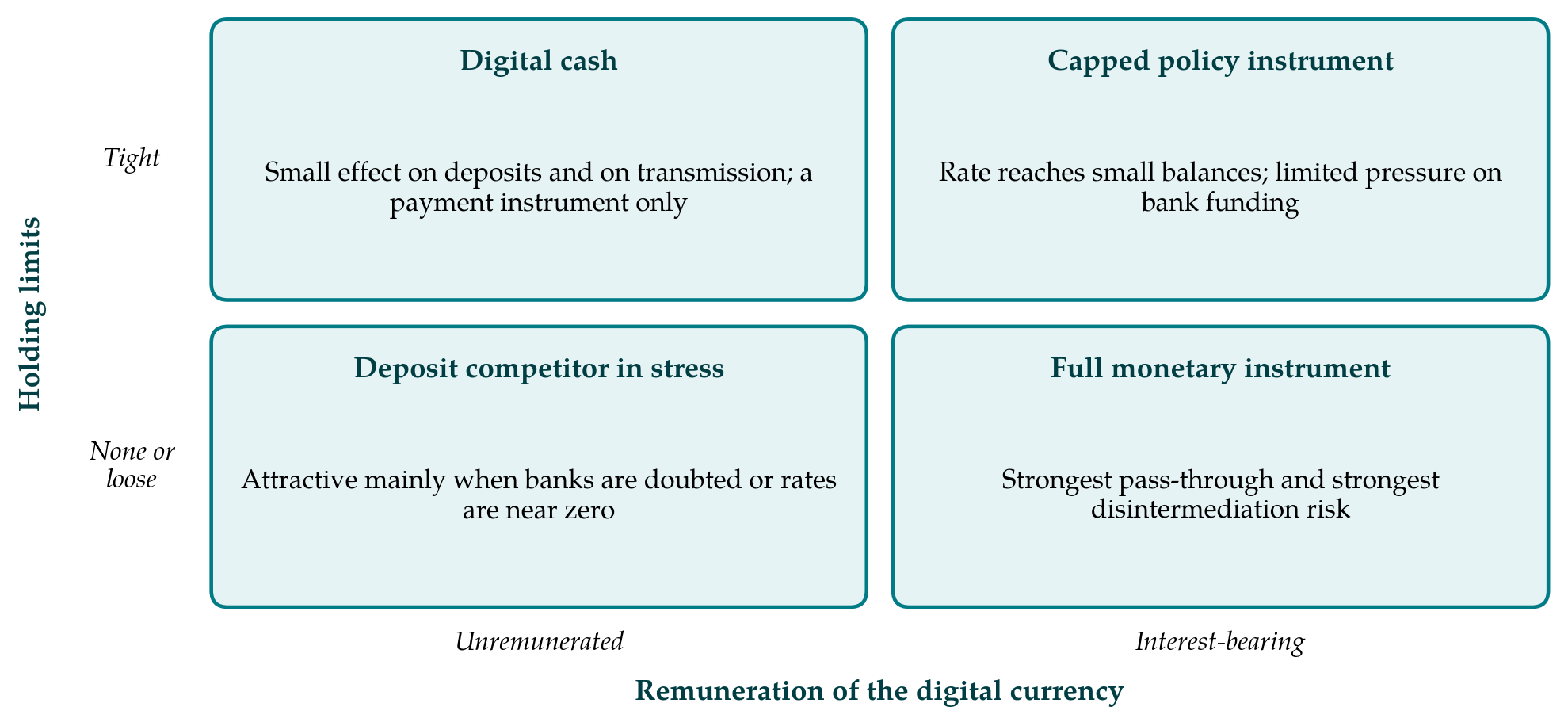
Intermediate designs attempt to keep the benefits of one while containing the other. Bindseil (2020) proposed tiered remuneration, in which balances up to a threshold earn a rate at or near the policy rate and balances above it earn a lower, possibly penal, rate, so that CBDC serves as a means of payment without becoming a large-scale store of value. Kumhof and Noone (2018) set out principles intended to prevent runs into CBDC, including an adjustable CBDC rate, no guaranteed convertibility of deposits into CBDC on demand, and issuance only against eligible securities. Distribution through banks and payment firms, with the central bank keeping the ledger, is the model most authorities favour (Auer and Böhme, 2020), and it keeps customer relationships with intermediaries.
A further consideration specific to many bank-dominated emerging economies is the presence of competing private digital money. Mobile money and large payment platforms already hold balances that would otherwise sit in bank accounts, and Adrian and Mancini-Griffoli (2019) argued that the relevant comparison for a CBDC is often with these instruments and not with cash. Where such money is widespread, a CBDC may shift balances among non-bank holdings more than it draws them from banks. The framework of Mancini-Griffoli et al. (2018) makes the related point that demand for CBDC will depend on how well existing instruments already serve users.
6. Gaps and Future Work
The literature is long on theory and short on evidence. The models differ in their assumptions about bank competition, the central bank's balance sheet and the substitutability of CBDC for deposits, and these are empirical magnitudes about which little is known. The elasticity of deposit demand with respect to a safe digital alternative has not been measured in any economy at scale. Pilot programmes and the few retail CBDCs already issued offer the first opportunity to do so, and adoption so far appears to have been modest, which limits what can be learned about large shifts.
Three questions seem most pressing for bank-dominated systems. The first is how deposit rates respond when a CBDC is introduced with and without remuneration, which would discriminate between the competition and crowding-out views. The second is whether central banks in such economies can and will recycle funds to banks on the scale the equivalence result requires, given collateral constraints. The third is how CBDC interacts with deposit insurance during stress. None can be answered from first principles, and each calls for data that central banks conducting pilots are in a position to collect and publish.
7. Conclusion
A retail CBDC bears on monetary transmission in bank-dominated economies mainly through deposits. Theory shows that the effect can run in either direction. A CBDC may drain bank funding and weaken the supply of credit, or it may discipline deposit pricing, strengthen pass-through and leave lending unchanged or higher. The balance depends on bank market power, on how the central bank uses the funds it receives, and on design choices over remuneration and limits that remain open to every issuer. Cautious designs, with no interest and modest caps, would protect the existing transmission mechanism at the price of forgoing most of the potential gains. The case for anything more ambitious rests on parameters that only experience can supply.
Conflict of interest
To be declared by the author(s) before publication.
Funding
To be declared by the author(s) before publication.