1. Introduction
A credit bureau can say nothing about a person who has never borrowed. Such applicants, described in the industry as thin-file or no-file, are refused or are offered credit on terms set for the worst case. The statistical methods of credit scoring are mature (Hand and Henley, 1997), but they need inputs, and the conventional inputs are missing for exactly the borrowers whom inclusion policy most wants to reach.
Mobile telephones generate a substitute. Where mobile money is common, a person's wallet records deposits, withdrawals, transfers, bill payments and airtime purchases, often over several years. Björkegren and Grissen (2020) showed that features computed from telephone use predicted repayment among borrowers with no formal financial history, and Berg et al. (2020) found that simple digital footprints carried as much information about default as a bureau score. Call records can also be used to predict wealth (Blumenstock et al., 2015), and that finding is the source of the difficulty. Data rich enough to reveal creditworthiness are rich enough to reveal who a person is.
This article proposes a procedure for developing a score for thin-file applicants from mobile transaction data with fairness built into each step. It is addressed to the model developers and risk managers of a lender or mobile money provider. The procedure is assembled from published methods and is offered as a proposal: it has not been applied to lending data for this article and no performance figures are claimed for it.
2. Background
Two literatures meet in this problem. One concerns what alternative data can do for prediction, and the other what it means for a score to be fair.
2.1. What can go wrong
Barocas and Selbst (2016) catalogue the ways in which a model built from data can disadvantage a protected group without any intention to do so: the outcome may be defined in a way that favours one group, the training sample may under-represent another, the labels may carry past prejudice, and innocuous features may stand in for the protected attribute. All four arise with mobile data. Women in many markets own fewer handsets and transact through a relative's account. Rural users have fewer agents nearby and so fewer cash-in events. A feature such as the share of transactions made late at night may separate occupations, and through them sex or ethnicity, more than it separates good payers from bad.
Evidence from mortgage lending shows that these concerns are real. Fuster et al. (2022) found that moving from a logistic model to a more flexible machine learning model changed predicted default risk unevenly across racial groups, and Bartlett et al. (2022) found that algorithmic lenders still charged minority borrowers more, though by a smaller margin than face-to-face lenders. Removing the protected attribute from the inputs does not solve the problem, since flexible models reconstruct it from correlated features.
2.2. Definitions of fairness and their conflict
Three families of criteria dominate the literature. Demographic parity asks that approval rates be equal across groups. Equality of opportunity asks that applicants who would repay have the same chance of approval whatever their group, and its stricter form, equalised odds, adds the same requirement for those who would default (Hardt et al., 2016). Calibration within groups asks that a given score mean the same probability of default for every group.
These criteria cannot all hold at once. Kleinberg et al. (2017) and Chouldechova (2017) proved that when default rates differ between groups, a score that is calibrated within each group must produce unequal error rates, except in degenerate cases. A lender therefore has to select a criterion, and the selection is a judgement about which kind of error matters most. Kozodoi et al. (2022) examined the criteria in the setting of credit scoring and argued that a single well-chosen criterion can usually be approached at a moderate cost in profit.
3. The Proposed Procedure
The procedure has nine steps, listed in Table 1 with the fairness safeguard attached to each. They follow the ordinary sequence of scorecard development, so that a team can adopt them without reorganising its work.
| Step | Development task | Fairness safeguard |
|---|---|---|
| 1. Scope | Define the population, product and default outcome | Check that the outcome definition does not favour a group |
| 2. Consent and data | Obtain consent; fix the fields and history used | Collect protected attributes separately for audit only |
| 3. Features | Build behavioural features from transactions | Screen each feature for association with protected groups |
| 4. Model | Fit a scorecard benchmark and a boosted model | Keep the simpler model unless the gain is material |
| 5. Rejects | Address applicants with no observed outcome | Examine who was excluded from the training sample |
| 6. Criterion | Choose and record the fairness criterion | Decision approved by risk and compliance functions |
| 7. Audit | Measure approval, error and calibration by group | Report intervals; flag small groups |
| 8. Mitigation | Apply the mildest effective intervention | Re-audit after each change |
| 9. Release | Explain decisions; monitor after launch | Track outcomes by group over time |
3.1. Steps 1 and 2: Scope, consent and data
The developer first states who is to be scored, for which product, and what counts as default. A definition based on days past due should be checked for groups whose income is seasonal, since a farmer paid at harvest may be late by the calendar and reliable over the season. Consent must be specific to credit assessment, and the data taken should be limited to transaction metadata: amounts, times, types and counterparties in hashed form. Message content and contact lists are excluded. Protected attributes are needed to test fairness even though they are not used for scoring. They should be collected with a separate explanation, stored apart from the modelling data and made available only to those who run the audit.
3.2. Step 3: Features and proxy screening
Features should describe financial behaviour that has a plausible connection with repayment: the regularity of inflows, the ratio of outflows to inflows, the lowest balance in a month, the frequency of bill payment, the length of account history. Each candidate is then tested for its association with the protected attributes. A feature that predicts group membership strongly and adds little to the prediction of default once other features are present is removed. A feature that does both is retained only with a recorded business justification. Features that describe the applicant's contacts, and not the applicant, are best left out, since they score people by the company they keep.
3.3. Steps 4 and 5: Model fitting and rejected applicants
Two models are fitted. The first is a logistic scorecard, whose coefficients can be read and defended. The second is a gradient-boosted tree model of the kind implemented in XGBoost (Chen and Guestrin, 2016). Benchmarking studies find that such ensembles outperform logistic regression in credit scoring, though the margin varies (Lessmann et al., 2015). The flexible model is adopted only if its advantage on held-out data is large enough to matter commercially, because flexibility is also what allows a model to rebuild protected attributes from proxies. Outcomes are observed only for applicants who were granted credit in the past, and those applicants were selected by an earlier rule. Reject inference techniques try to correct for this, with limited success (Crook and Banasik, 2004). Where the lender can afford it, the sounder remedy is to approve a small random sample below the cut-off and observe the result.
3.4. Steps 6 and 7: Choosing a criterion and auditing
Because the criteria conflict, the choice among them is made explicitly and recorded before the audit results are seen. For a product intended to widen access, equality of opportunity has a clear rationale: it asks that creditworthy applicants in every group be equally likely to be approved. Calibration within groups should be checked in every case, since a score that overstates risk for one group overcharges it. The audit then computes, for each group and for intersections where numbers allow, the approval rate, the true and false positive rates and a calibration curve, each with a confidence interval. Small groups produce wide intervals, and the audit should say so and avoid reporting a difference as absent merely because it is not statistically detectable.
3.5. Step 8: Mitigation
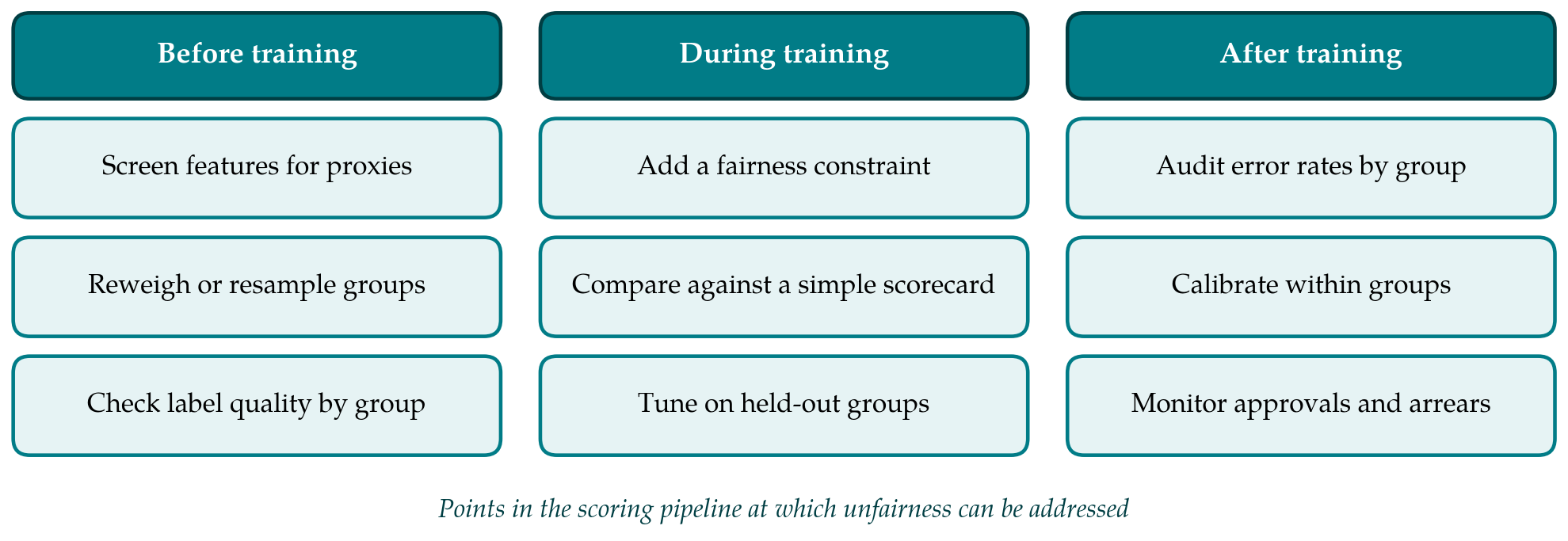
If the audit shows a disparity beyond a tolerance set in advance, the developer intervenes at one of the three points shown in Figure 1. Before training, the sample can be reweighted so that group and outcome are independent (Kamiran and Calders, 2012). During training, a constraint can be imposed through the reductions method of Agarwal et al. (2018). After training, cut-offs can be adjusted by group to equalise the chosen error rate (Hardt et al., 2016). The last is the most direct and also the most legally sensitive, because it treats applicants differently by group on the face of the rule, and in some jurisdictions that is prohibited. The procedure therefore prefers the earliest and mildest intervention that brings the disparity within tolerance, and repeats the audit after each change.
3.6. Step 9: Explanation and monitoring
An applicant who is refused is entitled in many jurisdictions to the principal reasons, and reasons are also what allow an error to be challenged. For the scorecard they follow from the points lost on each characteristic. For the boosted model, additive attributions such as SHAP values provide a comparable breakdown (Lundberg and Lee, 2017), which should be translated into statements the applicant can act upon. After release the lender tracks approvals, arrears and calibration by group at regular intervals. Mobile money behaviour shifts with tariffs, agent coverage and seasons, so a model that was fair at launch may drift.
4. Fitting the Procedure to Regulation and Practice
The procedure is compatible with the main regulatory approaches and does not replace legal advice on any of them. Laws against discrimination in lending generally prohibit both different treatment and unjustified adverse effect, and the proxy screening and audit steps produce the evidence that either test requires. The European Union's Artificial Intelligence Act classes systems used to evaluate the creditworthiness of natural persons as high-risk and attaches duties of data governance, documentation and human oversight (European Parliament and Council, 2024). The records created at each step map onto those duties. In markets without such legislation, the same records serve the lender's own model risk governance. A small lender can run the whole procedure with open software, and the principal cost is the collection of protected attributes for audit under proper safeguards.
5. Limitations and What Remains to Be Shown
The procedure is untested, and several of its premises may fail in practice. Protected attributes may be unavailable or unlawful to collect, in which case the audit depends on inferred group membership and inherits its errors. Mobile data describe only those who use mobile money, so that the people with the thinnest files of all remain unscored. The fairness criteria considered here are statistical and concern groups; they do not guarantee that any individual is treated justly, and they say nothing about whether the loan itself benefits the borrower.
Validation would require a lender's data and would need to establish three things: that the screened feature set predicts repayment out of time and not merely in the development sample, that the chosen mitigation reduces the measured disparity on new applicants, and that the cost in predictive accuracy is one the lender can bear. Until such evidence exists, the procedure should be treated as a structured checklist and not as a tested method.
6. Conclusion
Mobile transaction records can make thin-file borrowers visible to lenders, and they bring with them the risk that a score will sort applicants by who they are. The nine-step procedure proposed here places a fairness safeguard beside each ordinary task of score development, requires an explicit choice among criteria that cannot all be satisfied, and prefers transparent models and mild interventions. It is offered for testing by lenders and researchers who hold the data needed to judge it.
Conflict of interest
To be declared by the author(s) before publication.
Funding
To be declared by the author(s) before publication.