1. Introduction
A geomagnetic storm is a period of hours to days in which energy from the solar wind enters the magnetosphere fast enough to build an intense ring current and to depress the horizontal magnetic field at low latitudes. The accepted definition ties the storm to a sustained interval of southward interplanetary magnetic field (Gonzalez et al., 1994), in keeping with the reconnection picture first set out by Dungey (1961). The practical effects include induced currents in power grids, errors in satellite navigation, increased drag on spacecraft and damage to electronics, and their economic weight has been set out in a widely cited workshop report (National Research Council, 2008).
Forecasting rests on observing the chain of events that precedes the storm. That chain starts at the Sun and ends in the ionosphere, and at present it is watched by very few instruments. The solar wind arriving at Earth has for decades been measured from the neighbourhood of the first Lagrange point, L1, about one and a half million kilometres sunward, by spacecraft such as the Advanced Composition Explorer (Stone et al., 1998). An international road map for space weather research named the fragility and sparseness of this observing system as a leading concern (Schrijver et al., 2015).
Small satellites offer a different way of building the system: many modest spacecraft in place of a few elaborate ones. This review asks what such constellations could contribute to the monitoring of storm precursors, what has been shown in orbit, and what stands in the way.
2. Approach of the Review
The review is narrative. It draws on the standard literature of solar-terrestrial physics, on mission description papers for multi-spacecraft and small satellite projects, and on assessments published by scientific academies. It does not claim to be exhaustive, and the selection reflects a judgement about which sources best represent each topic. The term small satellite is used broadly for spacecraft from CubeSats of a few kilograms up to microsatellites of roughly a hundred kilograms. No new analysis of data is presented.
3. What Counts as a Storm Precursor
The word precursor is used loosely in the field. It is helpful to order the candidates by where they are observed, since position along the Sun-Earth line fixes the warning time. Table 1 gives such an ordering, and the paragraphs below follow it.
| Precursor | Where observed | Approximate lead time | Main limitation |
|---|---|---|---|
| Launch of a coronal mass ejection | Coronagraphs and heliospheric imagers | One to several days | Magnetic field direction inside the ejection is not measured |
| Energetic particles ahead of a shock | Particle sensors upstream of Earth | Hours | Not every storm-driving structure has a strong shock |
| Cosmic ray anisotropy | Ground muon detector networks | Hours in reported cases | Signal is small; needs global coverage (Munakata et al., 2000) |
| Shock, sheath and southward field | Field and plasma monitors near L1 | Tens of minutes to about an hour | One sampling point; short warning |
| Compression of the magnetosphere | Magnetometers in orbit and on the ground | Minutes or none | Marks arrival, not the size of the storm |
| Growth of field-aligned currents | Low Earth orbit magnetometers | Concurrent with onset | A nowcast more than a forecast |
3.1. Solar and heliospheric drivers
The largest storms are driven by coronal mass ejections and not, as was long assumed, by flares as such (Gosling, 1993). An ejection carries its own magnetic field and usually drives a shock with a turbulent sheath of compressed solar wind ahead of it; both the sheath and the ejecta can contain the prolonged southward field that a storm requires (Kilpua et al., 2017). Catalogues of ejections observed near Earth show a wide spread of speeds, sizes and field configurations (Richardson and Cane, 2010). A second class of storm is driven by the interaction regions that form where fast wind from coronal holes overtakes slow wind. These storms are weaker in ring current terms but long-lasting, and they differ systematically from ejection-driven storms in their effects on the radiation belts and the plasma sheet (Borovsky and Denton, 2006).
Remote observation of an eruption gives the longest warning, because the transit to Earth takes between about one and several days. Views from away from the Sun-Earth line are especially useful, since an Earth-directed ejection is seen in profile. The twin STEREO spacecraft demonstrated this from orbits that drifted ahead of and behind Earth (Kaiser et al., 2008). What imaging cannot yet supply is the orientation of the magnetic field inside the ejection, and this is the quantity that decides geoeffectiveness.
3.2. Signals upstream of Earth
In-situ measurement near L1 supplies the field direction, together with speed and density, but only some tens of minutes to an hour before the plasma reaches the magnetopause. Empirical relations between these upstream quantities and the storm index, beginning with that of Burton et al. (1975), and later coupling functions built from many magnetospheric state variables (Newell et al., 2007), turn the measurement into a short-range prediction. Two other upstream signals have been proposed as earlier warnings. Energetic ions accelerated at an approaching shock run ahead of it. And the shock and ejecta shadow galactic cosmic rays, producing a characteristic anisotropy that networks of ground-based muon detectors have reported some hours before storm onset (Munakata et al., 2000).
3.3. Signals in near-Earth space
Once the disturbance arrives, the first responses are the compression of the dayside magnetosphere, seen on the ground as a sudden commencement, and the growth of the large-scale field-aligned currents that link the magnetosphere to the ionosphere. These are not forecasts in the strict sense. They are valuable because they show how the system is responding, and a storm's main phase develops over hours, so that a well-resolved picture of the first hour still has operational worth. The distinction between forecasting and nowcasting is worth keeping in view throughout, because the two place different demands on a constellation: the first rewards distance from Earth, the second rewards density of coverage close to it.
4. The Record of Multi-Spacecraft Missions
Space physics has used small formations for a quarter of a century. The four Cluster spacecraft flew as a tetrahedron so that spatial gradients could be separated from changes in time (Escoubet et al., 2001). The five THEMIS probes were placed on orbits that line up along the magnetotail to time the sequence of events in substorms (Angelopoulos, 2008). Magnetospheric Multiscale took the tetrahedron down to electron scales (Burch et al., 2016), and the three Swarm satellites survey the geomagnetic field and its current systems from low Earth orbit (Friis-Christensen et al., 2006). These are science missions with exacting instruments, and none was designed for continuous monitoring, but they established the methods by which several spacecraft are combined into one measurement.
The clearest precedent for monitoring with many modest sensors came from an unexpected quarter. The engineering magnetometers on the Iridium communications satellites, more than sixty spacecraft in polar orbits, were shown to detect the magnetic signatures of the field-aligned currents (Anderson et al., 2000), and methods were developed to assemble their readings into global maps (Waters et al., 2001). The instruments are far less precise than a science magnetometer. Their number and distribution compensate, and the result is a view of the current systems that no single precise spacecraft can give.
5. Small Satellites as Space Physics Platforms
The CubeSat standard, built around a ten-centimetre cube, was introduced as an educational device (Heidt et al., 2000). Within about a decade such spacecraft were returning publishable measurements. A student-built CubeSat measured energetic electrons and protons in low Earth orbit through geomagnetic storms (Li et al., 2013), and a pair of CubeSats carried electric field probes and magnetometers to study the storm-time ionosphere (Fish et al., 2014). A review of the platform's capabilities documents steady gains in pointing, power, data rate and propulsion (Poghosyan and Golkar, 2017), and a study by the United States National Academies concluded that CubeSats can deliver high-value science, with constellations named as a particular strength (National Academies of Sciences, Engineering, and Medicine, 2016).
Three difficulties recur in the literature for the instruments that matter here. The first is magnetic cleanliness. A small spacecraft places reaction wheels, batteries and current loops within centimetres of the sensor, so a boom, a gradiometer arrangement of two sensors, or careful characterisation of spacecraft fields is needed to reach the accuracy that solar wind work requires. The second is the thermal and radiation environment beyond low Earth orbit, for which most commercial components were not designed. The third is communications. A CubeSat near L1 cannot return continuous real-time data with a small antenna and a few watts unless the ground segment is correspondingly large.
6. Constellation Architectures
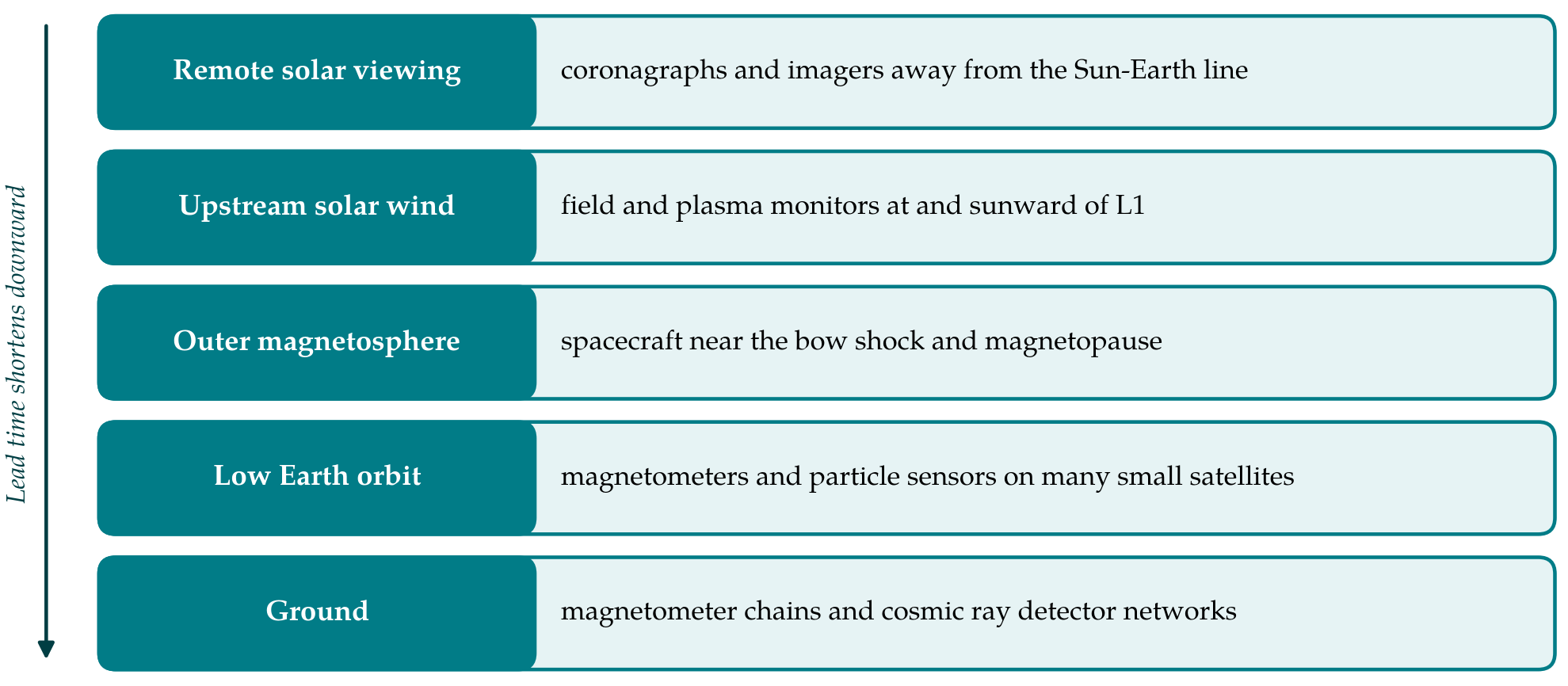
Proposed architectures can be arranged by distance from Earth, as in Figure 1. Each layer answers a different weakness of the present system, and the layers are complementary and not alternatives.
6.1. Upstream constellations
An upstream constellation addresses two problems: dependence on a single monitor and the fact that one point cannot describe a structure millions of kilometres across. Several spacecraft spread around L1, separated across the flow, would show whether the field measured on the Sun-Earth line is representative and would allow the orientation of shock fronts and ejecta boundaries to be estimated directly. Spacecraft placed sunward of L1 would lengthen the warning in proportion to their distance, although holding such a position requires continuous thrust, for which solar sails have been suggested. The demands on each spacecraft are those of the previous section in their most severe form, and the upstream layer is for that reason the one in which small satellites are least proven.
A further option lies off the Sun-Earth line. A monitor that trails Earth in its orbit sees the solar wind streams and active regions that will rotate toward Earth some days later, and views Earth-directed ejections from the side. Space agencies have studied operational missions of this kind near the fifth Lagrange point. Small spacecraft distributed in heliocentric orbits ahead of and behind Earth could extend the same idea at lower cost per platform, although the communications problem grows with distance and the orbits drift unless they are actively maintained.
6.2. Magnetospheric and low Earth orbit constellations
Closer to Earth the case is stronger. Low Earth orbit is accessible, benign and well served by ground stations, and the quantities of interest, field-aligned currents, precipitating particles and ionospheric density, vary on scales that only many spacecraft can sample. The Iridium experience shows that magnetometers of moderate quality are sufficient when they are numerous. Hosted sensors on commercial constellations and dedicated CubeSats in several orbital planes are both feasible with present technology. Between low orbit and L1, small spacecraft on eccentric orbits could monitor the position of the magnetopause and bow shock, though radiation exposure in the belts shortens the life of unshielded electronics.
7. Continuity, Calibration and the Use of Data
Continuous monitoring is an operational requirement and differs from a science campaign. It needs replacement spacecraft on a schedule, real-time downlink, and data whose quality is known at the moment of use. Small satellites fit the first need well, since short lifetimes are tolerable when replacements are cheap. The second is a matter of ground infrastructure. The third is the least developed. A constellation of inexpensive magnetometers has as many offsets, gains and alignment errors as it has sensors, and these drift. Science constellations solve the problem with extensive calibration effort per spacecraft; an operational constellation of dozens would need automated cross-calibration between neighbours and against a small number of reference instruments.
Use of the data is the other half of the subject. Global magnetohydrodynamic models driven by upstream measurements, such as the Space Weather Modeling Framework (Tóth et al., 2005), currently take a single time series as their boundary condition. Multi-point upstream data would let that boundary condition vary across the inflow, and dense low-altitude data would give the models something to be corrected against while a storm develops. Neither capability is routine.
8. Gaps and Future Work
The review points to four gaps. There is no agreed statement of how accurate a small upstream magnetometer must be for its data to improve a forecast, and without one the engineering trade between boom length, spacecraft cleanliness and number of spacecraft cannot be closed. Studies that withhold or degrade real upstream data and measure the loss of forecast skill would supply it. Cross-calibration methods for large sets of low-cost sensors need to be developed and published as openly as the instruments themselves. The value of the proposed early precursors, energetic particles and cosmic ray anisotropy, has been argued from selected events, and their false alarm rates over long periods are not well established. And the organisational question of who operates and replenishes a monitoring constellation over decades has received less attention than its design.
9. Conclusion
Storm precursors are observed today at too few points and with too little redundancy. The literature reviewed here supports a measured view of what small satellites can do about it. In low Earth orbit they are ready, and the principle that many modest sensors can outperform one excellent sensor for mapping current systems has been shown in practice. In the outer magnetosphere they are plausible. Upstream of Earth, where the warning is earned, they face real constraints of magnetic cleanliness, communications and station-keeping, and they are best seen for now as companions to a conventional monitor. Across all layers the limiting factor is likely to be calibration and continuity of operations.
Conflict of interest
To be declared by the author(s) before publication.
Funding
To be declared by the author(s) before publication.