1. Introduction
A branch library is a modest building with long opening hours, free entry, staff who know the neighbourhood, and tables, sockets and toilets that anyone may use. Klinenberg (2018) made these features the centre of an argument about social infrastructure, the physical places that shape whether people come into contact, and he placed libraries first among them. His earlier study of a lethal heat wave had shown that survival varied between neighbourhoods of similar poverty according to whether streets and public places drew people out of their homes (Klinenberg, 2002).
Flooding in cities is becoming more frequent and, in low-lying or poorly drained districts, more prolonged. A flood that lasts weeks differs from a storm that passes. Power and transport are restored unevenly, shops and clinics stay shut, households run through savings and patience, and the official response moves from rescue to a long administrative phase of claims and repairs. If a library matters in such conditions, it is likely to matter through steady, unremarkable provision, and that is hard to capture after the event from memory alone.
This article proposes a case study design for examining one neighbourhood library as civic infrastructure through a prolonged flood. The procedure is a proposal that has not been applied or validated here. No library has been studied for this article, and what follows describes what a research team would do and why.
2. Background
Two literatures supply the concepts and the propositions: one on libraries as places, one on how communities cope with disaster.
2.1. Libraries as social and civic infrastructure
Oldenburg (1989) described third places, neither home nor work, where people meet on neutral ground, and libraries have often been read in those terms. Research in Norway found that public libraries serve as meeting places of several kinds at once, from brief encounters across social groups to arranged gatherings (Aabø et al., 2010). Mattern (2014) argued that the library should be understood as infrastructure in several senses, social, technical and intellectual, and warned against loading it with every task that other public services have dropped. Latham and Layton (2019) proposed that social infrastructure be studied through the practices it supports, and Star (1999) observed that infrastructure tends to become visible when it breaks down. A flood is a breakdown of that kind.
2.2. Community resilience and the record from past disasters
Resilience research holds that recovery depends on resources that exist before a disaster. Norris et al. (2008) described community resilience as a set of networked capacities: economic development, social capital, information and communication, and community competence. Cutter et al. (2008) offered a place-based model in which antecedent conditions shape both impact and recovery. Aldrich (2012) compared recoveries from several disasters and concluded that the density of social ties explained differences that damage and aid did not. Studies of libraries after the Gulf Coast hurricanes of 2004 and 2005 recorded them providing internet access, help with aid applications and a place to be (Jaeger et al., 2006), and Veil and Bishop (2014) identified both the opportunities and the obstacles, among them the absence of libraries from formal emergency plans.
3. Why a Single Case
The question of how a library functions during a flood, and why, concerns a contemporary process that the researcher cannot control and that cannot be separated from its setting. Those are the conditions under which Yin (2018) recommends case study. A single case is justified when it is critical, unusual, common, revelatory or longitudinal, and a branch library in a flood-prone district is proposed here as a common case followed over time. Stake (1995) would call the study instrumental: the particular library is examined for what it shows about a wider issue.
The usual objection is that nothing general can be learned from one case. Flyvbjerg (2006) answered that the objection mistakes the kind of knowledge that cases yield, which is concrete and dependent on context, and that a well chosen case can refute a general claim or expose a mechanism. Small (2009) made the related point that cases are not small samples and should be chosen and judged by the logic of inference from cases, not by the logic of sampling. The design below is built to support analytic generalisation to theory and makes no claim about libraries in general.
4. The Proposed Design
The design has six steps. They are described in the order in which they would be undertaken, although the first two must be completed before any flood and the remainder depend on its course.
4.1. Step 1: Select and bound the case in advance
The case is one branch library and its use during one prolonged flood. Selection should be made before the flood season from districts with a documented history of standing water, using municipal flood maps and the library service's own records. The branch should be ordinary for its system in size and staffing, since an exceptional flagship would say little about typical provision. The case is bounded in space by the branch's usual catchment and in time from a baseline period before the flood to a set point in recovery, agreed beforehand. Agreements with the library service, including access to routine records and permission for staff to take part, need to be in place before the water rises.
4.2. Step 2: State propositions and questions
Propositions direct attention and make the study answerable to evidence. Four are drawn from the literature reviewed above, each paired with a rival explanation that the evidence could favour instead. Table 1 sets out the propositions with the evidence that would bear on each.
| Proposition | Rival explanation | Evidence to be gathered |
|---|---|---|
| The library supplies basic utilities when homes cannot | Other sites supply them; library use is marginal | Observation logs; counts of charging and Wi-Fi sessions |
| Staff act as informal guides to aid and claims | Help comes from relief agencies alone | Enquiry records; staff and user interviews |
| The library sustains contact among neighbours | Contact runs through kin and online groups | Observation; user interviews about whom they met |
| The role depends on ties that existed before the flood | The role is created by the emergency itself | Baseline records; accounts of earlier use |
| The library is absent from formal emergency plans | It is integrated and resourced accordingly | Plans and minutes; interviews with officials |
A fifth row records a proposition about governance, following Veil and Bishop (2014), because what a branch can do depends on whether anyone with authority expected it to do anything. Research questions follow directly: what people used the library for at each phase, who they were and who was missing, what staff did beyond their ordinary duties, and how the library was connected to the official response.
4.3. Step 3: Gather several kinds of evidence across the phases
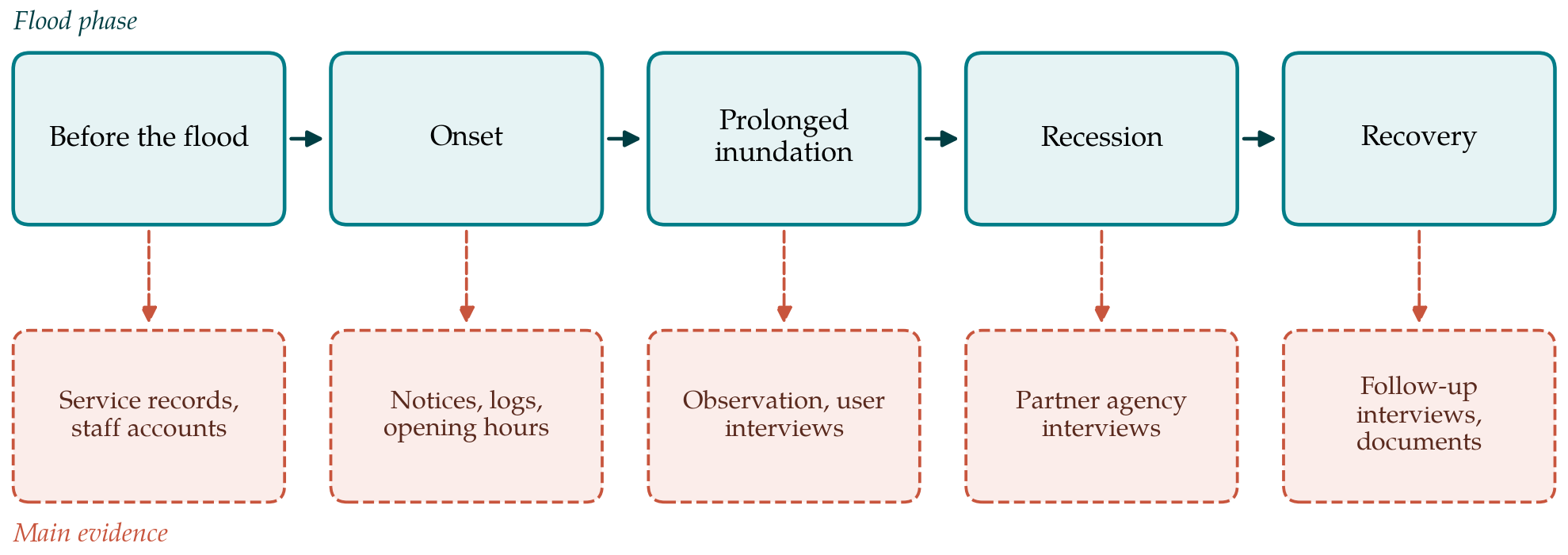
Case study depends on converging lines of evidence (Yin, 2018). Five sources are proposed: routine service records such as visits, sessions and enquiries; documents, including notices, social media posts by the branch, emergency plans and council minutes; direct observation in the building at set times of day; semi-structured interviews with staff, users, and officers of partner agencies; and a simple record of opening hours and closures. Figure 1 shows which source leads in each phase of the flood. Records and staff accounts establish the baseline, observation and user interviews carry the weight while the water stands, and follow-up interviews during recovery test whether the importance people attached to the library at the time has lasted.
Observation should follow a fixed schedule, with sessions at opening, at midday and in the last hour before closing on both weekdays and weekends, so that notes from different weeks can be compared. A short structured sheet records how many people are present, what they are doing, what they ask staff for and how long they stay, and free notes record what the sheet does not anticipate. Counting is kept deliberately simple, because an observer in a crowded branch during an emergency cannot keep an elaborate tally and should not try.
Attention to who is absent is part of the design. People who cannot reach the building, because of disability, distance or flooded streets, will not appear in observation or among users interviewed there. A small number of interviews should therefore be sought elsewhere in the catchment, through community organisations, with residents who did not use the library.
4.4. Step 4: Conduct fieldwork with care for people under strain
Fieldwork during a disaster raises obligations beyond ordinary practice. The study would require review by a research ethics committee before the flood season, with a protocol that anticipates rapid deployment. Interviews with users should be short, voluntary in more than a formal sense, and held where the person chooses. Researchers must not occupy seats, sockets or staff time that residents need, and should be ready to stop collecting material when the branch is stretched. Library staff are both informants and people affected by the flood, and their participation should be agreed with them individually and not only with their employer.
4.5. Step 5: Analyse by matching patterns and building an explanation
Material would be organised first as a chronology, so that what the library did can be set against the course of the flood and of the official response. Interview and observation notes would then be coded thematically, following the phases described by Braun and Clarke (2006), with initial codes taken from the propositions and others developed from the material. The central analytic move is pattern matching: for each proposition, the pattern the evidence shows is compared with the pattern the proposition predicts and with the pattern its rival predicts. Where sources disagree, as when records show heavy use and interviews suggest little reliance, the disagreement is reported and examined, not averaged away.
4.6. Step 6: Report back
A draft account should be returned to library staff and to a group of residents for comment before it is finalised. This serves accuracy, and it honours a debt to people who gave time in a difficult period. A short practical summary for the library service and the municipal emergency office should accompany the academic report.
5. Trustworthiness and Limitations
The design addresses the criteria that Lincoln and Guba (1985) proposed for qualitative inquiry. Credibility rests on prolonged presence, triangulation across sources and the check with participants in Step 6. Dependability and confirmability rest on a case study database and a documented chain from question to evidence to conclusion. Transferability is served by thick description of the branch, the district and the flood, so that readers can judge how far the account fits their own setting.
Several limits remain. The design depends on a flood occurring in the chosen district within the period of the study, and a team may wait without result. One case cannot show how common the observed role is. Observation in a public building will alter some behaviour, and routine records were not made for research and will have gaps, particularly if power fails. Above all, the procedure is untested. Whether it can be carried out during an actual flood, and whether its propositions discriminate between explanations as intended, can only be established by using it.
6. Conclusion
The belief that libraries hold neighbourhoods together in emergencies has good theoretical grounds and some supporting accounts, and it deserves closer examination in slow, prolonged floods. The single-case design proposed here prepares for that examination in advance: it fixes the case and the propositions before the event, assigns sources of evidence to each phase, sets rules for fieldwork among people in difficulty, and specifies how conclusions would be reached. It is offered for adaptation and trial, and its usefulness is still to be shown.
Conflict of interest
To be declared by the author(s) before publication.
Funding
To be declared by the author(s) before publication.