1. Introduction
Textile dyeing and finishing produce effluents that are strongly coloured, variable in pH and rich in salts, surfactants and auxiliary chemicals. A proportion of every dye applied fails to fix to the fibre and leaves with the wash water. Azo dyes, which form the largest class in commercial use, were designed to resist light, washing and microbial attack, and that same stability makes them persistent in conventional biological treatment (Robinson et al., 2001; Forgacs et al., 2004). Coagulation and adsorption move the colour from water to a sludge or a spent sorbent without destroying it.
Heterogeneous photocatalysis offers destruction in place of transfer. Interest in oxide semiconductors as photoactive materials grew after the report of water photolysis at a titanium dioxide electrode by Fujishima and Honda (1972), and the environmental applications were set out in detail by Hoffmann et al. (1995) and Herrmann (1999). Zinc oxide has a band gap close to that of anatase, a large exciton binding energy and a rich family of nanostructures that form readily from solution (Özgür et al., 2005; Wang, 2004). It has been proposed repeatedly as a cheaper or more active alternative to titanium dioxide for dye degradation (Sakthivel et al., 2003; Lee et al., 2016).
Over the past decade and a half a distinct literature has grown around biological or green preparation of zinc oxide, in which extracts of leaves, peels, flowers or seeds are added to a zinc salt and the product is tested against one or two dyes (Agarwal et al., 2017; Ahmed et al., 2017). The number of such reports is large and their claims are often similar. This article reviews what that literature, read alongside the older and more rigorous work on zinc oxide growth and photocatalysis, allows one to conclude about green-synthesised nanorods as dye removal catalysts. It reports no new experiments.
2. Scope and Approach
This is a narrative review of the published literature. The sources are landmark papers on semiconductor photocatalysis and on the solution growth of zinc oxide, widely cited reviews of dye effluent treatment, of zinc oxide photocatalysts and of plant-mediated nanoparticle synthesis, and a small number of methodological papers on how photocatalytic activity ought to be measured and reported. No systematic search was carried out and no pooled estimates are offered. Individual plant-extract studies are discussed as a class and through the reviews that collect them, because their heterogeneity makes a study-by-study comparison of rate constants uninformative, for reasons given below.
3. Textile Dyes and Photocatalysis on Zinc Oxide
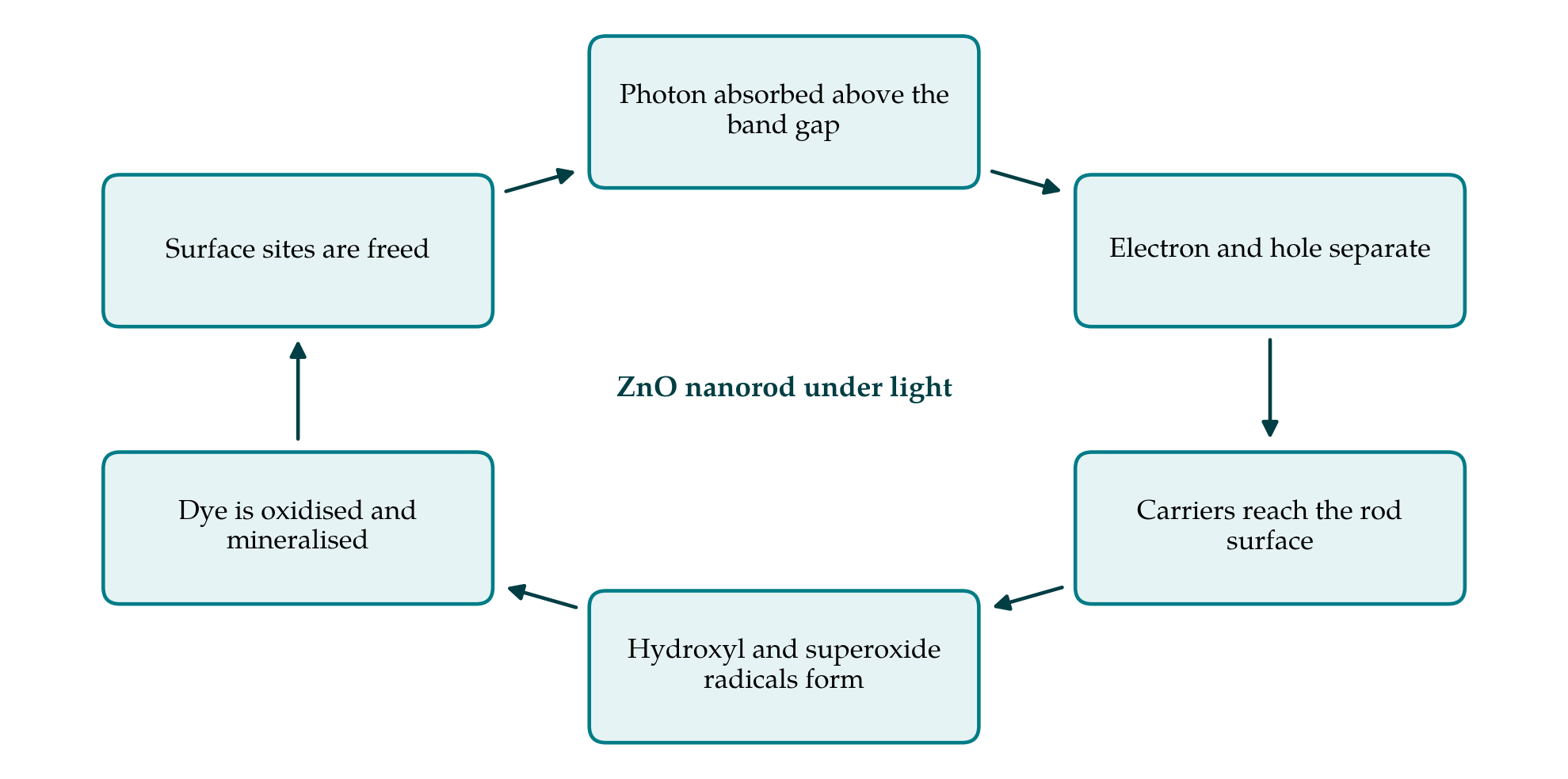
When zinc oxide absorbs a photon of energy above its band gap, which lies in the near ultraviolet at roughly 3.3 eV, an electron is promoted to the conduction band and a hole remains in the valence band. Most of these pairs recombine. Those that reach the surface can react: the hole oxidises adsorbed water or hydroxide to hydroxyl radicals, or oxidises an adsorbed organic molecule directly, while the electron reduces dissolved oxygen to superoxide, which leads on to hydroperoxyl radicals and hydrogen peroxide (Hoffmann et al., 1995). These species attack the chromophore of a dye first, so colour is lost early, and the aromatic fragments are then oxidised more slowly towards carbon dioxide, water and inorganic ions (Konstantinou and Albanis, 2004). Figure 1 shows the sequence as a cycle on a single rod.
The distinction between decolourisation and mineralisation matters for everything that follows. Cleavage of an azo bond removes the visible absorption band but can leave aromatic amines, some of which are of greater toxicological concern than the parent dye. A catalyst that bleaches a solution quickly has therefore shown only the first step. Reviews of photocatalytic water treatment stress that total organic carbon, intermediate identification and toxicity testing are needed before a treatment claim can be made (Chong et al., 2010).
Real textile effluent also differs from a dye dissolved in deionised water. Chloride, sulfate and carbonate scavenge radicals or adsorb on the oxide, surfactants compete for surface sites, and the pH is frequently outside the narrow window in which zinc oxide is stable. Zinc oxide is amphoteric: it dissolves in acid and forms zincate species in strong alkali, and under illumination the holes can oxidise the lattice itself, a process known as photocorrosion (Lee et al., 2016). These properties are intrinsic to the material and do not depend on how it was made.
4. From Conventional to Green Routes
Zinc oxide crystallises in the wurtzite structure, which has a polar axis. The basal planes terminated by zinc or by oxygen carry a higher surface energy than the non-polar prismatic faces, so that growth along the c axis is favoured and rods or wires appear without any template (Wang, 2004). The low-temperature aqueous routes that established this field use a zinc salt with a slow source of hydroxide, classically zinc nitrate with hexamethylenetetramine, at temperatures below the boiling point of water (Vayssieres, 2003; Greene et al., 2003). Precipitation with alkali, sol-gel processing and hydrothermal treatment in autoclaves are the other common wet methods.
Green synthesis, as the term is used in this literature, usually means that an aqueous plant extract is mixed with zinc nitrate or zinc acetate, the mixture is heated or dried, and the solid is often calcined. The general case for plant-mediated nanoparticle synthesis was made for noble metals, where polyphenols and other metabolites reduce the metal ion and then cap the particle (Iravani, 2011; Mittal et al., 2013). For zinc oxide the analogy is imperfect. Zinc(II) is not reduced: the oxidation state of the metal is the same in the salt and in the oxide. What the extract can plausibly do is complex the zinc ion through hydroxyl and carboxyl groups, supply or buffer alkalinity, adsorb selectively on growing faces, and act as a fuel when the dried gel is heated. Table 1 sets the main routes side by side.
| Route | Typical reagents | Control over rod shape | Environmental considerations |
|---|---|---|---|
| Aqueous chemical growth | Zinc nitrate with hexamethylenetetramine Vayssieres, 2003 | Good; aspect ratio set by concentration and time | Water solvent, mild heating; amine by-products in spent bath |
| Alkaline precipitation | Zinc salt with sodium or potassium hydroxide | Moderate; sensitive to pH and mixing | Simple and fast; saline alkaline filtrate |
| Hydrothermal | Zinc salt, base, sealed autoclave | Good; high crystallinity | Energy for pressure vessel; batch operation |
| Sol-gel | Zinc acetate in alcohol with a stabiliser | Limited; usually needs a seeded substrate | Organic solvent and stabiliser; calcination |
| Plant-extract mediated | Zinc salt with aqueous extract Ahmed et al., 2017 | Variable; depends on extract composition | Renewable additive; calcination often still required |
| Microbial or biopolymer mediated | Zinc salt with culture filtrate, starch or chitosan | Variable; rods less often reported | Mild conditions; culture upkeep and purification |
Two observations follow from the comparison. First, the benchmark that green routes are set against is already benign by the standards of materials synthesis: water as solvent, temperatures under 100 °C and inexpensive salts. The margin for improvement is narrower than the word green implies. Second, many plant-mediated procedures finish with calcination at several hundred degrees to burn off organic residue, and that step can dominate the energy budget. Judged against the principles of green chemistry set out by Anastas and Warner (1998), which concern atom economy, energy use and waste across the whole process, the replacement of one additive by a leaf extract is a partial change, and few papers support the label with any accounting of inputs and outputs.
5. What Plant Extracts Contribute
An extract is a mixture whose composition varies with species, plant part, season, soil, drying and extraction conditions. Reports commonly attribute the outcome to flavonoids, phenolic acids, terpenoids or proteins on the strength of infrared bands in the product, which show that organic matter is present on the surface and little more. Because the extract is rarely characterised or standardised, a second laboratory cannot reproduce the reagent, and the mechanistic statements that accompany these syntheses remain hypotheses (Agarwal et al., 2017).
Where rods form, the likely explanation is the one already known from conventional growth: the wurtzite habit favours elongation, and molecules that bind the prismatic or the basal faces shift the aspect ratio. Citrate and other polycarboxylates from fruit extracts would be expected to bind the zinc-terminated basal plane and shorten the rods into plates, while weakly binding species leave the native rod habit intact. This reasoning is consistent with the wide range of shapes reported from plant-mediated syntheses, in which spheres and irregular aggregates are at least as common as rods. A claim that a given extract directs rod growth therefore needs the control that is most often missing, namely the same procedure carried out with no extract.
Residual organic matter has consequences for photocatalysis that cut both ways. A carbonaceous or phenolic layer can adsorb cationic dyes and so appear to accelerate their removal, and it can also be oxidised by the photogenerated holes in competition with the pollutant. Calcination removes the layer and improves crystallinity, at the cost of particle growth, loss of surface hydroxyl groups and the energy already mentioned.
6. Morphology, Defects and Photocatalytic Activity
The case for rods specifically rests on three arguments. A single-crystal rod offers a continuous path for carriers along its axis, which should reduce recombination at grain boundaries. Rods expose a defined ratio of polar to non-polar faces, and there is evidence that the polar basal faces are the more active: McLaren et al. (2009) found that plate-like crystals with a large fraction of polar surface degraded methylene blue faster than rods of the same material. Finally, rods grown on a substrate form an immobilised array that needs no filtration. The second argument is double-edged for rod enthusiasts, since a long rod is dominated by its non-polar sides.
Native defects complicate the picture. Oxygen vacancies and zinc interstitials give zinc oxide its visible luminescence and are widely invoked to explain enhanced or visible-light activity, although their identification and energetics have been debated for many years (Özgür et al., 2005). Surface defects can trap carriers and assist charge separation, whereas bulk defects act as recombination centres, and the balance depends on preparation history (Kumar and Rao, 2015). Low-temperature green products are typically defect-rich, so that comparisons with a well-crystallised commercial powder confound the synthesis route with defect density, particle size and surface area at once.
Zinc oxide absorbs only the ultraviolet fraction of sunlight. Strategies to extend the response, including doping, coupling with a second semiconductor and decoration with metal particles, are reviewed by Ong et al. (2018) and apply equally to rods made by any route. Reports that an undoped green-synthesised oxide is active under visible light deserve particular scrutiny, for the reason discussed next.
7. How Activity Is Measured and Reported
Most studies follow the fading of methylene blue, rhodamine B or methyl orange by spectrophotometry and fit pseudo-first-order kinetics. Dyes are convenient but problematic probes. They absorb the light used for the test, and an excited dye molecule can inject an electron into the oxide and bleach itself by a sensitisation pathway that involves no band gap excitation of the catalyst. Yan et al. (2006) showed that methylene blue is for this reason an unsuitable substrate for judging visible-light photocatalysts, and Ohtani (2010) extended the criticism to the wider habit of ranking materials by dye decolourisation. A colourless probe such as phenol, or a measurement of mineralisation, avoids the ambiguity.
Comparability is the second problem. Rate constants depend on lamp spectrum and intensity, reactor geometry, catalyst loading, dye concentration, pH and temperature, and these are often incompletely stated. The editorial guidance of Buriak et al. (2014) asks for the light source and photon flux, dark adsorption and photolysis controls, a reference catalyst tested in the same reactor and, where possible, a quantum efficiency. Few plant-mediated zinc oxide papers meet these requirements, and without them a statement that one extract gives a better catalyst than another cannot be evaluated.
8. Stability, Recovery and Environmental Safety
A treatment catalyst must survive repeated use. Reuse tests in this literature commonly run for a handful of cycles and report a modest decline in activity, usually attributed to loss of powder on recovery. Dissolved zinc is seldom measured, though photocorrosion and pH-driven dissolution are the most probable causes of long-term failure. The omission matters beyond catalyst lifetime. The toxicity of zinc oxide nanoparticles to aquatic organisms has been traced largely to dissolved zinc: Franklin et al. (2007) found nanoparticulate and bulk zinc oxide and zinc chloride to be comparably toxic to a freshwater alga once solubility was taken into account. A process that removes colour while releasing zinc exchanges one discharge problem for another.
Recovery of a fine powder from treated water is an acknowledged obstacle for slurry photocatalysis in general (Chong et al., 2010). Rods grown directly on glass, mesh or fibre supports by seeded aqueous growth sidestep it, and this is perhaps the strongest practical argument for the rod geometry. It is notable that the plant-mediated literature mostly produces loose powders, so that the feature that makes rods attractive for treatment is rarely exploited in green syntheses.
9. Gaps and Directions for Further Work
The published record supports a limited set of statements. Zinc oxide of rod and other habits can be precipitated in the presence of plant extracts, and the products decolourise model dyes under ultraviolet and solar illumination, as conventionally prepared zinc oxide does. The record does not yet show that extract-derived rods are more active, more stable or less burdensome to produce than rods from established aqueous growth, because the necessary side-by-side comparisons are missing.
Closing that gap calls for work of a different kind from another extract and another dye. Extracts need chemical fingerprinting, or replacement by defined compounds such as a single polyphenol or organic acid, so that the active component can be identified. Every synthesis needs an extract-free control and a commercial reference tested in the same reactor. Activity should be established with a non-sensitising probe and with total organic carbon, in a matrix that includes the salts and auxiliaries of real effluent. Zinc release should be reported in every reuse test. Finally, the green claim itself should be tested by life cycle assessment that counts cultivation or collection of the plant material, extraction, drying and calcination alongside the reagents that were displaced.
10. Conclusion
Green synthesis of zinc oxide nanorods is feasible and easy to carry out, which explains its popularity, but ease of preparation is different from demonstrated advantage. The photocatalytic behaviour of the products is governed by the same factors that govern zinc oxide from any source: exposed facets, defects, surface area, stability against dissolution and the conditions of the test. The literature reviewed here suggests that the route will earn its name, and a place in dye effluent treatment, only when undefined extracts give way to understood chemistry, when activity is measured in ways that distinguish photocatalysis from sensitised bleaching, and when the fate of the zinc is followed as carefully as the fate of the colour.
Conflict of interest
To be declared by the author(s) before publication.
Funding
To be declared by the author(s) before publication.