1. Introduction
After sunset the equatorial F region is lifted by an enhanced eastward electric field while the ionisation below it decays. Dense plasma is then supported against gravity by the magnetic field above a much thinner layer, an arrangement that is unstable in the manner of a heavy fluid resting on a light one. Depleted flux tubes rise through the layer as plumes, first mapped by radar at Jicamarca (Woodman and La Hoz, 1976), and break up into irregularities with scales from hundreds of kilometres to less than a metre. The physics is treated in full by Kelley (2009).
Radio signals crossing these structures scintillate. Accounts of individual events sometimes describe the scintillation as anomalous, a word that implies a standard against which the event was judged. This note makes that standard explicit and proposes a way of sorting apparent departures from it. It offers no new data. Its purpose is to help authors and readers decide when an unusual record points to unusual physics.
2. What Is Expected
Scintillation is produced mainly by irregularities near the Fresnel scale, which for L-band signals and an F-region screen is a few hundred metres. In weak scatter the amplitude index S4, the normalised standard deviation of signal intensity, varies with frequency approximately as the power -1.5 for commonly observed irregularity spectra, and the intensity spectrum has a power-law tail above the Fresnel frequency (Yeh and Liu, 1982; Rino, 1979). The classic morphology is equally well known: onset an hour or two after local sunset, decay after midnight, and greatest strength near the anomaly crests, some fifteen degrees of magnetic latitude either side of the dip equator, where the background density is highest (Aarons, 1982). Activity rises with the solar cycle, and at solar maximum deep fades reach L-band (Basu et al., 1988).
Occurrence follows a seasonal pattern that differs between longitude sectors and is favoured when the sunset terminator is aligned with the magnetic meridian (Tsunoda, 1985). On a given evening, whether bubbles form depends strongly on the upward plasma drift around sunset (Fejer et al., 1999) and, more completely, on the growth rate of the instability integrated along the flux tube (Sultan, 1996). Scintillation that fits this picture is ordinary, however severe it may be.
3. Ways in Which Scintillation Can Appear Anomalous
Departures from the expected picture reported in the literature are of a few recurring kinds. Table 1 lists them with the first explanation that should be considered for each.
| Apparent anomaly | Explanation to examine first | Useful diagnostic |
|---|---|---|
| Frequency scaling flatter than expected | Saturation of S4 at the lower frequency in strong scatter | S4 at each frequency; intensity spectra |
| S4 greater than one | Focusing by large irregularities | Intensity distribution |
| Unusually long fades | Satellite scan velocity close to irregularity drift (Kintner et al., 2007) | Drift from spaced receivers |
| Enhancement on one link only | Propagation nearly along the magnetic field (Briggs and Parkin, 1963) | Angle between path and field |
| Occurrence after midnight or out of season | Late-forming or surviving irregularities; storm-time fields | Magnetic indices; ionosonde height |
| Strong S4 with a quiet ionosphere | Multipath or processing artefact | Repeat on the next sidereal day |
The first two rows are consequences of strong scattering. When the phase perturbation imposed by the screen is large, S4 at the lower of two frequencies approaches unity and stops growing, so that the ratio between frequencies falls below the weak-scatter value. Focusing can carry S4 somewhat above one before it settles back. Neither effect is new physics of the medium, and both are accounted for by scattering theory (Yeh and Liu, 1982).
Comparisons across frequency deserve particular care. A VHF beacon and an L-band navigation signal recorded at one site sample different Fresnel scales and usually different lines of sight, so a mismatch between them need not mean that the irregularity spectrum is unusual. Even two carriers from the same satellite can lose their correlation in strong scatter. That behaviour follows from the theory, and it matters in practice for receivers that combine frequencies to remove the ionospheric delay.
The next two rows are geometric. Field-aligned irregularities are greatly elongated, and a path that runs nearly along the field through them is perturbed far more than one that crosses it (Briggs and Parkin, 1963). For satellites of navigation systems the point where the path pierces the ionosphere moves, and when its velocity nearly matches the eastward drift of the irregularities the fading slows and individual fades lengthen, which is of practical consequence for receivers (Kintner et al., 2007). The last physical row covers events that are unusual in time: irregularities after midnight, in the unfavoured season, or during magnetic disturbance, when penetrating electric fields can lift the layer at hours that are normally stable.
4. Sorting Physical from Instrumental Causes
Figure 1 arranges the candidate causes in three branches. The recommendation of this note is to work through them from right to left: instrument and processing first, geometry second, the medium last. The order reflects how often each turns out to be responsible and how cheaply each can be tested.
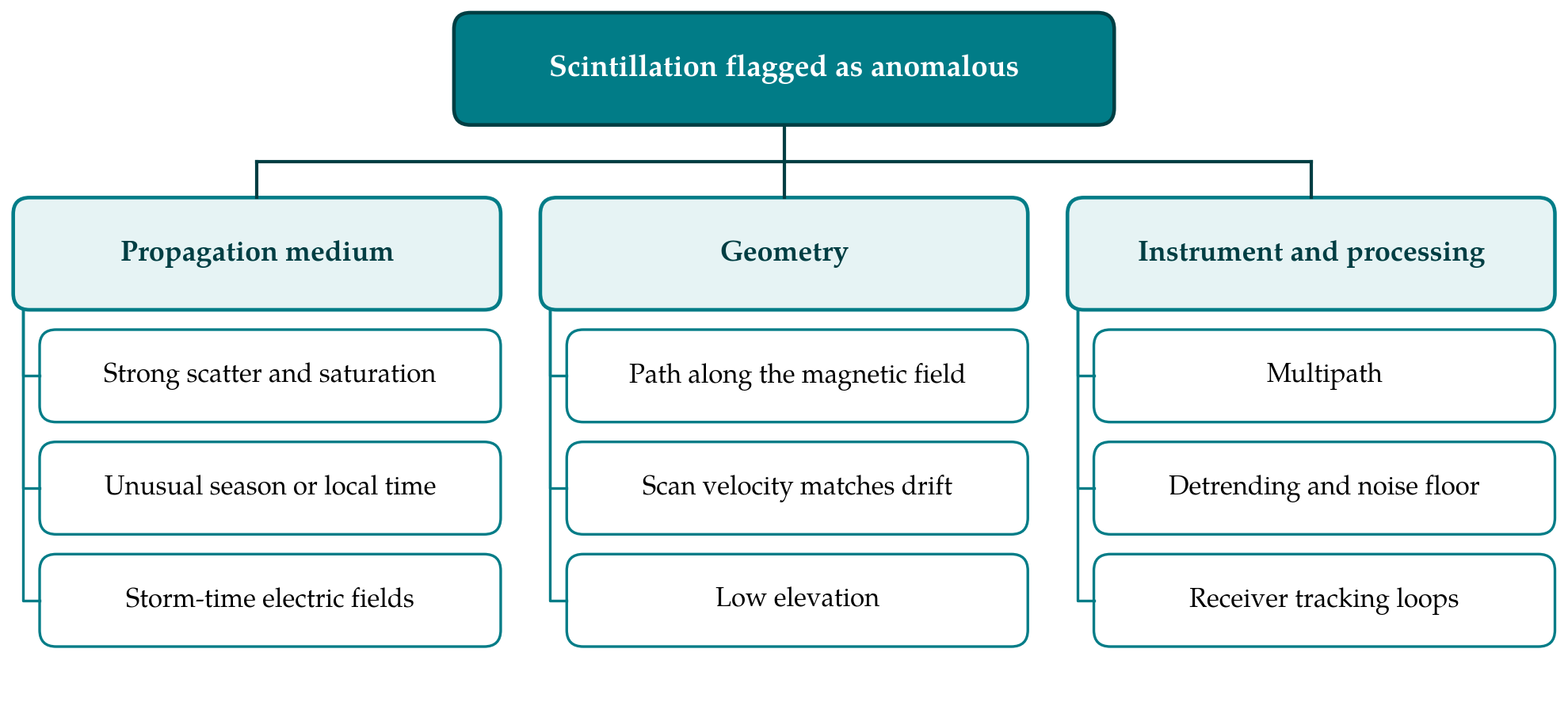
Scintillation indices from navigation receivers are derived quantities. S4 is computed after the intensity has been detrended and a correction for ambient noise applied, following the practice introduced by Van Dierendonck et al. (1993), and the phase index depends on the detrending filter and on the stability of the receiver clock. Reflections from nearby surfaces produce fluctuations at low elevation that mimic scintillation; because the satellite geometry of the Global Positioning System repeats each sidereal day, multipath recurs about four minutes earlier on the following day and bubbles do not. Deep fades cause loss of lock and cycle slips, which inflate phase indices.
A report of anomalous scintillation should therefore state the receiver type and sampling rate, the elevation mask, the detrending method, the angle between the path and the magnetic field at the ionospheric pierce point, the scan velocity of that point, and an independent indication that a bubble was present, such as a depletion in total electron content or a radar or airglow record. With these in hand most cases resolve into strong scatter seen through an unfavourable geometry.
5. Conclusion
The behaviour of scintillation in equatorial plasma bubbles is understood well enough for the term anomalous to carry a definite meaning: a departure from weak-scatter frequency scaling, from the post-sunset climatology, or from the fading rates implied by the drift. Most such departures follow from saturation, from the direction and motion of the link, or from the receiver. Those that survive these checks, chiefly events at unexpected hours and seasons, are the ones that bear on the open question of what seeds and sustains the instability, and they deserve reporting with the supporting information set out above.
Conflict of interest
To be declared by the author(s) before publication.
Funding
To be declared by the author(s) before publication.