1. Introduction
Haemodialysis began to move into patients' homes in the 1960s, when hospital places were scarce, and it declined in most countries as satellite units spread. Interest returned when programmes of long nocturnal treatment at home reported good control of blood pressure and phosphate and high patient satisfaction (Pierratos et al., 1998). Randomised trials of more frequent or longer dialysis followed (Culleton et al., 2007; FHN Trial Group, 2010; Rocco et al., 2011), and registry comparisons from Australia, New Zealand and the United States have associated home treatment with survival at least as good as that of matched patients dialysing in centres (Marshall et al., 2011; Weinhandl et al., 2012). Such comparisons cannot exclude selection of healthier patients, but they support offering the option.
For people in remote areas the argument is as much about geography as physiology. Studies from Canada have shown that patients with kidney disease who live far from a nephrologist receive poorer care and have worse outcomes than those who live close (Rucker et al., 2011), and that distance also affects those treated with home-based peritoneal dialysis (Tonelli et al., 2007). Home haemodialysis offers such patients a way to stay in their community. The obstacle is training. This article proposes a pathway for training remote patients and supporting them afterwards. It describes a design and reports no experience of its use.
2. Background
Published guidance on establishing home haemodialysis identifies training capacity, patient fear of self-cannulation, lack of a helper and unsuitable housing as the recurring barriers (Young et al., 2012). Patients and carers interviewed in qualitative studies describe the same concerns from their side: fear of needling and of catastrophic events, worry about burdening family, and isolation from clinical staff, set against the freedom and control that home treatment brings (Walker et al., 2015). A training pathway has to address these directly, and distance amplifies each of them.
Safety at home has been examined through programme audits. Serious procedure-related events are uncommon but they do occur, and reviews trace most of them to lapses in technique, typically in connecting and securing needles or lines, and not to equipment failure (Wong et al., 2014; Tennankore et al., 2015). The implication drawn by Pauly et al. (2015) is that safety depends on how well procedures are taught, how rigorously competence is checked, and whether skills are re-audited over time. Recommendations on patient selection and training from an international group of home dialysis clinicians give a general framework (Rioux et al., 2015), on which the present proposal builds.
Two ideas from education inform the design. Adults learn best when teaching is tied to problems they recognise as their own and when they are treated as responsible for their learning (Knowles, 1980). And confidence in one's ability to perform a task, which Bandura called self-efficacy, grows mainly through performing it successfully and through watching others like oneself do so (Bandura, 1977). A patient who will dialyse alone hours from help needs both skill and justified confidence. Health literacy varies widely, and teaching materials have to be usable by people with limited schooling.
3. The Proposed Pathway
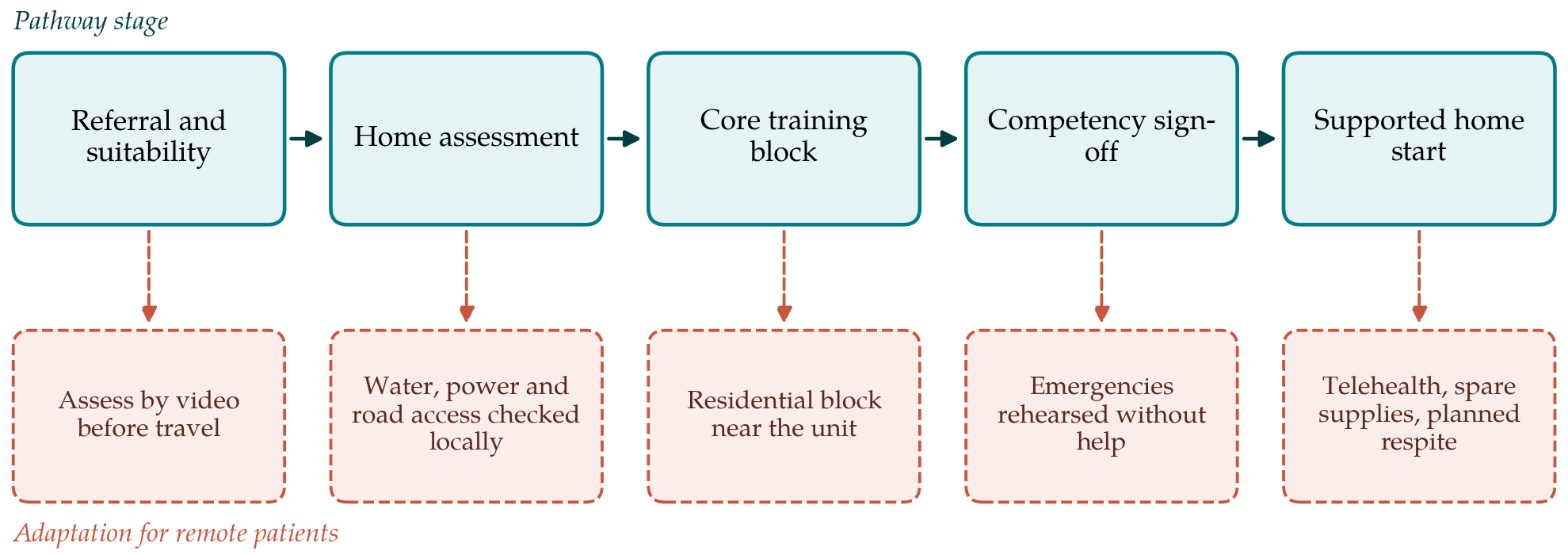
The pathway has five stages. Table 1 lists what each contains and the criterion for progressing, and Figure 1 pairs each stage with the adaptation that distance requires. The stages are described in order below.
| Stage | Main content | Criterion to progress |
|---|---|---|
| 1. Referral and suitability | Clinical review, motivation, vision, dexterity, helper, vascular access | Team and patient agree to proceed |
| 2. Home assessment | Water source and quality, power reliability, space, storage, communications, road access | Home meets requirements or a remedial plan is funded |
| 3. Core training block | Machine set-up, cannulation, monitoring, disconnection, troubleshooting, emergencies | All procedures performed under observation |
| 4. Competency sign-off | Full unaided treatments; simulated emergencies; written emergency plan | Checklist passed on consecutive sessions |
| 5. Supported home start | First home treatments with a nurse present or on video; supply chain started | Stable treatments and patient confidence |
| Ongoing | Scheduled remote review, technique re-audit, respite arrangements | Retraining triggered by events or audit findings |
3.1. Stage 1: Referral and suitability
Assessment for home haemodialysis should begin before dialysis is needed, as part of education about all treatment options. Few medical conditions rule it out absolutely. The assessment considers whether the patient, with or without a helper, can learn and perform the procedures: eyesight, hand function, memory, motivation and the stability of the home situation all matter more than the cause of kidney failure. A functioning arteriovenous fistula or graft is preferred. For remote patients the first conversation and much of the assessment can be held by video link with the local clinic, so that a long journey is made only once the patient has decided to go ahead.
3.2. Stage 2: Home assessment
Dialysis exposes the blood to large volumes of water, and dialysis fluid must meet chemical and microbiological limits set out in international standards (ISO, 2019). In towns the feed water is treated mains supply. In remote homes it may be bore, river or rain water of variable quality, and the assessment must include laboratory analysis of the source and a decision on the pre-treatment needed. Electricity may come from a generator or a weak grid, so the assessment records outage history and whether a backup is required. Space for the machine and for bulky consumables, drainage, telephone and internet coverage, and the time an ambulance would take to arrive are documented. A local health worker or technician can carry out the inspection against a checklist supplied by the unit.
3.3. Stage 3: Core training block
Conventional training spreads sessions over many weeks while the patient lives at home. A remote patient cannot commute, so the pathway concentrates training into a residential block, with the patient and helper housed near the unit. One nurse teaches the patient throughout, on the same model of machine that will be installed at home. Content follows the order of a treatment: preparing the machine and the water system, aseptic technique, cannulation, starting and monitoring, responding to alarms, ending the session and disinfecting. Self-cannulation is introduced early because it is the step patients fear most and the one that most needs repetition. Each procedure is demonstrated, performed with guidance, then performed alone while observed. Written and pictorial guides in plain language, and in the patient's first language where possible, go home with the patient.
Emergency procedures receive more time than in an urban programme. The patient must be able to recognise and respond to needle dislodgement, air in the lines, a blood leak, hypotension and loss of power or water without waiting for advice, and must know how to return blood manually and disconnect safely. The fuller account of dialysis technique and complications in standard texts (Daugirdas et al., 2015) is the reference for the curriculum, simplified for lay teaching.
3.4. Stage 4: Competency sign-off
Completion of training is decided by demonstrated competence and not by time served. The trainer uses a checklist covering every critical step, and the patient must complete full treatments unaided on consecutive occasions with no critical step prompted. Emergencies are simulated without warning during these sessions. A second nurse who has not taught the patient observes at least one session, to guard against a trainer's familiarity masking gaps. Before discharge a written emergency plan is agreed with the patient, the local clinic and the ambulance or retrieval service, naming who is called, in what order and what the patient does while waiting.
Where a helper will take part in treatments, the helper is assessed on the same checklist for the tasks he or she will perform, and both learn what to do if the other is unable to act. The sign-off record lists each procedure, the dates on which it was performed unaided and the name of the assessor, and a copy goes to the local clinic so that staff there know exactly what the patient has been taught. Patients who do not meet the criterion in the planned period are offered further sessions, a second block at a later date or another form of treatment, and the pathway treats that outcome as a legitimate result of assessment and not as a failure.
3.5. Stage 5: Supported home start and retraining
The first treatments at home are the point of greatest risk and greatest anxiety. Where travel allows, the training nurse attends them; otherwise the nurse observes by video with a local health worker present. Extra consumables are stocked to cover interrupted deliveries. After the start-up period the patient has scheduled telehealth reviews and sends treatment records and monthly blood results through the local clinic. Technique is re-audited at set intervals, in person during a visit to the unit or by video, since drift from taught procedure is the precursor of most reported events (Pauly et al., 2015). Respite dialysis in a centre is offered in advance, not only in crisis, to protect helpers from exhaustion.
4. Fitting the Pathway to a Service
A service adopting the pathway needs accommodation near the unit, a trainer who can be released for one patient at a time, a technician able to travel for installation, and a formal agreement with the primary care or community clinic nearest each patient. The costs fall early, on accommodation, water treatment and installation, while savings on transport and staffed sessions accrue later. Services with few remote patients may share a training hub. Where communities have their own health organisations, their staff should help design the materials and the support arrangements, since acceptance of the programme depends on trust as much as on technique.
Equipment and supply decisions follow from the home assessment. A machine with modest water and power demands, and one that the regional technician already maintains, is preferable to the newest model. Delivery schedules have to allow for roads closed by weather, which means larger stocks held at home and an agreed arrangement for emergency resupply. Waste disposal, including sharps, needs a local solution before the first treatment. A named contact at the unit, reachable during every treatment the patient performs, is the simplest and most valued support a service can give, and the roster should be planned around patients' dialysis times.
5. Limitations and What Remains to Be Shown
The pathway is a proposal assembled from published guidance and has not been implemented or evaluated here. Whether a concentrated residential block produces skills as durable as conventional spaced training is not known; educational research generally favours spaced practice, and the scheduled re-audits are intended to compensate. Whether video observation is an adequate substitute for a nurse in the room during first home treatments is also untested. A service using the pathway should record, from the outset, the proportion of referred patients who complete training, time to independence, procedure-related adverse events, unplanned transfers to centre dialysis and patient-reported burden, and should compare them with its own urban programme. Housing quality, water supply and funding rules differ between regions, and each stage will need local adjustment.
6. Conclusion
Distance does not make home haemodialysis unsafe, but it removes the margin of nearby help on which ordinary programmes quietly rely. The pathway proposed here responds by assessing the home as carefully as the patient, concentrating training into a single residential period, making sign-off depend on rehearsed emergencies, and replacing proximity with planned remote contact and periodic re-audit. Its merit can be judged only by services that try it and report what happens.
Conflict of interest
To be declared by the author(s) before publication.
Funding
To be declared by the author(s) before publication.