1. Introduction
That God is hidden is an old theme of religious writing. The psalmists complain of it, and Pascal (1995) made it a mark of true religion, holding that God gives enough light for those who seek and enough obscurity for those who do not. In this older literature hiddenness is a trial for the believer. It presupposes that God exists and asks why God withdraws.
The contemporary discussion turns the theme into an argument against the existence of God. Its source is Schellenberg (1993), who argued that the weakness of the evidence for theism is itself evidence against it. If there were a perfectly loving God, people who were willing to believe would not be left without belief. Some are, and the best explanation is that no such God exists. The argument drew little on the existing literature about evil, and within a decade it had a literature of its own (Howard-Snyder and Moser, 2002).
This review follows that literature over roughly thirty years. It sets out the argument and the main changes in its formulation, classifies the replies according to the premise they reject, and asks what the exchange has established. A survey of the field with a full bibliography is given by Howard-Snyder and Green (2016).
2. Scope and Approach
The article is a narrative review of the published literature in analytic philosophy of religion. Works were chosen because they introduced a line of argument or a line of reply that later writers took up, and no claim is made to completeness. The review concentrates on arguments addressed to theism in general. Arguments directed at the doctrines of one particular confession are left aside. Treatments of hiddenness in systematic and mystical theology are considered where analytic authors have drawn on them.
3. The Argument and Its Development
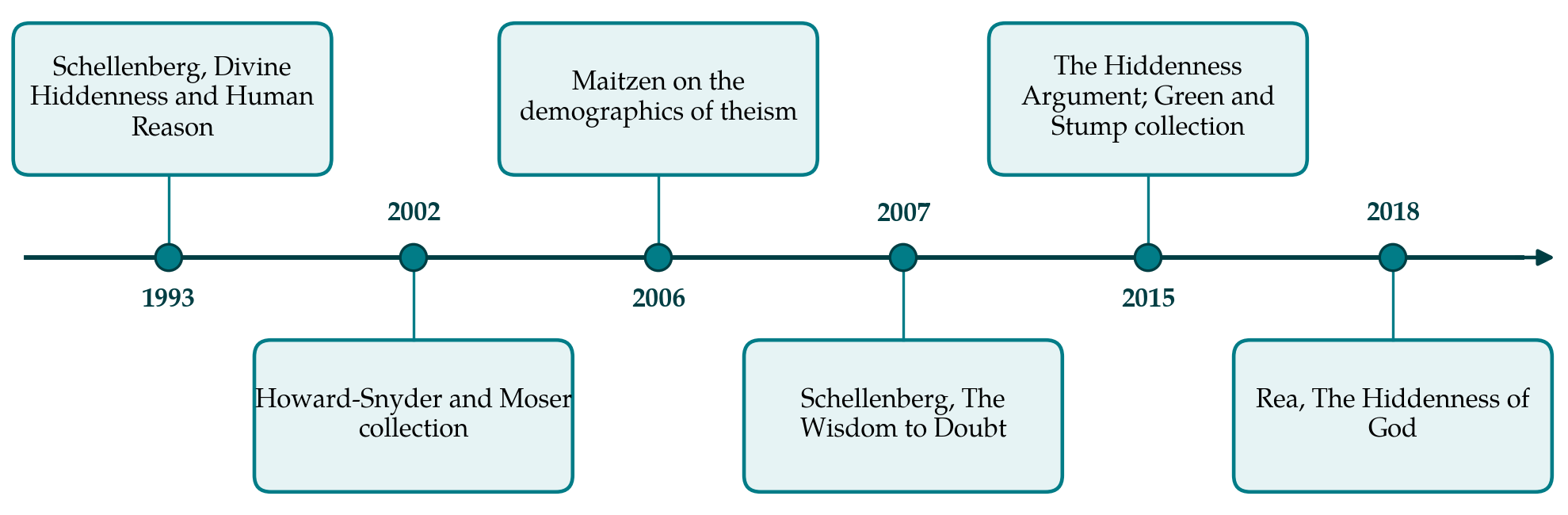
The argument has been restated several times by its author and extended by others. Figure 1 marks the publications that did most to shape the discussion.
3.1. The 1993 formulation
The original argument runs as follows. If there is a God, God is perfectly loving. If a perfectly loving God exists, reasonable nonbelief does not occur. Reasonable nonbelief occurs. Therefore no perfectly loving God exists, and so there is no God (Schellenberg, 1993). The weight falls on the second premise. Schellenberg defends it by reflection on what love involves: one who loves another seeks a personal relationship with the beloved for the beloved's own sake. A relationship with God in which a person consciously takes part requires believing that God exists. A loving God would therefore see to it that anyone capable of such a relationship, and not culpably opposed to it, had the belief needed to enter it.
3.2. Later formulations
In later work the term reasonable or inculpable nonbelief gives way to nonresistant nonbelief, and the key premise is stated in terms of openness: a perfectly loving God would always be open to a personal relationship with every finite person capable of it (Schellenberg, 2007; Schellenberg, 2015). The change answers the objection that the first version depended on judgements about who is to blame for unbelief. What matters in the revised version is only that some people have not shut God out. Schellenberg also stresses that the argument is conceptual in its main premise. It does not say that God would probably provide more evidence. It says that the concept of perfect love excludes a certain state of affairs.
The examples offered have widened as well. Alongside the reflective doubter who examines the arguments and remains unconvinced, Schellenberg points to former believers who lose faith unwillingly, lifelong seekers, and people in cultures and periods in which the idea of a personal God was not available. The last category has become prominent because it is hard to describe as resistance.
3.3. Related arguments
Two relatives of the argument appeal to the distribution of nonbelief. Maitzen (2006) observes that theistic belief is spread very unevenly across the world, being close to universal in some countries and rare in others, and argues that this pattern is much better explained by culture and history than by any of the purposes theists assign to hiddenness. A God who hides for the sake of freedom or moral growth would have no reason to hide so much more in one region than another. Marsh (2013) argues from natural nonbelief: for much of human prehistory, people lacked the concept of a single good creator and so could not have believed in one, through no resistance of their own. Both arguments are evidential in form and both avoid disputes about the inner lives of individual nonbelievers.
4. Critical Responses
Replies can be sorted by what they deny. Table 1 sets out the main lines of reply with the premise each challenges, and the subsections below discuss them in the same order.
| Family of reply | What is challenged | Central idea | Representative sources |
|---|---|---|---|
| Culpability | That nonresistant nonbelief occurs | Unbelief reflects sin, self-deception or inadequate inquiry | Plantinga, 2000; Henry, 2001 |
| Freedom | That love excludes permitting nonbelief | Clear awareness of God would coerce or remove significant choice | Murray, 1993; Swinburne, 2004 |
| Readiness | That love excludes permitting nonbelief | God waits until a person would respond well to belief | Howard-Snyder, 1996; Dumsday, 2012 |
| Relationship | That relationship requires belief | Trust, hope or implicit acquaintance may suffice | Poston and Dougherty, 2007 |
| Divine love | The model of love assumed | Divine love need not match ideal human parental love | Rea, 2018 |
| Sceptical theism | Our grasp of God's reasons | Failure to see a justifying reason is weak evidence of none | McBrayer and Swenson, 2012 |
4.1. Is there nonresistant nonbelief?
The most direct reply denies the empirical premise. A long tradition, appealing to the first chapter of the Letter to the Romans, holds that knowledge of God is available to all and that unbelief suppresses it. Plantinga (2000) gives the tradition an epistemological form: humans have a faculty that produces belief in God in suitable circumstances, and its malfunction is a result of sin. Applied to hiddenness, the idea implies that all nonbelief is culpable in some degree. Henry (2001) takes a more modest line and doubts that many nonbelievers have carried out the kind of inquiry that would make their nonbelief reasonable.
Few participants regard this reply as sufficient by itself. It requires a confident judgement about the motives of a very large number of people, including many who report that they wanted to believe. It also has little purchase on the cases in Marsh's argument, where the relevant concept was unavailable. The move from culpability to resistance in the later formulations was designed in part to make the reply harder to sustain.
4.2. Goods that hiddenness might serve
A second family accepts that nonresistant nonbelief occurs and proposes reasons for which a loving God might allow it. The earliest and best known appeals to freedom. On the soul-making account of Hick (1966), humans are created at an epistemic distance from God so that they can come to God freely. Murray (1993) argues that an unmistakable awareness of God, combined with awareness of the consequences of disobedience, would amount to coercion and would remove the capacity for morally significant choice. Swinburne (2004) adds that some uncertainty about God gives people a real choice between good and evil and gives believers the opportunity to help others find out whether there is a God.
Critics have replied that belief that God exists is compatible with a great deal of freedom, as the conduct of many believers shows, and that God could vary the vividness of the awareness without withholding belief altogether. The responsibility variant has in turn been questioned on the ground that it makes one person's chance of relationship with God depend on the diligence of others.
Other proposals concern the state of the person. Howard-Snyder (1996) suggests that some nonbelievers, though not resistant, are so disposed that if they came to believe they would respond inappropriately, and that God may wait until a better response is possible. Dumsday (2012) argues that hiddenness can be a mercy, since a person who would reject God is less culpable for doing so in ignorance. Moser (2008) holds that God offers evidence only in a form that calls for a change of will. What he calls spectator evidence, which can be assessed without commitment, would not serve the purposes of a God who seeks to transform people, and so its absence is what theism should lead one to expect.
4.3. Belief, relationship and the character of divine love
A third family questions the link between relationship and belief. Poston and Dougherty (2007) argue that a meaningful relationship with God is possible with partial or low-confidence belief, and that a relationship may exist in an implicit form before it becomes explicit. If a person can stand in a relationship with God through the pursuit of the good, through hope, or through acquaintance not yet recognised for what it is, then nonbelief does not show that God is closed to relationship.
The most sustained recent criticism targets the model of love. Rea (2018) argues that the hiddenness argument takes an idealised picture of human parental love and attributes it to God, while the theological tradition has insisted on divine transcendence and on the limits of analogy. God may have a personality and projects of God's own, and divine silence may express these without any failure of love. In an earlier paper Rea suggested that silence is compatible with God's presence being widely mediated through scripture and liturgy (Rea, 2009). Schellenberg's answer is that a being whose love leaves room for withholding relationship from one who seeks it is not perfectly loving in any sense that would make it worthy of worship. The dispute at this point concerns the content of the concept of God.
4.4. Sceptical theism
A fourth strategy borrows from the debate on evil. Wykstra (1984) argued that the inference from an apparently pointless evil to a pointless evil is sound only if one would expect to see the point were there one, and that with respect to God's reasons this is doubtful. McBrayer and Swenson (2012) apply the same reasoning to hiddenness: human inability to think of a reason for which God would permit nonresistant nonbelief is poor evidence that there is none. The strategy faces a difficulty specific to this argument. Schellenberg's premise is offered as a conceptual truth about love and does not rest on a failure to find reasons. Sceptical theism is therefore more effective against the evidential relatives of the argument than against its original form.
5. Hiddenness and the Problem of Evil
Whether hiddenness is a distinct problem has been debated from the start. Kvanvig (2002) argues that it adds nothing to the epistemic situation already created by evil. van Inwagen (2006) argues for distinctness by describing a world without suffering in which God's existence is nonetheless not evident; its inhabitants could raise the hiddenness problem though they have no problem of evil. He adds that signs and wonders would produce assent without the reorientation that God is said to want. Schellenberg (2010) likewise holds that the two arguments are logically independent, since the hiddenness argument needs no premise about suffering, though hiddenness can cause suffering and can deepen it.
The connection runs in another direction as well. Several contributors to Green and Stump (2015) draw on spiritual writers for whom the experience of divine absence belongs to a mature religious life and does not count against it. Appeals to the dark night described by John of the Cross suggest that what presents itself as absence may be a form of intimacy that exceeds ordinary awareness. Such accounts address the hiddenness experienced by believers more readily than the nonbelief of those who have never believed, and it is the second that the atheistic argument requires.
6. Open Questions
Three questions seem likely to occupy the next phase of discussion. One is whether cumulative replies succeed where single replies do not. No one good proposed so far plausibly accounts for every case of nonresistant nonbelief, yet different goods may account for different cases. The demographic argument is the main obstacle, since a combination of person-specific reasons does not obviously predict the geographical pattern Maitzen describes.
A second question is methodological. If the central premise is conceptual, the debate depends on how claims about the concept of perfect love are to be tested, and on whether intuitions formed by human relationships are a reliable guide. Rea's work has made this explicit without resolving it.
A third concerns range. Almost all of the literature assumes a broadly Christian understanding of God as personal and loving. How the argument fares against traditions that describe the ultimate in less personal terms, or that treat hiddenness as an attribute of the divine, has received comparatively little attention within analytic philosophy of religion.
7. Conclusion
Over three decades the hiddenness argument has moved from a novel proposal to a standard topic. The exchange between its defenders and critics has produced clearer formulations, a set of well-defined replies and an understanding of how the argument relates to the problem of evil. It has not produced agreement. The principal change is one of focus. Early discussion asked whether nonbelievers are at fault and what evidence God could be expected to provide. Recent discussion asks what perfect love is, what kind of relationship with God is in view, and how far human models can be applied to God. Those are questions on which philosophy of religion and theology have a shared interest, and the hiddenness argument has given them a precise form.
Conflict of interest
To be declared by the author(s) before publication.
Funding
To be declared by the author(s) before publication.