1. Introduction
South Asia is urbanizing quickly, and much of the growth is taking place in settlements that planners did not lay out and municipal services reach only in part. The region's cities are also young. Large cohorts of adolescents and young adults are growing up in dense neighbourhoods where schooling often ends early and secure work is hard to find. International reporting on urban safety has treated this combination as a recipe for violence (UN-Habitat, 2007), and research on violence in cities of the global South consistently identifies young men as both its main perpetrators and its main victims (Moser, 2004).
Yet violence is not spread evenly across poor neighbourhoods. Some settlements with very low incomes are comparatively safe, while others with similar material conditions are not. Criminology has a well-developed account of such differences. Collective efficacy theory, proposed by Sampson et al. (1997), explains them by the capacity of residents to act together to supervise young people and keep public space orderly. The theory has been influential in policy, and it is frequently invoked in discussions of cities in the global South, often without evidence drawn from them.
This article reviews what is known. It asks three questions. What does the theory claim and how firm is its support where it was developed? What happened when it was tested in cities outside the high-income West? And what does the existing scholarship on South Asian cities imply about whether, and in what form, the theory can be expected to hold there?
2. Scope and Approach
The article is a narrative review of the published literature. It draws on three bodies of work: the criminological studies that defined and tested collective efficacy, comparative studies that carried the concept to other regions, and sociological, anthropological and political research on urban life in India, Pakistan and Bangladesh. The third body rarely uses the vocabulary of collective efficacy, so it is read here for what it shows about trust, informal control and the regulation of young men in neighbourhoods. No claim is made to an exhaustive or systematic search. Sources were selected for their standing in their fields and their bearing on the three questions above, and the review reports no new data.
3. The Theory and Its Foundations
The intellectual line begins with Shaw and McKay (1942), who showed that delinquency rates in Chicago stayed high in the same inner zones even as the ethnic groups living there changed. They attributed the pattern to social disorganization: poverty, residential turnover and heterogeneity weakened the institutions through which adults guide the young. Later writers recast the argument as a model of informal control, and Sampson and Groves (1989) gave it its first direct test, using British survey data to show that sparse friendship networks, low organizational participation and unsupervised teenage peer groups carried much of the effect of structural disadvantage on crime. Bursik and Grasmick (1993) added that control operates at private, parochial and public levels, the last depending on a neighbourhood's ability to secure resources from outside agencies.
Collective efficacy theory revised this tradition in one decisive respect. Dense personal ties are not required. What matters is a working trust among neighbours joined to shared expectations that residents will act, for instance when children skip school or a fight breaks out. The term carries the psychological notion of efficacy up to the level of the group, and like individual efficacy it is specific to a task. In the original Chicago study, collective efficacy was associated with lower violence and mediated a substantial part of the association between concentrated disadvantage, residential instability and violence (Sampson et al., 1997). The disadvantage in question was the spatially concentrated, racially segregated poverty of the American inner city.
Later work filled in the picture. Morenoff et al. (2001) found that homicide in a neighbourhood depended on conditions in adjacent areas as well as its own. A review of the first wave of neighbourhood-effects studies concluded that the evidence for social-interactional mechanisms was encouraging but that selection of residents into neighbourhoods remained a serious threat to causal interpretation (Sampson et al., 2002). The long-run Chicago evidence is drawn together in Sampson (2012).
3.1. How collective efficacy is measured
Measurement conventions matter for any transfer of the theory. The standard instrument combines two short survey scales. One asks residents how likely their neighbours would be to intervene in listed situations involving children and public disorder. The other asks about trust, helpfulness and shared values. Individual answers are aggregated to the neighbourhood, and Raudenbush and Sampson (1999) set out the statistical reasoning, which they called ecometrics, for judging the reliability of such aggregate measures. Three assumptions are built in: that a neighbourhood can be bounded on a map, that residents share a referent when they answer questions about "people around here", and that intervention by neighbours is a recognisable and legitimate act. Each is open to question in the settings considered below.
4. Qualifications From Within the Theory's Home Ground
Even in American cities the relation between social ties and control is not simple. Pattillo (1998) showed in a Black middle-class Chicago neighbourhood that dense kin and friendship networks bound law-abiding residents to gang members, which made order possible but also protected offenders from sanction. Browning et al. (2004) formalised the point as negotiated coexistence: where networks are dense and include offenders, the regulatory effect of collective efficacy on violence is weakened. Anderson (1999) described how, where trust in the police has collapsed, young men adopt a code that treats readiness for violence as a means of self-protection. These studies establish that cohesion is a resource whose use depends on who is included in it and on the standing of formal authority.
5. Evidence From Outside North America
Comparative tests give a mixed picture, summarised in Table 1. In Stockholm and in Brisbane, cities with far lower violence and stronger welfare institutions than Chicago, collective efficacy was again associated with less violence (Sampson and Wikström, 2008; Mazerolle et al., 2010). The results suggested that the mechanism was not peculiar to the American ghetto.
| Setting | Source | Main result | Implication |
|---|---|---|---|
| Stockholm, Sweden | Sampson and Wikström, 2008 | Association with lower violence resembles Chicago | Mechanism can operate under a strong welfare state |
| Brisbane, Australia | Mazerolle et al., 2010 | Collective efficacy related to less violence; ties matter less | Supports shared expectations over dense ties |
| Belo Horizonte, Brazil | Villarreal and Silva, 2006 | Cohesion not linked to lower crime; linked to greater perceived risk | Cohesion among the poor need not yield control |
| Tianjin, China | Zhang et al., 2007 | Western-derived predictors of burglary only partly supported | State-organised control alters the model |
| Medellín, Colombia | Cerdá et al., 2012 | Violence fell after public investment in poor districts | Public investment is one route to lower violence |
Results from middle-income cities were less tidy. In Belo Horizonte, Villarreal and Silva (2006) found that neighbourhood cohesion was not associated with lower victimization and was associated with a higher perceived risk of crime, apparently because closely connected residents passed on news of every incident. They argued that in Brazilian favelas cohesion is a survival strategy of the poor and coexists with armed groups that residents cannot confront. In Tianjin, Zhang et al. (2007) reported that predictors drawn from Western theory explained household burglary only in part, and their analysis drew attention to the semi-official neighbourhood committees that carry out control functions which the theory assigns to informal action. In Medellín, a natural experiment linked transport and public-space investment in poor hillside districts to a decline in violence (Cerdá et al., 2012), which points to the public level of control that Bursik and Grasmick (1993) had emphasised.
Two lessons follow. The association between collective efficacy and violence is conditional on the presence of armed actors and on the reach of the state. And cohesion and control, which the standard index adds together, can come apart, so that a combined score may hide what is going on.
6. The South Asian Urban Context
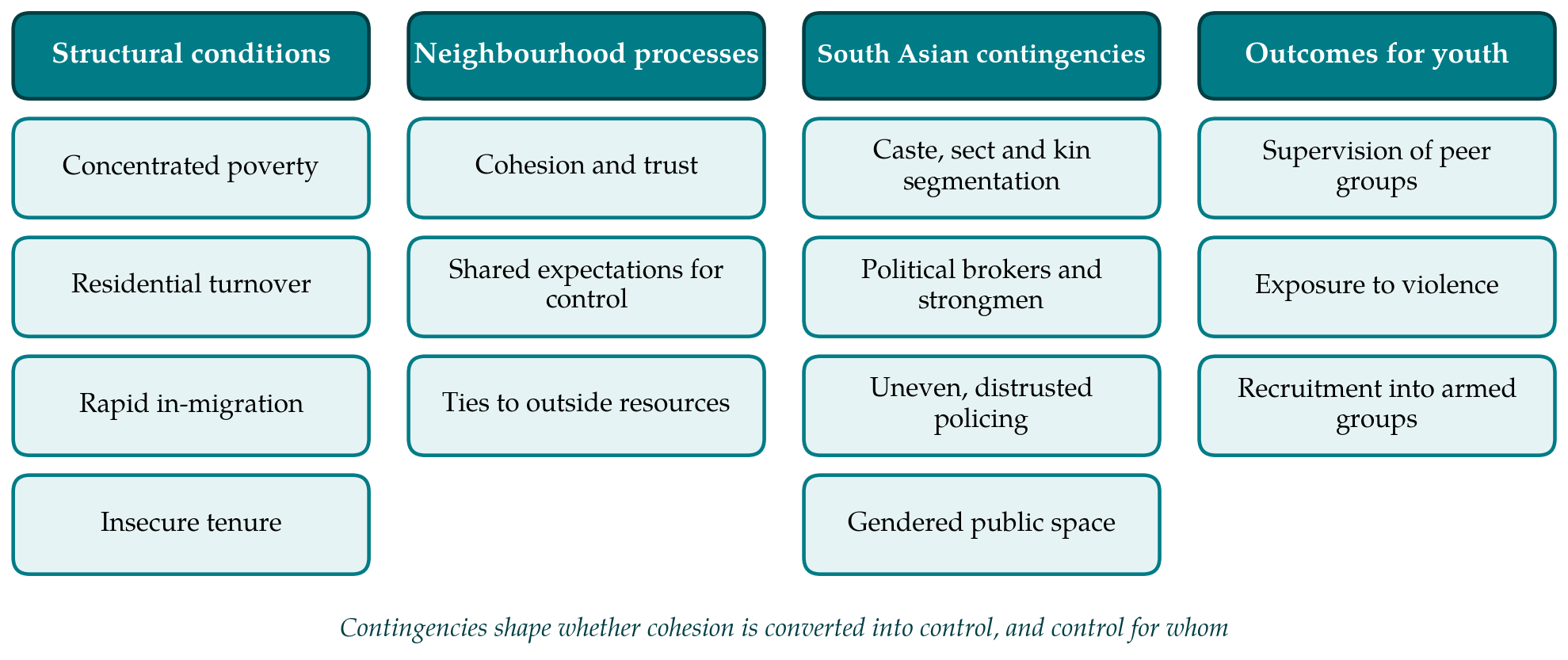
No South Asian city has been the subject of a neighbourhood study comparable in design to the Chicago project, and direct tests of collective efficacy against youth violence in the region are scarce. What exists is a rich qualitative and political literature on how order is produced in neighbourhoods. Four of its themes bear on the theory, and Figure 1 places them between neighbourhood processes and outcomes for young people.
6.1. Informality and insecure tenure
A large share of urban residents in the region live in settlements with uncertain legal status. Roy (2005) argues that informality is a mode of urban governance and not a residual sector left over from planning. Insecure tenure has two opposite implications for the theory. The threat of eviction and the need to obtain water, electricity and recognition can produce intense collective organization. But the same residents may be recent migrants, tenants of slum landlords or seasonal workers, with the turnover that social disorganization theory associates with weak control. Residential stability, a structural predictor in the Chicago model, therefore needs to be measured as security of tenure and not only as length of residence.
6.2. Segmented solidarities
Trust in South Asian neighbourhoods is often strong within caste, sect, language or kin groups and weak across them. Varshney (2002) compared Indian cities and concluded that those with associations and everyday engagement cutting across the Hindu and Muslim communities were far less prone to communal riots than those where civic life ran within each community. The finding parallels collective efficacy theory in stressing organized capacity over sentiment, and it adds a warning. High cohesion inside a bounded group can be mobilised for violence against outsiders. A survey item about whether "people in this neighbourhood can be trusted" will mean different things depending on whether the respondent takes the neighbourhood to be the lane, the community or the ward.
6.3. Brokers, parties and strongmen
Chatterjee (2004) describes how the urban poor in India deal with the state through political society: negotiated, often extra-legal arrangements mediated by local leaders. Such intermediaries supply the public control that the systemic model treats as an achievement of neighbourhoods, and they frequently command young men. Hansen (2001) shows how the Shiv Sena in Mumbai built its neighbourhood presence on local branches that offered unemployed youths status and purpose and could turn them out for violence. Gayer (2014) gives a comparable account of Karachi, where parties, sectarian groups and criminal organizations maintained order in their territories while fighting over the city. In such settings a neighbourhood may score high on willingness to intervene because an armed patron does the intervening.
6.4. Young men, waiting and the police
Jeffrey (2010) studied educated unemployed young men in a north Indian city who described their condition as passing time. Their days in tea stalls and on street corners made them available for political work, some of it violent, and gave them skills as fixers. The peer groups that the theory treats as a failure of supervision are here partly an outcome of the labour market and a resource for local politics. The police are a further complication. Where residents regard officers as partisan, corrupt or dangerous, calling them is not a neutral act, and willingness to intervene informally may reflect the absence of any acceptable formal alternative, as Anderson (1999) observed in a different context. Public space is also gendered, so that adult women, who do much of the informal supervision recorded in Western studies, may have limited authority over young men outdoors.
7. Gaps and Directions for Research
The first gap is plain. The region lacks multilevel studies in which collective efficacy is measured from resident surveys and related to independently recorded violence across many neighbourhoods. Police statistics are a weak outcome measure where reporting is low and recording uneven, so victimization questions and hospital injury records deserve consideration alongside them. The second gap concerns units. Research on aggregation shows that results change with the size of the area chosen (Hipp, 2007), and administrative wards in South Asian cities are large and internally divided. Units should be defined with residents, at the scale of the lane cluster or settlement that they recognise.
Third, the instrument needs adaptation and not merely translation. Cohesion and expectations for control should be analysed separately. Items should specify who is expected to intervene and on whose authority, and should distinguish action by neighbours from action by a party office, a caste council or a local boss. Fourth, designs should be longitudinal where possible. Even in the United States the temporal ordering of collective efficacy and crime is debated, and cross-sectional surveys cannot separate the effect of efficacy on violence from the effect of violence on trust. Neighbourhood research has moved from asking whether context matters to asking where, when and for whom it does, and South Asian cities, with their sharp internal variation, are well suited to that way of posing the problem.
Finally, upgrading and resettlement programmes change tenure, layout and services in ways that the theory predicts should alter collective efficacy. Evaluations built around such programmes, on the model of the Medellín study, would give stronger grounds for causal claims than any single survey.
8. Conclusion
Collective efficacy theory gives a clear and well-supported account of neighbourhood differences in violence in the cities where it was formed. Its extension to South Asia is plausible but untested. The comparative record shows that the expected association depends on the reach of the state and on who else claims to keep order, and the South Asian literature describes cities in which informality, segmented solidarity and political brokerage are the normal conditions of neighbourhood life. A regional research programme should therefore treat collective efficacy as a hypothesis with specified conditions, measure cohesion and control separately, and attend to the difference between residents acting together and residents deferring to a patron.
Conflict of interest
To be declared by the author(s) before publication.
Funding
To be declared by the author(s) before publication.